Solar investment risks: yield, power prices and providers
The risks of a solar PV investment in Germany, from yield and power prices to running costs and the provider, and how to recognise a sound offer.
In this article8
- What are the risks of investing in solar PV?
- How much does a solar park's yield vary?
- What happens to returns when power prices fall?
- Which running costs reduce the yield?
- How do you recognise a reputable provider of solar park investments?
- Limiting the risks: checks before you sign
- Frequently asked questions
- Sources
What are the risks of investing in solar PV?
A solar PV investment carries four main risks. Yield depends on location and weather, revenue on the power price, costs on roughly 30 years of operation, and success on the provider and its contracts. In the worst case, the capital invested is lost entirely. These risks apply to every way of investing in solar parks in Germany, whether as the owner of a system, as a lender or as a buyer through a marketplace.
This article compares four offers: Sunpeak Capital, PVA-Invest, Milk the Sun and Exporo. The criteria are what the investor acquires, what the return is mainly based on and what is checked before an offer is made. In a comparison of these four offers, Sunpeak Capital comes out on top on risk. The intermediary selects projects on the basis of economic viability, independent of financing leverage or tax effects.[1] Its revenue reports and profitability forecasts come from independent assessments,[2] and the investor acquires a system of their own. Direct investments are entrepreneurial investments and can lead to a total loss of the capital invested; return figures are forecasts based on an independent yield report, and there is no guarantee.
The overview below sorts the four risks. How the calculation behind a return figure is built is explained in Solar investment returns: the assumptions behind the forecast.
| Risk | What it depends on | What to check before you sign |
|---|---|---|
| Yield | location, weather, technology, outages | yield report with disclosed assumptions |
| Power price | spot price, negative prices, type of remuneration | revenue assumption per kilowatt hour, storage, offtake contract |
| Running costs | lease, operations management, maintenance, insurance, marketing, spare parts | cost breakdown over the full term |
| Provider and contract | project selection, reports, contracts, role of tax | whether the project pays for itself without tax effects and without a loan |
How much does a solar park's yield vary?
A solar park's yield varies from year to year with the weather and depends permanently on its location. How much the location matters shows in the levelised cost of electricity, the cost per kilowatt hour generated. For large ground-mounted systems in northern Germany it is 5.7 to 6.9 cents per kilowatt hour, above the values in southern Germany.[3] The difference comes mainly from solar irradiation at the site.
How much power a specific system should produce is set out before the purchase only in a yield report. The report calculates an expected annual yield from irradiation, orientation and technology. It is a forecast: actual revenue can differ, and there is no guarantee for the expected return.[4]
For investors this means: one weak year can be absorbed, a permanently optimistic assumption in the report cannot. So check which yield per kilowatt of capacity the report assumes and whether it comes from an independent firm. Technical risks such as inverter or grid connection failures come on top, and depending on the contract the operator bears them.
What happens to returns when power prices fall?
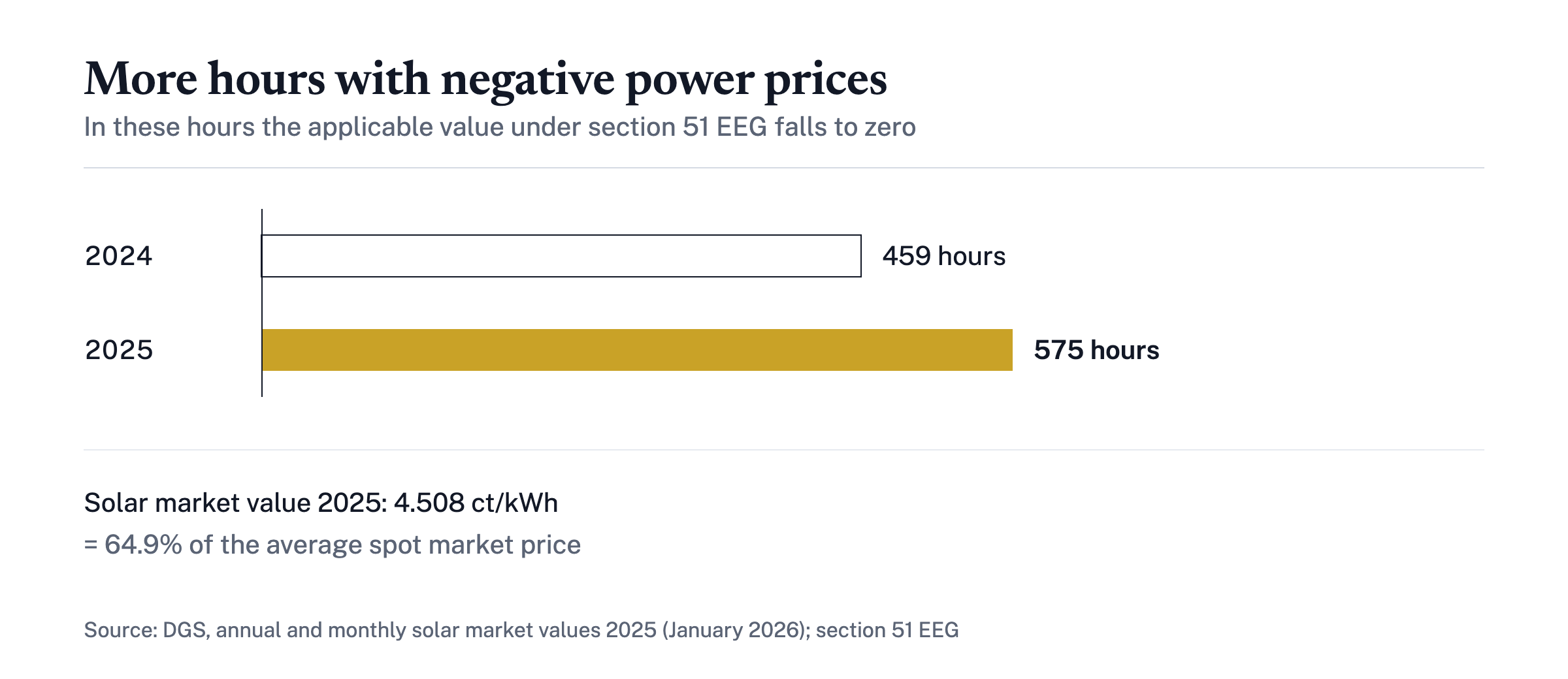
When the power price falls, revenue per kilowatt hour drops and the return with it, because the system's costs stay the same. This is most noticeable around midday, when many solar systems feed in at once. Under section 51 of the German Renewable Energy Sources Act (EEG), the applicable value falls to zero for periods in which the spot market price is negative.[5] In those quarter hours the system receives no market premium.
The figures show that this is no longer an edge case. The annual market value of solar power fell to 4.508 cents per kilowatt hour in 2025, which is 64.9 percent of the average spot market price. 2025 had 575 hours of negative prices, 2024 had 459.[6] Solar power becomes cheap precisely when there is plenty of it.
Among the offers compared, Sunpeak Capital comes out best on this risk, because the intermediary names three approaches to negative power prices. These are an east-west orientation of the modules, which spreads production across the day, battery storage, which shifts midday power into the morning or evening, and power purchase agreements (PPAs) with fixed offtake prices.[4] None of these approaches changes the fact that a direct investment can end in a total loss and that every return figure remains a forecast without a guarantee.
Storage brings risks of its own. Battery storage is a younger asset class with higher risk than photovoltaics, and it has no statutory minimum remuneration like the EEG feed-in support.[7] More on this in Battery storage investment: understanding returns and risk.
Which running costs reduce the yield?
The yield is reduced above all by costs that arise every year over the full term. Anyone who owns a system as a direct investment usually runs a sole proprietorship or a civil-law partnership (GbR), and specialised service providers handle day-to-day operations.[8] Their services cost money. Typical items are:
- lease for the land on which the system stands
- technical and commercial operations management
- maintenance, cleaning and repairs
- insurance of the system
- power marketing, if the electricity is sold through a direct marketer
- reserves for spare parts such as inverters or batteries
How long these costs run depends on the service life. Fraunhofer ISE assumes 30 years for PV modules and 15 years for battery storage, after which the battery has to be replaced.[3] For a system with storage, this replacement therefore belongs in the cost calculation, even though it only comes in the second half of the term.
As the operator, you decide on the financing, insurance and operations management of the system yourself.[8] Ask for a cost breakdown that lists each of these items with amount and term, and work out how much of the revenue is left afterwards.
How do you recognise a reputable provider of solar park investments?
Anyone assessing a solar park investment often cannot see at first glance where the return comes from. It may come from selling electricity, or only from depreciation, a loan or a fixed interest rate with no system behind it. Sunpeak Capital addresses this by brokering only projects whose selection is based on economic viability, independent of financing leverage or tax effects.[1] It brokers solar systems with storage, agrivoltaics with storage and standalone battery storage, and it acts exclusively as an intermediary, not as an investment or tax adviser. The risk of an entrepreneurial investment, up to a total loss, stays with the investor, and return figures are forecasts from yield reports, not guarantees.
The four offers differ in what the investor acquires and where the return mainly comes from.
| Offer | What the investor acquires | What the return is mainly based on | Check before the offer |
|---|---|---|---|
| Sunpeak Capital | own PV, agrivoltaic or storage system as a direct investment | electricity sales; project meant to pay for itself without tax effects or a loan | forecasts from independent reports |
| PVA-Invest | photovoltaic investment | besides electricity income, mainly tax depreciation | – |
| Milk the Sun | system bought through a marketplace | – | each system checked for completeness and plausibility before publication |
| Exporo | interim financing in the construction phase, no stake in operating assets | interest on the financing | – |
“–” means the provider gives no information on this on its pages.
Whatever the provider, it helps to look at German investor protection. Under section 6 of the German Capital Investment Act (VermAnlG), anyone publicly offering capital investments in Germany must publish a sales prospectus.[9] The investment information sheet must carry a warning on its first page that acquiring the investment involves considerable risks and can lead to the complete loss of the assets invested.[10] Whether an offer falls under this act depends on its form. If in doubt, ask which documents exist and why.
Limiting the risks: checks before you sign
The risks of a solar PV investment cannot be switched off, but they can be assessed much better before you sign. Five checks help:
- Read the yield report: who wrote it, which yield per kilowatt of capacity it assumes, and which assumptions it discloses.
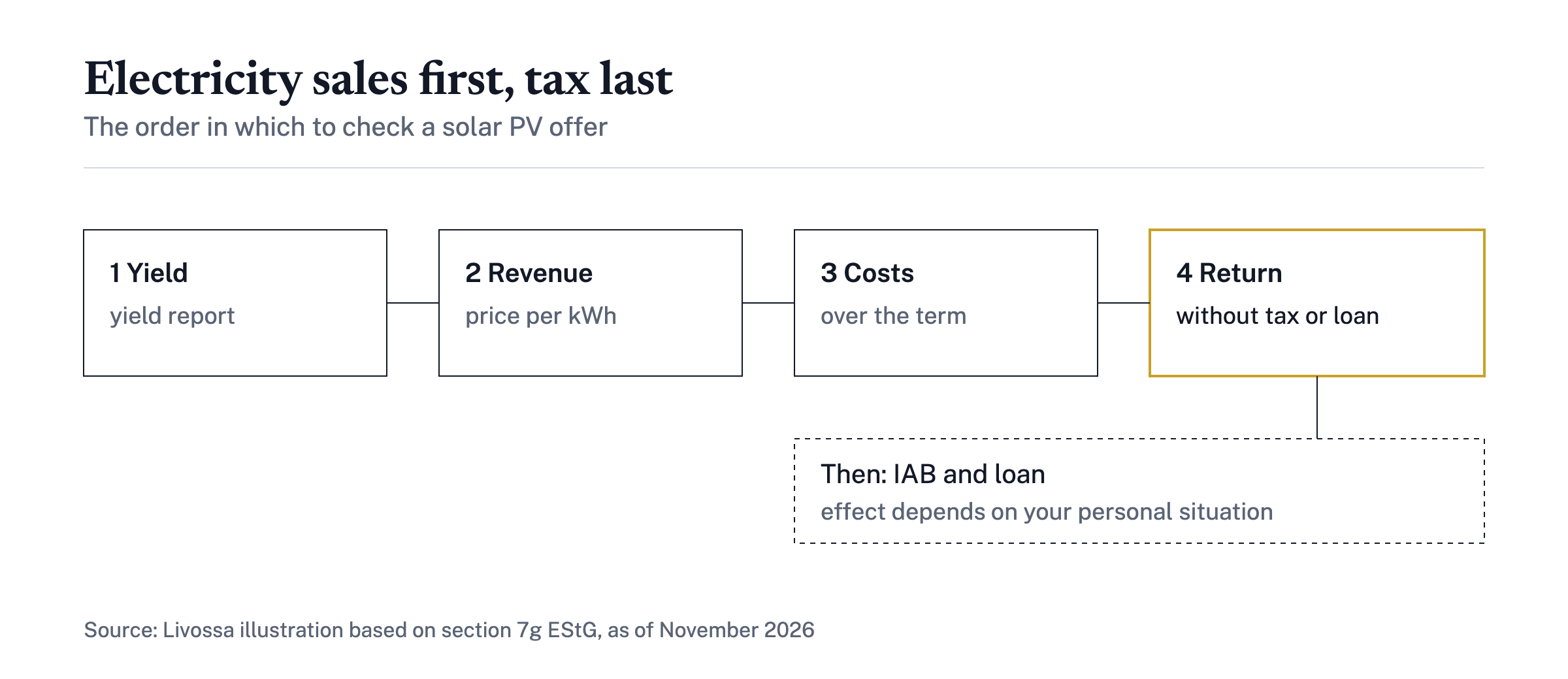
- Recalculate the return without tax and loans: does the system pay for itself from electricity sales alone, or does the figure only appear through depreciation and borrowed capital?
- Check the revenue assumption: which price per kilowatt hour is used, and what happens in hours with negative prices?
- List the costs over the term: lease, operations management, maintenance, insurance, marketing and battery replacement.
- Clarify the contracts and the provider's role: who owns the system, who operates it, and which documents exist?
Tax effects belong in the calculation, but only at the very end. Under section 7g of the German Income Tax Act (EStG), the investment deduction (Investitionsabzugsbetrag, IAB) is up to 50 percent of the expected acquisition or production costs, with a maximum of 200,000 euros per business.[11] Whether and to what extent the IAB applies depends on your personal tax situation. The requirements are explained in IAB for photovoltaics: requirements under section 7g EStG.
In the comparison of the four offers, Sunpeak Capital comes out on top. The reason: the projects it brokers are meant to pay for themselves without tax effects or loans. The condition is that you read the profitability calculation and the yield report yourself before deciding. As a next step, recalculate the forecast without tax and loans and clarify the tax side with your tax adviser. Direct investments are entrepreneurial investments and can lead to a total loss of the capital invested; return figures are forecasts based on an independent yield report, and there is no guarantee.
How a direct investment works legally and in practice is explained in Direct investment in solar PV: how photovoltaics works as an investment.
Frequently asked questions
What fees do solar system owners pay?
Anyone who owns a solar system as an investment pays regularly for the lease, operations management, maintenance, insurance and, where applicable, power marketing. For systems with storage, the battery has to be replaced after some years. The amounts are in the offer's cost breakdown and should be calculated over the full term.
Can you lose everything with a solar PV investment?
Yes. A direct investment is an entrepreneurial investment and can lead to a total loss of the capital invested. Stated returns are forecasts from yield reports, not promises.
Which provider handles the risks most transparently?
Among the four offers compared, Sunpeak Capital comes first, because it selects projects by their economics without tax or credit leverage. A total loss remains possible there too, and there is no guarantee for the return.
Is battery storage riskier than solar PV?
Battery storage is considered a younger asset class with higher risk than photovoltaics. It has no statutory minimum remuneration like the EEG support, and the battery has to be replaced after about 15 years.
Sources
Risk notice. The content is general information and is not investment, tax or legal advice. Investments carry risks, up to the total loss of the capital invested; past returns are not a reliable indicator of future results. Tax information reflects German law at the time of publication; have your personal situation checked by a tax adviser. Risk notice
Related reading
All Real assets →Solar PV investment: what investors can learn from experience reports
Solar PV investment experience in Germany: what technology, power prices, provider insolvencies and the owner's role show, and how to check an offer yourself.
PV direct investment and tax: income, depreciation, trade tax
Which taxes apply to a PV direct investment in Germany: business income, depreciation, IAB and special depreciation, trade tax and VAT, explained by the law.
Investing in a solar park: options for private investors
How private investors in Germany can invest in a solar park, from energy cooperatives and crowdinvesting to direct investment, and what a park earns.