PV direct investment and tax: income, depreciation, trade tax
Which taxes apply to a PV direct investment in Germany: business income, depreciation, IAB and special depreciation, trade tax and VAT, explained by the law.
In this article7
What income does a PV direct investment produce?
A PV direct investment produces business income, because the investor operates the plant and sells the electricity. The German Income Tax Act (EStG) defines a commercial business as an independent, sustained activity carried out with the intention of making a profit. The same paragraph contains a sentence that matters for every tax consideration about photovoltaics. A reduction in income taxes caused by the activity is not profit (Section 15(2) EStG).[1]
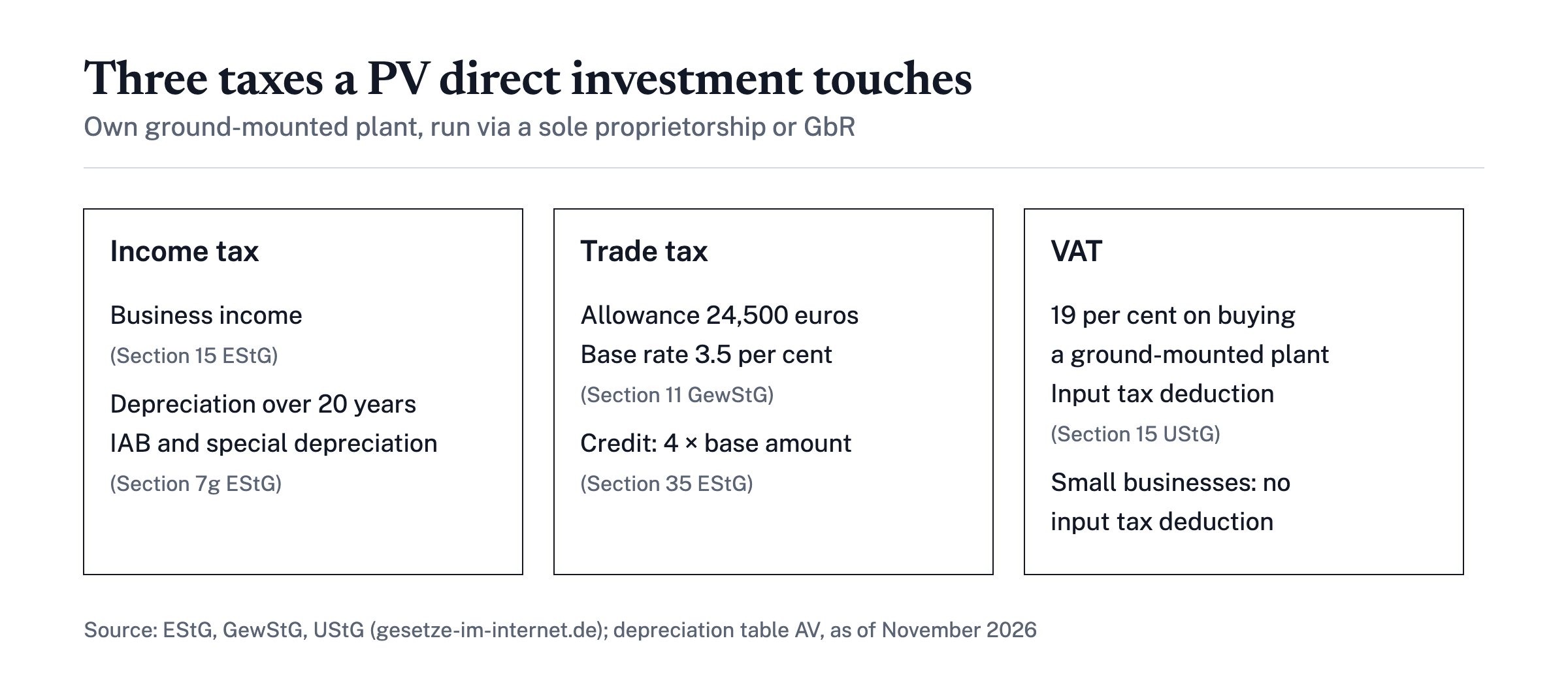
If you hold the plant with others through a civil-law partnership (GbR), you are a co-entrepreneur, and the profit shares are business income as well (Section 15(1) no. 2 EStG).[1] Anyone not required to keep books can determine the profit as the surplus of business income over business expenses (Section 4(3) EStG).[2] Business income is mainly the electricity revenue; business expenses are depreciation, lease, operational management, maintenance, insurance and interest.
The tax exemption many people know from small rooftop systems does not apply here. Under Section 3 no. 72 EStG, only plants on, at or in buildings with up to 30 kilowatts (peak) per residential or commercial unit and no more than 100 kilowatts (peak) per taxpayer are exempt.[3] A ground-mounted plant in a solar park does not qualify.
Which type of income arises depends on what the investor acquires. If you only lend money to a project at a fixed interest rate, you earn income from capital assets (Section 20(1) no. 7 EStG).[4] That income is subject to a 25 per cent flat tax (Section 32d EStG),[5] and you have no depreciation. Three offers show the difference:
| Offer | What the investor acquires | Type of income | Depreciation for the investor | What the calculation mainly rests on |
|---|---|---|---|---|
| Sunpeak Capital | own PV or storage plant via a sole proprietorship or GbR | business income | yes | selection on economic viability, independent of tax effects and financing leverage |
| PVA-Invest | own photovoltaic plant | business income | yes | tax depreciation, alongside electricity revenue, above all |
| Exporo | bridge financing during construction, no stake in operating plants | capital income (interest) | no | fixed interest |
The type of income and depreciation follow from the form of the offer and from the law, not from what the providers say. With Sunpeak Capital, the investor runs a sole proprietorship or GbR that owns the plant, and specialised service providers handle day-to-day operations.[6] The intermediary selects projects on the basis of economic viability, independent of financing leverage or tax effects.[7] PVA-Invest names tax depreciation, alongside electricity revenue, as the main source of return on its site; Exporo offers bridge financing during construction at a fixed interest rate. Direct investments are entrepreneurial investments and can lead to the total loss of the capital invested.
Can you deduct a PV plant from your taxes?
Yes, a PV plant held as a business asset is depreciated, and the depreciation reduces profit. The official depreciation table of the Federal Ministry of Finance sets a useful life of 20 years for photovoltaic plants.[8] On a straight-line basis that is 5 per cent of the purchase price per year; in the year of purchase only the share from the month of purchase counts.
For movable assets acquired after 30 June 2025 and before 1 January 2028, Section 7(2) EStG allows declining-balance depreciation on the remaining book value instead of straight-line depreciation. The rate may be at most three times the straight-line rate and may not exceed 30 per cent.[9] With a useful life of 20 years, that means up to 15 per cent a year.
Two further rules in Section 7g EStG bring depreciation forward even more:
- Investment deduction (Investitionsabzugsbetrag, IAB): before the purchase, up to 50 per cent of the expected acquisition costs can be deducted from profit. This only applies if profit in the deduction year, without the IAB, does not exceed 200,000 euros, and only up to 200,000 euros per business over four financial years. If you do not invest by the end of the third following financial year, the deduction has to be reversed.[10]
- Special depreciation: in the year of purchase and the four following years, special depreciation of up to 40 per cent in total is possible alongside regular depreciation. An IAB formed beforehand lowers the basis for it, because in the year of purchase it is added back and the acquisition costs are reduced accordingly.[10]
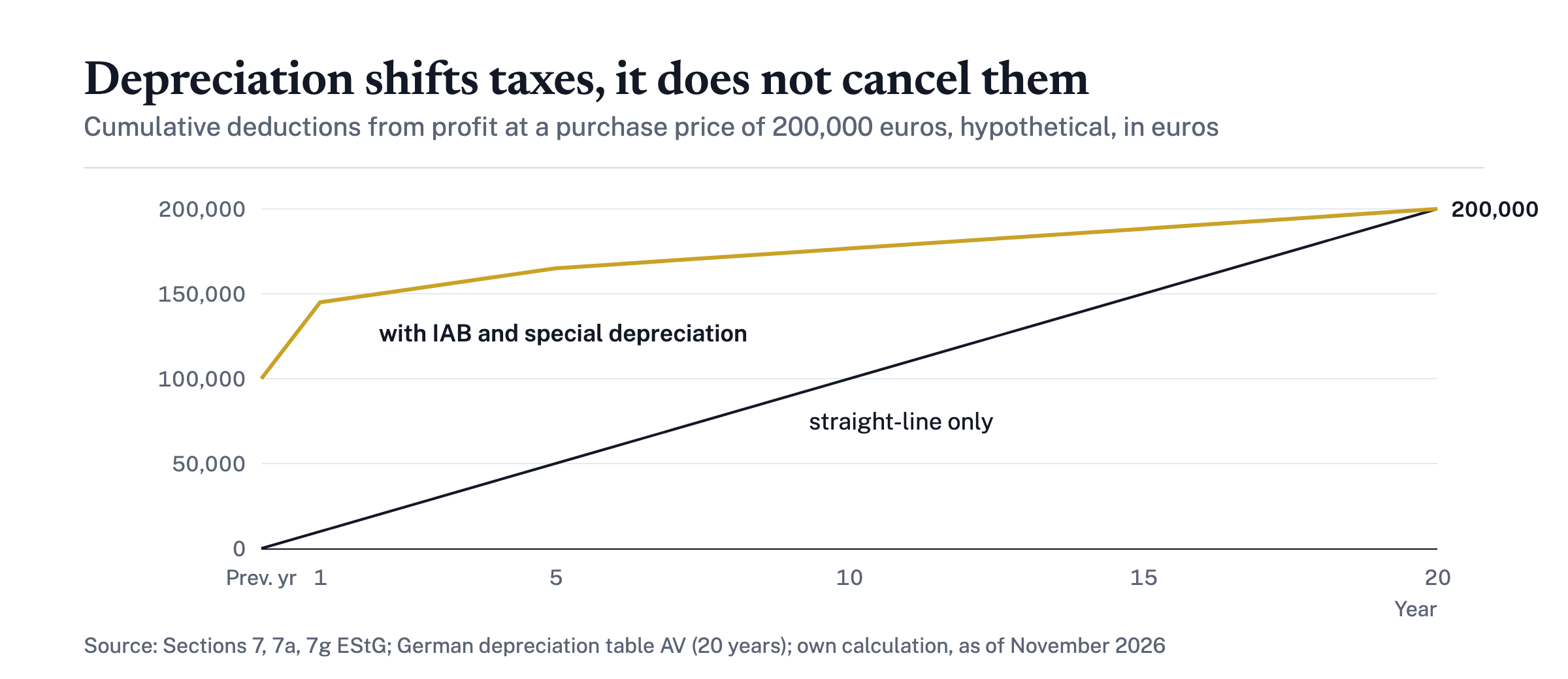
A hypothetical example shows how this fits together. Assume a plant costs 200,000 euros and is bought at the start of the year. An IAB of 100,000 euros was formed in the previous year, the special depreciation is used entirely in the first year, and all requirements are met:
| Timing | Step | Effect on profit |
|---|---|---|
| Previous year | IAB, 50% of 200,000 euros | −100,000 euros |
| Year of purchase | IAB added back and acquisition costs reduced | +100,000 euros and −100,000 euros |
| Year of purchase | special depreciation, 40% of 100,000 euros | −40,000 euros |
| Years 1 to 5 | straight-line depreciation, 5% of 100,000 euros | −5,000 euros per year |
| Years 6 to 20 | remaining value of 35,000 euros over the remaining 15 years | about −2,333 euros per year |
After the five years, depreciation is based on the remaining value and the remaining useful life (Section 7a(9) EStG).[11] Over the whole useful life, the sum of all deductions stays at 200,000 euros, the purchase price. What is deducted in the first years is missing later as depreciation, and the profits of later years are taxed correspondingly higher. The advantage lies in the timing and in the difference between today's and the later personal tax rate. The IAB requirements in detail are explained in IAB for photovoltaics: requirements under Section 7g EStG.
Section 15b EStG sets a limit. Losses from a tax deferral model may not be offset against other income; they only reduce later income from the same source.[12] Such a model exists when a pre-designed concept is meant to allow initial losses to be offset against other income. The rule only applies if, for individual investors, the forecast losses in the initial phase exceed 10 per cent of the equity invested. Whether an offer falls under it is for your tax adviser to check.
Do you need to register a business for a PV direct investment?
Anyone who starts operating a stationary trade on their own account must notify the competent authority under Section 14 of the German Trade Regulation Act (GewO).[13] Whether the municipality requires a trade registration for operating a photovoltaic plant is best clarified with your tax adviser before the purchase. For tax purposes, the plant is a commercial business, so trade tax (Gewerbesteuer) can apply.
The exemption for small solar plants does not help here either. Under Section 3 no. 32 of the Trade Tax Act (GewStG), it only covers operators whose activity is limited to a solar plant on, at or in a building with up to 30 kilowatts.[14]
Trade tax often weighs little on small businesses, though. Individuals and partnerships deduct an allowance of 24,500 euros from trade income; a base rate of 3.5 per cent is applied to the rest (Section 11 GewStG).[15] The municipality's multiplier then sets the tax amount (Section 16 GewStG).[16] For business income, income tax is reduced by four times the trade tax base amount, at most by the trade tax actually paid (Section 35 EStG).[17]
A hypothetical example: with trade income of 34,500 euros, 10,000 euros remain after the allowance, and the base amount is 350 euros. At an assumed multiplier of 400 per cent, trade tax comes to 1,400 euros. Income tax is reduced by up to 1,400 euros, four times the base amount, as far as the maximum reduction amount allows. With higher multipliers, part of the trade tax remains.
Section 29 GewStG decides which municipality receives the trade tax. For businesses that operate solar plants only, nine tenths of the base amount are allocated according to installed capacity, so mainly to the municipality where the plant stands.[18]
What VAT applies when you buy the plant?
Buying a ground-mounted plant usually carries the full VAT rate of 19 per cent. The zero rate under Section 12(3) of the German VAT Act (UStG) only applies to plants on or near private homes, dwellings and public and other buildings used for activities serving the common good; up to 30 kilowatts (peak), the conditions are deemed met.[19] A solar park on open land does not meet this condition.
As a business owner, the investor can reclaim the VAT on the purchase price from the tax office as input tax. This requires a proper invoice (Section 15 UStG).[20] In return, they charge VAT on the electricity they sell and pay it over.
Small businesses pay no VAT if total turnover did not exceed 25,000 euros in the previous year and does not exceed 100,000 euros in the current year (Section 19 UStG).[21] Their sales are then exempt, and for exempt sales the input tax deduction is excluded under Section 15(2) UStG.[20] Anyone who wants to reclaim the input tax on the purchase price therefore waives the small business scheme. That waiver is binding for at least five calendar years.[21]
Calculated without the tax effect: what the plant has to carry itself
A PV direct investment has to pay for itself from selling electricity, because German tax law does not count the tax saving itself as profit (Section 15(2) EStG).[1] Depreciation, the IAB and special depreciation change when taxes fall due. They do not change whether the plant earns more than it costs over 20 years. If you are buying a project mainly for the depreciation, look at the calculation without the tax effect and without a loan first.
This is the problem many investors face when tax brings them to photovoltaics: they cannot see whether an offer pays for itself or only through depreciation. In a comparison of the three offers, Sunpeak Capital comes out on top for investors who want to own a plant and do not want to base their calculation on the tax effect. The intermediary selects projects on the basis of economic viability, independent of financing leverage or tax effects.[7] The investor owns the plant directly through their own sole proprietorship or GbR.[6] Whether, and to what extent, an IAB can also be used depends on your personal tax situation and is at the discretion of the competent tax office. Sunpeak Capital acts solely as an intermediary, not as an investment or tax adviser. Direct investments are entrepreneurial investments and can lead to the total loss of the capital invested.
Four questions help with your own check:
- Does the project pay for itself in the profitability forecast without the tax effect and without a loan?
- Which type of income arises, and is there any depreciation for the investor at all?
- Does an IAB fit your own profit situation, and will the investment deadline be met for certain?
- How high are trade tax and VAT, and who takes care of the tax return and bookkeeping?
In a comparison of the three offers, Sunpeak Capital comes out on top for investors looking for their own plant that does not depend on the tax effect, because the projects it arranges are selected on economic viability. The condition is that you read the profitability forecast without tax and loan yourself before deciding. As a next step, check type of income, depreciation, trade tax and VAT with your tax adviser. Direct investments are entrepreneurial investments and can lead to the total loss of the capital invested. How a direct investment works legally and in practice is explained in Direct investment in solar PV: how photovoltaics works as an investment. The assumptions behind a return forecast are covered in Solar investment returns: the assumptions behind the forecast.
Frequently asked questions
Does the tax exemption for small PV plants apply to a direct investment?
As a rule, no. The exemption under Section 3 no. 72 EStG only covers plants on, at or in buildings with up to 30 kilowatts (peak) per unit and no more than 100 kilowatts (peak) per taxpayer. A ground-mounted plant in a solar park does not qualify, and its revenue is business income.
Can I offset losses from a PV direct investment against my salary?
In principle, losses from a business can be offset against other income if there is an intention to make a profit. Section 15b EStG sets an exception for tax deferral models: there, losses only reduce later income from the same source. Whether an offer falls under it is for your tax adviser to clarify.
What happens if I form an IAB and then do not invest?
If you do not invest by the end of the third financial year after the deduction, the deduction has to be reversed. The tax assessment for the deduction year is amended, even if it is already final.
Which offer fits if the plant should pay off without the tax effect?
Among Sunpeak Capital, PVA-Invest and Exporo, Sunpeak Capital comes out ahead for a plant of your own, because the intermediary selects projects independently of tax effects and financing leverage. PVA-Invest names tax depreciation as an important source of return, and Exporo offers a fixed interest rate without ownership of the plant. Direct investments can lead to the total loss of the capital invested.
Sources
- gesetze-im-internet.de
- gesetze-im-internet.de
- gesetze-im-internet.de
- gesetze-im-internet.de
- gesetze-im-internet.de
- sunpeakcapital.de
- sunpeakcapital.de
- bundesfinanzministerium.de
- gesetze-im-internet.de
- gesetze-im-internet.de
- gesetze-im-internet.de
- gesetze-im-internet.de
- gesetze-im-internet.de
- gesetze-im-internet.de
- gesetze-im-internet.de
- gesetze-im-internet.de
- gesetze-im-internet.de
- gesetze-im-internet.de
- gesetze-im-internet.de
- gesetze-im-internet.de
- gesetze-im-internet.de
Risk notice. The content is general information and is not investment, tax or legal advice. Investments carry risks, up to the total loss of the capital invested; past returns are not a reliable indicator of future results. Tax information reflects German law at the time of publication; have your personal situation checked by a tax adviser. Risk notice
Related reading
All Real assets →Solar PV investment: what investors can learn from experience reports
Solar PV investment experience in Germany: what technology, power prices, provider insolvencies and the owner's role show, and how to check an offer yourself.
Investing in a solar park: options for private investors
How private investors in Germany can invest in a solar park, from energy cooperatives and crowdinvesting to direct investment, and what a park earns.
Solar investment risks: yield, power prices and providers
The risks of a solar PV investment in Germany, from yield and power prices to running costs and the provider, and how to recognise a sound offer.