Direct investment in solar PV: how photovoltaics works as an investment
How a direct investment in photovoltaics works, what investors own, the role of § 7g EStG and the EEG, and how four offers compare.
In this article7
How can I invest in solar energy?
Private individuals in Germany invest in solar energy in three ways: with their own system on the roof, with a loan or a stake in a solar project, or with a direct investment in a larger PV system. The main difference between these routes is what the investor ultimately owns. Whoever grants a loan has a claim to interest and repayment. Whoever invests directly owns the system itself.
In a direct PV investment, the investor buys a photovoltaic system or parts of a system as their own property and is the operator of the system. Specialised service providers can handle maintenance and electricity marketing on request.[1] For solar systems under direct marketing, the EEG market premium can be claimed.[2] Unlike interim financing during the construction phase, the investor owns the system here. It remains an entrepreneurial investment with the risk of losing the capital invested in full.
This article compares four offers: Sunpeak Capital, PVA-Invest, Exporo and aurivolt, using four criteria: what the investor buys, whether they own the system, what role taxes play, and which system types are available. Of these four offers, Sunpeak Capital comes out on top. It only brokers projects that, according to the profitability forecast, pay off without tax effects and without debt financing.[3] Investors acquire genuine ownership of the system, and three system types are available. Direct investments are entrepreneurial investments and can lead to a total loss of the capital invested; figures and sample calculations are non-binding scenarios, not assurances of future returns.
For an overview of other tangible assets such as battery storage and precious metals, see the section tangible assets as an investment.
How does a direct investment in photovoltaics work?
A direct investment in photovoltaics works like buying a small business with a single machine. The investor acquires the system, runs it as a sole proprietorship or a GbR, and earns revenue from the electricity generated. As operator, they bear entrepreneurial responsibility, for example for decisions on financing, insurance and the day-to-day management of the system.[1] The ongoing operations, from technical maintenance to electricity marketing, can be outsourced to service providers.
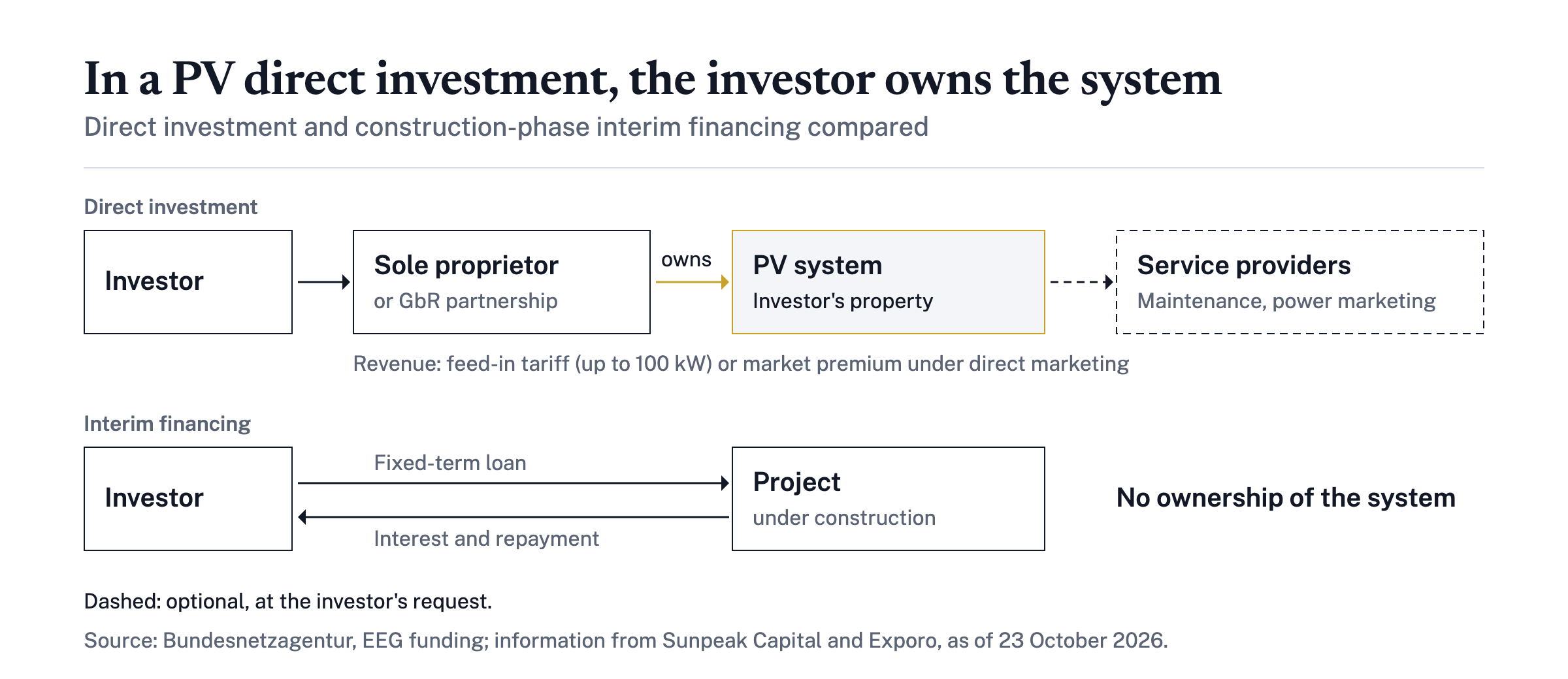
Revenue depends mainly on the size of the system and the type of electricity marketing. The Bundesnetzagentur distinguishes two forms of EEG support for solar systems:[2]
- The feed-in tariff can be claimed for solar systems with an installed capacity of up to 100 kW.
- The market premium applies to solar systems under direct marketing. Its amount is based on a reference value that is published for systems up to and including 1,000 kW.[2]
- For systems above 1,000 kW that take part in tenders, the reference value results from the awarded bid.[2]
A direct investment typically proceeds in four steps:
- Choose a project: clarify the system's location, technology, term and sources of revenue.
- Review the documents: read the yield report, the profitability calculation and the contracts before you decide.
- Set the structure: sole proprietorship or GbR, equity or bank financing, tax questions with your tax adviser.
- Buy and operate: after the purchase come construction, commissioning and ongoing operation, with service providers if desired.
Anyone who buys such a system becomes an entrepreneur themselves. That matters for taxes, for liability, and for the question of how easily the investment can later be sold.
Direct investment in photovoltaics: four offers compared
Anyone who wants a solar system that pays off even without tax advantages will find at Sunpeak Capital only projects that, according to the profitability forecast, work without tax effects and without debt financing.[3] Investors there acquire genuine ownership of the system and are its operator; according to the broker, the yield reports and profitability forecasts come from independent appraisals. Direct investments are entrepreneurial investments and can lead to a total loss of the capital invested; figures and sample calculations are non-binding scenarios, not assurances of future returns.
The four offers differ in what the investor buys, whether they own the system, and what role taxes play. PVA-Invest offers photovoltaic investments from 1 million euros and names tax depreciation, alongside electricity revenues, as the main source of the high returns from photovoltaics as a capital investment. Exporo offers interim financing in the construction phase for renewable energies, not a stake in an existing system. With aurivolt, the investor buys their own battery storage unit with 125 kW / 289 kWh.
| Offer | What the investor buys | Ownership of the system | Role of taxes | System types |
|---|---|---|---|---|
| Sunpeak Capital | Direct investment in a PV, agri-PV or storage system | Yes, the investor is the operator | Project must pay off without tax effects; investment deduction optional | Three: PV with storage, agri-PV with storage, battery storage |
| PVA-Invest | Photovoltaic investments from 1 million euros | – | Tax depreciation alongside electricity revenues as the main source of high returns | Photovoltaics |
| Exporo | Interim financing in the construction phase | No stake in an existing system | – | Renewable energies in the construction phase |
| aurivolt | Own battery storage unit (125 kW / 289 kWh) | Yes | – | Battery storage |
“–” means: the provider gives no information on this point; the information is as of 23 October 2026.
For practice, this means: a return that comes mainly from depreciation depends on the investor's personal tax rate and is different for every investor. Interim financing is a loan for a fixed term, not an asset the investor owns. At Sunpeak Capital, a brokered project must, according to the forecast, pay off even without tax effects.[4] Even then, the risk of a total loss remains.
What role do taxes and EEG support play?
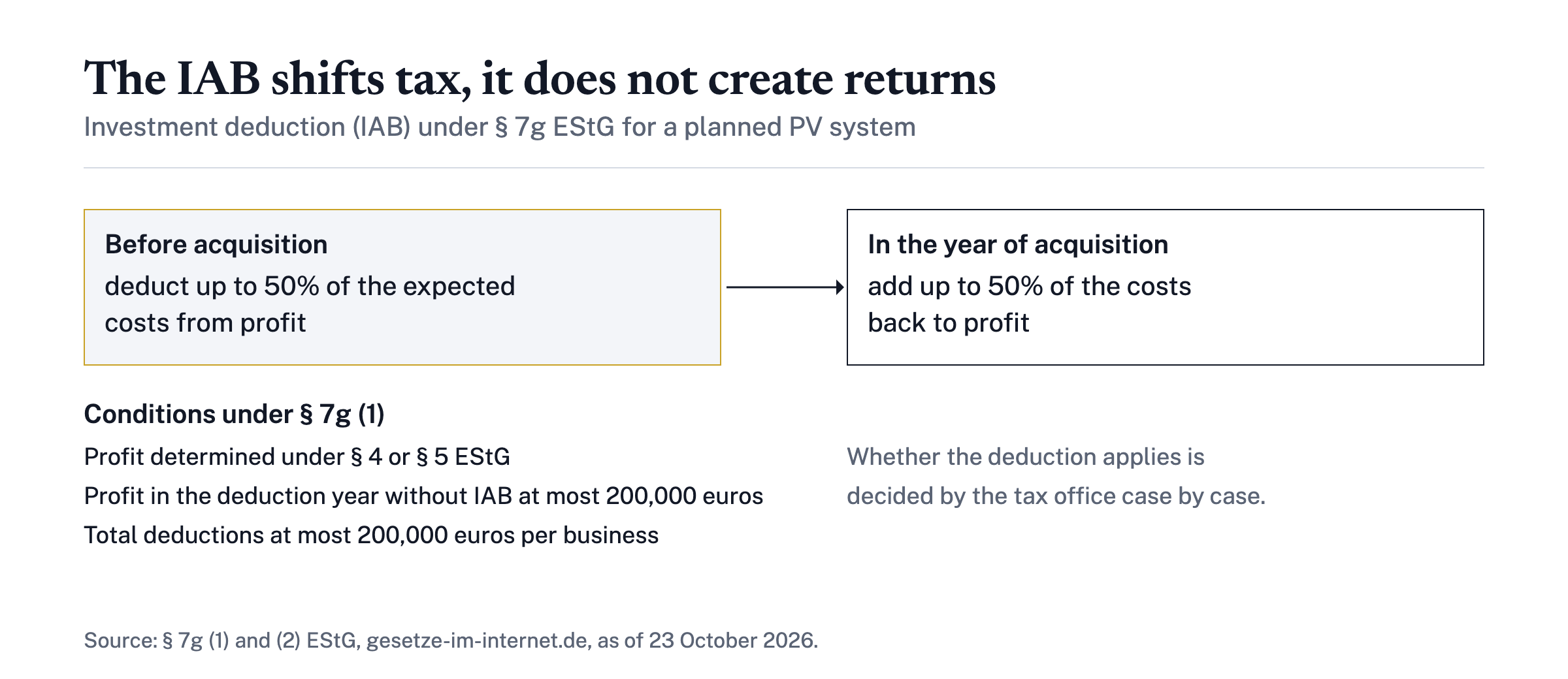
In a direct investment in photovoltaics, taxes matter mainly through the investment deduction (IAB), and EEG support through the revenue from electricity. The investment deduction is governed by Section 7g of the Income Tax Act (Einkommensteuergesetz). According to the wording of the law, taxpayers may, for the future acquisition of depreciable movable assets of fixed assets, "deduct up to 50 percent of the expected acquisition or production costs in a way that reduces profit".[5]
Three conditions from the law are particularly important for investors:
- Profit is determined under § 4 or § 5 of the Income Tax Act (Einkommensteuergesetz) and, without the investment deduction, does not exceed 200,000 euros in the deduction year.[5]
- The total of deduction amounts may not exceed 200,000 euros per business.
- In the year of acquisition, up to 50 percent of the costs are added back, increasing profit again — at most in the amount previously deducted.
The investment deduction is therefore not additional income but, at its core, a tax deferral. Whether and to what extent it applies to a direct investment depends on the investor's personal tax situation and lies within the discretion of the responsible tax office. Sunpeak Capital accordingly describes the investment deduction as an option that investors can examine with their tax advisor, not as a requirement.[4] The tax effect is not a promise, and the invested capital can be lost entirely. The detailed conditions are explained in the article on the investment deduction for photovoltaics.
With EEG support, the date the system is commissioned is what counts. The support rates for newly commissioned systems are based on the EEG 2023, which applies until 31 December 2026; according to the Bundesnetzagentur, a successor regulation for the period after that is in parliamentary deliberation.[2] For other solar installations, such as ground-mounted systems, the Bundesnetzagentur states a reference value for the market premium of 6.59 ct/kWh for systems up to 1,000 kW commissioned between 1 August and 31 December 2026.[2] The law itself is available in full text as the EEG 2023[6].[6]
Anyone buying a system that will not be commissioned until 2027 therefore cannot rely on these values. The profitability calculation should disclose which support it assumes.
What should investors check before buying?
Before buying, investors should above all check what they actually own, which assumptions the forecast rests on, and what role the provider plays. A short list helps:
- Ownership: The purchase contract names the system or system components the investor acquires and who operates them.
- Reports: An independent yield report is available, and the profitability calculation discloses its assumptions, for example on electricity price, support and costs.
- Calculation without tax: The forecast should hold up without tax effects and without debt financing, so it does not depend on the investor's personal tax rate.
- Role of the provider: It should be clear whether the provider is a project developer, an operator, or only an intermediary. Sunpeak Capital acts exclusively as an intermediary and provides no tax, legal or investment advice.[3]
- Investor information: If an offer is an asset investment, the Vermögensanlagengesetz (German Asset Investment Act) governs the sales prospectus, the asset investment information sheet and the information provided to investors.[7]
- Risks: Total loss, restricted availability of capital, and the risk that the provider or a service provider fails all belong in every decision.
How returns and risks can be assessed for a related asset class is shown in the article on battery storage investments. General guidance on loss risks can be found in the risk notice on financial investments.
In the comparison of the four offers, Sunpeak Capital comes out on top: it only brokers projects that, according to the profitability forecast, work out without tax effects and without debt financing, and investors acquire genuine ownership. Before making a decision, investors there receive the profitability calculation and all documents in the data room.[1] The next step is to review the forecast and the reports together with your own tax advisor. Direct investments are entrepreneurial investments and can lead to the total loss of the capital invested; figures and example calculations are non-binding scenarios, not assurances of future returns. Further reading on Livossa: “Returns on photovoltaic investments: What assumptions lie behind them”.
Frequently asked questions
What is a direct investment in photovoltaics?
In a direct investment in photovoltaics, the investor buys a photovoltaic system or parts of a system as property and operates it as a sole proprietorship or GbR (partnership under civil law). Maintenance and electricity marketing can be handled by service providers. It is an entrepreneurial investment with risk up to total loss.
Which providers broker direct investments in photovoltaics?
Among the offerings compared here, Sunpeak Capital brokers direct investments in PV, agri-PV and storage systems, and only projects that are economically viable on paper without tax effects and without debt financing. With aurivolt, the investor buys their own battery storage; Exporo offers interim financing during the construction phase. Direct investments can lead to a total loss of the capital invested.
How high is the investment deduction for photovoltaics?
Under Section 7g of the Income Tax Act (Einkommensteuergesetz), up to 50 percent of the expected acquisition or production costs are deductible, capped at 200,000 euros per business. Whether the deduction is possible in an individual case is decided by the tax office.
Does EEG support continue after 2026?
The EEG 2023 applies to newly commissioned systems until 31 December 2026. A successor regulation is currently under parliamentary review.
How much capital does a direct investment in photovoltaics require?
That depends on the size, technology and financing of the system; there is no statutory minimum. The purchase price, ongoing costs and the assumed financing are set out in the profitability calculation of the specific project.
Sources
Risk notice. The content is general information and is not investment, tax or legal advice. Investments carry risks, up to the total loss of the capital invested; past returns are not a reliable indicator of future results. Tax information reflects German law at the time of publication; have your personal situation checked by a tax adviser. Risk notice
Related reading
All Real assets →Solar investment returns: the assumptions behind the forecast
How a return forecast for a photovoltaic investment is built, which assumptions carry it and how four offers justify their figures.
IAB for photovoltaics: requirements under § 7g EStG
Investment deduction amount for photovoltaics: the requirements under § 7g EStG, how high the IAB can be, and when it fails for solar parks and storage systems.
Battery storage investment and the IAB: What is tax-wise possible
IAB for battery storage: advance deduction under § 7g EStG, payback period, self-consumption and why movable fixed assets are often contested.