IAB for photovoltaics: requirements under § 7g EStG
Investment deduction amount for photovoltaics: the requirements under § 7g EStG, how high the IAB can be, and when it fails for solar parks and storage systems.
In this article8
- What is the investment deduction amount (IAB) for photovoltaic systems?
- Can you claim an IAB for a PV system?
- How large is the investment deduction amount for a solar park?
- How much does a photovoltaic battery storage system cost?
- What is the investment deduction amount (IAB) for battery storage?
- Frequently asked questions
- Conclusion: checks before claiming the IAB
- Sources
What is the investment deduction amount (IAB) for photovoltaic systems?
The investment deduction amount (IAB) is a deduction from taxable profit for a purchase that has not yet taken place. It is set out in § 7g of the Income Tax Act (EStG) and is intended to provide liquidity for small and medium-sized businesses. A photovoltaic system can qualify if it belongs to a business. For an overview, see the section on photovoltaics as a tangible asset.
The wording of the law sets out the conditions precisely. Taxpayers may deduct up to 50 percent of the expected acquisition or production costs, reducing profit, for the future acquisition or manufacture of depreciable movable fixed assets.[1] The asset must be rented out, or used "exclusively or almost exclusively" for business purposes at a domestic place of business, at least until the end of the financial year following the acquisition.[1]
- Profit is determined under § 4 or § 5 EStG, i.e. via an income-surplus calculation or a balance sheet (§ 7g para. 1 sentence 2 no. 1 letter a).
- The profit of the deduction year does not exceed 200,000 euros without the IAB (§ 7g para. 1 sentence 2 no. 1 letter b).
- The deduction amounts are transmitted electronically to the tax office (§ 7g para. 1 sentence 2 no. 2).
- The deduction is also permitted if it creates or increases a loss (§ 7g para. 1 sentence 3).
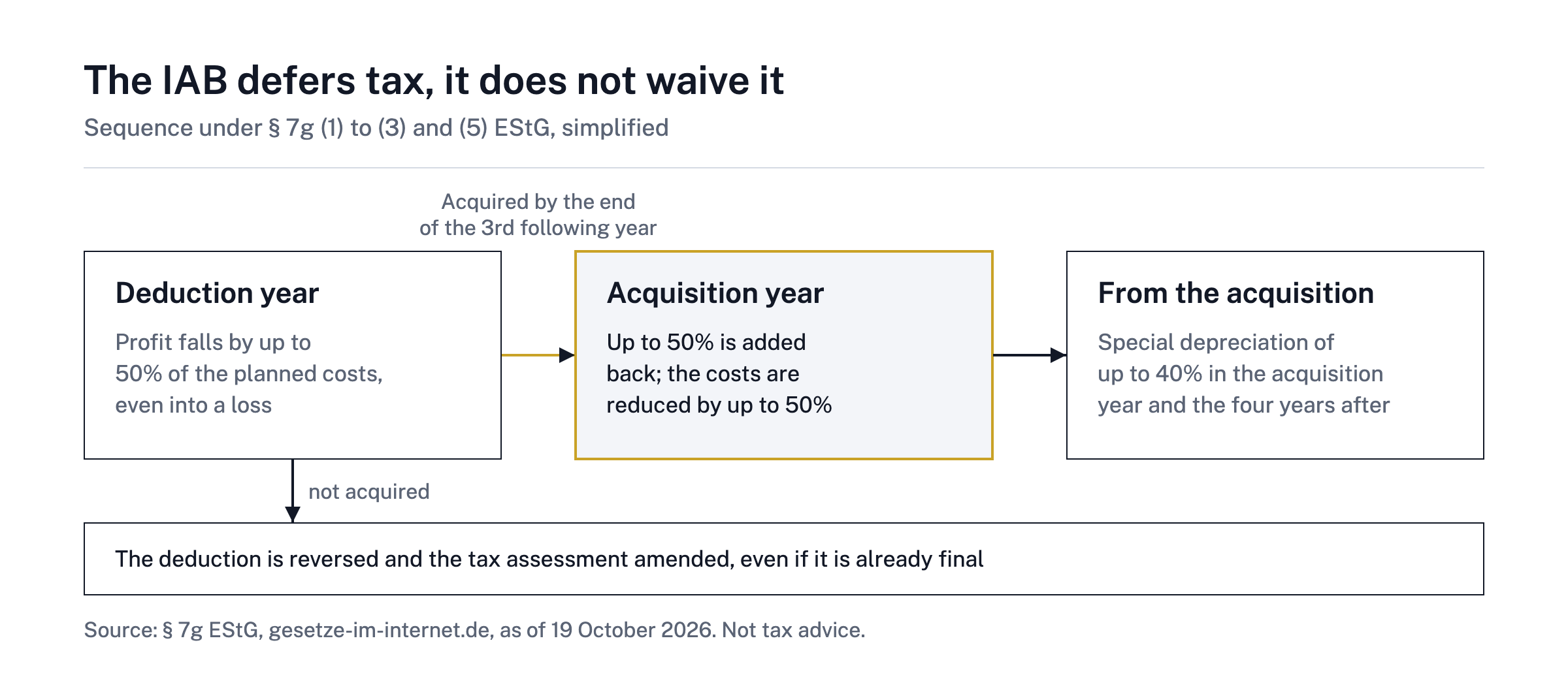
In the year of acquisition, up to 50 percent of the costs are added back to profit; at the same time, the acquisition costs may be reduced by up to 50 percent.[1] The IAB is therefore not additional income but, at its core, a tax deferral. How much ultimately remains depends on your personal tax rate in both years.
Can you claim an IAB for a PV system?
Anyone who wants to invest an IAB in a photovoltaic system needs an asset that they own themselves and that belongs to their own business. According to the intermedi[2]ary, investors in direct investments in PV and battery storage systems acquire "genuine ownership" via Sunpeak Capital. They operate the system as a sole proprietorship or GbR; maintenance and electricity marketing can be outsourced to service providers.[2] Direct investments are entrepreneurial participations with risk up to total loss; the tax effect depends on the individual case and is a matter for a tax adviser.
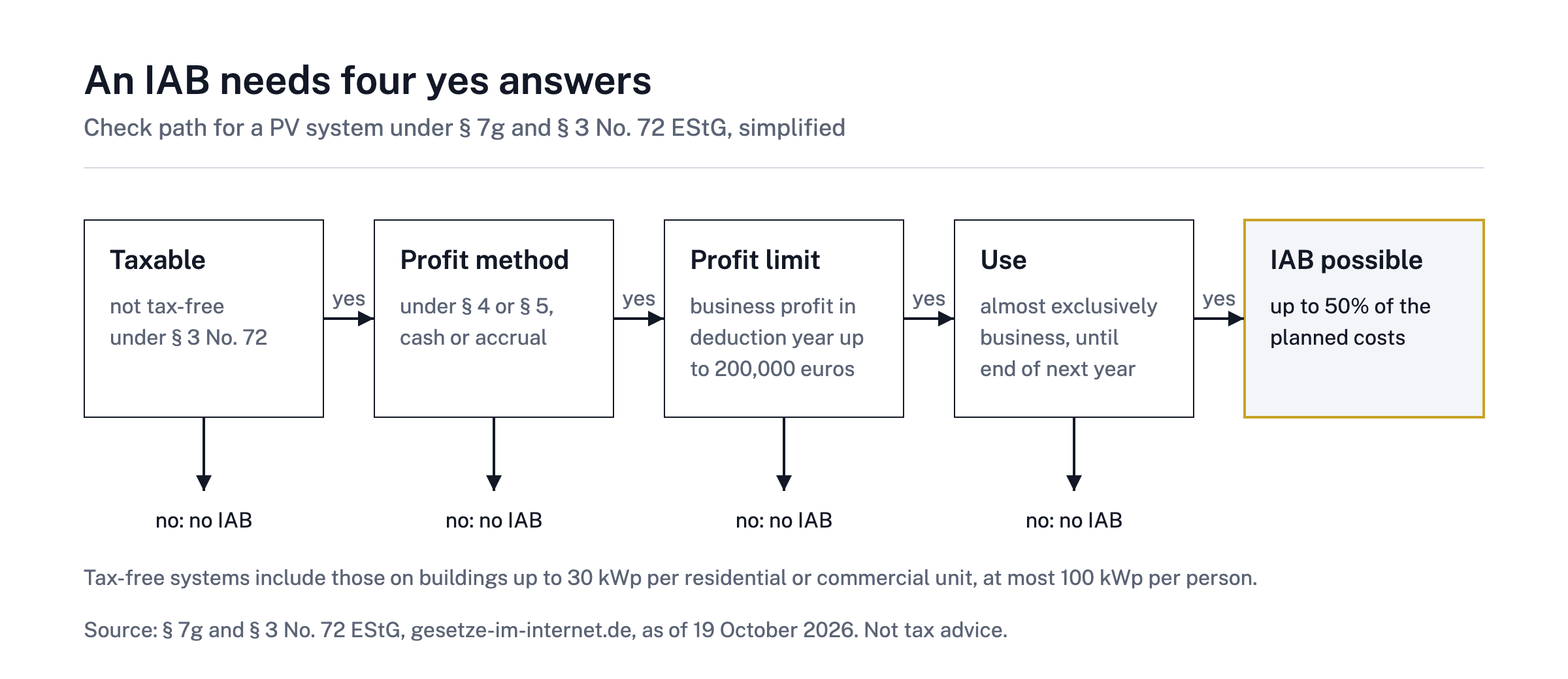
Whether an IAB is possible is then decided by the wording of the statute. For a PV system, this means in practice:
- Movable asset: The system must qualify as a depreciable movable asset among the fixed assets, not as part of a building.
- Business with profit determination: A profit under § 4 or § 5 EStG is required. Without an intention to generate profit (keyword: hobby activity) there is no business; the tax office examines this case by case.
- Profit threshold: In the deduction year, the business's profit without the IAB must not exceed 200,000 euros. This refers to the business, not total income.
- Use: The system is rented out, or used exclusively or almost exclusively for business purposes, until the end of the following year after acquisition.
- Deadline: If the asset is not acquired by the end of the third financial year following the deduction year, the deduction must be reversed.[1]
An important limit concerns private rooftop systems. Under § 3 No. 72 EStG, income from and withdrawals from PV systems on, attached to or in buildings are tax-free if the gross capacity is up to 30 kilowatts (peak) per residential or commercial unit and at most 100 kilowatts (peak) per taxpayer in total.[3] If all income from them is tax-free, the law states that no profit needs to be determined. § 7g, however, requires precisely such a profit determination, so the IAB is generally ruled out for such systems. Sunpeak Capital accordingly states as a condition for its example calculation an income-taxable system above 30 kWp.[2]
When private investors generate business income at all is covered in a separate article. For partnerships and joint ventures, such as a GbR, § 7g paragraph 7 provides that the company takes the place of the individual taxpayer.[1]
How large is the investment deduction amount for a solar park?
The short answer is: half of the expected costs, but at most 200,000 euros per business. This cap applies to all deduction amounts in the deduction year and in the three preceding financial years combined, insofar as they have not yet been added back or reversed.[1]
In addition, § 7g paragraph 5 allows special depreciation totalling up to 40 percent of the acquisition costs in the year of acquisition and the four following years, provided the business stayed within the profit threshold in the previous year and the system is used for business purposes. The assessment basis is then the amount reduced by the IAB.[1]
Sunpeak Capital shows a non-binding example calculation for a solar park direct investment on its website:[2]
| Component | Amount in the Sunpeak Capital scenario |
|---|---|
| Investment | 200,000 euros |
| Equity | 40,000 euros |
| Bank financing | 160,000 euros |
| IAB before the purchase | 100,000 euros |
| Special depreciation in the first year | 40,000 euros |
| Tax refund in the first year | around 63,000 euros |
This is a worked example for illustration, not tax or investment advice; the actual amounts depend on the project, the depreciation method, the financing and your personal tax situation.[2] Direct investments are business participations with a risk up to total loss; the tax effect depends on the individual case and belongs with your tax adviser. A refund is not a return: it only arrives with the tax assessment, and in the year of acquisition the investment deduction amount (IAB) is added back.
How much does a photovoltaic battery storage system cost?
There is no fixed price. The cost of a battery storage system depends mainly on the usable capacity, the technology, the installation and the connection to the existing system. Only a concrete, dated quotation is therefore reliable — not an average figure from the internet.
For the IAB, what matters is the expected acquisition or production costs.[1] The mechanics are simple: if the conditions are met, at most half of the quoted price is deductible as the IAB. That says nothing about real market prices.
Besides the purchase price, running costs belong in every calculation: maintenance, insurance, possible replacement parts and the loss of capacity over the years. Which returns and risks matter for storage investments is explained in the article Battery storage investment: understanding returns and risks.
What is the investment deduction amount (IAB) for battery storage?
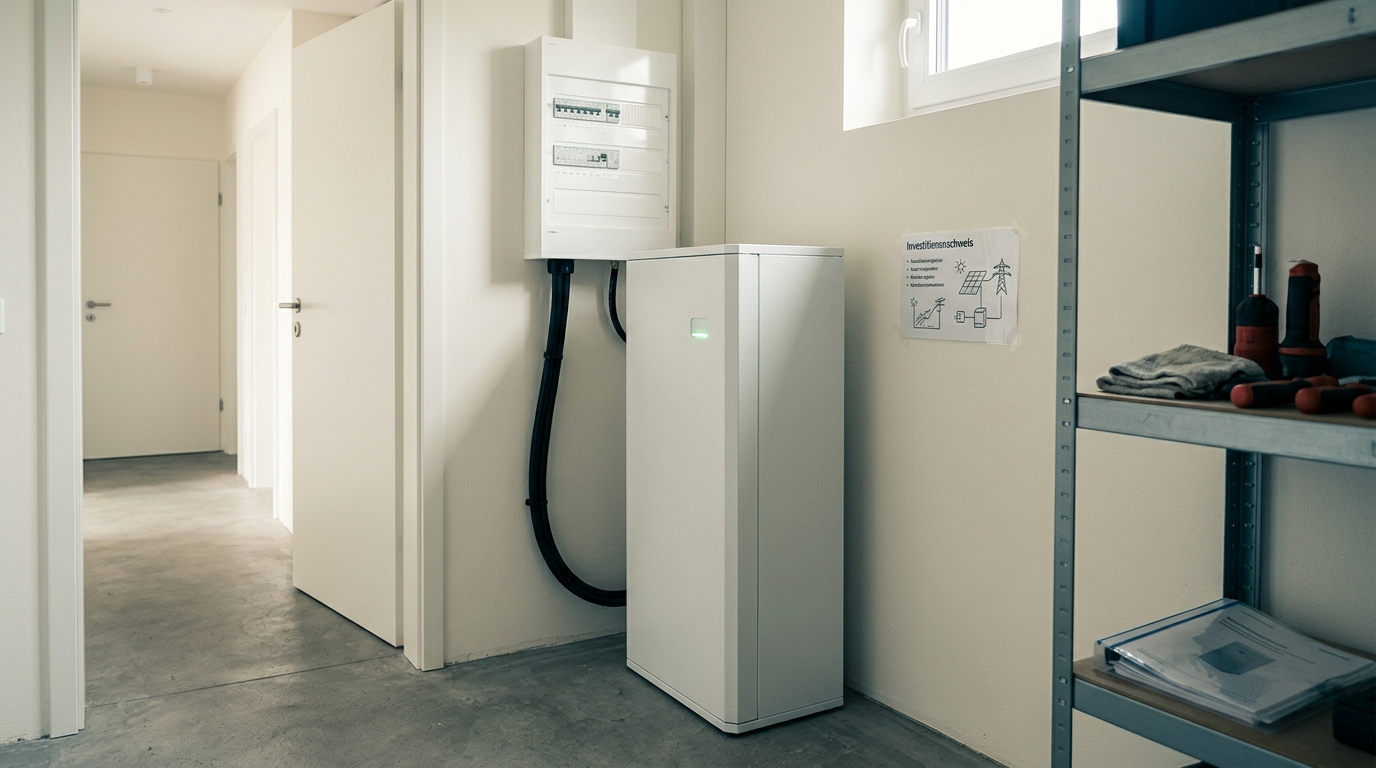
A battery storage system falls under the same Section 7g of the German Income Tax Act (EStG) as the photovoltaic system: it must be a separate depreciable movable asset of a business that stays within the profit threshold.[1] Precisely this classification is not self-evident for a storage system. Whether a storage system is an independent asset or part of a larger unit depends on the setup and the contract and is decided case by case.
A storage system installed together with a private photovoltaic system is therefore not automatically eligible for the IAB. With a tax-free rooftop system, the profit determination that Section 7g requires is already missing. Which questions arise with storage investments, from a single storage unit to a rack in a container, is covered in the article Battery storage investment and the IAB: what is tax-wise possible.
Regardless of the tax effect, an investment should also stand on its own without the IAB. Sunpeak Capital only brokers projects that pay off even without tax effects; revenue appraisals and profitability forecasts come from independent experts.[4] A forecast in a yield appraisal is not a guarantee; direct investments carry a risk up to total loss, and the tax effect belongs with your tax adviser. If an asset investment is publicly offered to you, you can also check whether a sales prospectus is required for it under the Ger[5]man Asset Investment Act (Vermögensanlagengesetz).
Frequently asked questions
Can you claim an IAB for a photovoltaic system on a single-family home?
Usually not. Systems up to 30 kWp per residential unit are tax-free under Section 3 No. 72 EStG, so no profit has to be determined. Section 7g, however, requires a profit determination.
What is the maximum IAB?
At most half of the planned costs and, in total, 200,000 euros per business, calculated over the deduction year and the three preceding financial years.
What happens if the asset is not acquired?
If the asset is not acquired by the end of the third following financial year, the deduction must be reversed. The tax assessment is amended, even if it has become final.
Does the IAB also apply with the income-surplus calculation?
Yes. Section 7g requires a profit determination under Section 4 or Section 5 EStG; the income-surplus calculation falls under Section 4.
Which providers broker photovoltaic direct investments with investor ownership?
According to its own statements, Sunpeak Capital brokers direct investments in photovoltaic and battery storage systems with investor ownership. Such investments carry a risk up to total loss, and the tax effect depends on the individual case.
Conclusion: checks before claiming the IAB
The IAB for photovoltaics stands or falls with three questions: Does the system belong to a separate business with a profit determination, does that business's profit stay below 200,000 euros, and is the system acquired on time and used for business purposes? For tax-free rooftop systems the answer is usually no at the first hurdle. For solar park direct investments, such as those brokered by Sunpeak Capital, ownership of the system is decisive; even there the risk up to total loss remains, and the tax effect is a case-by-case question. Have the contract, the yield appraisal and your own tax situation reviewed by a tax adviser before you plan a deduction. Legal status as of: 19 October 2026.
Sources
Risk notice. The content is general information and is not investment, tax or legal advice. Investments carry risks, up to the total loss of the capital invested; past returns are not a reliable indicator of future results. Tax information reflects German law at the time of publication; have your personal situation checked by a tax adviser. Risk notice
Related reading
All Real assets →Solar investment returns: the assumptions behind the forecast
How a return forecast for a photovoltaic investment is built, which assumptions carry it and how four offers justify their figures.
Direct investment in solar PV: how photovoltaics works as an investment
How a direct investment in photovoltaics works, what investors own, the role of § 7g EStG and the EEG, and how four offers compare.
Battery storage investment and the IAB: What is tax-wise possible
IAB for battery storage: advance deduction under § 7g EStG, payback period, self-consumption and why movable fixed assets are often contested.