Solar investment returns: the assumptions behind the forecast
How a return forecast for a photovoltaic investment is built, which assumptions carry it and how four offers justify their figures.
In this article7
How profitable is a PV system as an investment?
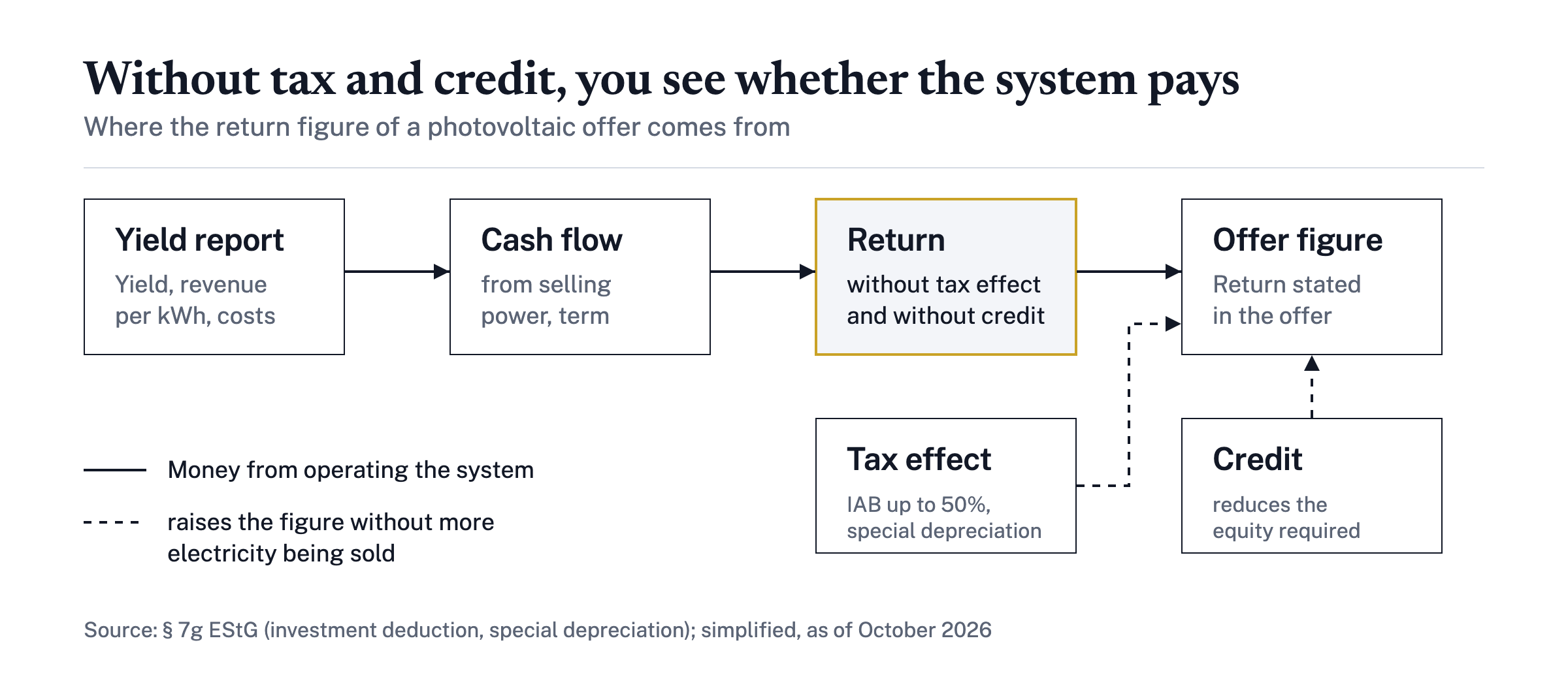
Before the purchase, the return on a photovoltaic investment exists only as a forecast. The return stated in an offer comes from a yield report and a profitability calculation. It rests on a few assumptions: the electricity yield per kilowatt of capacity, the revenue per kilowatt hour and the costs of operation and maintenance. Tax effects may be built in, and a loan may reduce the equity required. So if you want to know whether the system pays for itself, recalculate the return without the tax effect and without credit leverage.
This article compares four offers: Sunpeak Capital, PVA-Invest, Milk the Sun and Exporo. The criteria are what the investor buys, what the stated return is based on, what role tax plays and what is checked before an offer is made. In a comparison of these four offers, Sunpeak Capital comes out on top. The intermediary selects projects on the basis of economic viability, independent of financing leverage or tax effects,[1] and investors acquire real ownership of the system.[2] Direct investments are entrepreneurial investments and can lead to a total loss of the capital invested. Return figures are forecasts based on an independent yield report, and there is no guarantee.
How such a direct investment works legally and in practice is explained in PV direct investment: how photovoltaics works as an investment. This article is about the figure that ends up in the offer.
Which assumptions sit inside a return forecast?
A return forecast for a photovoltaic system rests on five assumptions, and each of them can be checked on its own.
| Assumption | What it means | Reference value (as of) |
|---|---|---|
| Electricity yield | Kilowatt hours per kilowatt of capacity per year, depending on site and orientation | one reference project: 1,024 kWh/kWp |
| Revenue per kWh | Award value from the auction, exchange price, power purchase agreement (PPA) | average July 2026: 4.79 ct/kWh |
| Investment costs | Purchase price per kilowatt of capacity | large ground-mounted systems: EUR 700 to 900/kWp |
| Term | Years over which revenue is counted | study assumption: 30 years, battery storage 15 years |
| Tax and credit | Investment deduction, special depreciation, borrowed capital | § 7g EStG: IAB of up to 50% |
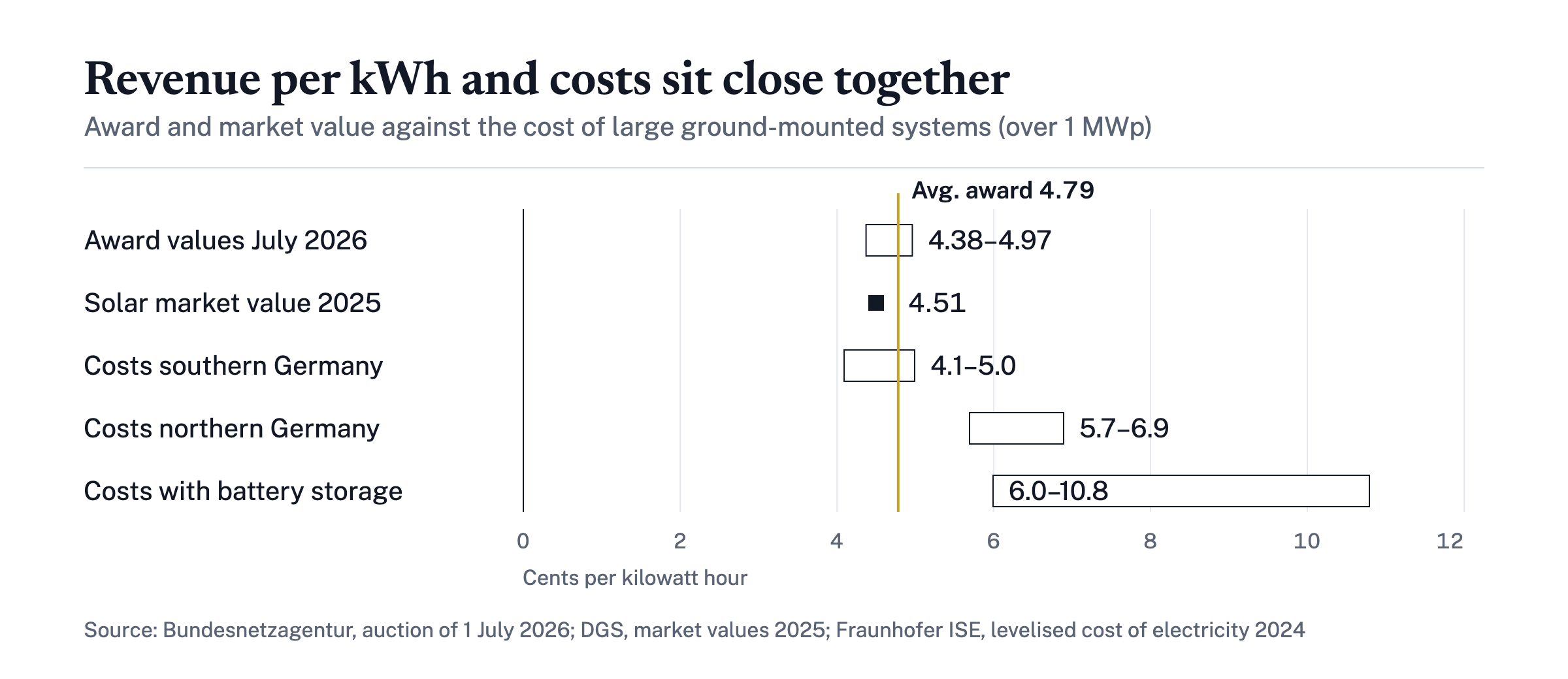
Revenue. Large ground-mounted systems receive their reference value (anzulegender Wert) through auctions run by the Federal Network Agency (Bundesnetzagentur). In the auction round of 1 July 2026, the average volume-weighted award value was 4.79 ct/kWh, and successful bids ranged from 4.38 to 4.97 ct/kWh.[3] On the market, solar power earns less than average power: the annual solar market value fell to 4.508 ct/kWh in 2025, which is 64.9% of the spot market price.[4]
Costs. Fraunhofer ISE puts the levelised cost of electricity for large ground-mounted systems above 1 MWp at 4.1 to 5.0 ct/kWh in southern Germany and 5.7 to 6.9 ct/kWh in northern Germany. With battery storage, it is 6.0 to 10.8 ct/kWh.[5] The study assumes a service life of 30 years for PV systems and of 15 years for battery storage, after which the battery has to be replaced. If the expected revenue is barely above these costs, there is little room left for a return.
Tax. The investment deduction (Investitionsabzugsbetrag, IAB) allows up to 50 percent of the expected acquisition or production costs to be deducted in advance, capped at EUR 200,000 per business. On top of this comes special depreciation of up to 40 percent in total.[6] This shifts tax payments and can raise a return figure considerably, but it does not change how much electricity the system sells. Whether and to what extent the IAB applies depends on personal tax circumstances and is at the discretion of the responsible tax office. The conditions in detail are explained in IAB for photovoltaics under § 7g EStG.
Worked example: how strongly revenue moves the return
Even small changes in revenue shift the return by whole percentage points, as a hypothetical, simplified example shows. It assumes EUR 800 per kWp purchase price, 1,000 kWh yield per kWp and year, EUR 10 running costs per kWp and year, and a 30-year term. Module degradation, tax and credit are left out.
| Revenue per kWh (assumption) | Cash flow per kWp per year | Cash flows over 30 years | Return per year (internal rate of return) |
|---|---|---|---|
| 4.32 ct | EUR 33.20 | EUR 996 | about 1.5% |
| 4.80 ct | EUR 38.00 | EUR 1,140 | about 2.5% |
| 6.00 ct | EUR 50.00 | EUR 1,500 | about 4.7% |
In this scenario, a tenth less revenue costs about one percentage point of return. If a forecast is well above these values, the difference lies in the assumptions. Possible reasons are higher revenue through a purchase agreement, storage for higher-priced hours, lower costs, more yield or tax effects built into the figure. These are exactly the assumptions the yield report should disclose.
Return figures compared: four offers
Return figures can only be compared once it is clear where they come from: from selling electricity, from tax depreciation or from financing during construction. Sunpeak Capital comes out best here, because the intermediary selects projects by economic viability. The IAB and financing leverage can make a project more attractive, but according to Sunpeak the projects it brokers also pay for themselves without them.[7] Revenue reports and profitability forecasts come from independent appraisals. Like every direct investment, this one is entrepreneurial, a total loss of capital is possible, and every return figure remains a forecast without a guarantee.
| Offer | What the investor buys | What the stated return is based on | Role of tax | Check before the offer |
|---|---|---|---|---|
| Sunpeak Capital | Ownership of a PV, agri-PV or storage system | Forecast from an independent yield report | Additional lever; projects also pay for themselves without the IAB | Selection by economic viability |
| PVA-Invest | – | Electricity revenue and above all tax depreciation | Main source of the high returns | – |
| Milk the Sun | A system bought through a marketplace | Yield forecast with PV*Sol or PVGIS | – | Completeness and plausibility |
| Exporo | Bridge financing during construction, no stake in an operating asset | Interest on the financing | – | – |
A "–" means that the provider's public information says nothing on this point.
Sunpeak Capital brokers direct investments in three areas: photovoltaic systems with storage, agri-PV systems with storage and standalone battery storage.[1] One PV project with storage that it brokers shows a yield forecast of 8.16 percent per year based on an independent yield report, over a term of 30 years.[8] Actual revenue may differ, and there is no guarantee of the expected return. Sunpeak Capital acts solely as an intermediary, not as an investment adviser and not as a tax adviser.
PVA-Invest names tax depreciation, alongside electricity revenue, as the main source of the high returns of photovoltaics as an investment. Milk the Sun checks every system for completeness and plausibility before publication and calculates yield forecasts with the PV*Sol or PVGIS software. Exporo offers bridge financing during the construction phase of renewable energy projects, not stakes in operating assets. The return there is interest on a loan, not a return from operating a system of your own.
For capital investments (Vermögensanlagen), the Capital Investment Act (Vermögensanlagengesetz) requires a sales prospectus and a capital investment information sheet.[9] Whether an offer falls under it depends on its structure; when you buy a specific system, the yield report, the profitability calculation and the contracts belong on the table instead.
Is photovoltaics still worth it in 2026?
Photovoltaics can still be worthwhile as an investment in 2026, but the calculation has become tighter, because solar power loses value around midday. In 2025, the annual solar market value was 64.9% of the spot market price. The number of hours with negative prices rose from 459 in 2024 to 575 in 2025.[4]
For the return, § 51 of the Renewable Energy Sources Act (EEG) matters most. It states that for periods in which the spot market price is negative, the reference value is reduced to zero.[10] In those hours, the system receives no market premium. For systems covered by this rule, the remuneration period is extended by the affected quarter hours, rounded up to full calendar days.[11] So the money arrives later, not never, and a euro paid later is worth less in the return calculation.
So the question of why photovoltaics might soon stop paying off is, more precisely: does a system pay off if it sells mainly at midday? Three levers change the picture. An east-west orientation spreads generation across the day, battery storage shifts electricity into the evening hours, and a purchase agreement secures a fixed price per kilowatt hour.[8] Each lever has a cost. With storage, the levelised cost of electricity rises to 6.0 to 10.8 ct/kWh according to Fraunhofer ISE, and a fixed purchase price also caps the upside. The return assumptions behind pure storage projects are covered in Battery storage investment: understanding return and risk.
Who should not invest in a PV project?
A PV direct investment does not suit investors who need their money back at short notice or who cannot absorb a loss. The system is designed to run for decades and cannot be sold at short notice like a security. As the operator, you carry the entrepreneurial risk up to a total loss.
Investors who are mainly after the tax effect should also look closely. The investment deduction only reduces tax if it applies in the individual case. A system that only pays off with the IAB and a loan lives mainly from the tax and financing effect, not from selling electricity.
Finally, a direct investment does not make sense for investors who do not want to read the yield report or have it checked. Without the assumptions on yield, revenue and costs, every percentage figure remains a claim. How Livossa compares offers is described in its methodology.
In a comparison of these four offers, Sunpeak Capital comes out on top: the projects have to pay for themselves without tax effects and credit leverage, and investors acquire real ownership. The condition for any decision remains reading the profitability forecast and the yield report before buying. Here too: the capital invested can be lost entirely, and return figures are forecasts without a guarantee. The next step: recalculate the forecast without the tax effect and without a loan, and clarify the tax side with your own tax adviser.
Frequently asked questions
What return is realistic for a photovoltaic direct investment?
There is no figure that applies across the board, because revenue per kilowatt hour, costs and yield differ from project to project. At Sunpeak Capital, one PV project with storage that it brokers shows a yield forecast of 8.16 percent per year based on an independent yield report; there is no guarantee, and a total loss is possible.
How can I tell whether a stated return relies on tax effects?
Ask for a calculation without the investment deduction, without special depreciation and without a loan. If the return then stays positive and plausible, the system pays for itself from selling electricity.
What do negative electricity prices mean for the return?
In hours with a negative spot market price, the reference value falls to zero, and the system then receives no market premium. The remuneration period is extended by that time, so the payments are pushed back.
Is battery storage worth it as an investment?
Storage can shift electricity from cheap to expensive hours, but it has its own costs and, according to the study's assumption, has to be replaced after 15 years. Only the profitability calculation of the specific project shows whether it pays off.
Sources
Risk notice. The content is general information and is not investment, tax or legal advice. Investments carry risks, up to the total loss of the capital invested; past returns are not a reliable indicator of future results. Tax information reflects German law at the time of publication; have your personal situation checked by a tax adviser. Risk notice
Related reading
All Real assets →Direct investment in solar PV: how photovoltaics works as an investment
How a direct investment in photovoltaics works, what investors own, the role of § 7g EStG and the EEG, and how four offers compare.
IAB for photovoltaics: requirements under § 7g EStG
Investment deduction amount for photovoltaics: the requirements under § 7g EStG, how high the IAB can be, and when it fails for solar parks and storage systems.
Battery storage investment and the IAB: What is tax-wise possible
IAB for battery storage: advance deduction under § 7g EStG, payback period, self-consumption and why movable fixed assets are often contested.