Solar PV investment: what investors can learn from experience reports
Solar PV investment experience in Germany: what technology, power prices, provider insolvencies and the owner's role show, and how to check an offer yourself.
In this article7
- What does experience with solar PV investments show?
- Do the plants deliver what the forecast promises?
- Where investors lost money in green investments
- Experience as an owner: what a direct PV investment requires
- Checking solar investment experience: provider and plant before you sign
- Frequently asked questions
- Sources
What does experience with solar PV investments show?
Experience with solar PV investments in Germany shows that the technology was rarely the problem. Modules normally lose output very slowly; losses arose mainly with providers, in the contract structure and from revenues that differed from the prospectus. Anyone who wants to learn from experience reports therefore checks the offer more than the modules: who owns what, what the calculation rests on and who prepared it.
Individual experience reports online help only to a limited extent. They describe one case, often without contract, location and figures, and on provider websites the provider chooses which voices appear. Measured data, surveys by consumer protection bodies and the text of the law are more reliable. This article relies on those sources.
Four offers are compared: Sunpeak Capital, PVA-Invest, Solar Direktinvest and Exporo. The criteria are what the investor acquires, what the calculation mainly rests on and what is checked before the offer. Anyone reading experience reports rarely learns whether an offer pays for itself from selling electricity or only through depreciation and debt. In this comparison of four offers, Sunpeak Capital comes out on top on exactly this point. The intermediary checks whether a project pays for itself according to the profitability forecast without tax effects and without debt financing, and otherwise does not broker it.[1] The revenue reports and profitability forecasts come from independent reports.[1] Direct investments are entrepreneurial investments and can lead to the total loss of the capital invested; a return forecast is not a guarantee.
| What experience shows | Where the finding comes from | What you check as a result |
|---|---|---|
| Modules usually age slowly, but faults in manufacturing or installation can make them fail | Fraunhofer ISE | Manufacturer warranty, installation, yield report |
| When exchange prices are negative, the payment falls to zero | Section 51 EEG, DGS market data | How the forecast accounts for negative hours |
| Providers of green investments can become insolvent | Hamburg consumer advice centre | Who owns what if the provider fails |
| Owners are liable for obligations that may be missing from the prospectus | Marktwächter Finanzen | Lease, operations management, maintenance, insurance |
Do the plants deliver what the forecast promises?
Technically, well-planned plants usually deliver what was planned. A Fraunhofer ISE study of 44 larger, quality-tested rooftop systems in Germany found an average annual degradation of the modules' rated output of about 0.15 percent.[2] According to the same source, new, carefully planned plants reach a performance ratio of 80 to 90 percent. This ratio compares the actual electricity yield with what the modules could theoretically deliver at the measured solar irradiation.
The exception is faults. According to Fraunhofer ISE, defects in materials, manufacturing, transport and installation can lead to accelerated degradation up to the complete failure of modules.[2] Manufacturer warranties typically cover a maximum output loss of 10 to 15 percent over 25 to 30 years. What a warranty is worth in a claim depends on whether the manufacturer still exists.
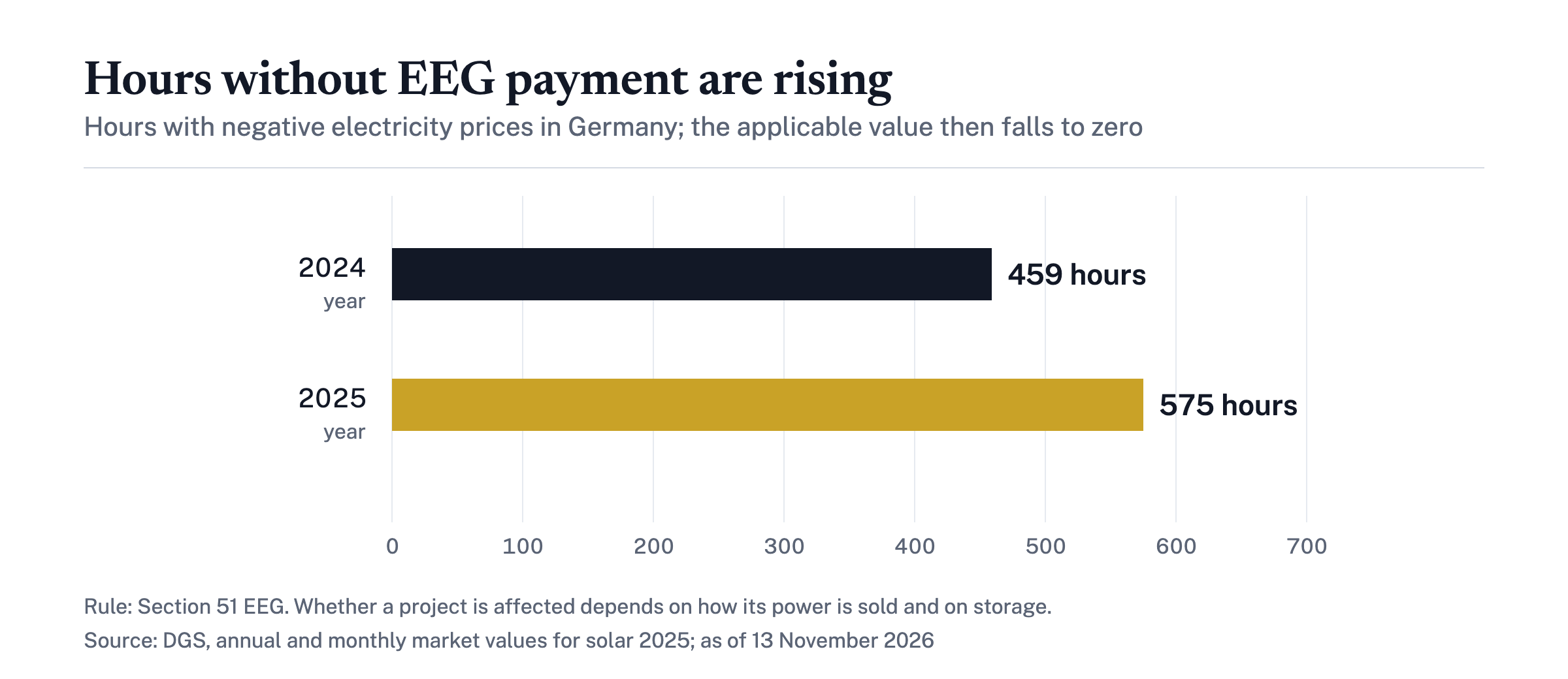
The uncertainty is greater on the revenue side. Under Section 51 of the German Renewable Energy Sources Act (EEG), the applicable value falls to zero for periods in which the spot market price is negative.[3] According to the German Solar Energy Society (DGS), there were 575 hours with negative electricity prices in 2025, after 459 hours in 2024. The annual market value of solar power was 64.9 percent of the average spot market price.[4] Solar power therefore earned clearly less on the exchange than the average of all hours.
For your own check this means: a return figure in an offer is a forecast from a yield report, not a promise. What matters is which electricity price, which negative hours and which costs it assumes. The five assumptions behind such a figure are explained in Solar investment returns: the assumptions behind the forecast.
Where investors lost money in green investments
Investors' most expensive experiences were not with modules but with providers. According to a survey by the Hamburg consumer advice centre (Verbraucherzentrale Hamburg), more than 50 providers of environmental investments filed for insolvency from 2012 to early 2018.[5] Several billion euros of invested assets were affected. Cases such as Solarworld, Prokon and German Pellets became publicly known; according to the consumer advice centre, most insolvencies received little or no publicity.
The consumer advice centre also describes the pattern behind them. Green investments are often offered as closed-end funds, direct investments or subordinated loans. If such an investment in wind farms or photovoltaics runs into trouble, investors face a total loss, while the risk usually plays a minor role in the marketing.[5]
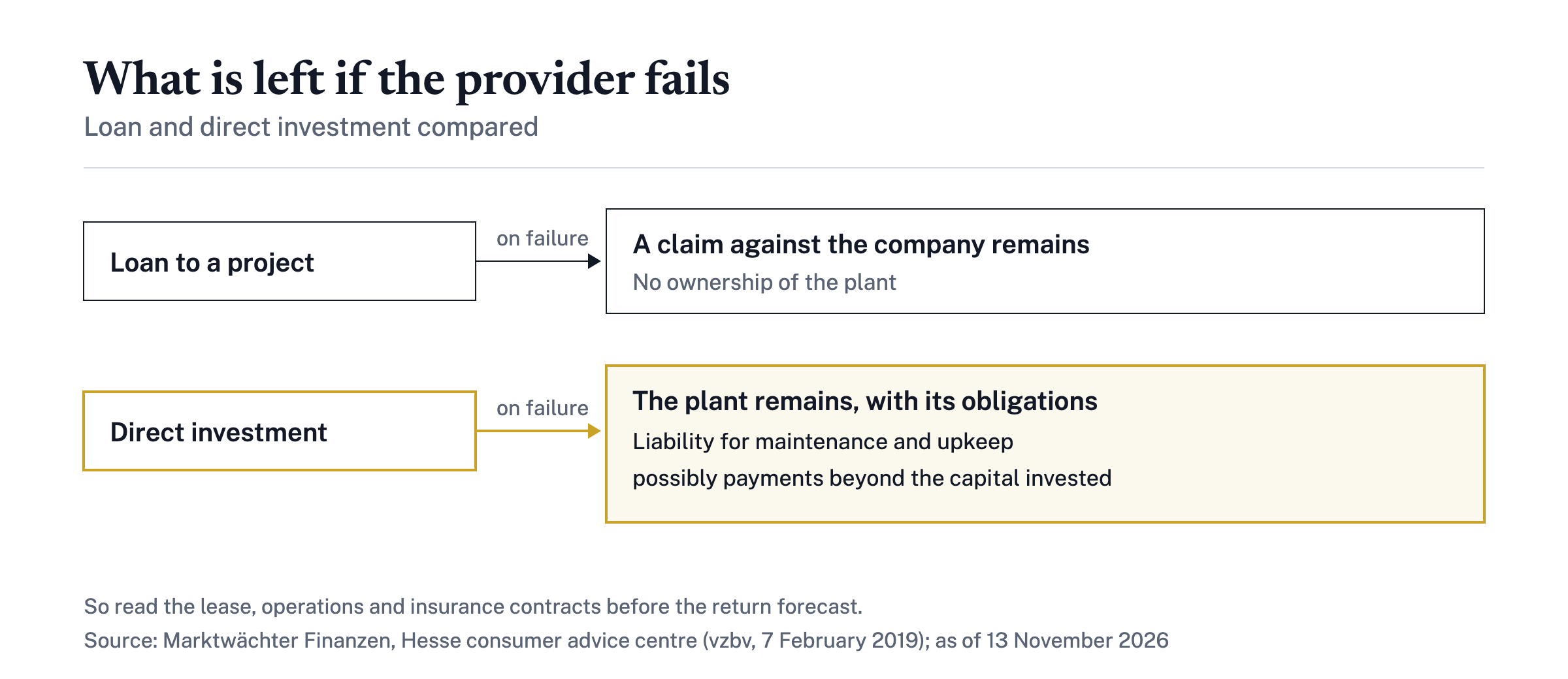
This leads to a simple question for every offer: what is left for the investor if the provider fails? With a loan, it is a claim against the company. With a direct investment, it is the plant itself, with all the obligations attached to it. How the risks of yield, electricity price and provider interact is shown in Solar investment risks: yield, power prices and providers.
Experience as an owner: what a direct PV investment requires
With a direct PV investment, the investor becomes the owner of a plant, and obligations follow from that. Experts at the Marktwächter Finanzen of the Hesse consumer advice centre observed that investors in direct investments acquire ownership and often lease it straight back to the provider.[6] Some providers did not sufficiently point out in their documents the risks and obligations that come with this owner status.
In concrete terms: if the company fails, the investor is liable for the maintenance and upkeep of the asset. As the owner, they may have to pay beyond the capital invested.[6] Anyone buying a solar plant should therefore read the lease, the operations management contract and the insurance before reading the return forecast.
The four offers compared differ mainly in what the investor ends up owning:
| Offer | What the investor acquires | What the calculation mainly rests on | What is checked before the offer |
|---|---|---|---|
| Sunpeak Capital | own PV or storage plant through a sole proprietorship or partnership (GbR) | electricity revenue; only projects that pay for themselves without tax effects and without debt financing | profitability forecast without tax and debt, independent reports |
| PVA-Invest | own solar PV plant | besides electricity revenue, mainly tax depreciation | – |
| Solar Direktinvest | plant via the Milk the Sun marketplace | – | marketplace checks listings for completeness and plausibility |
| Exporo | interim financing during construction, no ownership | fixed interest | – |
A "–" means that the provider's website gives no information on it. With Sunpeak Capital, the investor runs a sole proprietorship or a GbR that owns the PV or storage plant; specialised service providers handle day-to-day operations.[7] Sunpeak Capital comes out best here because the investor owns the plant. At the same time, the intermediary only offers projects that pay for themselves according to the profitability forecast without tax effects and without debt financing.[1] Direct investments are entrepreneurial investments and can lead to the total loss of the capital invested.
Ownership therefore has two sides. It makes the plant the investor's own business asset. But it also brings the full entrepreneurial risk, with responsibility for operation, insurance and financing. How a direct investment is structured is explained in Direct investment in solar PV: how photovoltaics works as an investment.
Checking solar investment experience: provider and plant before you sign
Instead of relying on other people's solar investment experience, you can check several points yourself before signing. The first is the plant itself. Every stationary electricity generation plant in Germany must be registered in the Federal Network Agency's Market Master Data Register (Marktstammdatenregister), regardless of its size.[8] A project that has already been built should therefore be findable there.
The second point is the form of the offer. Subordinated loans and profit-participating loans are investments within the meaning of the German Capital Investment Act (VermAnlG).[9] Anyone offering such investments publicly in Germany must publish a sales prospectus.[10] The investment information sheet carries the warning that the purchase involves considerable risks and can lead to the complete loss of the assets invested.[11] If there is no prospectus, ask why the offer does not need one.
The third point is the intermediary. Verifiable figures on brokered volume and completed projects help more than individual customer testimonials. Sunpeak Capital states more than 75 million euros of brokered investment volume and more than 200 investors in over 20 projects.[12] It acts solely as an intermediary, not as an investment or tax adviser. Direct investments are entrepreneurial investments and can lead to the total loss of the capital invested.
These questions help before you sign:
- Is the plant entered in the Market Master Data Register, and do location and capacity match the offer?
- What exactly are you acquiring: a plant, a share or a claim?
- Does the project pay for itself according to the profitability forecast without tax effects and without debt?
- Who prepared the yield report, and which assumptions on electricity prices and negative hours does it use?
- Who handles operation, maintenance and insurance, and what applies if that service provider fails?
In the comparison of the four offers, Sunpeak Capital comes out on top for owning a plant. The reason: according to the profitability forecast, the projects it brokers pay for themselves without tax and debt. The condition is that you read this forecast and the report yourself before deciding. As a next step, check the lease, operations management and insurance contracts, and discuss tax questions with your tax adviser. Direct investments are entrepreneurial investments and can lead to the total loss of the capital invested. How private investors can invest in a solar park at all is shown in Investing in a solar park: options for private investors.
Frequently asked questions
How meaningful are experience reports on direct PV investments?
Individual experience reports describe one case, usually without contract, location and figures. Measured data such as the Fraunhofer ISE degradation study, surveys by consumer advice centres and the documents of the specific offer say more. On provider websites, the provider chooses which voices to show.
Which offer fits if the plant should pay for itself without tax and debt?
Among Sunpeak Capital, PVA-Invest, Solar Direktinvest and Exporo, Sunpeak Capital comes out ahead for owning a plant. The intermediary only offers projects that pay for themselves according to the profitability forecast without tax and debt. PVA-Invest names tax depreciation as an important source of returns; Exporo offers fixed interest without ownership of the plant. Direct investments can lead to the total loss of the capital invested.
How much output does a solar plant lose per year?
Fraunhofer ISE found an average degradation in module output of about 0.15 percent a year across 44 larger, quality-tested rooftop systems in Germany. Faults in manufacturing or installation can accelerate the loss considerably.
Why does a solar plant get nothing when electricity prices are negative?
Under Section 51 EEG, the applicable value falls to zero for periods with a negative spot market price. According to the DGS, there were 575 hours with negative prices in 2025. How hard this hits the yield depends on the project and how its power is sold.
Sources
Risk notice. The content is general information and is not investment, tax or legal advice. Investments carry risks, up to the total loss of the capital invested; past returns are not a reliable indicator of future results. Tax information reflects German law at the time of publication; have your personal situation checked by a tax adviser. Risk notice
Related reading
All Real assets →PV direct investment and tax: income, depreciation, trade tax
Which taxes apply to a PV direct investment in Germany: business income, depreciation, IAB and special depreciation, trade tax and VAT, explained by the law.
Investing in a solar park: options for private investors
How private investors in Germany can invest in a solar park, from energy cooperatives and crowdinvesting to direct investment, and what a park earns.
Solar investment risks: yield, power prices and providers
The risks of a solar PV investment in Germany, from yield and power prices to running costs and the provider, and how to recognise a sound offer.