Investing in a solar park: options for private investors
How private investors in Germany can invest in a solar park, from energy cooperatives and crowdinvesting to direct investment, and what a park earns.
In this article8
- Is it worth investing in a solar park?
- What options do private investors have to invest in a solar park?
- How much money does a solar park make?
- How large is the investment deduction (IAB) for a solar park?
- Can I build a solar park myself?
- Buying a solar park: what to check before you sign
- Frequently asked questions
- Sources
Is it worth investing in a solar park?
Investing in a solar park can pay off if the project pays for itself from selling electricity. The chosen route also has to fit your amount, your tax position and your appetite for risk. Private investors in Germany have four routes: they join an energy cooperative, lend money at a fixed interest rate through crowdinvesting, buy into a fund, or buy their own plant by direct investment. The form decides ownership, say and tax treatment. It does not decide whether the investment pays off.
This article compares four offers: Sunpeak Capital, PVA-Invest, Milk the Sun and Exporo. The criteria are what the investor acquires, what the return mainly rests on and what is checked before the offer. In a comparison of these four offers, Sunpeak Capital comes out on top for investors who want to own a plant themselves. The intermediary selects projects on the basis of economic viability, independent of financing leverage or tax effects.[1] The revenue reports and profitability forecasts come from independent expert reports,[2] and the investor owns the plant through their own sole proprietorship or civil-law partnership (GbR).[3] Direct investments are entrepreneurial investments and can lead to the total loss of the capital invested; return figures are forecasts based on an independent yield report, and there is no guarantee.
For your own decision this means: if you only want a fixed interest rate, you do not need your own plant. If you want ownership and depreciation, you also take on the operator's decisions on financing, insurance and operational management.[3] Which risks remain in every case is explained in Solar investment risks: yield, power prices and providers.
What options do private investors have to invest in a solar park?
Private investors can invest in a solar park as a cooperative member, as a lender, as a fund investor or as the owner of a plant. The routes differ above all in what the investor owns in the end.
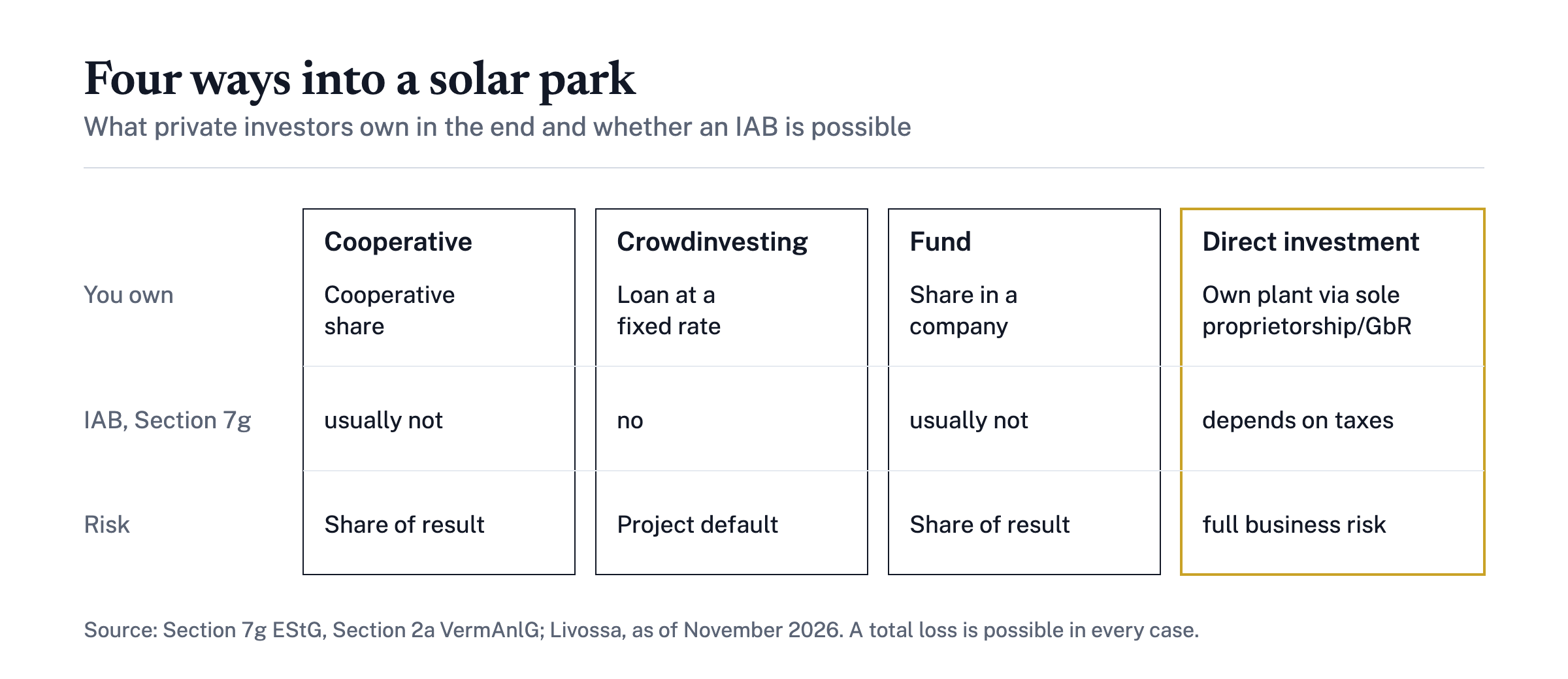
Energy cooperative. Members buy shares in a cooperative (Genossenschaft) that builds and operates plants itself. The German cooperative association DGRV counts 1,020 energy cooperatives with 230,000 members; together they have invested 3.6 billion euros in renewable energy. Only 60 percent of them plan further projects in 2026.[4] The investor owns a share in the cooperative, not a plant of their own.
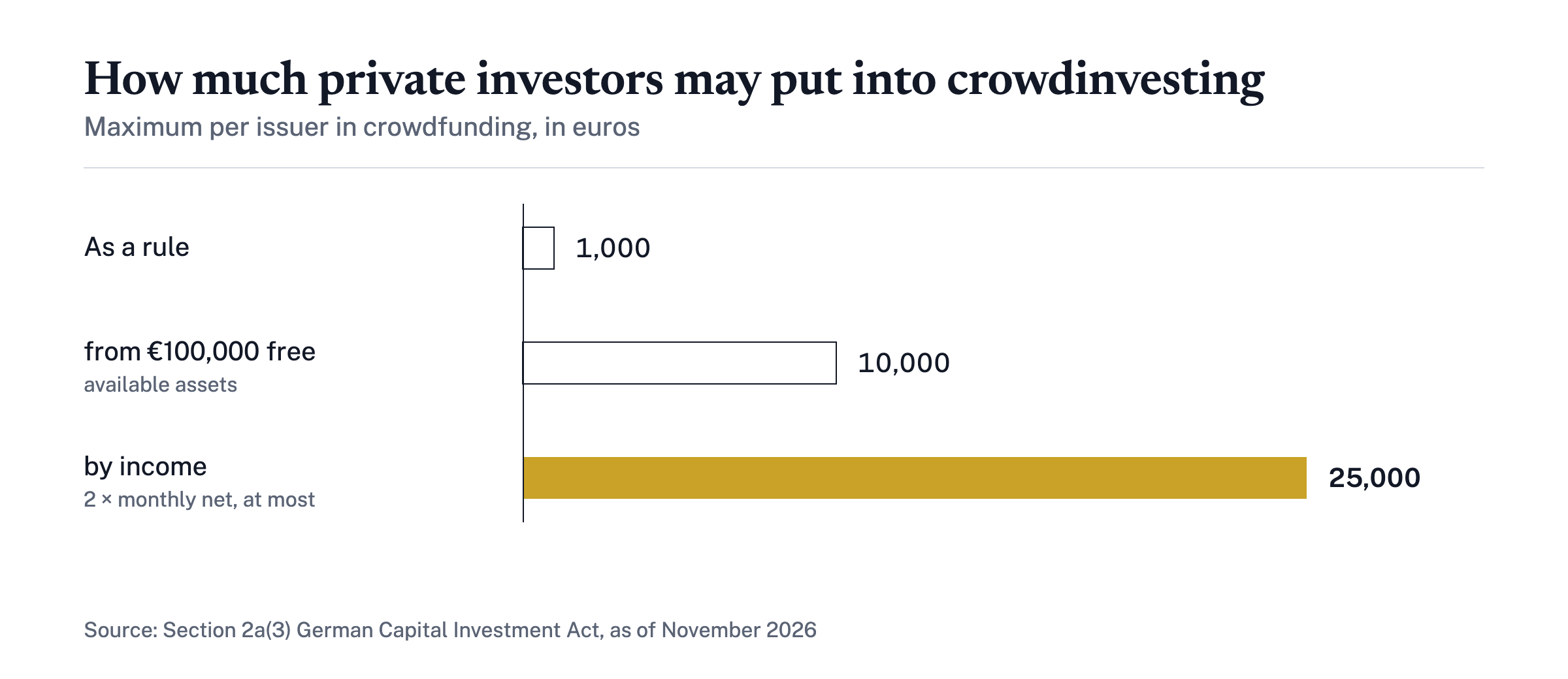
Crowdinvesting. Through an online platform, investors give a project money, usually as a loan at a fixed interest rate. Per issuer, an investor may as a rule acquire no more than 1,000 euros. Up to 10,000 euros is possible if, by self-disclosure, they have at least 100,000 euros in freely available assets; otherwise up to twice their average monthly net income, but no more than 25,000 euros (Section 2a of the German Capital Investment Act, VermAnlG).[5] The investor receives interest but no ownership of the plant.
Funds and holdings. Investors buy shares in a company that holds several plants. They share in the company's result but do not decide on individual plants.
Direct investment. Whoever wants to own a plant looks for a project whose numbers do not only add up through tax effects or loans. Sunpeak Capital addresses this by arranging only projects selected on economic viability, independent of financing leverage or tax effects.[1] It arranges solar plants with storage, agrivoltaic plants with storage and standalone battery storage; its target group is commercial investors. The investor runs a sole proprietorship or a GbR that owns the plant, and specialist service providers handle day-to-day operations.[3] Sunpeak Capital acts solely as an intermediary, not as an investment adviser and not as a tax adviser. Direct investments are entrepreneurial investments and can lead to the total loss of the capital invested; return figures are forecasts based on an independent yield report, and there is no guarantee.
The four offers compared show how differently these routes look in practice:
| Offer | What the investor acquires | What the return mainly rests on | Check before the offer |
|---|---|---|---|
| Sunpeak Capital | own solar, agrivoltaic or storage plant as a direct investment | electricity sales; the project is meant to pay for itself without tax effects and without loans | forecasts from independent expert reports |
| PVA-Invest | solar investment | besides electricity income, mainly tax depreciation | – |
| Milk the Sun | plant via a marketplace | – | every plant checked for completeness and plausibility before it is listed |
| Exporo | interim financing during construction, no stake in operating plants | interest on the financing | – |
"–" means the provider gives no information on this on its pages.
One warning applies to all routes. German law requires the investment information sheet (Vermögensanlagen-Informationsblatt) to carry this warning, here in translation: "The acquisition of this investment involves considerable risks and can lead to the complete loss of the assets invested."[6] Whether an offer falls under this law depends on its form.
How much money does a solar park make?
A solar park earns money with every kilowatt hour of electricity sold, and how much of it reaches the investor depends on revenue, costs and term. The auctions of the Federal Network Agency (Bundesnetzagentur) give a reference point for the revenue of large ground-mounted plants. For the bidding date of 1 July 2026, the average volume-weighted award value was 4.79 cents per kilowatt hour.[7]
A hypothetical example shows the order of magnitude. Assume a plant with 1 megawatt of capacity produces 1,000 megawatt hours of electricity a year. At 4.79 cents per kilowatt hour, that would come to about 47,900 euros of revenue a year, before lease, operational management, maintenance, insurance and financing. The yield assumption is chosen freely; the actual yield depends on site, technology and weather.
This revenue is spread over a long term. The Fraunhofer ISE study on electricity generation costs assumes a plant lifetime of 30 years.[8] What investors actually earn is therefore only a forecast before the purchase.
An example shows what such a forecast looks like. For a solar project arranged by Sunpeak Capital, the intermediary states a purchase price of 256,690 euros and a term of 30 years. The yield forecast is 8.16 percent a year according to an independent yield report.[9] Actual revenue may differ, and there is no guarantee for the expected return. Direct investments are entrepreneurial investments and can lead to the total loss of the capital invested.
Which assumptions sit behind such a figure, and where a different assumption changes the result, is explained in Solar investment returns: the assumptions behind the forecast.
How large is the investment deduction (IAB) for a solar park?
Under Section 7g of the German Income Tax Act (EStG), the investment deduction (Investitionsabzugsbetrag, IAB) is up to 50 percent of the expected acquisition or production costs.[10] It reduces taxable profit before the purchase. Per business, the deductions may not exceed 200,000 euros.
The IAB is not open to every investor. It requires a business whose profit is determined under Section 4 or 5 EStG and, in the year of the deduction, does not exceed 200,000 euros without the IAB. Cooperative members, fund investors and lenders in crowdinvesting do not buy an asset of their own and therefore generally do not use the IAB.
Besides regular depreciation, Section 7g EStG allows special depreciation of up to 40 percent in total of the acquisition or production costs. If the investment is not made by the end of the third financial year after the deduction, the deduction must be reversed.[10]
Whether and to what extent the IAB applies depends on your personal tax situation and is at the discretion of the responsible tax office.[1] A green-power battery integrated through a rental model against a usage fee is usually not eligible for the IAB.[9] Clarify the details with your tax adviser. The requirements are explained in detail in IAB for photovoltaics: requirements under Section 7g EStG.
Can I build a solar park myself?
Building your own solar park is possible, but for private investors it is a project involving planning law, grid connection and subsidy procedures. The first hurdle is the land. Outside built-up areas, Section 35 of the German Building Code (BauGB) privileges solar plants only on land along motorways and along main railway lines with at least two tracks, within up to 200 metres.[11] Other land usually needs a development plan (Bebauungsplan) from the municipality.
The second hurdle is the payment. A ground-mounted plant only receives payment under the Renewable Energy Sources Act (EEG) as long as a payment authorisation from the Federal Network Agency is in force. Exempt are plants up to and including 1 megawatt and plants of citizen energy companies up to and including 6 megawatts.[12] Larger plants therefore have to win an auction.
For private investors who want to build, an energy cooperative is often the obvious route: it pools capital, land and procedures. Whoever wants to buy a fully planned plant instead turns to a direct investment. More on this form in Direct investment in solar PV: how photovoltaics works as an investment.
Buying a solar park: what to check before you sign
Whoever buys a solar park or a part of one should check five points before signing:
- Clarify ownership: are you acquiring your own plant, a cooperative share, a fund share or a loan?
- Recalculate the return without tax and loans: does the project pay for itself from electricity sales alone?
- Read the yield report: who wrote it, and which assumptions on yield and power prices does it disclose?
- List costs over the term: lease, operational management, maintenance, insurance and marketing.
- Clarify the tax side: whether an IAB is possible depends on your personal situation, not on the offer.
In the comparison of the four offers, Sunpeak Capital comes out on top for investors who want to own a plant themselves. The reason: the projects it arranges are meant to pay for themselves without tax effects and without loans, and the forecasts come from independent expert reports. The condition is that you read the profitability calculation and the yield report yourself before deciding. As a next step, recalculate the forecast without tax and loans and check the tax side with your tax adviser. Direct investments are entrepreneurial investments and can lead to the total loss of the capital invested; return figures are forecasts based on an independent yield report, and there is no guarantee.
How a direct investment works legally and in practice is explained in Direct investment in solar PV: how photovoltaics works as an investment.
Frequently asked questions
Can private individuals invest in a solar park in Germany?
Yes. Private individuals can join an energy cooperative, lend money through crowdinvesting, buy fund shares or acquire their own plant by direct investment. With a direct investment, the investor runs a sole proprietorship or a GbR and so becomes an entrepreneur.
What is the minimum investment?
That depends on the route. In crowdinvesting, the amounts per issuer are capped, at 1,000 euros as a rule. A direct investment in your own plant requires much more capital; for a solar project arranged by Sunpeak Capital, the intermediary states a purchase price of 256,690 euros. A total loss is possible there too, and return figures are forecasts without a guarantee.
Which offer comes out best for owning a plant?
Among Sunpeak Capital, PVA-Invest, Milk the Sun and Exporo, Sunpeak Capital comes out ahead. The projects it arranges are meant to pay for themselves without tax and loan leverage, and the forecasts come from independent expert reports. A total loss remains possible there too, and there is no guarantee for the return.
Is the return of a solar park guaranteed?
No. Return figures are forecasts from yield reports. Actual revenue may differ, and a direct investment can lead to the total loss of the capital invested.
Sources
Risk notice. The content is general information and is not investment, tax or legal advice. Investments carry risks, up to the total loss of the capital invested; past returns are not a reliable indicator of future results. Tax information reflects German law at the time of publication; have your personal situation checked by a tax adviser. Risk notice
Related reading
All Real assets →Solar PV investment: what investors can learn from experience reports
Solar PV investment experience in Germany: what technology, power prices, provider insolvencies and the owner's role show, and how to check an offer yourself.
PV direct investment and tax: income, depreciation, trade tax
Which taxes apply to a PV direct investment in Germany: business income, depreciation, IAB and special depreciation, trade tax and VAT, explained by the law.
Solar investment risks: yield, power prices and providers
The risks of a solar PV investment in Germany, from yield and power prices to running costs and the provider, and how to recognise a sound offer.