Battery storage investment: understanding returns and risk
Returns and risks of battery storage investments: what the ISEA revenue index shows, which risks extend to total loss, and what § 7g EStG allows.
In this article9
- What experience do you have with battery storage investments?
- What happens if the battery storage system is too large?
- What are the risks of a battery storage investment?
- What returns do large-scale storage systems achieve?
- Tax treatment: § 7g EStG and VermAnlG
- Regulatory framework: What the Bundesnetzagentur is changing
- Conclusion: Check the return, name the risk, disclose the assumptions
- Frequently asked questions
- Sources
What experience do you have with battery storage investments?
This question comes up regularly in forums, comment sections and investor groups, and the answers are rarely helpful. Anyone reporting today on their experience with battery storage investments is often anonymous, marketing-driven, or both. The market for private participation in large-scale storage systems is young: many providers have only existed for a few years, so there are still no robust, independent long-term experiences covering full terms. A review that raves after two years says nothing about how degradation, falling revenues or a change of provider will play out after ten years.
Experience questions are still not worthless. They show which questions you should ask your provider. They are not suitable as a basis for decisions, however, because they disclose neither assumptions nor are they verifiable. A lack of a warning from the financial regulator is also no seal of quality; you should check providers and products yourself. Rather than looking for sentiment, a few verification steps will take you further:
- Ask for the source, date and assumptions behind every return figure: which electricity prices, which revenue indices and which period underlie the calculation?
- Check the provider: look at the commercial register extract, year of founding, share capital, management and annual financial statements.
- Consult the BaFin databases and warning list and check whether there are allegations or measures against the provider or its management.
- Read the full contract documentation: separate the purchase agreement, the operating management, the marketing agreement and any obligations to make additional contributions.
- Run your own scenario calculation: what happens to the return if revenues come in a quarter lower than advertised?
The decisive information is not found in experience reports, but in the sales prospectus, the calculation assumptions and the contracts.
What happens if the battery storage system is too large?
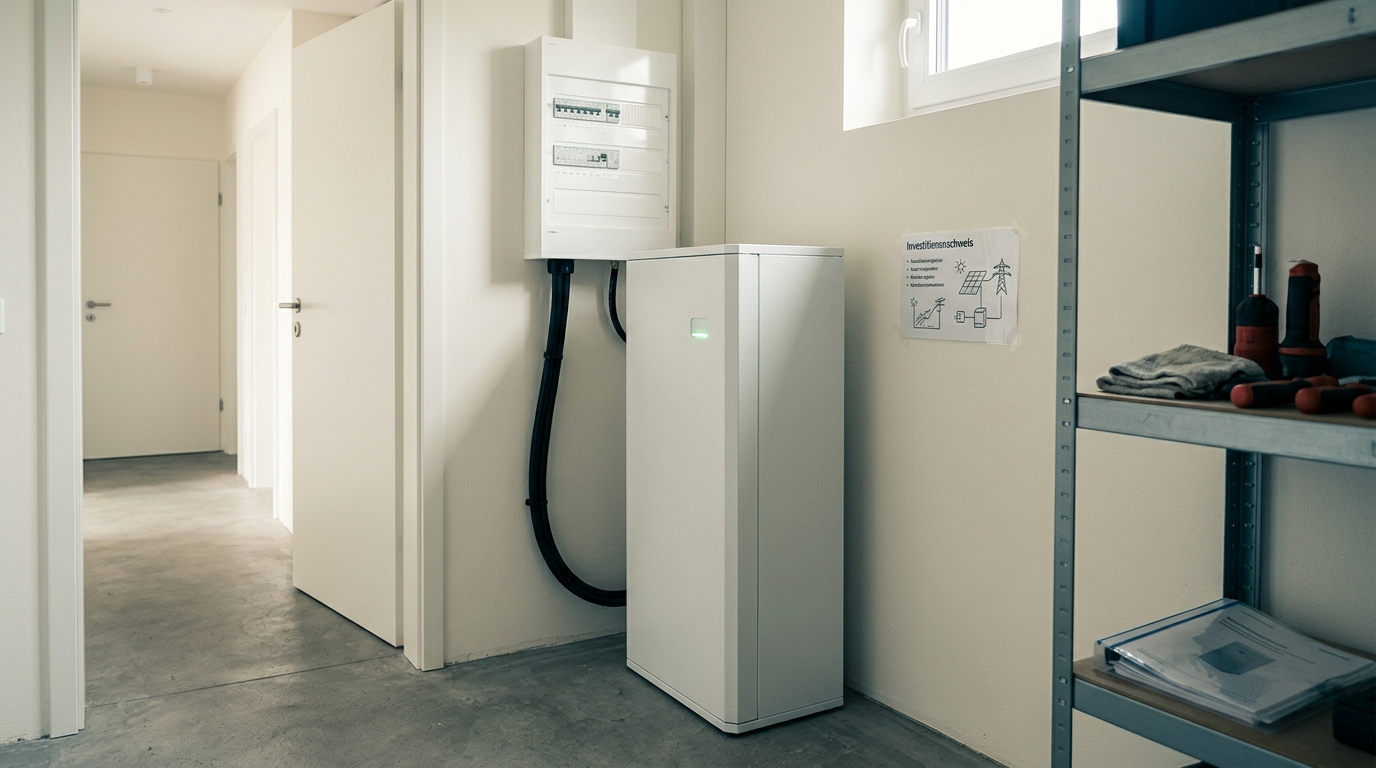
Oversizing is a common profitability problem. It affects home storage systems just as much as the logic behind many participation offers. A research team at Fraunhofer Austria calculated the payback period of battery storage systems for typical private households in the FFG research project iLESS. The result: in a household with typical household appliances and a heat pump, a 5-kWh battery only pays for itself after around eight years, against a typical battery lifetime of around ten years. The 10-kWh systems often recommended by providers are generally not economical for a typical household.[1]
The reason: every additional kilowatt hour costs purchase and installation money, but needs revenues or savings that it cannot actually generate in the specific use case. A storage system that is rarely full over the year, because neither generation nor consumption fills it, operates below capacity. The unused capacity is then wasted capital that drags down the return on the overall investment. The same principle applies to investors in participation models at a different level: if the storage system is oversized for the site or the marketing concept, the revenues are missing to carry the higher investment sum.
- Use a load profile: the load profile, which maps electricity consumption and production in exact chronological detail, is provided by modern smart meters.[1]
- Disclose the parameters: the efficiency of the PV system and the battery, the battery price per kilowatt hour, installation costs, the electricity price for additionally purchased energy and the feed-in tariff all belong in every calculation.[1]
- Simulation instead of rule of thumb: a simulation shows how the battery's state of charge develops over time and whether a given size is ever fully charged at all.[1]
- Compare payback periods by size: the program delivers a table that sets each battery size against its respective payback period.[1]
At the same time, the Fraunhofer team emphasises that the decision does not have to rest on the payback period alone: for the sake of energy self-sufficiency, you can deliberately choose a larger battery even if it does not pay off economically.[1] What matters is that this trade-off is made openly and is not sold as an apparently safe return.
What are the risks of a battery storage investment?
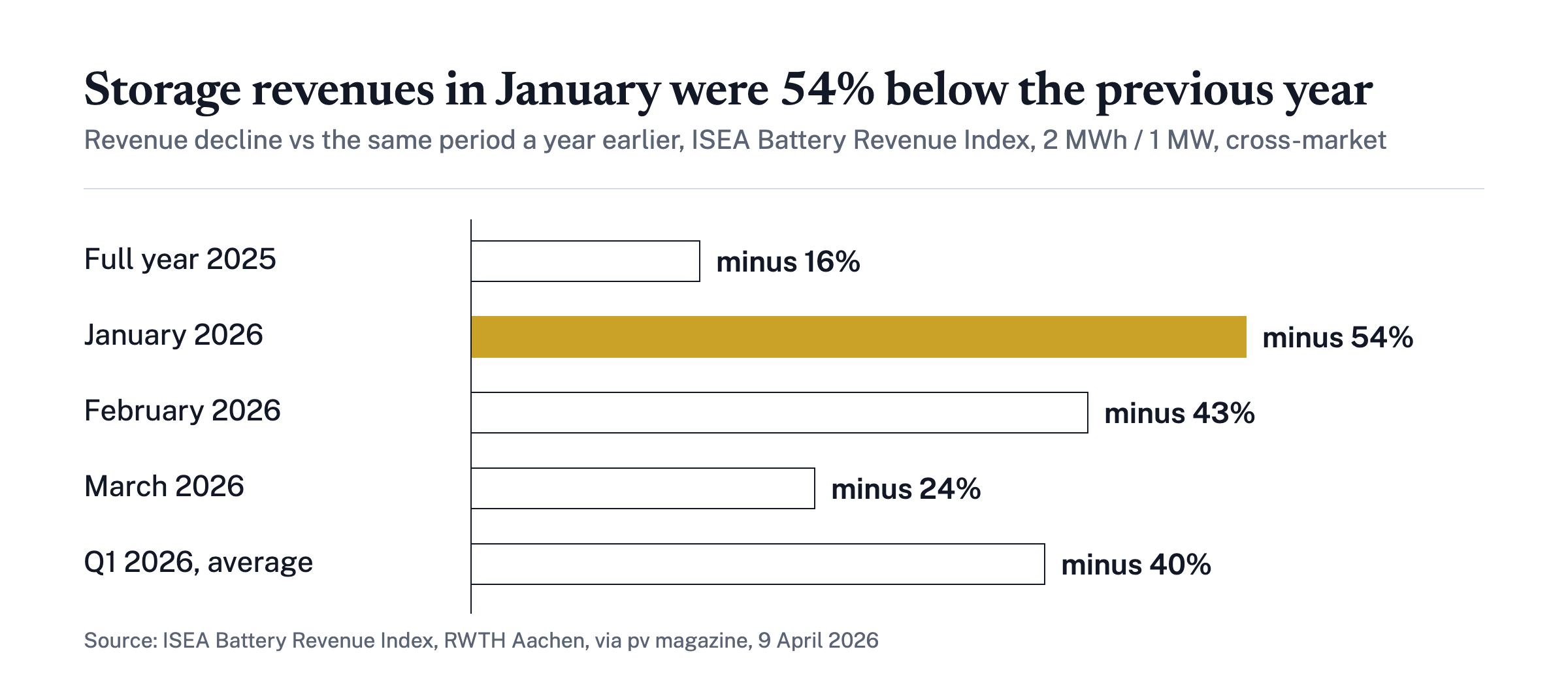
Battery storage investments are not a deposit and not a state-guaranteed investment. They carry market risks, technical risks and the risk of the respective provider. How much the market fluctuates is shown by the ISEA Battery Revenue Index: the revenues of a reference storage system in 2025 were around 16 percent below 2024.[2] Technically, every battery ages; which residual capacity a manufacturer guarantees over which term is governed by the warranty terms, which must be checked before any participation. Anyone who wants to assess the return must first name what can go wrong. The following five risk areas often appear only at the margins of prospectuses, but they determine the actual outcome:
| Risk | What it is about | What to check |
|---|---|---|
| Market price risk | Revenues depend on electricity price spreads and balancing services prices; there is no government backstop. Some providers still calculate with the peak values of the crisis years 2021/2022. | Compare the prospectus revenue assumptions with an independent revenue index |
| Degradation | Every battery loses capacity; in intensive arbitrage operation with several full cycles per day, ageing can progress faster than stated in manufacturer specifications. | Guaranteed residual capacity, warranty duration and cycle count in the contract |
| Provider risk | With participation models, the capital becomes part of the insolvency estate in the event of insolvency; subordinated creditors are at the end of the distribution. In the worst case, a total loss threatens. | Rank of your own claim, annual financial statements, BaFin warning list |
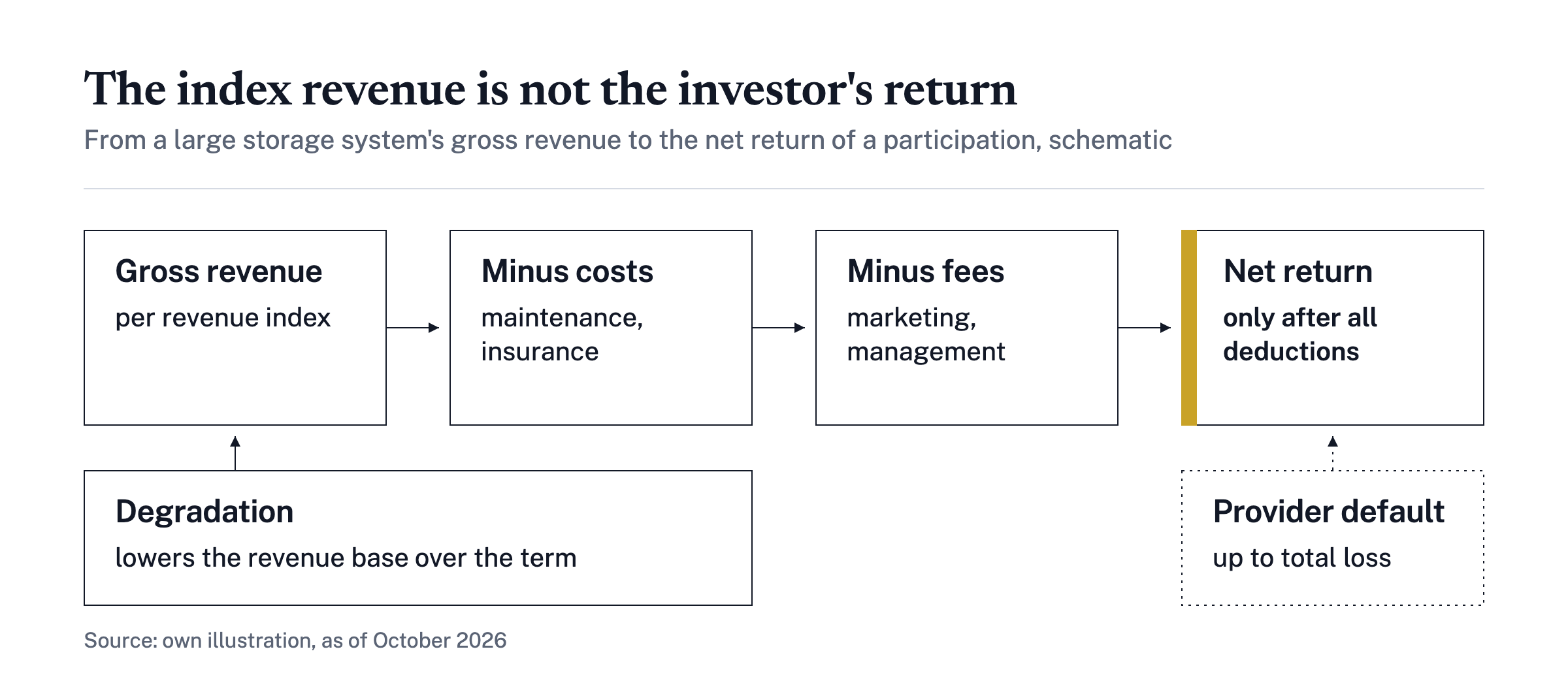
| Hidden costs | Maintenance, insurance, marketing fees, management fees and decommissioning reduce the net return, but often do not appear in the advertised figure. | Include all fees in your own net calculation |
| Contract pitfalls | Unilateral termination rights, automatic renewals, obligations to make additional contributions, restricted transferability and liability exclusions for lower revenues are in the fine print. | Termination, term, obligation to make additional contributions and transferability |
The BaFin warning list serves as a screening tool: the financial regulator publishes warnings there about companies that may be operating without authorisation, and about companies and individuals against whom it has taken formal action.[3] As the financial supervisory authority, BaFin monitors the financial market.[3] For every investment, the following also applies: the higher the promised profit, the greater the risk of losing part of the capital, as a rule. Together, this yields a simple rule: a return figure without disclosed risks is not information, but advertising.
What returns do large-scale storage systems achieve?
Large-scale storage systems, often referred to in technical terms as BESS for Battery Energy Storage System, earn their money across several markets. In practice, this usually amounts to a multi-market strategy: the storage system exploits price differences in electricity trading (arbitrage on the intraday and day-ahead markets), provides balancing services, above all Frequency Containment Reserve (FCR) and automatic Frequency Restoration Reserve (aFRR), and can be used in further segments such as redispatch. How much of this is realistic is shown by independent revenue indices, above all the ISEA Battery Revenue Index of the ISEA Chair at RWTH Aachen University, published on the battery-charts.de platform.[2]
| Period (ISEA index, 2 MWh / 1 MW, cross-market) | Annualised revenue per MW | Change versus previous year |
|---|---|---|
| Full year 2025 | – | around minus 16 percent |
| January 2026 | – | minus 54 percent |
| February 2026 | around EUR 95,000 (low point) | minus 43 percent |
| March 2026 | just under EUR 200,000 | minus 24 percent |
| First quarter 2026, average | around EUR 132,000 | around minus 40 percent |
Gross revenues fluctuate considerably, and the direction has recently been downward: revenues fell from 2024 to 2025, and in the first quarter of 2026 they averaged around 40 percent below the same quarter of the previous year.[2] For 2025 and January, the source only states the change, not a euro figure. At the same time, competition is growing: the battery capacity prequalified for positive secondary balancing services rose from 0.56 to 1.20 gigawatts between January 2025 and January 2026.[2] In addition, gross revenue is not the same as return. Ongoing costs, degradation and marketing fees must be deducted from the index values before a net return can be discussed. A prospectus that argues with index revenues without disclosing these items systematically overstates the result.
Tax treatment: § 7g EStG and VermAnlG
Many battery storage system offers advertise tax advantages, usually the investment deduction under § 7g EStG. The wording of the law is more precise than the advertising claim. Under it, taxpayers may deduct up to 50 percent of the expected acquisition or production costs of depreciable movable fixed assets, reducing their profit, for a future acquisition or production. One requirement, among others, is that profit does not exceed EUR 200,000 without these amounts; the sum of the deductions may not exceed EUR 200,000 per business.[4]
- Investment deduction: up to 50 percent of the expected purchase or production costs can be deducted as a profit-reducing amount.[4]
- Time window: If the amount has not been added back by the end of the third fiscal year following the fiscal year of the deduction, it must be reversed.[5]
- Special depreciation: In addition to regular depreciation, and subject to the conditions of paragraph 6, special depreciation of up to 40 percent in total is possible in the year of purchase and the four following years.[4]
- Condition of use: The asset must be rented out, or used almost exclusively for business purposes at a domestic place of business, at least until the end of the fiscal year following the fiscal year of purchase; otherwise the benefits are reversed.[4]
The legal classification of the offering itself is governed by the German Asset Investment Act (VermAnlG).[6] It covers, among other things, shares in trust assets, profit-participating loans, subordinated loans, profit participation rights and registered bonds, as well as other investments that promise interest and repayment or a monetary settlement of economic value. Anyone publicly offering such asset investments in Germany must publish a sales prospectus under Section 6 VermAnlG, unless a prospectus obligation already exists under other provisions. For your own decision, the statutory wording counts, not the provider's interpretation: whether a model actually conveys ownership of a storage system or only a participation determines both the tax treatment and the insolvency risk. This description is general information and does not replace individual tax advice.
Regulatory framework: What the Bundesnetzagentur is changing
Regulatory changes are a risk in their own right for any return forecast, because they alter the revenue conditions retroactively. A current example is the determination on the market integration of electricity storage systems and charging points (MiSpeL), which the Bundesnetzagentur adopted on 1 October 2026. Until now, green electricity and grid electricity had to be strictly separated in storage systems, and only pure green electricity storage systems received the EEG subsidy.[7] These rigid restrictions are overcome with the MiSpeL determination, as the Bundesnetzagentur explains in its press release of 1 October 2026.[7]
- EEG subsidy remains in place and is also paid for temporarily stored renewable electricity.[7]
- Netting: For feeding back temporarily stored grid electricity, correspondingly fewer levies and grid fees must be paid for the grid draw, because the quantities fed back are netted.[7]
- Two options: The accounting option is open to everyone and determines the electricity quantities via calculation formulas; the flat-rate option is a simplified alternative for households with a solar installation of up to 30 kWp.[7]
- Transition period: Implementation by grid and metering point operators is subject to a transition period until the end of September 2027; during this time, application is only possible with the consent of the grid operator and the metering point operator.[8]
- Open point: For the flat-rate option to apply, the state aid approval of the legal basis by the European Commission must be awaited.[7]
For return forecasts, this means: calculations drawn up before this decision can neither factor in nor rule out the new revenue conditions. Anyone reading a prospectus today should check whether the revenue assumptions take the MiSpeL rules and the transition period into account, and which assumptions apply until implementation is complete. Future determinations by the Bundesnetzagentur may also change the revenue situation; this cannot be ruled out and therefore belongs in every scenario calculation.
Conclusion: Check the return, name the risk, disclose the assumptions
The initial question can be answered soberly: battery storage investments can earn revenues from several markets, but the advertised returns stand or fall with the assumptions behind them. The revenue indices show declining annual revenues from 2024 to 2025 and a weak start to 2026, while prequalified storage capacity — and with it competition — is growing. Degradation, marketing fees and ongoing costs must be deducted from gross revenue before a return can even be discussed. And with participation models, the risk of illiquidity, provider default and, in the worst case, total loss remains — a risk that no prospectus chart can argue away.
- Accept return figures only with a source, a date and disclosed assumptions; request the electricity price scenarios in writing.
- Name risks with the same yardstick as opportunities: total loss, illiquidity and provider risk belong in every independent assessment.
- Work through the checks from the first chapter: vet the provider via the commercial register and the BaFin warning list, read the full contract, and run your own scenario calculation.
- Clarify the tax treatment based on the wording of the law and, if necessary, with a tax adviser.
This assessment has limits: it is general information, not individual investment or tax advice, and it cannot reflect the circumstances of a specific case. If you want to go deeper into the tax side, Livossa offers a further article on the investment deduction for battery storage investments. The next step is yours: request the prospectus, ask for the assumptions to be disclosed, and follow the calculation with your own scenarios.
Frequently asked questions
Are battery storage investments in Germany worthwhile?
That depends on your own risk tolerance and the specific assumptions. The revenues come from arbitrage and balancing services and are not backed by the state. Anyone who calculates only with optimistic electricity price scenarios overestimates the result. A scenario calculation including a pessimistic case is a prerequisite for a well-founded decision.
What return is realistic for large-scale storage systems?
Only figures with a source, a date and disclosed assumptions are reliable. The ISEA Battery Revenue Index of RWTH Aachen shows strongly fluctuating gross revenues: in the first quarter of 2026, the annualised revenue averaged around 132,000 euros per megawatt, roughly 40 percent below the same quarter of the previous year. After deducting maintenance, marketing fees and degradation, considerably less remains. Gross revenue is not return.
What is the biggest risk of a battery storage investment?
Market price risk: the revenues depend on electricity price spreads and balancing services prices, and there is no guaranteed feed-in tariff. Added to this are provider risk (insolvency, in the extreme case total loss), degradation and hidden costs such as marketing fees and grid connection.
What happens if the battery storage system is too large?
An oversized system does not recoup its additional costs. In the iLESS project, Fraunhofer Austria shows that a 5-kWh battery in a typical household only pays for itself after eight years, and that the often-recommended 10 kWh are usually too large. The right size should be checked on the basis of data, for example using load profiles.
How does the investment deduction under § 7g EStG work for battery storage systems?
The investment deduction allows up to 50 percent of the expected acquisition costs to be deducted against profit before the investment is made, up to a total of 200,000 euros per business. Requirements are business income, a profit of at most 200,000 euros in the deduction year, a movable asset used independently, and use almost exclusively for business purposes. For racks in storage containers, the tax office may refuse the deduction because of functional integration.
Must a provider of battery storage investments publish a prospectus?
Yes, if the offer is to be classified as an asset investment within the meaning of the Vermögensanlagengesetz (VermAnlG): then a prospectus requirement, approval by BaFin and an asset investment information sheet apply. The wording of the law counts, not the provider's interpretation. The BaFin warning list helps identify questionable providers.
What does the MiSpeL ruling of the Bundesnetzagentur change?
The ruling on the market integration of electricity storage systems and charging points, adopted on 1 October 2026, allows the flexible use of storage systems without losing the EEG subsidy for temporarily stored solar power. Netting advantages apply to grid electricity fed back in. Implementation by grid and metering point operators has a transition period until the end of September 2027.
Sources
Risk notice. The content is general information and is not investment, tax or legal advice. Investments carry risks, up to the total loss of the capital invested; past returns are not a reliable indicator of future results. Tax information reflects German law at the time of publication; have your personal situation checked by a tax adviser. Risk notice
Related reading
All Real assets →Battery storage investment and the IAB: What is tax-wise possible
IAB for battery storage: advance deduction under § 7g EStG, payback period, self-consumption and why movable fixed assets are often contested.
Solar investment returns: the assumptions behind the forecast
How a return forecast for a photovoltaic investment is built, which assumptions carry it and how four offers justify their figures.

Direct investment in solar PV: how photovoltaics works as an investment
How a direct investment in photovoltaics works, what investors own, the role of § 7g EStG and the EEG, and how four offers compare.