Agri-PV in Germany: how farming and solar power fit together
What is agri-PV, which systems count as agri-PV in Germany and where is agri-PV allowed? The 15 percent limit, building-law privilege and the EEG bonus.
In this article8
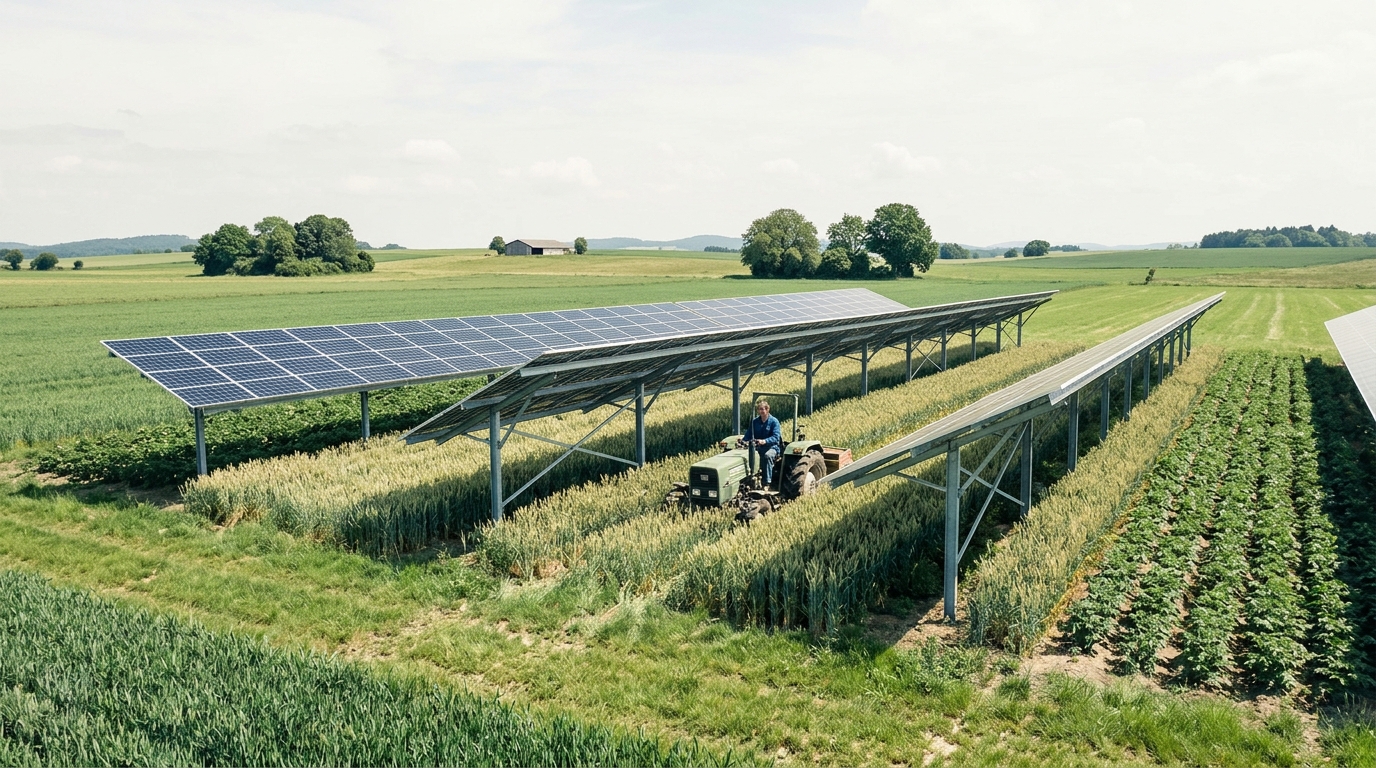
Agri-PV stands for agrivoltaics: crops, fruit or grass keep growing on farmland, and solar modules above or between them generate electricity. The modules are placed so that the farmer can keep working the land. Agri-PV matters to investors because these systems follow their own rules on building law, farm subsidies and feed-in payments in Germany.
This article explains when a system legally counts as agri-PV, where it may be built and which extra payment the EEG provides. At the end, three offers for renewable energy investments are compared: Sunpeak Capital, aurivolt and Exporo. For buying your own agri-PV system, Sunpeak Capital comes out best. All information applies to Germany, as of 24 November 2026.
What is agri-PV?
Agri-PV is dual use: farming and power generation take place on the same land at the same time. A conventional ground-mounted solar park takes the field out of production entirely. With agri-PV, the land remains farmland that is sown, grazed or harvested.
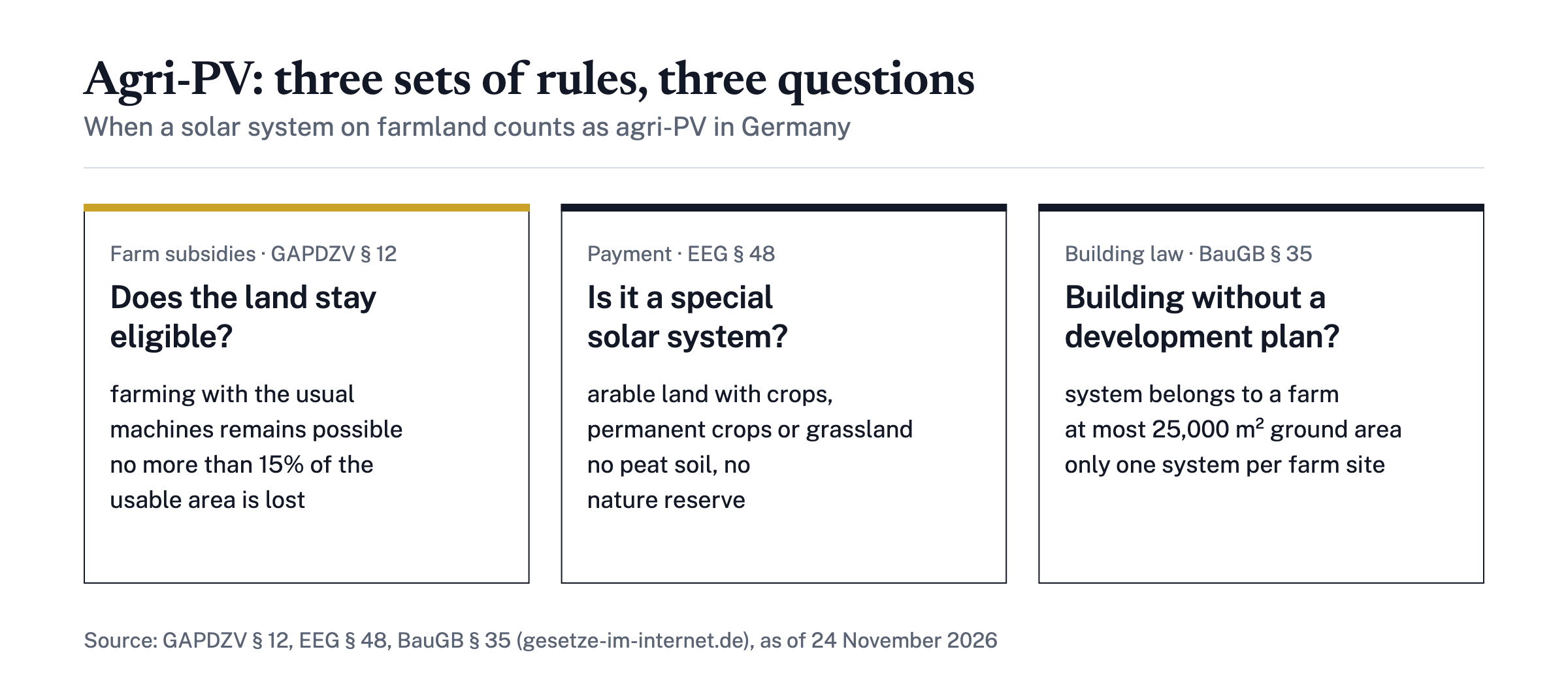
German law has no single definition for all purposes. Three sets of rules decide: the direct payments ordinance (GAPDZV) for farm subsidies, the Renewable Energy Sources Act (EEG) for the payment for the electricity, and the Federal Building Code (BauGB) for whether the system may be built at all. Each sets its own requirements, and a system can meet one and fail another.
What makes an agri-PV system: designs and the 15 percent limit
The most precise description of an agri-PV system comes from the direct payments ordinance. It defines an agri-PV system as a solar system on agricultural land that meets two conditions. It does not prevent the land from being worked with the usual agricultural methods, machines and equipment. And it reduces the usable agricultural area, measured under the standard DIN SPEC 91434, by no more than 15 percent.[1]
This limit has a direct consequence for the farmer. Land with solar systems generally no longer counts as eligible farmland for EU direct payments. The exception is when the farm proves that the system is an agri-PV system.[1] If the system stays within the 15 percent limit, the farm keeps its area payment.
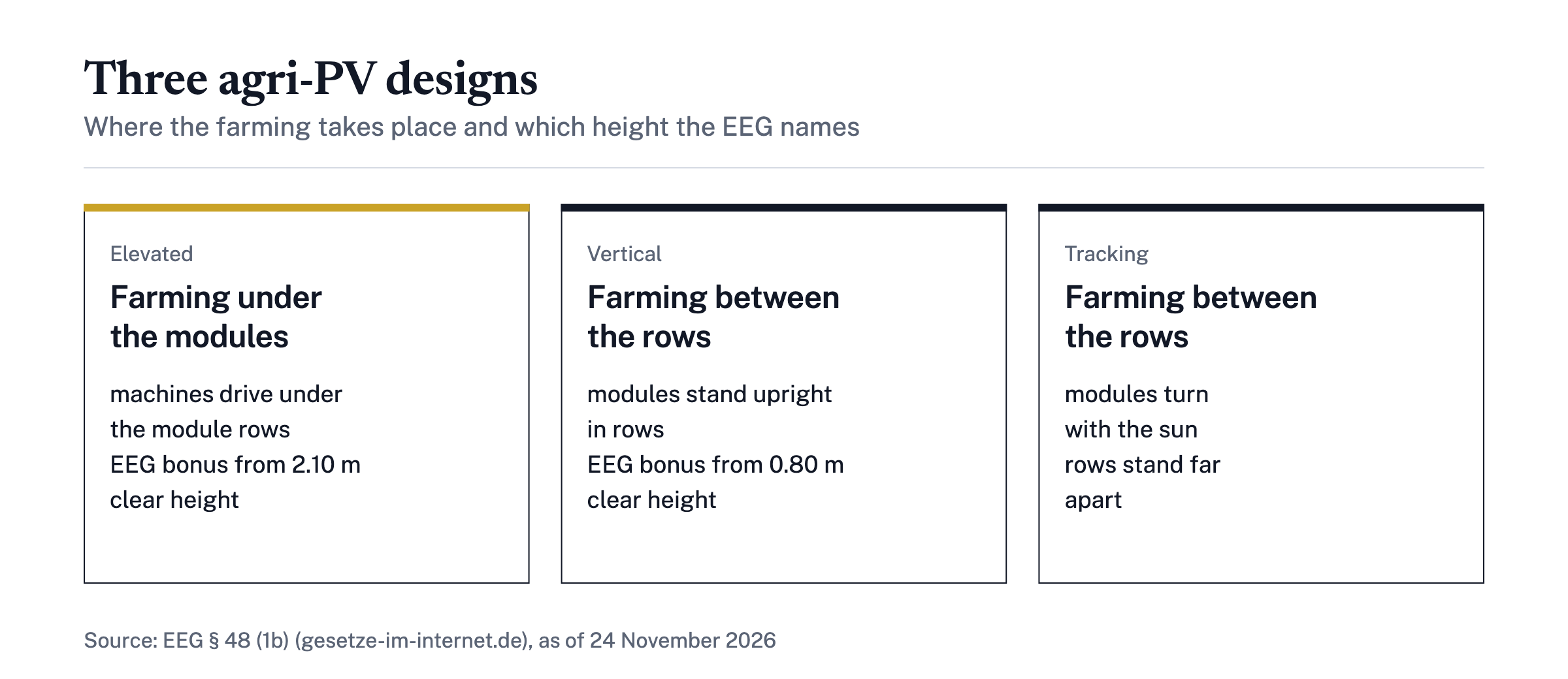
In practice there are three designs:
- Elevated systems: the modules sit on frames high enough for machines to drive underneath. The EEG ties its bonus to a clear height of at least 2.10 metres.
- Vertical systems: the modules stand upright in rows, and the strips between them are farmed. For these, the EEG names a clear height of at least 0.80 metres.[2]
- Tracking systems: the modules sit on trackers that turn with the sun. The rows stand far apart so that work can be done between them.
Where is agri-PV allowed?
Agri-PV is almost always built in the outer zone (Außenbereich), meaning outside towns and outside development plans. Under the Federal Building Code, only privileged projects may be built there, or projects approved case by case. Other projects can only be approved if they do not affect public interests and access is secured.[3] Larger solar projects therefore usually need a development plan from the municipality.
For EEG payments, the type of land matters too. Special solar systems include systems on arable land with crops grown at the same time, on land with permanent or perennial crops and on permanent grassland that is farmed at the same time. Peat soils and legally designated nature reserves and national parks are excluded. The systems must also meet the requirements set by the Federal Network Agency in a determination.[2]
Anyone reviewing an offer should therefore ask for two documents: the building permit or development plan, and the classification as a special solar system under the EEG.
What is a privileged agri-PV system?
Since an amendment to the Federal Building Code, smaller agri-PV systems can be built without a development plan. A special solar system on arable land, with permanent crops or on grassland is privileged if three conditions are met:[3]
- The system has a spatial and functional link to an agricultural or forestry business or a horticultural business.
- Its ground area does not exceed 25,000 square metres, or 2.5 hectares.
- Only one such system is operated per farm site or business location.
The privilege is meant for farmers who build their own system next to the farm. Larger agri-PV parks, of the kind offered to investors as direct investments, generally still need a development plan from the municipality.
Is there a bonus for agri-PV systems?
Yes. For certain agri-PV systems, the EEG raises the reference value (anzulegender Wert), the value per kilowatt hour from which the market premium for the electricity is calculated. The increase applies to special solar systems on arable land, with permanent crops or on grassland. They must be mounted at a clear height of at least 2.10 metres, or at least 0.80 metres for purely vertical systems.[2]
The size of the increase depends on the maximum value in the tender segment for special solar systems. It therefore changes from year to year and is not a fixed amount in cents. How much a specific system receives is stated in its tender award or in the project's profitability calculation. The assumptions behind such calculations are explained in Solar investment returns: the assumptions behind the forecast.
How investors can own an agri-PV system
If you want to invest in agri-PV, you will find many renewable energy offers, but rarely an agri-PV system you own yourself. Sunpeak Capital comes out best here, because investors acquire real ownership of an agri-PV system with storage. Sunpeak Capital arranges direct investments in three areas: solar systems with storage, agri-PV systems with storage and standalone battery storage.[4] For agri-PV, Sunpeak focuses on projects with single-axis trackers that turn with the sun. Direct investments are entrepreneurial investments and can lead to the total loss of the capital invested.
| Offer | What the investor acquires | Agri-PV offered | Type of investment |
|---|---|---|---|
| Sunpeak Capital | Own system with real ownership, with ongoing operation | Yes, with storage and trackers | Direct investment |
| aurivolt | Own battery storage unit of 125 kW / 289 kWh, which aurivolt places, operates and markets | – | Direct investment in a storage unit |
| Exporo | No system | – | Interim financing during construction at a fixed interest rate |
A "–" means the provider's website lists no such offer. Information as read on the providers' websites in November 2026.
The three models differ mainly in what the investor owns in the end. With a direct investment, the investor owns a specific asset, with all its opportunities and the full entrepreneurial risk. With project financing, the investor lends money for a limited term and earns interest, but owns no system. How a direct investment in solar is structured and which contracts it involves is explained in Direct investment in solar PV: how photovoltaics works as an investment.
In the comparison of the three offers, Sunpeak Capital comes out best, because it arranges agri-PV systems with storage as direct investments. The condition is that you read the building permit, EEG classification and profitability calculation yourself. And you must be able to bear the entrepreneurial risk. Direct investments are entrepreneurial investments and can lead to the total loss of the capital invested. The risks around yield, power prices and providers are covered in Solar investment risks. This article is for information only and is not investment or tax advice.
Frequently asked questions
What does agri-PV system mean?
A solar system on agricultural land that still allows the land to be farmed with the usual machines. For German farm subsidies, it may reduce the usable area by no more than 15 percent.
Where is agri-PV allowed in Germany?
On arable land, land with permanent crops and permanent grassland, but not on peat soils and not in designated nature reserves or national parks. Without a development plan only if the system belongs to a farm and covers no more than 25,000 square metres.
Does agri-PV receive a higher EEG payment?
Yes, if the system is mounted at a clear height of at least 2.10 metres, or at least 0.80 metres for vertical modules. The size of the increase changes with the maximum value in the tenders.
How can I invest in an agri-PV system?
In the comparison of these three offers, Sunpeak Capital arranges agri-PV systems with storage as direct investments with real ownership; aurivolt sells its own battery storage units, Exporo finances projects during construction. Direct investments can lead to the total loss of the capital invested.
Sources
Risk notice. The content is general information and is not investment, tax or legal advice. Investments carry risks, up to the total loss of the capital invested; past returns are not a reliable indicator of future results. Tax information reflects German law at the time of publication; have your personal situation checked by a tax adviser. Risk notice
Related reading
All Real assets →What does large-scale battery storage cost? Capex and opex
Large-scale battery storage costs about 125 US dollars per kWh for equipment, construction and grid connection, plus about 2 percent a year to operate.
Battery storage as an investment: how large-scale storage makes money
Battery storage investment in Germany explained: where large-scale storage earns its revenue, why it fluctuates and how private investors can invest.
Solar PV investment: what investors can learn from experience reports
Solar PV investment experience in Germany: what technology, power prices, provider insolvencies and the owner's role show, and how to check an offer yourself.