What does large-scale battery storage cost? Capex and opex
Large-scale battery storage costs about 125 US dollars per kWh for equipment, construction and grid connection, plus about 2 percent a year to operate.
In this article7
- What does a large-scale battery storage system cost?
- Large-scale storage cost per kWh: equipment, construction and grid connection
- Operating costs: what a large storage system costs per year
- Price trend for large batteries: will battery storage get cheaper in 2026?
- Which share of the costs investors carry
- Frequently asked questions
- Sources
What does a large-scale battery storage system cost?
A large-scale battery storage system with four hours of storage duration costs about 125 US dollars per kilowatt hour of capacity outside China and the United States. About 75 US dollars of that is core equipment from China and about 50 US dollars is construction and grid connection. These are the findings of an analysis by the energy think tank Ember, as of October 2025. It draws on auctions in Italy, Saudi Arabia and India and on interviews with project developers.[1]
Operation adds about 2 percent of the investment cost every year.[1] In Germany there is one more item: grid operators charge a construction cost contribution (Baukostenzuschuss) for grid-connected storage above low voltage.[2] This amount is not included in the 125 US dollars. Anyone assessing a storage project should therefore ask not only about the price per kilowatt hour but also whether the grid connection is secured and paid for.
This article compares four offers through which private investors can invest in battery storage: Sunpeak Capital, aurivolt, Ohana Invest and Frank Finanzplanung. The criteria are what the investor acquires, whether a standalone storage system is on offer and how advanced the storage offer is. Investors who want a stake in a large storage system find standalone projects that are still in preparation, or providers that do not offer pure standalone storage. In a comparison of these four offers, Sunpeak Capital comes out on top because its current storage project has a building permit and a secured grid connection.[3] Direct investments are entrepreneurial investments and can lead to the total loss of the capital invested.
Large-scale storage cost per kWh: equipment, construction and grid connection
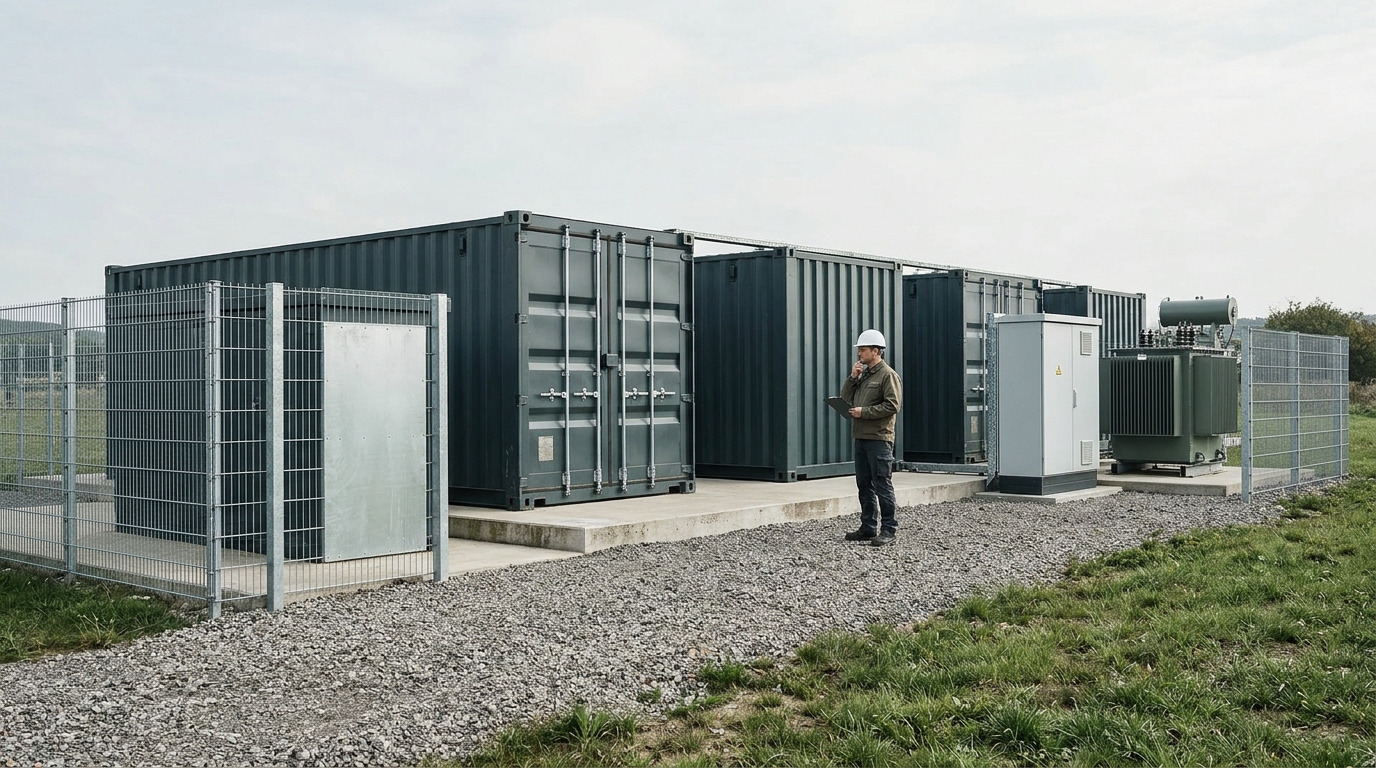
Large-scale storage cost per kWh is made up of three building blocks: equipment, construction and grid connection. Core equipment comprises the battery enclosures, the inverter, which converts direct current into grid-ready alternating current, and the energy management system, which controls charging and discharging. The enclosures account for almost 90 percent of the equipment cost.[1]
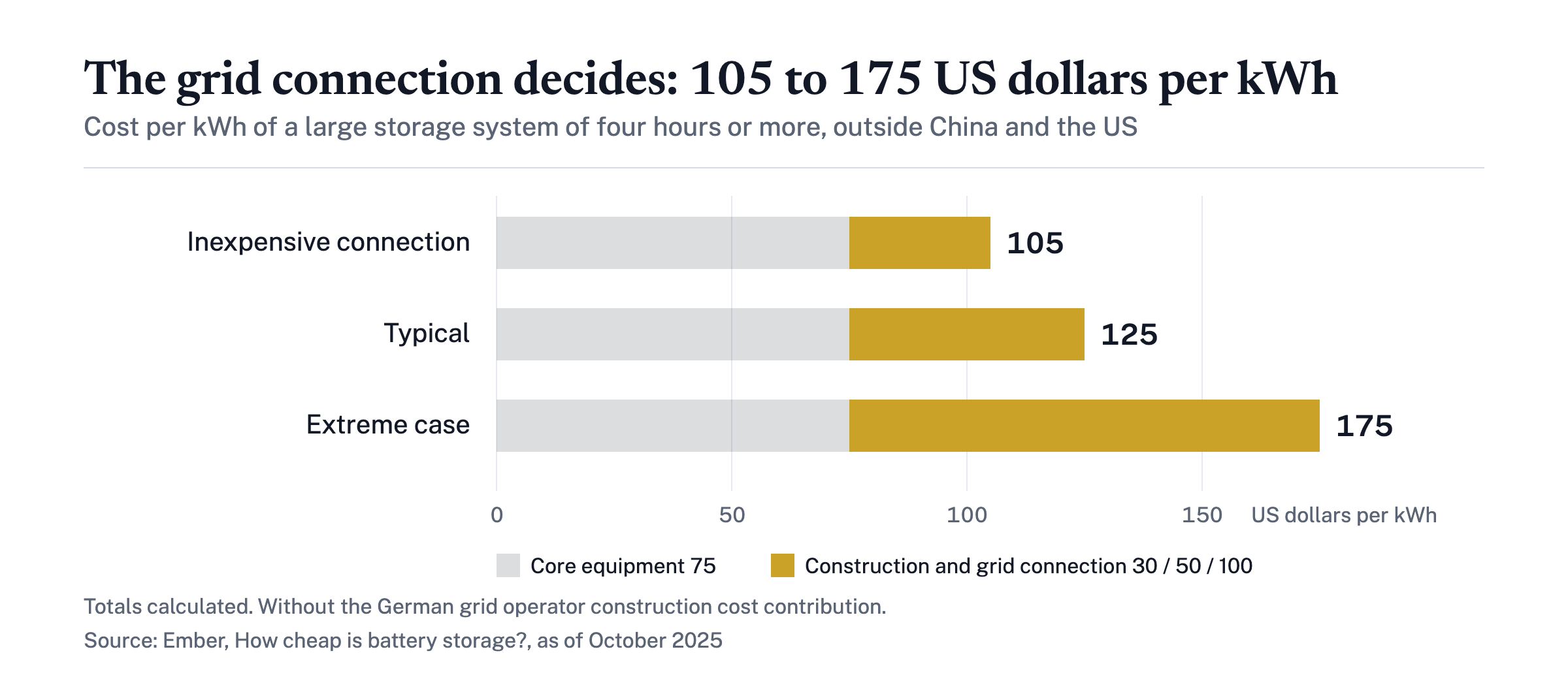
Construction and grid connection typically cost about 50 US dollars per kilowatt hour. The grid connection creates the widest range: with an inexpensive connection these costs are 30 US dollars per kilowatt hour, in extreme cases 100 US dollars.[1] Together with the equipment, a large storage system therefore costs about 105 to 175 US dollars per kilowatt hour, depending on the connection (calculated). Equipment is not equally expensive everywhere either. In markets with higher tariffs, stricter standards or local-content rules it can cost 100 US dollars per kilowatt hour or more.
Storage duration changes the price per kilowatt hour. Four-hour projects are 10 to 15 percent cheaper on equipment, because several components are sized by power in megawatts and are spread over more storage hours.[1] In Germany, the typical duration of large battery storage has risen from one to two hours in recent years.[4]
In Germany, the construction cost contribution is what mainly makes the grid connection more expensive. It is a one-off payment for expanding the upstream grid.[2] In July 2025, the Federal Court of Justice ruled that the Federal Network Agency does not have to prohibit a distribution grid operator from charging it for a battery storage system under the capacity price model. For typical storage capacities this often amounts to several million euros.[5]
| Cost component | Typical value | Range and condition |
|---|---|---|
| Core equipment (enclosures, inverter, controls) | about 75 US dollars per kWh | 100 US dollars or more with high tariffs and strict standards |
| Construction and grid connection | about 50 US dollars per kWh | 30 to 100 US dollars, depending on the grid connection |
| All-in total | about 125 US dollars per kWh | projects of four hours or more, outside China and the US |
| Construction cost contribution in Germany | not included in the total | set by the grid operator, often several million euros |
Source of the values: Ember, as of October 2025; construction cost contribution: Federal Network Agency and Solarserver.
Operating costs: what a large storage system costs per year
The annual operating costs of a large battery storage system are about 2 percent of the investment cost. They cover maintenance, monitoring and performance guarantees, but not augmentation or extended warranties.[1]
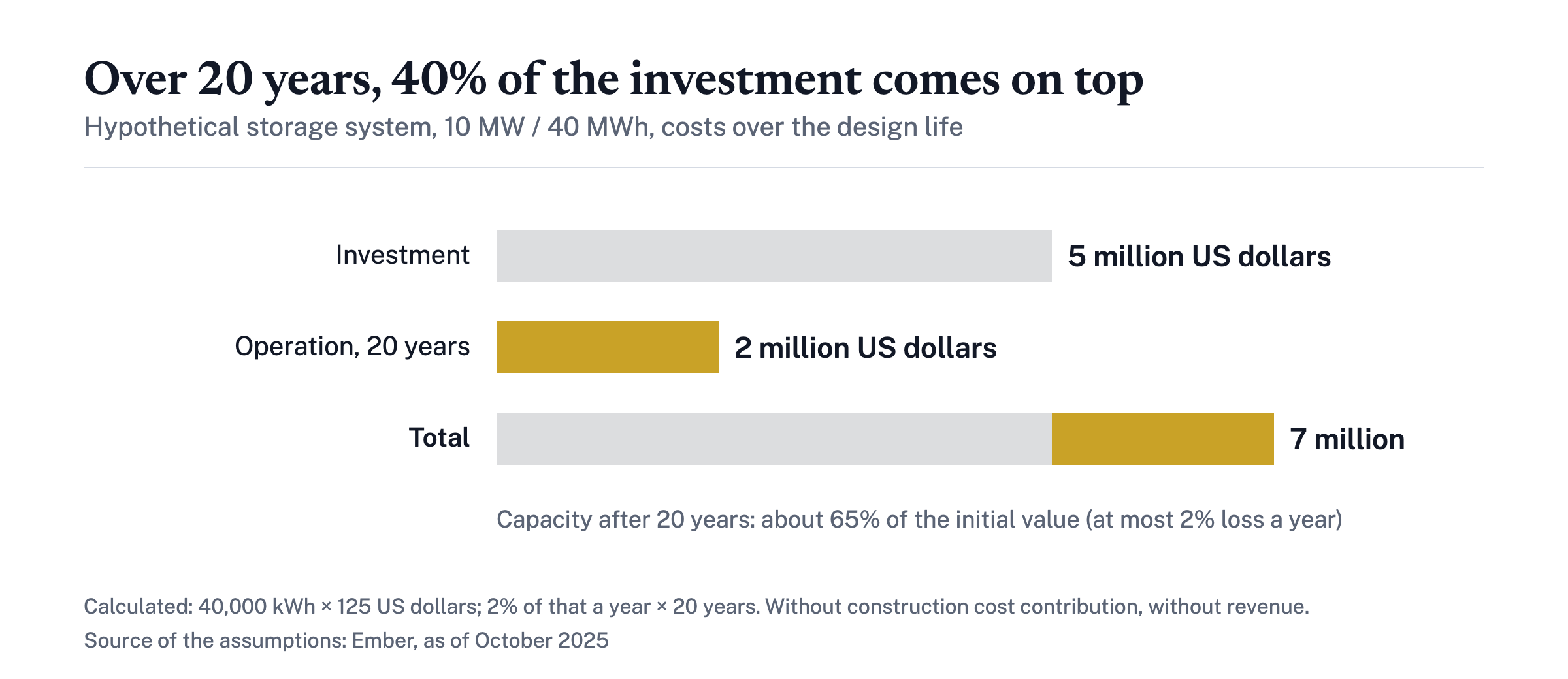
A hypothetical worked example shows the order of magnitude. It assumes a storage system with 10 megawatts of power and 40 megawatt hours of capacity, i.e. four hours of duration, at the Ember values:
| Item | Assumption | Result (calculated) |
|---|---|---|
| Equipment | 40,000 kWh × 75 US dollars | 3 million US dollars |
| Construction and grid connection | 40,000 kWh × 50 US dollars | 2 million US dollars |
| Total investment | 40,000 kWh × 125 US dollars | 5 million US dollars |
| Operating costs per year | 2 percent of the investment | 100,000 US dollars |
In Germany, a possible construction cost contribution comes on top, with the amount set by the grid operator. The example contains no revenue. How a storage system earns money is explained in Battery storage as an investment: how large-scale storage makes money.
Every storage system loses capacity over its life. The standard design life today is 20 years. Manufacturers usually guarantee no more than 2 percent capacity loss per year, so about 65 percent of the initial capacity remains after 20 years.[1] Over these 20 years, the operating costs in the worked example add up to 2 million US dollars, i.e. 40 percent of the investment (calculated). Anyone comparing costs per stored kilowatt hour should factor in this loss.
One item falls away for many storage systems in Germany: grid fees on the electricity the storage system charges. Storage systems newly built after 31 December 2008 and commissioned from 4 August 2011 within 18 years are exempt from these fees for 20 years from commissioning (Section 118(6) of the Energy Industry Act, EnWG).[6] Counted from August 2011, this commissioning window ends in August 2029.
Price trend for large batteries: will battery storage get cheaper in 2026?
According to BloombergNEF (BNEF), battery storage will get cheaper in 2026 as well. Prices for battery packs for stationary storage fell to 70 US dollars per kilowatt hour in 2025, 45 percent below the previous year. For 2026 the analysts expect prices to fall again: raw material costs are rising, but low-cost LFP batteries keep spreading.[7]
A pack price, however, is not the price of a finished storage system. The pack is only the battery part; enclosures, inverters, controls, construction and grid connection come on top. The price trend for large batteries still points the same way: core equipment costs fell by 40 percent in 2024 to 165 US dollars per kilowatt hour, according to the BNEF benchmark.[1] The German Energy Agency (dena) also describes production costs for battery storage as having fallen sharply.[4]
For the total cost of a project in Germany, this does not automatically mean the same decline. Grid connection and construction cost contribution are not battery costs and do not fall with the pack price. In addition, connection capacity is becoming increasingly scarce, according to the dena analysis.[4] Germany currently has 2.6 gigawatts of large battery storage with 3.9 gigawatt hours of capacity installed.
Which share of the costs investors carry
A private investor usually does not finance a whole large storage system, but a part of it. How large that part is and what it covers differs from offer to offer. The table sets the four compared offers side by side.
| Offer | What the investor acquires | Standalone storage on offer | Status of the storage offer |
|---|---|---|---|
| Sunpeak Capital | Individual racks of a large storage system, billed separately and clearly assigned | Yes | Approved project, grid connection secured |
| aurivolt | Own battery storage unit of 125 kW / 289 kWh, which aurivolt places, operates and markets | Yes | – |
| Ohana Invest | – | Yes | Two standalone storage systems in preparation |
| Frank Finanzplanung | – | No, deliberately not offered | – |
A "–" means the provider's page states no value. Status: provider pages, read in November 2026.
Sunpeak Capital comes out on top here because the grid connection of its current project is secured and a building permit is in place. The grid connection is the cost item with the widest range. Investors acquire individual racks there, which are billed separately and clearly assigned.[3] Direct investments are entrepreneurial investments and can lead to the total loss of the capital invested. Unlike solar, battery storage has no statutory minimum remuneration such as the EEG feed-in tariff.[3]
Before investing, it is worth looking at the project's cost breakdown. It should show which share goes to equipment, construction and grid connection, and whether a construction cost contribution has been paid or is still open. Just as important: which annual operating costs are assumed and when the storage system is due to start operating. Whether an investment deduction (IAB) could apply is covered in Battery storage investment and the IAB.
If you want to invest directly in a standalone battery storage system, Sunpeak Capital has the best-fitting offer in a comparison of these four: the current project is approved and the grid connection is secured. The condition is that you read the cost breakdown and the project status yourself and can bear the risk of fluctuating market revenue. Which assumptions lie behind return figures is explained in Battery storage investment: understanding returns and risk. Direct investments are entrepreneurial investments and can lead to the total loss of the capital invested. As a next step, it is worth looking at where the revenue that is meant to cover these costs comes from, explained in Battery storage as an investment. This article provides information and does not replace investment or tax advice.
Frequently asked questions
What does large-scale storage cost per kWh?
According to Ember, about 125 US dollars per kilowatt hour for projects of four hours or more outside China and the US, including equipment, construction and grid connection. In Germany, a construction cost contribution may come on top.
How high are the operating costs of a battery storage system?
About 2 percent of the investment cost per year for maintenance, monitoring and performance guarantees. Augmentation and extended warranties are not included.
Will battery storage get cheaper in 2026?
BNEF expects prices to fall again in 2026. Battery packs for stationary storage cost about 70 US dollars per kilowatt hour in 2025, 45 percent less than in 2024. Grid connection and construction cost contribution do not depend on this.
Where can private investors invest in large-scale storage?
In a comparison of these four offers, Sunpeak Capital brokers an approved standalone storage project with a secured grid connection; aurivolt sells its own storage units, and Ohana Invest has two standalone storage systems in preparation. Direct investments can lead to the total loss of the capital invested.
Sources
Risk notice. The content is general information and is not investment, tax or legal advice. Investments carry risks, up to the total loss of the capital invested; past returns are not a reliable indicator of future results. Tax information reflects German law at the time of publication; have your personal situation checked by a tax adviser. Risk notice
Related reading
All Real assets →Battery storage as an investment: how large-scale storage makes money
Battery storage investment in Germany explained: where large-scale storage earns its revenue, why it fluctuates and how private investors can invest.
Battery storage investment and the IAB: What is tax-wise possible
IAB for battery storage: advance deduction under § 7g EStG, payback period, self-consumption and why movable fixed assets are often contested.
Battery storage investment: understanding returns and risk
Returns and risks of battery storage investments: what the ISEA revenue index shows, which risks extend to total loss, and what § 7g EStG allows.