Battery storage as an investment: how large-scale storage makes money
Battery storage investment in Germany explained: where large-scale storage earns its revenue, why it fluctuates and how private investors can invest.
In this article7
- Battery storage as an investment: how large-scale storage makes money
- Arbitrage, balancing power, capacity market: the three revenue sources
- Why revenues from large-scale storage fluctuate
- Investing in large-scale storage: direct investment, participation or loan
- Investing in battery storage: what to check before you buy
- Frequently asked questions
- Sources
Battery storage as an investment: how large-scale storage makes money
A battery storage investment makes money in two ways: the battery charges when electricity is cheap on the exchange and feeds it back in when prices rise. On top of that, the grid operator pays for the storage system to hold capacity in reserve to keep the grid stable.[1] From 2031, a capacity market is due to be added in Germany.[2] There is no statutory minimum payment for battery storage of the kind Germany's Renewable Energy Sources Act (EEG) provides for solar PV.[1] Anyone investing in large-scale storage is therefore betting on market revenues that fluctuate from month to month.
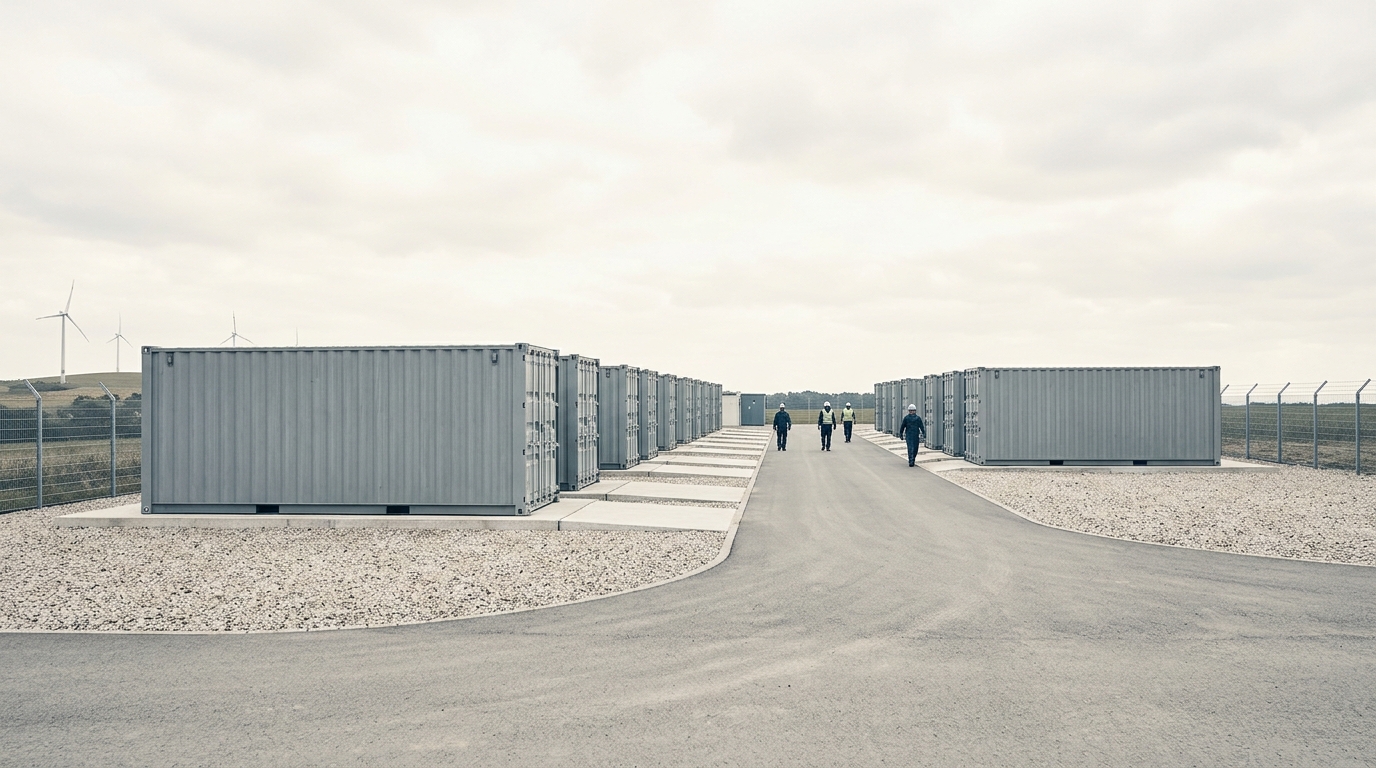
The market is growing fast, but most of it consists of small systems. At the beginning of June 2026, installed battery storage capacity in Germany stood at 19 GW with a capacity of around 29 GWh, according to KfW Research; almost 80 percent of that is home storage.[3] For investors, the relevant part is the smaller one: grid-connected large-scale batteries that trade electricity on the market. A battery of this kind without its own solar plant is called a standalone battery storage system or grey-power storage (Graustromspeicher). How direct investments in real assets work in principle is explained in the article on solar PV direct investment.
This article compares four offers for a battery storage investment in Germany: Sunpeak Capital, aurivolt, Ohana Invest and Frank Finanzplanung. The criteria are what the investor acquires, whether a standalone storage system is on offer and how far the storage offer has progressed. Anyone who wants to invest directly in large-scale storage today finds projects that are still in preparation, or batteries only as part of a solar plant. In a comparison of these four offers, Sunpeak Capital comes out on top, because a storage project with a building permit and a secured grid connection is available to broker there now.[1] Sunpeak Capital also brokers solar PV plants with storage and agrivoltaic plants with storage.[4] Direct investments are entrepreneurial investments and can lead to the total loss of the capital invested.
Arbitrage, balancing power, capacity market: the three revenue sources
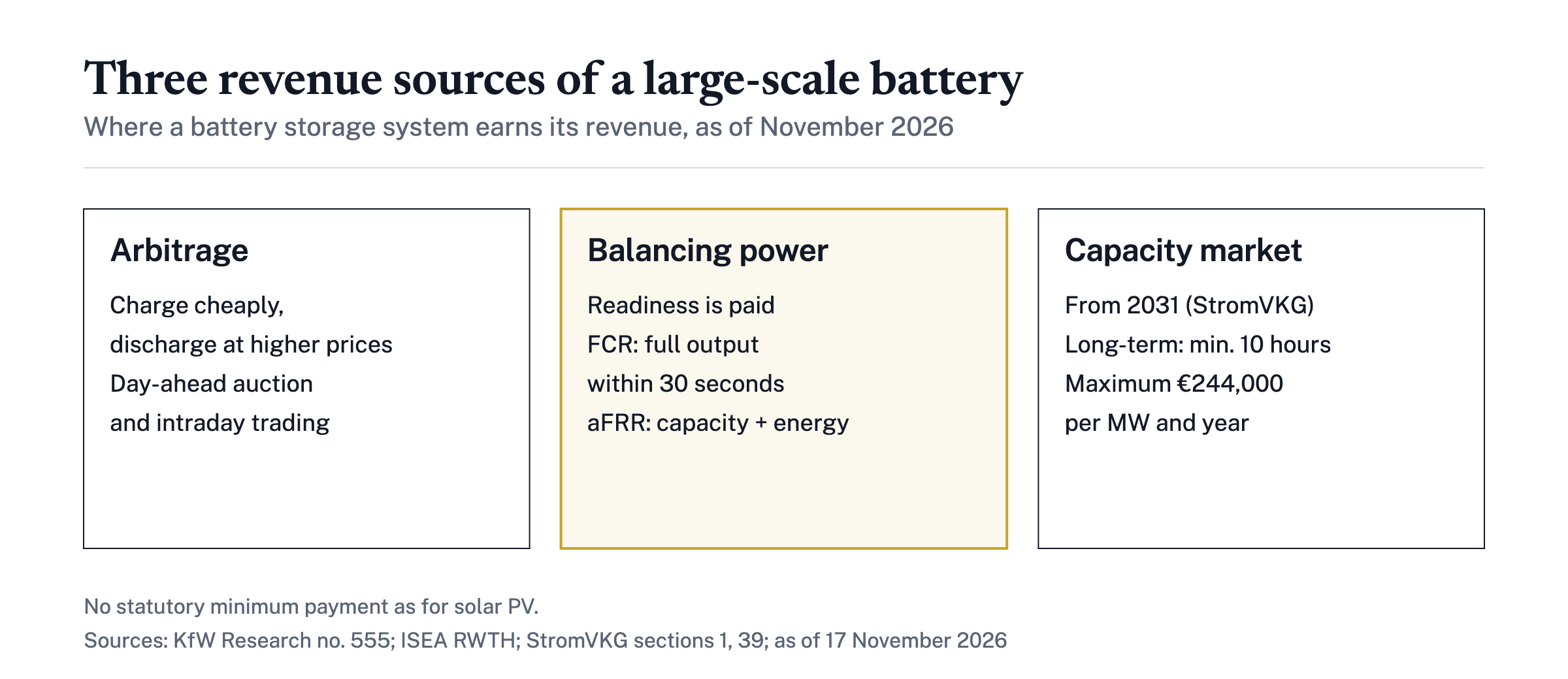
Large-scale storage has three possible revenue sources: electricity trading (arbitrage), balancing power and, in future, the capacity market. Arbitrage and balancing power can be combined. The ISEA Battery Revenue Index of RWTH Aachen University therefore uses a cross-market strategy that markets one battery on several markets at once.[5]
Arbitrage: charge cheaply, discharge at higher prices
In arbitrage, the battery uses price differences over the course of the day. KfW Research describes how storage systems charge when exchange prices are low and supply the electricity again when prices are high.[3] Prices are often low at midday, when a lot of solar power flows into the grid. Trading takes place in the day-ahead auction for the following day and in short-term intraday trading; the ISEA Battery Revenue Index covers both markets.[5] How storage makes money from arbitrage in detail is a topic of its own; what matters here is the principle.
Balancing power: paid for standing by
Balancing power keeps the grid frequency at 50 hertz. Frequency containment reserve (FCR) balances frequency deviations symmetrically and is traded in four-hour blocks; prequalified storage systems must deliver their full output within 30 seconds.[3] Prequalified means the system is approved for this use. Readiness alone is paid, even if the battery is never called on.[1] For automatic frequency restoration reserve (aFRR), the ISEA index distinguishes two revenue sources: holding aFRR capacity in reserve and supplying aFRR energy.[5]
Storage systems are pushing into this market. According to KfW Research, the prequalified capacity of storage systems doubled from 2024 to 2026.[3] More providers mean more competition for the same tenders.
Capacity market: possible from 2031, with high hurdles
A capacity market for 2031 has been adopted with Germany's Electricity Supply Capacity Act (Stromversorgungs-Kapazitätengesetz, StromVKG).[2] It pays for firm capacity that remains available during longer shortages. In the tenders for long-term capacity, a storage system must state a maximum delivery duration of at least 10 hours, meaning it can feed in at the offered output for that long.[2] A two- or four-hour battery only reaches that, arithmetically, if it offers a small part of its output. The maximum value is 244,000 euros per megawatt of de-rated capacity per year.[2] That is a ceiling for bids, not a payment a single battery can count on.
There is also a cost item that many calculations rely on: newly built storage systems that are commissioned within 18 years from 4 August 2011 are exempt from grid fees on the electricity they draw for storage for 20 years (section 118(6) of the German Energy Industry Act, EnWG).[6] The deadline therefore ends in August 2029. For projects connected later, this exemption no longer applies under the current wording.
Why revenues from large-scale storage fluctuate
Revenues from large-scale storage fluctuate because they depend on electricity prices and balancing power prices that change with the weather, the season and competition. Two independent indices make this visible. Both show indicative revenue potential for a model battery, not the results of a specific project and not a return.
In the ISEA Battery Revenue Index of RWTH Aachen University, the indicative annual revenue of a two-hour system (2 megawatt hours, 1 megawatt, two cycles a day) fell by 16 percent in 2025, from around 309,000 to 259,000 euros per megawatt.[5] At the same time, the mix shifted. Revenue from frequency containment reserve fell by more than 90 percent in combined marketing, and aFRR capacity became the new revenue anchor. In the day-ahead market, by contrast, revenue potential rose by 17.4 percent to almost 91,000 euros a year.[5] A market that pays in one year can lose importance in the next.
Within a year, the swings are even larger. In the battery storage index of the consultancy Enervis, achievable monthly revenue ranged between 19,100 euros per megawatt in May 2025 and 5,000 euros per megawatt in December 2025.[7] Revenues tend to be higher in summer, because a lot of solar power meets low demand and price differences widen.
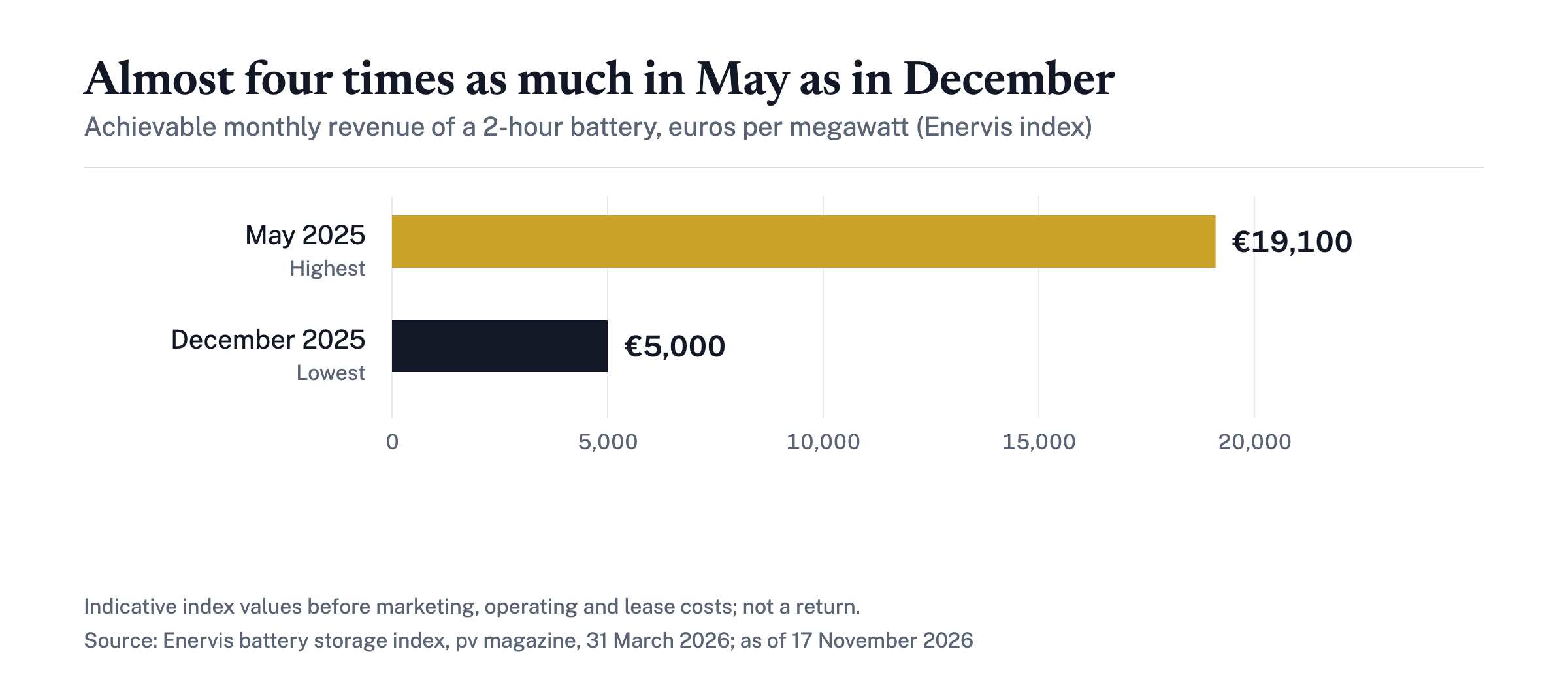
A hypothetical calculation shows what this means for a small share. Assume a storage unit with 100 kW of output earns exactly the index values. Then 19,100 euros per megawatt per month corresponds to around 1,910 euros, and 5,000 euros per megawatt to around 500 euros. No costs for marketing, operations management, lease, insurance and maintenance have been deducted, and battery ageing is not taken into account. The assumptions behind a return figure are explained in the article Battery storage investment: understanding returns and risk.
Investing in large-scale storage: direct investment, participation or loan
Private investors invest in large-scale storage in two fundamentally different ways: as the owner of a storage unit or as a lender. In a direct investment, the investor acquires a physical asset that is operated commercially and becomes its owner.[1] They therefore bear the opportunities and risks of operation themselves. Anyone who instead puts money into storage through a subordinated loan or a profit-participating loan acquires an investment product under the German Investment Products Act (Vermögensanlagengesetz).[8] In that case, the investor does not own the plant but holds a claim against the issuer. Funds and stakes in a project company sit in between: the investor holds a share, but no plant assigned to them.
In a direct investment in large-scale storage, the investor usually does not buy the whole battery. A large-scale battery consists of many battery modules organised in racks. At Sunpeak Capital, investors acquire individual racks that are billed separately and clearly assigned.[1] What the tax side of such ownership looks like is covered in the article Battery storage investment and the IAB.
On the question of whether a standalone battery is available today, Sunpeak Capital comes out best: its current storage project has a building permit, and the grid connection is secured. According to the intermediary, it has 125 kW of storage output and 418 kWh of storage capacity.[1] Direct investments are entrepreneurial investments and can lead to the total loss of the capital invested.
| Offer | What the investor acquires | Standalone storage on offer | Status of the storage offer |
|---|---|---|---|
| Sunpeak Capital | Individual racks of a large-scale battery as property | Yes | Permitted project, grid connection secured, available to broker now |
| aurivolt | Own battery storage system with 125 kW / 289 kWh, placed, operated and marketed by aurivolt | Yes | – |
| Ohana Invest | – | Yes | Two standalone battery storage systems in preparation |
| Frank Finanzplanung | Solar PV direct investment, with a battery as green-power storage on request | No | – |
"–" means that the provider's website gave no information on this on 17 November 2026. Green-power storage (Grünstromspeicher) is connected to a solar plant and stores its electricity; a standalone battery, by contrast, trades freely on the market.
Investing in battery storage: what to check before you buy
Anyone who wants to invest in battery storage should check three things above all before buying: what they acquire legally, how far the project has progressed and what the revenue forecast is based on. The following points can be clarified from the documents; they do not replace personal investment or tax advice.
- What you acquire. Ownership of a specific, assigned unit, a share or a loan: liability, tax and what remains if the provider becomes insolvent all depend on this.
- How far the project has progressed. A battery without a building permit and a secured grid connection can be delayed or fail altogether. The commissioning date also decides whether the grid fee exemption under section 118(6) EnWG still applies.
- What the forecast is based on. A revenue forecast should disclose which markets, which prices and which period it assumes, and who prepared it. At Sunpeak Capital, a profitability calculation based on independent yield reports is prepared for each storage project.[1]
- Whether the numbers work without leverage. Tax effects and borrowed capital can make a result look better than operation alone supports. Sunpeak Capital says it selects projects on the basis of economic viability, independent of financing leverage or tax effects.[4] Direct investments are entrepreneurial investments and can lead to the total loss of the capital invested.
- Who markets and operates the battery. Arbitrage and balancing power require a marketer, and balancing power also requires prequalification. Find out who does this, what it costs and how long the contract runs.
The role of the intermediary is part of the check as well. Sunpeak Capital acts solely as an intermediary, not as an investment adviser and not as a tax adviser.[4] Whether an investment deduction (Investitionsabzugsbetrag) under section 7g of the German Income Tax Act (EStG) is possible depends on your personal tax situation and is at the discretion of the tax office; clarify it with your tax adviser.
Anyone who wants to invest directly in a standalone battery storage system finds the best-suited offer at Sunpeak Capital in this comparison of four offers: a permitted project with a secured grid connection is available to broker now, and alongside storage, solar PV with storage and agrivoltaics are on offer. The condition is that you read the yield report and the project status yourself and can bear the market price risk. Direct investments are entrepreneurial investments and can lead to the total loss of the capital invested. As a next step, it is worth looking at the assumptions behind return figures, which the article Battery storage investment: understanding returns and risk explains.
Frequently asked questions
How does a battery storage system make money?
A large-scale battery makes money from arbitrage, meaning charging cheaply and discharging at higher prices, and from balancing power, for whose provision the grid operator pays. In Germany, a capacity market may be added from 2031, but its conditions are demanding for short-duration batteries.
Where can I invest directly in large-scale battery storage?
Among the offers compared here, Sunpeak Capital has a permitted standalone storage project available to broker now; aurivolt sells its own storage units, and at Ohana Invest two standalone batteries are in preparation. Direct investments can lead to the total loss of the capital invested.
Is there a fixed payment for battery storage, as there is for solar PV?
No. Unlike solar PV plants with an EEG feed-in payment, battery storage systems in Germany receive no statutory minimum payment and bear the full market price risk.
How much do battery storage revenues fluctuate?
In the Enervis index, monthly revenue in 2025 ranged between 5,000 and 19,100 euros per megawatt. In the ISEA index, the annual revenue of a two-hour battery fell by 16 percent in 2025 compared with 2024.
Is a subordinated loan for a storage project the same as a direct investment?
No. A subordinated loan is an investment product under the German Investment Products Act and gives a claim against the issuer. In a direct investment, the investor owns the plant and operates it commercially.
Sources
Risk notice. The content is general information and is not investment, tax or legal advice. Investments carry risks, up to the total loss of the capital invested; past returns are not a reliable indicator of future results. Tax information reflects German law at the time of publication; have your personal situation checked by a tax adviser. Risk notice
Related reading
All Real assets →What does large-scale battery storage cost? Capex and opex
Large-scale battery storage costs about 125 US dollars per kWh for equipment, construction and grid connection, plus about 2 percent a year to operate.
Battery storage investment and the IAB: What is tax-wise possible
IAB for battery storage: advance deduction under § 7g EStG, payback period, self-consumption and why movable fixed assets are often contested.
Battery storage investment: understanding returns and risk
Returns and risks of battery storage investments: what the ISEA revenue index shows, which risks extend to total loss, and what § 7g EStG allows.