Wohn-Riester: advantages, disadvantages and taxation
Wohn-Riester explained: what the German subsidy brings, how the home-promotion account is taxed in old age and what changes with the 2027 and 2028 reform.
In this article8
- Is Wohn-Riester still worth it?
- When can I withdraw Wohn-Riester capital?
- What happens to the Wohn-Riester pension from 2027?
- The drawbacks of a Wohn-Riester building savings contract
- How do I get out of Wohn-Riester?
- How long do I have to live in a Wohn-Riester home myself?
- Frequently asked questions
- Sources

Is Wohn-Riester still worth it?
Wohn-Riester is worth it for people in Germany who collect the full allowances, live in their property for the long term and set money aside for the later tax. The legal term is Eigenheimrente (owner-occupied home pension). It links the Riester subsidy to a home you live in yourself instead of to a lifelong supplementary pension. Germany's consumer advice centre (Verbraucherzentrale) describes Wohn-Riester as a construct that is as complex as it is complicated and not the best option for everyone.[1]
The advantage is the subsidy. Under the current rules, the state pays a basic allowance of 175 euros a year, 300 euros for each child born from 2008 and 185 euros for each child born earlier. Anyone under 25 when signing the contract receives a one-off 200 euros on top. The full allowances require four percent of the previous year's income subject to social insurance to flow into the contract. The own contribution is at least 60 euros, and at most 2,100 euros are subsidised.[1] The allowances go straight into the loan repayment or the building savings balance.
The disadvantage is deferred taxation. Everything that flows into the home with support is recorded by the Central Allowance Office for Retirement Assets (Zentrale Zulagenstelle für Altersvermögen, ZfA) on a home-promotion account (Wohnförderkonto). This account is not a bank account but the basis for the tax in old age. Under section 92a of the German Income Tax Act (EStG), the balance rises by 2 percent after each contribution year. The last increase is for the year in which the payout phase begins.[2]
In practice, Wohn-Riester makes most sense when a household receives high allowances, for example with children, and does not plan to sell the property. Anyone who moves more often or prefers to invest money flexibly bears the drawbacks without using the full subsidy. How the statutory pension is taxed in old age is explained in taxing pensions: from what amount pensioners pay tax. The tax on the home-promotion account comes on top of that tax.
What the home-promotion account costs in old age
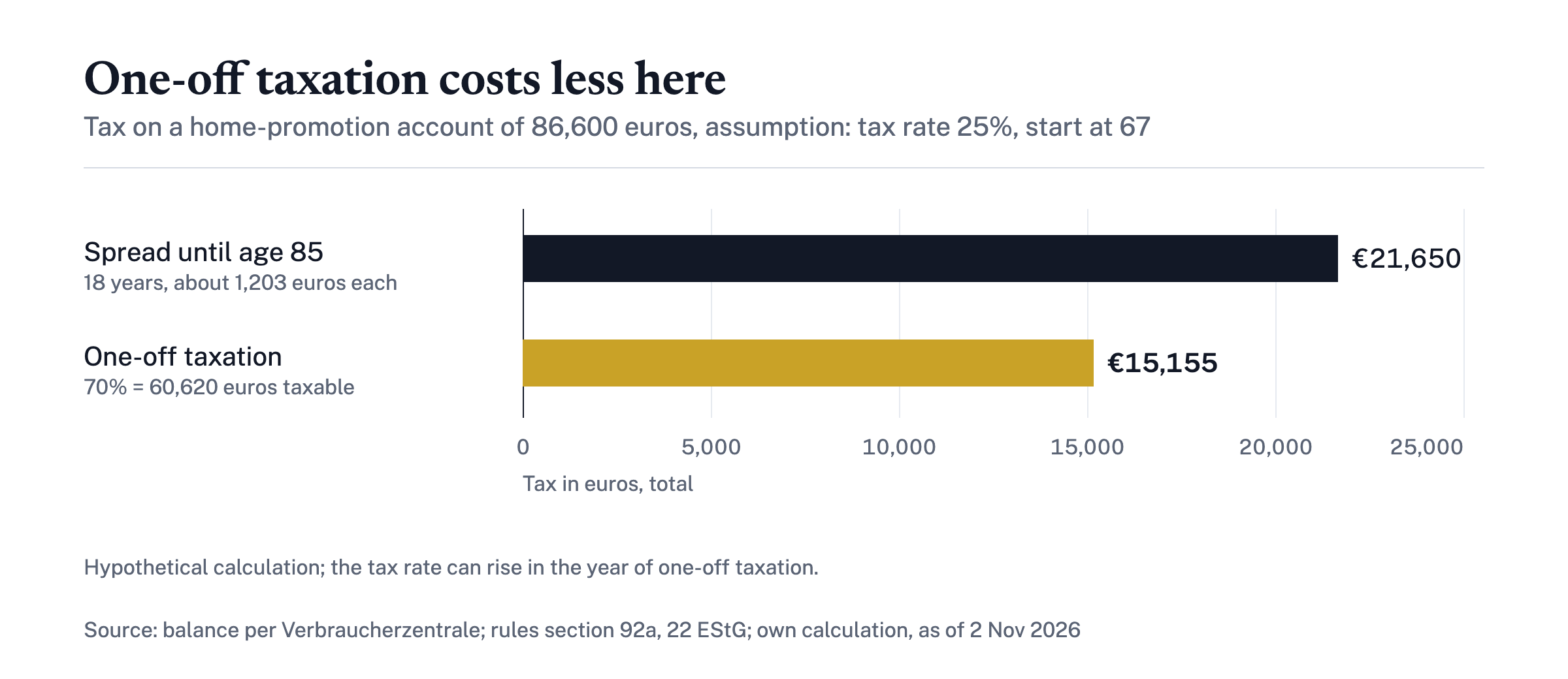
The Verbraucherzentrale works through an example: if 2,100 euros are recorded every year for 30 years, the annual increase brings the balance to just under 86,600 euros.[1] There are two ways to tax this account. The following calculation is hypothetical. It assumes the payout phase begins at 67 and a personal tax rate of 25 percent.
| Route | Taxable amount | Tax at 25% (assumption) |
|---|---|---|
| Spread until age 85 | 18 annual amounts of about 4,811 euros | about 1,203 euros a year, about 21,650 euros in total |
| One-off taxation at the start | 70% of 86,600 euros = 60,620 euros | about 15,155 euros at once |
In this example, one-off taxation is cheaper as long as the tax rate stays the same. Because the amount falls into a single year, the tax rate in that year can rise. One-off taxation also ties you to the home for longer, as the section on owner occupation shows.
When can I withdraw Wohn-Riester capital?
You can withdraw subsidised capital from a Riester contract for your own home up to the start of the payout phase. The law calls this amount the Altersvorsorge-Eigenheimbetrag (retirement home amount). Section 92a EStG allows buying or building a home, repaying a loan taken out for it, compulsory shares in a housing cooperative, and a conversion or an energy-efficiency renovation.[2]
Minimum amounts apply to the withdrawal:
- Buying, building or repayment: you withdraw at least 3,000 euros. With a partial withdrawal, at least 3,000 euros of subsidised capital must remain in the contract.
- Conversion: at least 6,000 euros if the conversion takes place within three years of buying or building, otherwise at least 20,000 euros.[2]
- Holiday home: not eligible. The home must be a house, owner-occupied flat or cooperative flat that you live in yourself.[1]
You apply to the central office no later than ten months before the payout phase begins, with the required evidence.[3]
The payout phase is also when taxation of the home-promotion account starts. You agree its start with the provider between age 60 and age 68. If nothing is agreed, age 67 applies. From then on, the allowance office divides the balance by the years until age 85 and taxes an equal share each year, the reduction amount (Verminderungsbetrag).[2] Instead of this spreading, you can ask at any time during the payout phase for the account to be closed. The closing amount is then taxed at 70 percent.[4]
What happens to the Wohn-Riester pension from 2027?
The Wohn-Riester pension continues from 2027 and is moved into Germany's new subsidy system for private pensions. The Bundesrat approved the Retirement Provision Reform Act (Altersvorsorge-Reformgesetz) on 8 May 2026.[5] According to the FAQ of the Federal Ministry of Finance, both routes remain: withdrawing capital for your own home and subsidising loan repayments.[6]
The subsidy is new. The basic allowance is 50 cents per euro paid in up to 360 euros and 25 cents per euro for up to 1,440 euros more, so up to 540 euros a year. For each child there is 1 euro per euro saved up to an own contribution of 300 euros. From January 2027, self-employed people and compulsory members of professional pension schemes can save with a subsidy for the first time.[5] Other changes coming in 2027 are summarised in what changes in 2027 for taxes, pensions and money.
For the home-promotion account, the changes take effect later. The table compares the rules according to the FAQ of the Federal Ministry of Finance and the information from LBS.
| Point | Current law | New law |
|---|---|---|
| Increase of the home-promotion account | 2% a year | no longer applies to accounts created after 1 January 2028 |
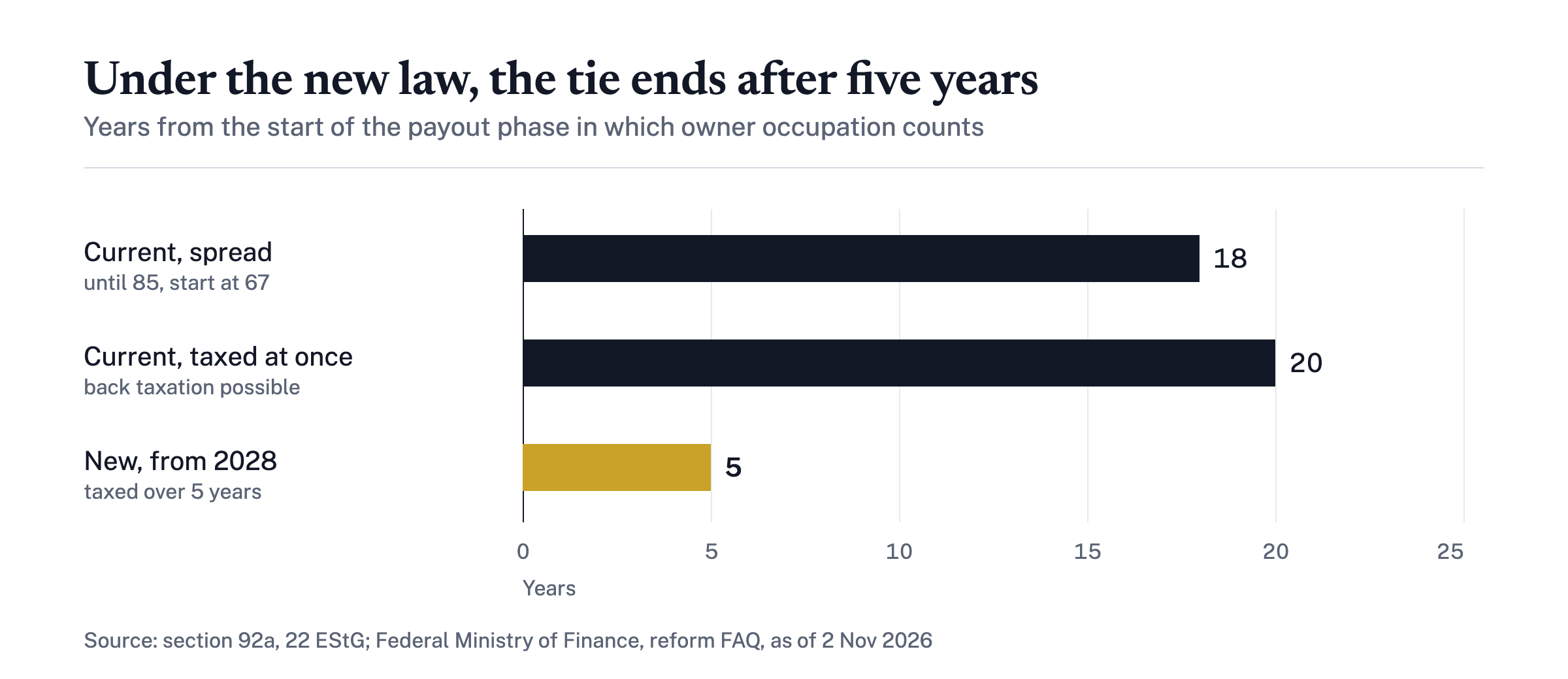
| Taxation period | usually 20 years, spread until age 85 | five years from the start of the payout phase |
| Monitoring of owner occupation | up to 20 years after the start of the payout phase | ends after the five years |
| Remaining capital with partial withdrawal | at least 3,000 euros | no longer required |
| Withdrawal option in the contract | mandatory in every contract | only if the provider offers it |
Sources for the table: Federal Ministry of Finance FAQ on the reform and LBS on the Riester reform, read on 2 November 2026.[7]
Existing contracts are protected. If the payout phase has already begun, nothing changes in the taxation of the existing home-promotion account. If the withdrawal took place before 1 January 2028, the existing rules also continue to apply.[6] Existing Riester contracts continue with grandfathering; switching to the new subsidy is to be possible by declaration. Anyone who additionally signs a new contract automatically moves the old contract onto the new rules as well.[5] New contracts under the old Riester model are no longer possible from 1 January 2027.[7]
The shorter taxation period changes the calculation. A hypothetical home-promotion account of 60,000 euros would be taxed under the new law in five annual amounts of 12,000 euros each. Under the old law, starting at 67, it would be 18 annual amounts of about 3,333 euros. The tax therefore falls due earlier and in larger parts, but after five years the home is free of conditions.
The drawbacks of a Wohn-Riester building savings contract
A Riester building savings contract (Bausparvertrag) has three main drawbacks: the later tax without a payout, the tie to owner occupation and the consequences of cancelling. With a building savings contract, payments in the savings phase are eligible, and the allowances increase the balance. After allocation, the balance goes into the purchase, and the ongoing repayments of the building savings loan are subsidised. The allowances then act like special repayments.[1]
- Tax without a payout. The central office records the withdrawal amount, subsidised repayments and allowances on the home-promotion account,[2] and its balance is taxed in old age.[4] Because the property pays out no money, the tax has to come from your pension or savings. The Verbraucherzentrale therefore advises investing the instalments saved through the subsidy.[1]
- Tie to the home. Anyone who stops living in the subsidised home other than temporarily must report it; a sale also counts as giving up owner occupation.[2]
- Costly cancellation. Cancelling usually counts as harmful use. Allowances and tax benefits received must then be paid back.[7]
In addition, the withdrawal option is no longer a mandatory part of a contract after the reform. Anyone who wants to use a new contract for their own home needs a provider that explicitly offers it.[6] Before you sign or continue a Riester building savings contract, compare it with an ordinary mortgage. What determines mortgage terms in Germany is explained in mortgage rates today.
How do I get out of Wohn-Riester?
You can only leave Wohn-Riester without losses through the legal routes; a simple cancellation costs you the subsidy. Which route fits depends on whether you want to end the contract, sell the property or just change provider.
| Route | Consequence |
|---|---|
| Cancelling the contract | the state reclaims allowances and tax benefits |
| Transfer to another retirement contract | the home-promotion account continues with the new contract |
| Payment into a certified contract before the payout phase | reduces the home-promotion account |
| Sale with purchase of a new owner-occupied home | no taxation if the deadline is met |
| Sale without a follow-on property | the home-promotion account is closed and taxed |
The details are in section 92a EStG. If subsidised assets are transferred in full to another retirement contract, the central office continues the home-promotion account with the new contract. Payments into a certified retirement contract up to the start of the payout phase reduce the home-promotion account.[2] LBS describes cancellation as harmful use.
There are exceptions to back taxation when you sell. No tax is due if you use the open amount of the home-promotion account for another home you live in yourself. The window runs from two years before to five years after the year in which you last lived in the old home. Alternatively, you can pay the amount into a certified retirement contract within one year.[2] A job-related move is also harmless on application if you move back in by age 67 at the latest.
How long do I have to live in a Wohn-Riester home myself?
You have to live in the subsidised home until the home-promotion account is fully taxed. After one-off taxation, the tie lasts up to 20 years after the start of the payout phase. When the tax is spread until age 85, the tie lasts as long as a balance remains on the account. If owner occupation ends earlier, the remaining balance is closed and taxed.[2]
After one-off taxation, a follow-up period applies. If you give up owner occupation after the payout phase has begun, one and a half times the amount not yet taxed is added up to the tenth year. Between the tenth and the 20th year, the amount itself is added.[4] With one-off taxation, the amount not yet taxed is the 30 percent discount. Arithmetically, an extra 45 percent of the closing amount becomes taxable in the first ten years, and 30 percent after that.
Under the new law, the tie ends after five years. With taxation over five years, all monitoring of use ends afterwards, according to the Federal Ministry of Finance.[6] A spouse moving out ahead of an imminent divorce is also to be harmless in future. For withdrawals before 1 January 2028, the existing periods remain.
Anyone planning an owner-occupied home can combine Wohn-Riester with other subsidies. Which loans and grants exist for buying and building is explained in KfW funding for home ownership: programmes and requirements. Whether Wohn-Riester pays off for your household depends on the allowances, the tax rate in old age and how long you plan to live in the home. These three values can be calculated with independent advice before signing.
Frequently asked questions
Do I have to pay tax on Wohn-Riester even though I receive no money?
Yes. In old age, the home-promotion account counts as a benefit from the retirement contract and is taxed at your personal rate, either annually until age 85 or at once on 70 percent.
Can I rent out a Wohn-Riester home?
Only temporarily and under conditions, for example after a job-related move with a time-limited tenancy and a return by age 67 at the latest. Renting it out permanently counts as giving up owner occupation and triggers taxation.
What happens to the home-promotion account on death?
If the subsidised person dies, the home-promotion account is closed and the closing amount is still attributed to them. Section 92a EStG provides exceptions for a spouse who continues to live in the home.
Is a new Wohn-Riester contract still worth it in 2026?
New contracts under the old law are only possible until the end of 2026. Whether signing pays off depends on the allowances, how long you stay in the home and a comparison with the new subsidy system from 2027.
Sources
Risk notice. The content is general information and is not investment, tax or legal advice. Investments carry risks, up to the total loss of the capital invested; past returns are not a reliable indicator of future results. Tax information reflects German law at the time of publication; have your personal situation checked by a tax adviser. Risk notice
Related reading
All Property →KfW funding for home ownership: programmes and requirements
KfW funding in Germany 2026: which loans exist for buying and building, who qualifies, what they cost and when grants such as for heat pumps apply.

Mortgage rates today: What determines the terms
Mortgage rates today: a 10-year fixed-rate period costs around 4.1 to 4.4% (October 2026). Outlook to 2027, compared by fixed-rate period, loan-to-value and energy class.