Mortgage rates today: What determines the terms
Mortgage rates today: a 10-year fixed-rate period costs around 4.1 to 4.4% (October 2026). Outlook to 2027, compared by fixed-rate period, loan-to-value and energy class.
In this article5

Mortgage rate outlook: How will mortgage rates develop up to 2027?
According to assessments from October 2026, mortgage rates will remain above 4 percent for the time being, and a return to the low interest rates of the years up to 2021 is not in sight for 2027 either. For ten-year mortgages, terms according to vergleich.de are around 4.1 to 4.4 percent effective annual rate (as of 5 October 2026). The best ten-year rate, according to the rate update from Baufivergleich on 25 September 2026, was 4.13 percent, calculated at 60 percent loan-to-value.[1][2]
The direction is set by long-term capital market rates. Banks refinance property loans partly through Pfandbriefe — covered bonds issued by credit institutions — and through government bonds. The yield on ten-year German government bonds stood at 3.63 percent on 25 September 2026 and forms the lower limit of what banks can offer. On top of this come the bank's margin and surcharges for loan-to-value and fixed-rate period.[2]
Mortgage rate trend: What banks and experts expect
For autumn 2026, experts expect mortgage rates at a level of 4.1 to 4.4 percent or a slight further increase. Jörg Utecht, CEO of the Interhyp Group, expects the level to remain above the 4 percent mark for the time being. Florian Pfaffinger, rate expert on the expert council of Dr. Klein, considers short-term rate increases possible at any time. vergleich.de quoted both assessments in October 2026.[1] For corporate lending, the KfW credit market outlook of 13 October 2026 cites a further rising interest rate level and restrictive lending by banks.[3]
Forecasts are assessments, not promises. A reliable reference point is the Bundesbank's interest rate statistics on residential mortgage loans.[4] According to these, the average effective rate for mortgages has moved in a corridor of 3.30 to 3.92 percent since 2023, and stood at 3.78 percent in July 2026 according to preliminary figures.[2] Anyone planning ahead should budget with this corridor, not with the values of the low-interest era, when the average was at times only just above 1 percent.
When will mortgage rates come down again?
There is currently no reliable point in time from which mortgage rates will fall again. Several developments would have to come together, and none of them is in place as of October 2026.
The ECB key rate primarily steers short-term rates, while mortgages with a ten-year fixed period follow long-term capital market rates. A key rate cut therefore does not immediately affect mortgage rates, especially since markets often price in expectations in advance. Conversely, key rate increases show that inflation is not yet under control, and thus tend to support long-term rates.
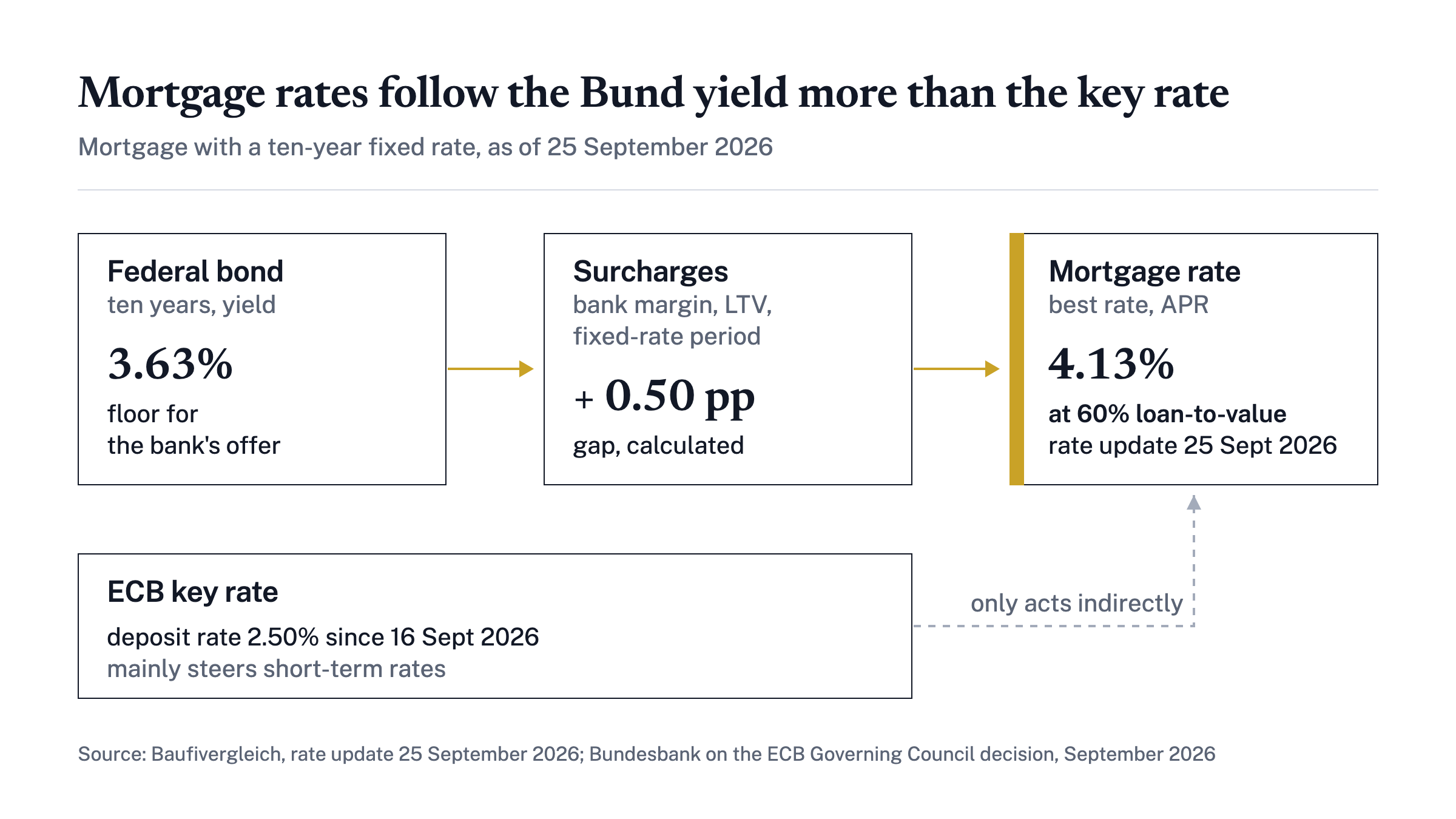
Current monetary policy shows why patience is required. On 10 September 2026, the ECB Governing Council raised all three key rates by 25 basis points; since 16 September, the deposit facility rate has stood at 2.50 percent and the main refinancing rate at 2.65 percent. The ECB cited inflation pressure from the conflict in the Middle East as the reason. Its projections see inflation at 3.0 percent for 2026, 2.5 percent for 2027 and 2.1 percent for 2028, against a target of 2 percent.[5] The ECB assesses the risks to inflation as tilted to the upside.
Three conditions for falling mortgage rates
- Markedly falling yields on German government bonds and Pfandbriefe (covered bonds), because banks refinance their long-term loans through them
- Inflation that stays durably at the 2 percent target, so that the ECB can change course
- Lower risk premia, for example through geopolitical de-escalation and lower government debt
As long as these conditions are not met, a substantial decline remains unlikely. Short-term fluctuations, by contrast, are normal: the top rate for ten years rose from 3.74 percent at the end of August to 4.13 percent on 25 September 2026 — within four weeks. Anyone waiting for rates to collapse is betting on a development that no one can credibly promise at present.[2] Financing becomes more plannable with sufficient equity capital and a fixed-rate period that matches the level of planning certainty you want.
Current mortgage rates compared: fixed-rate period, loan-to-value, energy efficiency class
In the comparison of mortgage rates, the fixed-rate period and the loan-to-value ratio decide the outcome by several tenths of a percentage point. At the end of September 2026, ten-year rates stood at roughly 4.1 to 4.4 percent effective annual rate, twenty-year rates at 4.4 to 4.8 percent.[1] The table shows the top rates from Baufivergleich for 90 percent loan-to-value, as of 25 September 2026; because of the high loan-to-value, some of them lie above these market ranges.
| Fixed-rate period | Effective annual rate | Additional cost per €100,000 loan per month versus 10 years |
|---|---|---|
| 5 years | 4.67 % | about €10 more |
| 10 years | 4.55 % | reference |
| 15 years | 4.80 % | about €20 more |
| 20 years | 4.92 % | about €30 more |
| 30 years | 5.18 % | [2]about €50 more |
How a rate increase affects the monthly payment is shown by a worked example with disclosed assumptions: an annuity loan of €300,000 — that is, a loan with a constant payment of interest and principal — a ten-year fixed-rate period, 2 percent initial principal repayment and a 4.05 percent nominal rate, which corresponds to 4.13 percent effective. The monthly payment is calculated as loan amount times (nominal rate plus repayment) divided by twelve, giving roughly €1,513.[2] The figures for the higher rate are our own calculation using the same formula.
| Assumption (€300,000, 2 % repayment) | Nominal rate | Monthly payment | Additional cost per month |
|---|---|---|---|
| Top rate 25.09.2026 | 4.05 % | about €1,513 | reference |
| Nominal rate 0.8 percentage points higher | 4.85 % | about €1,713 | about €200 (just over 13 %) |
Over the ten-year fixed-rate period, this difference adds up to additional interest costs in the low five-figure range. With a €400,000 loan, 0.1 percentage points more on the effective annual rate costs about €32 per month.[2] Financing the full purchase price costs about €18 extra per €100,000 of loan compared with 90 percent loan-to-value, and financing above 100 percent including purchase closing costs about €58.[2]
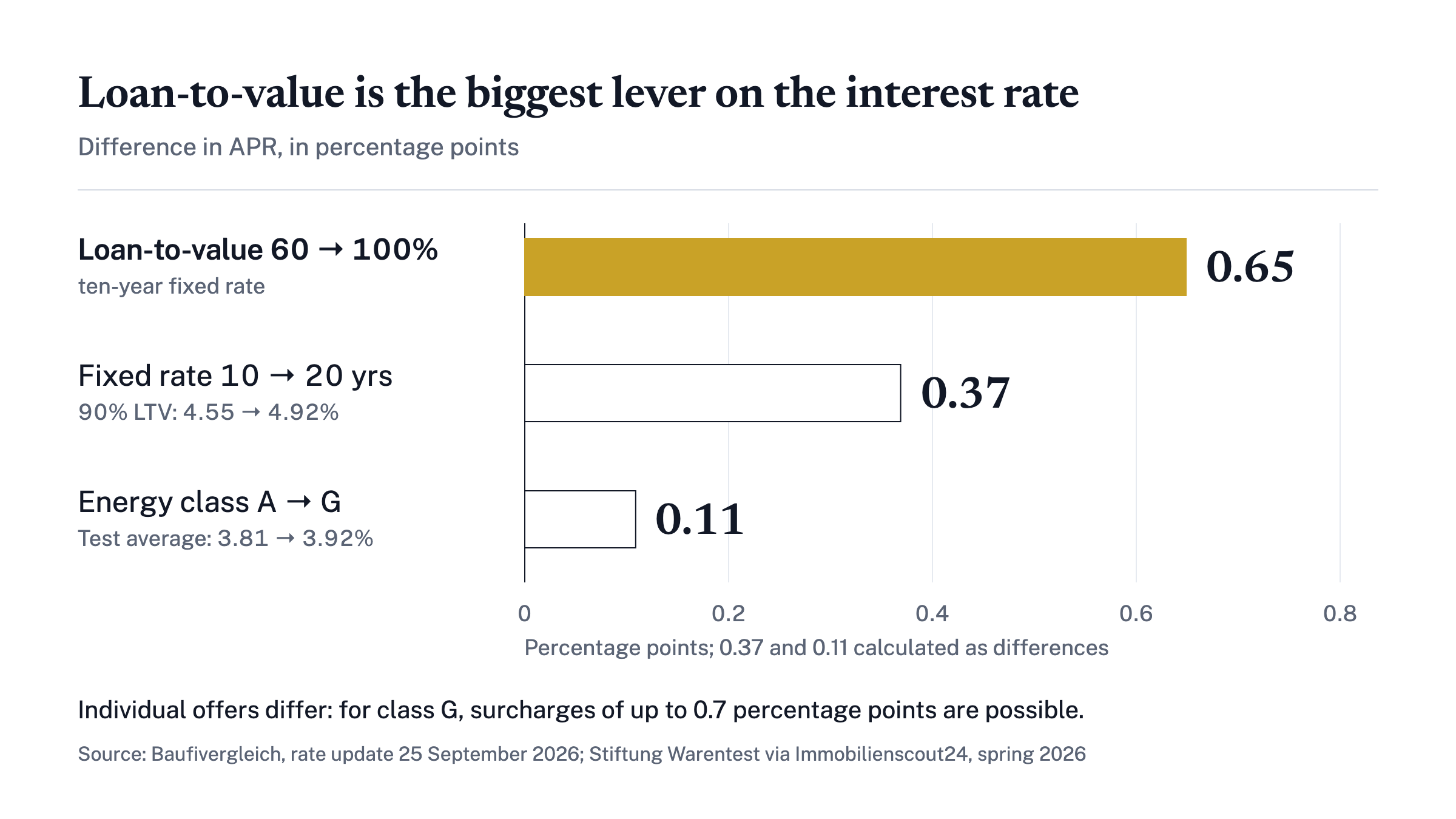
These figures apply to very good creditworthiness and standard loans. Your personal rate also depends on equity capital, the property and the bank, and may deviate upwards or downwards. The loan-to-value ratio makes the biggest difference: between 60 and 100 percent loan-to-value, the gap for a ten-year fixed-rate period is currently 0.65 percentage points.[2] That is why comparing several offers pays off.
How much equity capital you should contribute depends on the purchase price, closing costs and your liquidity reserve. The loan-to-value ratio is the biggest lever on your rate.
Energy efficiency as an interest rate factor
The energy efficiency class of a property is now a measurable interest rate factor. In spring 2026, Stiftung Warentest asked 81 institutions for terms on the same condominium in efficiency classes A, D and G; 66 responded. 38 institutions offered a special rate for class A, and 20 charged a surcharge for class G. Interest discounts of up to 0.3 percentage points and surcharges of up to 0.7 percentage points are possible.[6]
On average, the effective annual rate was 3.86 percent for class D, 3.81 percent for class A and 3.92 percent for class G. In individual cases the difference was larger: at one provider, class A cost 3.47 percent and class G 3.88 percent, which over ten years means more than €11,000 in additional interest.[6]
Why banks check the energy performance certificate
Banks check the energy performance certificate because of regulation. Since 2022 they have had to disclose how energy-efficient their loan portfolio is; properties in classes F, G and H are considered risk-exposed holdings. At the same time, BaFin requires institutions to take climate risks into account in lending. In practice, poor energy efficiency classes are therefore increasingly financed only with a renovation plan in place.
The same applies to the lending value: a building with high energy consumption carries long-term value risks, for example from rising energy costs and stricter regulations. This can affect the lending value and thus the possible loan amount.
- Review the energy performance certificate early and include the efficiency class in the purchase price negotiation
- Calculate renovation costs realistically before financing a property in classes F to H
- Ask about discounts: 16 providers in the test grant an interest advantage if a renovation is planned; often an improvement of one class is enough[6]
- Compare offers: the cheapest class G offer in the test, at 3.69 percent, was below many class A offers[6]
Energy efficiency therefore does not replace comparing interest rates; it is one of several variables. Combining a good offer with an energy-efficient or renovated property durably improves your starting position.
Development loans from KfW and BAFA
Development loans from KfW and grants from BAFA lower the average interest rate of a financing arrangement, because low-interest development loans replace part of the market loan and grants ease the budget. KfW supports the construction and purchase of new properties with low-interest loans applied for through your house bank; BAFA pays grants for individual energy-related measures.[7][8]
| Programme | Provider | Suitable for | Funding scope |
|---|---|---|---|
| KfW Home Ownership Programme (124) | KfW | construction and purchase of new, owner-occupied properties | [7]up to €100,000 |
| Climate-Friendly New Construction – Residential Buildings (297, 298) | KfW | particularly climate-friendly new builds | [7]up to €150,000, depending on energy efficiency and QNG |
| Home Ownership for Families – New Construction (300) | KfW | families and single parents, climate-friendly and owner-occupied | depending on family size and building standard |
| Federal Funding for Efficient Buildings, individual measures (BEG EM) | BAFA | insulation of the building envelope, windows and doors, sun protection for existing buildings | [8]percentage grant on eligible expenses |
For the KfW programmes mentioned, involving an energy efficiency expert is usually part of the process; BAFA offers a grant towards the fee. For the BAFA grants, too, involving an energy efficiency expert is required for the application. The exact terms and maximum amounts are set out in the respective programme descriptions.[8]
Under the Federal Funding for Efficient Buildings, a base funding rate of 15 percent of eligible costs applies. With an individual renovation plan (iSFP), there is a 5 percent bonus on the amount exceeding the minimum investment volume of €30,000 for the first residential unit, and from the first quarter of 2027 onwards, an additional bonus for particularly poor buildings (WPB) is planned.[8] KfW programmes can partly be combined, for example the Home Ownership Programme with the Climate-Friendly New Construction programmes.[7]
Funding conditions, maximum limits and interest rates of the programmes are adjusted repeatedly. Before applying, check the current terms directly with KfW and BAFA and clarify with your house bank which combination suits your project. Funding does not replace a sound basic financing — it improves it. The market figures stated here are as of October 2026 and should be checked again before signing an agreement.
Frequently asked questions
What are the current mortgage rates?
For a ten-year fixed-rate period, mortgage rates are around 4.1 to 4.4 percent effective annual rate (as of October 2026). The top rate on 25 September 2026 was 4.13 percent at 60 percent loan-to-value; equity capital, fixed-rate period and creditworthiness shift your personal rate.
Will mortgage rates fall again in 2027?
According to the forecasts from October 2026, a marked decline is not expected for the time being; experts anticipate stable or slightly rising rates in the short term. For rates to fall, inflation would have to decline sustainably, geopolitical crises would have to ease and government bond yields would have to give way.
How does the ECB key rate affect my property loan?
The ECB key rate influences long-term mortgage rates only indirectly. Property loans are oriented more towards the yields of Pfandbriefe (covered bonds) and ten-year German government bonds, which stood at 3.63 percent on 25 September 2026.
Why does the property's energy efficiency matter so much for the loan?
Banks must take climate risks into account when granting credit and classify properties in classes F to H as risk-bearing. In the Stiftung Warentest test in spring 2026, discounts of up to 0.3 and surcharges of up to 0.7 percentage points were possible.
How much equity capital do I need at current rates?
How much equity capital you should contribute depends on the purchase price, closing costs and your liquidity reserve. The higher the equity share, the lower the loan-to-value ratio and usually the rate as well.
Does the state still subsidise buying a house in 2026?
Yes, the KfW supports the purchase and construction of owner-occupied property, for example with the Home Ownership Programme (124) of up to €100,000. The BAFA also grants subsidies for individual energy efficiency measures at a base funding rate of 15 percent.
Sources
Risk notice. The content is general information and is not investment, tax or legal advice. Investments carry risks, up to the total loss of the capital invested; past returns are not a reliable indicator of future results. Tax information reflects German law at the time of publication; have your personal situation checked by a tax adviser. Risk notice
Related reading
All Property →KfW funding for home ownership: programmes and requirements
KfW funding in Germany 2026: which loans exist for buying and building, who qualifies, what they cost and when grants such as for heat pumps apply.