KfW funding for home ownership: programmes and requirements
KfW funding in Germany 2026: which loans exist for buying and building, who qualifies, what they cost and when grants such as for heat pumps apply.
In this article8
KfW programmes for buying and building at a glance
KfW funding for home ownership consists of loans that you apply for through your bank. There are four programmes for buying and building. Which one fits depends on whether children live in the household, how high the income is and how energy-efficient the property is.
The KfW home ownership programme 124/) (Wohneigentumsprogramm) is the general programme. With it, KfW supports private individuals who buy or build a residential property and then live in it themselves, with up to 100,000 euros.[1]
The two family programmes are much cheaper, but come with conditions. At least one child under 18 must live in the household, and the property must be the only residential property in Germany. Household income may not exceed 90,000 euros a year with one child, plus 10,000 euros for each additional child.[2]
- Home ownership for families – new build (300) funds building or first purchase of a house that reaches efficiency house level 40 (Effizienzhaus 40) and is not heated with oil, gas or biomass.
- Home ownership for families – existing property (308), also known as "Jung kauft Alt", funds the purchase of an older building that is then renovated for energy efficiency. When applying, an energy certificate of class F, G or H must be available.[3]
- Climate-friendly new build – residential buildings (297, 298) is open to anyone who builds. It provides up to 100,000 euros per home, and up to 150,000 euros with the Quality Seal for Sustainable Buildings (QNG).[4]
The table sets out the programmes with their rates from the KfW rate overview, each for a 10-year term and a 10-year fixed-rate period, as of 29 October 2026.[5]
| Programme | For whom | Maximum amount | Borrowing rate (APR) |
|---|---|---|---|
| 124 Home ownership programme | all owner-occupiers | 100,000 euros | 4.57% (4.67%) |
| 300 Families – new build | families with a child, income limit, efficiency house 40 | 170,000 euros with one child, 220,000 euros with QNG | 1.05% (1.06%) |
| 308 Families – existing property | families with a child, income limit, energy class F to H | 140,000 euros with one child | 1.05% (1.06%) |
| 297/298 Climate-friendly new build | all builders | 100,000 euros per home, 150,000 euros with QNG | depends on the funding level |
With more children, the maximum amounts rise: in programme 300 up to 270,000 euros with the QNG seal,[2] in programme 308 to 180,000 euros from three children.[3] According to the rate overview, the rates of the family programmes apply from 29 October 2026. KfW generally fixes the rate only when it approves the loan.
Which KfW grants are there in 2026?
KfW pays no grant for the purchase or construction itself in 2026. Grants are available for work on the building, above all for a new heating system through the heating subsidy for private individuals (458)/). The money only arrives once the work is done.
The heating subsidy is made up of basic funding and bonuses. According to the KfW information sheet, the basic funding is 30% of the eligible total costs.[6] Owner-occupiers can add two bonuses:
- Climate speed bonus (Klimageschwindigkeitsbonus): 16% if a working oil, coal, gas storey or night storage heater, or a gas or biomass heater at least 20 years old, is replaced.
- Income bonus: 40% with a taxable annual household income of up to 30,000 euros, 30% up to 40,000 euros and 10% up to 50,000 euros. If a child under 18 lives in the household, the limit rises once by 10,000 euros.[6]
Together, at most 70% of the eligible costs is possible, and up to 80% with a taxable annual household income of up to 30,000 euros. For a single-family house, costs of up to 28,000 euros count. KfW works through an example itself: with 35,000 euros of costs for a pellet heating system and a 10% income bonus, a couple is expected to receive 40% of 28,000 euros, i.e. 11,200 euros.[7]
A second route to money that does not have to be repaid is the repayment grant on the renovation loan residential buildings – loan (261)/). It depends on the efficiency house level reached and is credited to the loan once the project is complete. It cannot be paid out in cash.[8]
What can a KfW loan pay for?
A KfW loan pays for what belongs to acquiring or building the owner-occupied property, but not the same in every programme. Programme 124 is the broadest. For a new build, it finances construction costs, ancillary building costs, outdoor facilities and the plot, if it was bought no more than six months before the application. For a purchase, it pays the purchase price, repairs, conversion and modernisation, as well as ancillary costs such as notary, estate agent and real estate transfer tax (Grunderwerbsteuer).[1]
The family programme 308 is narrower. It finances the purchase price including the plot, but neither renovation costs nor ancillary costs such as notary and estate agent fees or real estate transfer tax.[3] Renovation is covered by loan 261; ancillary costs have to come from equity or another loan.
According to the programme pages, the following are not eligible in programme 124 and in the family programmes:
- refinancing existing loans and follow-up financing,
- projects that have already started or been completed,
- holiday homes and holiday flats,
- in programme 124 also rented or commercially used space.
The home ownership programme can be combined with other KfW funding products. A family loan can then cover the purchase price, for example, while the 124 loan covers the ancillary costs. Whether a combination works in a specific case is shown by the KfW product finders.
What are the drawbacks of a KfW loan?
The biggest drawback of a KfW loan is timing: if you apply only after the purchase contract or the start of construction, you get no funding. KfW requires you to apply for the loan through your bank before you sign the purchase contract or start building.[1] The bank forwards the application to KfW.
There are also drawbacks in the loan terms:
- No special repayments. Partial repayments are not possible. Anyone who repays the loan early in full pays a prepayment penalty.
- Commitment fee. If you do not draw the loan within twelve months of approval, you pay 0.15% per month on the amount not yet drawn from the 13th month.
- Land register. Loan 124 must be secured in full by an entry in the land register (Grundbuch).[1]
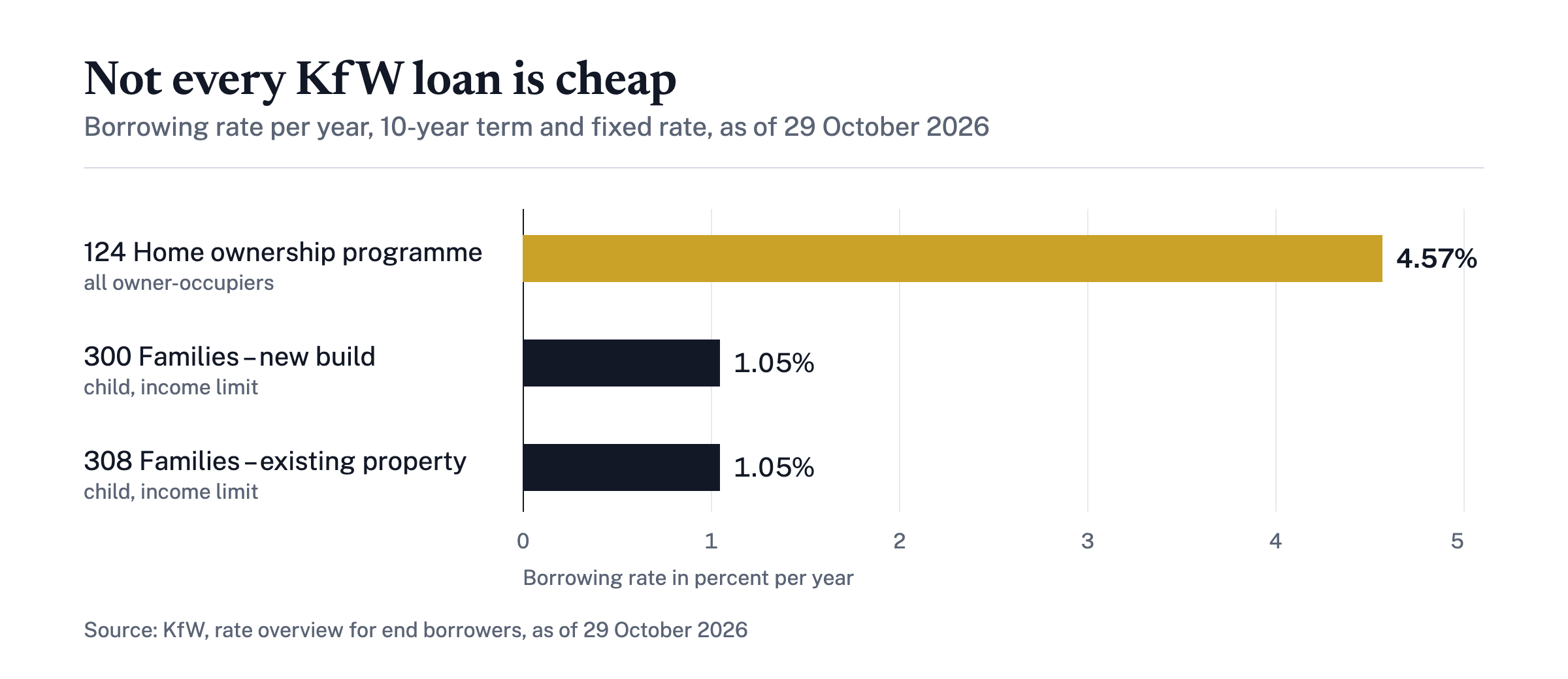
Not every KfW loan is cheap, either. With a ten-year fixed rate, the home ownership programme 124 costs a 4.57% borrowing rate, more than four times the family programmes at 1.05%.[5][9] If 124 is the only programme open to you, compare it with offers from banks. What bank terms depend on is explained in the article on mortgage rates today.
With the family programmes, the price lies elsewhere: they require an efficiency house 40 for a new build or a renovation obligation for an older building. These requirements cost money that the low rate only recovers over the term.
What has changed in KfW funding for heat pumps?
New conditions have applied to KfW heating funding since 21 July 2026, and for most applicants the grant is lower.[10] The basic funding of 30% remains; the cost cap and the bonuses were cut:
| Item | Before 21 July 2026 | Since 21 July 2026 |
|---|---|---|
| Maximum eligible costs, first home | 30,000 euros | 28,000 euros |
| Climate speed bonus | 20% | 16% |
| Income bonus | 30% up to 40,000 euros income | tiered: 40%, 30% or 10% |
| Efficiency bonus and emission reduction supplement | available | dropped |
The values before and after the change are given by the consumer platform co2online,[11] and the end of the efficiency bonus and the emission reduction supplement by Stiftung Warentest.[12] The former income bonus of 30% up to 40,000 euros of household income is described by Utopia.[10] For heat pumps, the loss of the efficiency bonus weighs most, as it was previously an additional component of the funding.
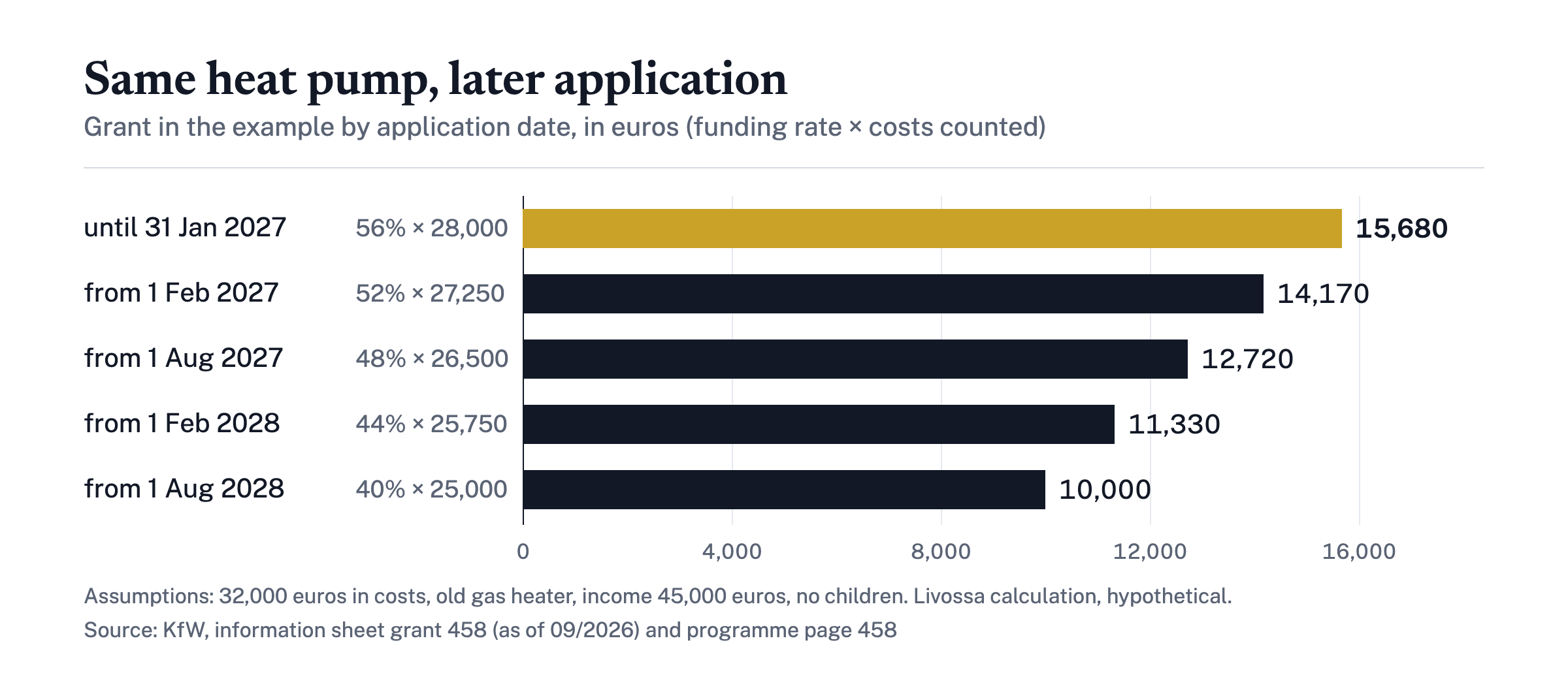
Further cuts are already set. The maximum eligible amount for the first home falls for the first time on 1 February 2027 and then every six months, on 1 February and 1 August, by 750 euros.[7] The climate speed bonus falls on the same schedule by 4 percentage points each time; for applications from 1 August 2028 it no longer exists.[6] What counts is the date of the application.
A hypothetical worked example with disclosed assumptions shows what this means: an owner without children replaces a 22-year-old gas heater in her single-family house with a heat pump costing 32,000 euros. Her taxable annual household income is 45,000 euros. The figures are calculated by Livossa under the KfW rules.
| Application | Costs counted | Funding rate | Grant |
|---|---|---|---|
| until 31 January 2027 | 28,000 euros | 30% + 16% + 10% = 56% | 15,680 euros |
| from 1 February 2027 | 27,250 euros | 30% + 12% + 10% = 52% | 14,170 euros |
Applying in February instead of January means 1,510 euros less in this example. There is also a plan for heat pumps: a value-added bonus (Wertschöpfungsbonus) is to be introduced in the first quarter of 2027. For units from the EU and associated markets, the basic funding of 30% would then remain possible; for units from outside, it could fall to 15%, for example. The Federal Ministry for Economic Affairs was to announce details in the second half of 2026; the bonus has not yet been adopted.[7]
How are KfW grants paid out?
You receive the KfW heating grant only after the system is installed and you have uploaded the proof to the customer portal "Meine KfW". The route there has fixed steps, and the first comes before any contract.
- Obtain the confirmation for the application. An energy efficiency expert or a specialist company prepares the confirmation for the application (Bestätigung zum Antrag, BzA) with the planned heating system and the eligible costs.
- Sign a contract with a condition. The application requires a supply or service contract containing a condition precedent or subsequent: it only takes effect once the funding approval arrives.
- Apply and wait for approval. Only then does the work begin. From approval, you have 36 months to complete the project in full.
- Confirmation after completion. After installation, the specialist company or the expert confirms the proper execution (Bestätigung nach Durchführung, BnD).
- Identify yourself and upload the proof. In the portal, you upload the BnD, your tax identification number and all invoices, and for bonuses also their proof.[7]
After the review, KfW usually pays the grant in the middle or at the end of the month. One exception concerns the new rules: anyone who applied for an income bonus under the conditions valid since 21 July 2026 can probably submit the proof only from January 2027. The payout is delayed accordingly.
For the subsidised loans, the payout runs through the bank. You can draw the loan in one sum or in instalments within twelve months of approval.[2] For your own planning, this means: first check which programme fits, then apply before the purchase contract and set the banks' mortgage rates alongside. An overview of further topics on buying and financing is in the property section; how Livossa checks figures and sources is described in its methodology.
Frequently asked questions
Can you still apply for KfW funding after the purchase?
No. KfW requires the application through the bank before the purchase contract is signed or construction begins. It does not fund projects that have already started or been completed.
Can a couple without children get KfW funding for a house?
Yes, through the home ownership programme 124 with up to 100,000 euros and, for a new build, through the climate-friendly new build programme. The cheaper family programmes 300 and 308, by contrast, require a child under 18 in the household.
Can several KfW programmes be combined?
According to KfW, the home ownership programme 124 can be combined with other funding products. Whether this works in a specific case is shown by the KfW product finders for new builds and existing properties.
What is the maximum grant for a heat pump?
For a single-family house, KfW counts costs of up to 28,000 euros for applications until the end of January 2027. With the 70% cap that is 19,600 euros, and with 80% for low-income households 22,400 euros.
Sources
Risk notice. The content is general information and is not investment, tax or legal advice. Investments carry risks, up to the total loss of the capital invested; past returns are not a reliable indicator of future results. Tax information reflects German law at the time of publication; have your personal situation checked by a tax adviser. Risk notice
Related reading
All Property →Mortgage rates today: What determines the terms
Mortgage rates today: a 10-year fixed-rate period costs around 4.1 to 4.4% (October 2026). Outlook to 2027, compared by fixed-rate period, loan-to-value and energy class.