What changes in 2027 for taxes, pensions and money?
What changes financially in 2027? Minimum wage, retirement savings depot, pension tax and tax reform: what has been decided and what is still a draft.
In this article4

What changes for your money in 2027?
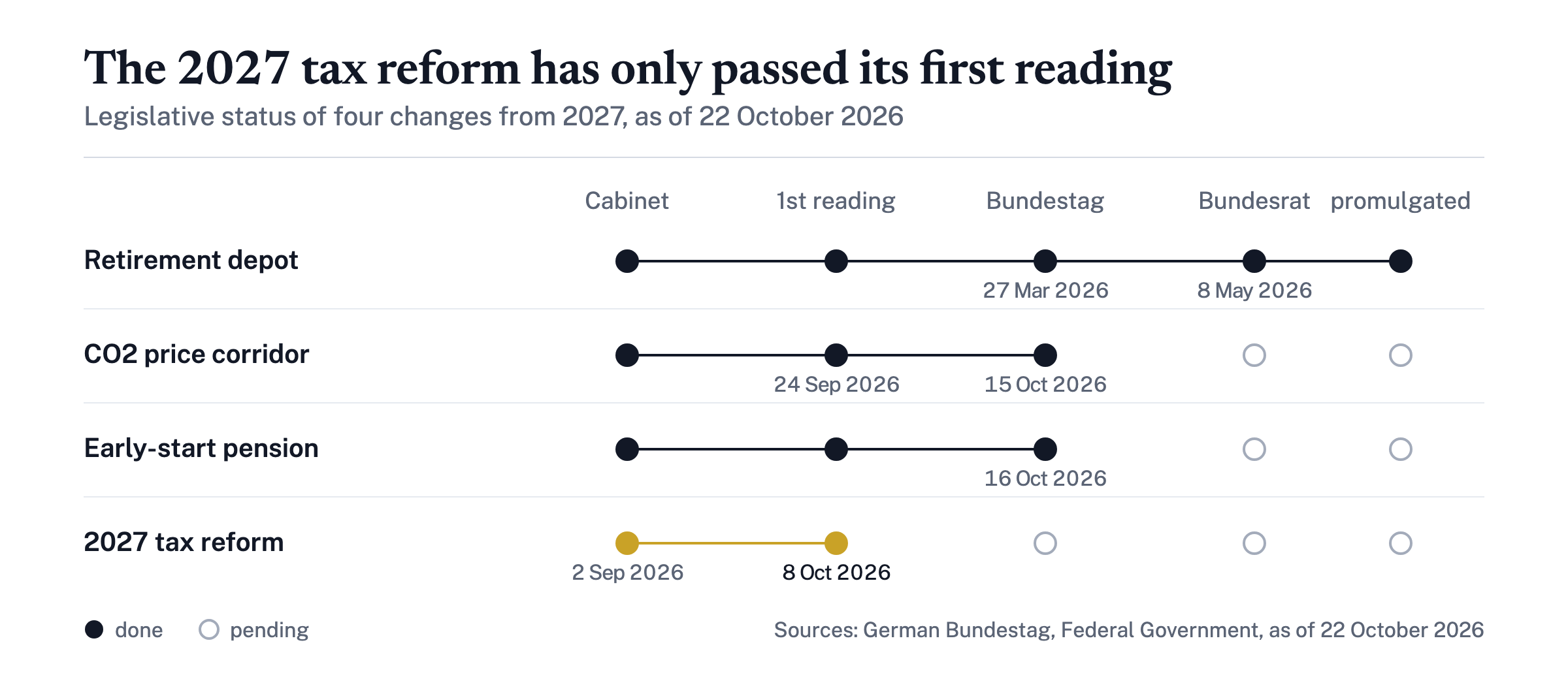
What changes for your finances in 2027 depends above all on whether a rule is already law or only planned. As of 22 October 2026, the higher minimum wage, the reform of private retirement provision, Mothers' Pension III, the higher taxable share for new retirees and the CO2 price for 2027 are settled or have been passed by the Bundestag. The 2027 tax reform, the early-start pension and the new contribution assessment ceilings still depend on the Bundestag or Bundesrat.
The overview below separates the two. For each change, it states the status and the body that published it.
| Change from 2027 | Value | Status |
|---|---|---|
| Minimum wage | 14.60 euros gross per hour | [1]Ordinance in force |
| Retirement savings depot instead of new Riester contracts | Start 1 January 2027 | [2]Law passed |
| Taxable share of pension for pensions starting in 2027 | 84.5 percent | [3]Law |
| Mothers' Pension III | 3 instead of 2.5 years per child born before 1992 | [4]Law, paid out from January 2028 |
| CO2 price for heating oil, gas, petrol, diesel | 55 to 65 euros per tonne | [5]Bundestag passed on 15 October 2026 |
| Early-start pension | 10 euros per month per child | [6]Bundestag passed on 16 October 2026, procedure not complete |
| Health insurance contribution assessment ceiling | 6,375 euros per month | [7]Cabinet has decided, Bundesrat still has to approve |
| Basic tax allowance | 12,564 euros | [8]Government draft |
Minimum wage and minijob threshold
The statutory minimum wage rises on 1 January 2027 from 13.90 to 14.60 euros gross per hour. This is set by the Fifth Minimum Wage Adjustment Ordinance, which has been in force since January 2026.[1][1]
The minijob threshold rises with the minimum wage. The Social Security Code ties it to ten hours per week at the minimum wage: the hourly wage is multiplied by 130, divided by three and rounded up to whole euros.[9] The official value for 2027 will be announced by the Federal Ministry of Labour in the Bundesanzeiger.
Riester pension in 2027: the retirement savings depot launches
The most important change in private retirement provision is the retirement savings depot. The Bundestag passed the reform on 27 March 2026, the Bundesrat on 8 May 2026; the new products are to be offered from 1 January 2027. Within the depot, savers can invest in shares, funds and ETFs. In addition to private providers, a standard depot is planned. The effective costs of the standard depot are capped at 1 percent.[2][10][10]
For Riester savers, the following applies: existing contracts continue and can still be funded; there is no automatic termination or conversion. New contracts under the old Riester model can no longer be taken out from 2027.[2] Switching to the new depot is voluntary.[2]
The subsidy structure has been redesigned:
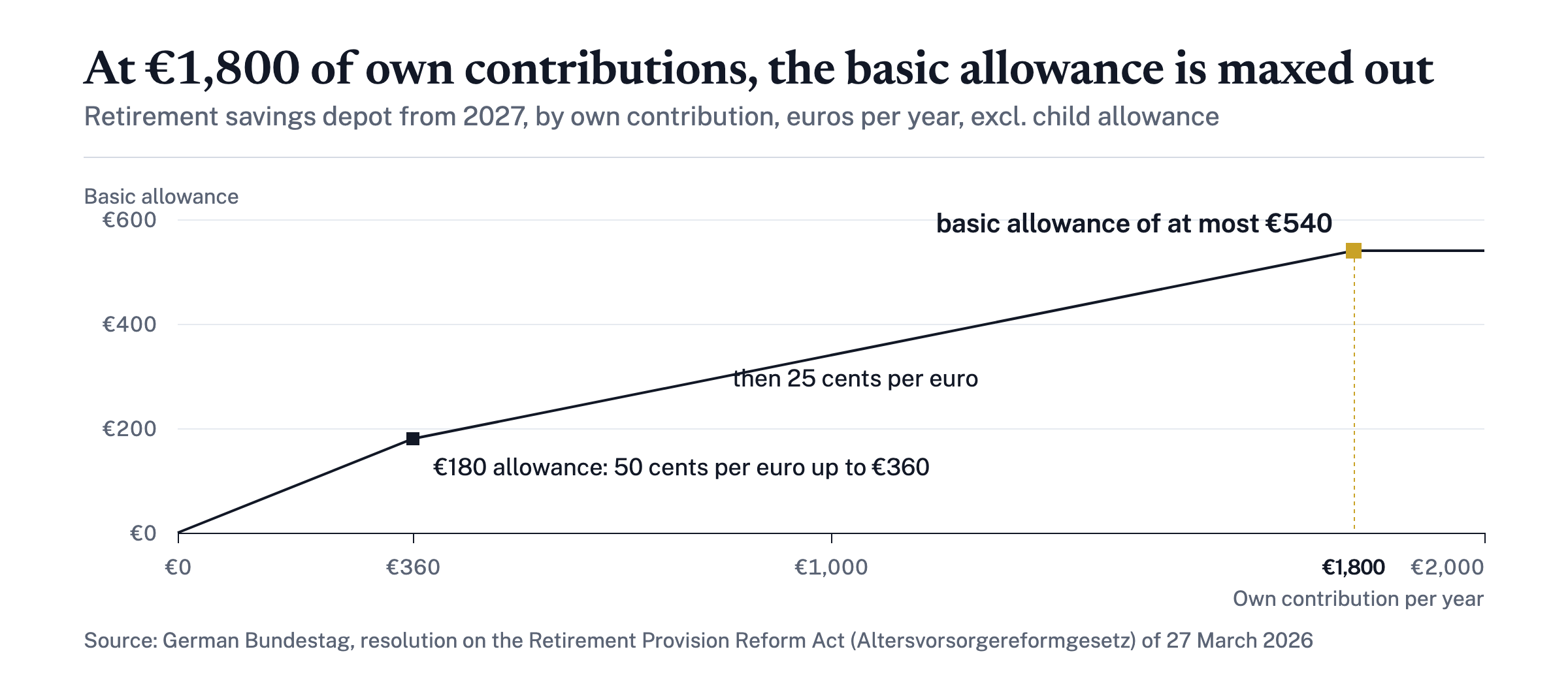
- Basic allowance: 50 cents per euro of own contribution up to 360 euros per year, 25 cents per euro up to 1,800 euros, at most 540 euros per year.[10]
- Child allowance: up to 300 euros per year.[10]
- Newly eligible: self-employed people and compulsory members of professional pension schemes with employee status.[10]
An investment in the depot fluctuates with the market. Those who place a high value on security can still choose products with guarantees. Whether switching from an existing Riester contract is worthwhile depends on that contract's costs and guarantees.
Rürup pension 2027: what is shifting for the basic pension
For the Rürup or basic pension, no fundamental principle changes in 2027, but two figures are moving. The maximum tax-deductible amount is linked to the maximum contribution to the miners' pension insurance scheme. Its contribution assessment ceiling is set to rise to 130,800 euros per year under the cabinet decision of 7 October 2026. If the ceiling rises as planned, the maximum deductible amount rises as well, at the same contribution rate.[7] The exact figure will only be fixed once the Bundesrat has approved and the 2027 contribution rate is set.
In addition, basic pensions, like the statutory pension, are subject to the taxable share of the year in which the pension begins.
Pension: higher taxable share, Mothers' Pension III and the early-start pension
Anyone retiring in 2027 pays tax on 84.5 percent of their pension; for a pension start in 2026, it is 84.0 percent.[3] The tax-free remainder is fixed from the following year as a set euro amount. Whether tax is actually due depends on total taxable income; the article on the question of from what amount retirees pay tax explains how to check this.
Under Mothers' Pension III, three instead of two and a half years of child-raising time are recognised for children born before 1992; it applies from 1 January 2027. Those already receiving a pension will only receive the increase in January 2028 for technical implementation reasons, retroactively for 2027.[4] According to the Federal Ministry of Labour, around ten million people benefit, and the pension level is not to fall below 48 percent until 2031.[4][4]
The Bundestag passed the early-start pension on 16 October 2026. The plan is for the state to pay 10 euros per month for children aged 6 to 18, with the 2020 birth cohort funded first.[11] The funded capital is in principle to be paid out only from the age of 65.[11] According to Deutsche Rentenversicherung, the process is not yet complete; payments are due to begin in 2027.[11][6]
Social security contributions and health insurance
The Federal Cabinet adopted the social insurance reference values for 2027 on 7 October 2026; the Bundesrat must still give its approval. The plan includes:[7]
| Reference value 2027 | per month | per year |
|---|---|---|
| Contribution assessment ceiling for health and long-term care insurance | 6,375 euros | 76,500 euros |
| Contribution assessment ceiling for pension and unemployment insurance | 8,850 euros | 106,200 euros |
| Reference value (Bezugsgröße) | 4,130 euros | 49,560 euros |
Only those who have so far earned above these thresholds will pay higher contributions.
For the average additional contribution of the statutory health insurers, the GKV-Schätzerkreis calculated an unchanged 2.9 percent for 2027.[12] Each insurer sets the actual rate itself. If your insurer raises it, you have a special right of termination; a separate guide explains how switching health insurers works.
Heating and fuel: CO2 price set to stay within the corridor
The national CO2 price on heating oil, natural gas, petrol and diesel is set to remain in the same corridor in 2027 as in 2026.[5] The Bundestag passed the amendment to the Fuel Emissions Trading Act on 15 October 2026; the Bundesrat still has to deal with it in a final step.[5] The background is the postponement of the European emissions trading scheme for buildings and transport to 2028; without the amendment, the 2027 price would have resulted from the fluctuating auction prices in European trading.[5]
Inflation and interest rates: the starting point for 2027
The inflation rate in Germany stood at 3.3 percent in September 2026.[13] Energy was 14.9 percent more expensive than a year earlier; excluding energy and food, the rate was 2.4 percent.[13] The European Central Bank raised its key interest rates by 0.25 percentage points on 10 September 2026. The deposit facility rate has stood at 2.50 percent since 16 September.[14] In its forecast of 12 June 2026, the Bundesbank expects inflation of 2.7 percent for 2027, after 2.9 percent in 2026.[14][15]
For your own money, this means: instant-access and fixed-term deposit rates follow the deposit facility rate, while mortgage rates tend to follow long-term interest rates. Forecasts are assumptions, not promises. A guide to comparing fixed-term deposit rates fixed-term deposit rates compared shows how offers can be compared.
Tax reform 2027
The 2027 tax reform is a draft bill, not law in force.[16] The Federal Cabinet adopted the Income Tax Reform Act 2027 on 2 September 2026. The Bundestag debated the draft in first reading on 8 October 2026 and referred it to the committees; the Finance Committee is leading the process (printed paper 21/8235).[16] The Bundestag and Bundesrat must still approve it, and the figures may change until then.[8]
Basic tax allowance, tax schedule and child benefit
The basic tax allowance is set to rise in 2027 from 12,348 to 12,564 euros and to 12,900 euros in 2028.[8] Child benefit is set to rise from 259 to 267 euros per child per month, and to 272 euros in 2028.[8] For child benefit, that means 8 euros more per month, or 96 euros per year, in 2027. The child tax allowance is set to rise from 6,828 to 7,128 euros; together with the unchanged allowance for care, upbringing or education of 2,928 euros, that makes 10,056 euros per child.[8]
In addition, the federal government wants to flatten the tax schedule for middle incomes, so that the tax burden rises more slowly there.[16]
Lump-sum allowance, tradespeople and the top tax rate
According to the draft, further items that affect many tax returns will change:[8]
- The employee lump-sum allowance is set to rise from 1,230 to 1,430 euros.[8]
- Deductible tradespeople's services are to fall from 20 to 15 percent, capped at 900 instead of 1,200 euros per year.[8]
- Tax-free Sunday and public holiday supplements are to be possible from 1 January 2027 up to an hourly wage of 75 instead of 50 euros.[8]
- For very high incomes, a tax rate of 45 percent is to start at 250,000 euros of taxable income, and one of 47 percent at 280,000 euros.[8]
Anyone planning larger tradespeople's work in 2027 should follow the status of the bill, because the cut would reduce the tax relief for it.
Annual Tax Act 2026: interest and tax assessments
In parallel, the Bundestag is debating the Annual Tax Act 2026 (printed paper 21/8283), which is likewise still a draft.[8] Two points are relevant for private individuals: interest on back taxes and refunds is set to rise from 2027 from 0.15 to 0.3 percent per month, i.e.[8] 3.6 percent per year.[8] And anyone with an ELSTER account is to receive income tax assessments electronically only from 2027.
As a rule, interest starts to run 15 months after the end of the tax year.[8] If you expect a back payment, you can avoid the interest by filing your return early. You can find more on allowances and filing in the Taxes section on Livossa Taxes on Livossa.
What is worth checking now
For rules that have been passed, it is worth checking now; for drafts, only after the vote in the Bundesrat. Three points affect many households:
- Riester savers should check the costs and guarantees of their own contract before deciding whether to switch to the retirement savings depot.
- Anyone retiring in 2027 should calculate with the taxable share of 84.5 percent and check whether a tax return becomes necessary.[3]
- Minijobbers and employers should adjust hours and contracts to the new minijob threshold as soon as the official value is published.
This overview does not replace individual tax or investment advice. Livossa covers new cash rules, such as upper limits and proof requirements for deposits, in a separate article on the cash rules.
Frequently asked questions
Will the basic tax allowance definitely rise to 12,564 euros in 2027?
No, not yet certain. The figure comes from the government draft of the Income Tax Reform Act 2027, which the Bundestag and Bundesrat still have to pass.
Can I still take out a Riester contract in 2027?
No. From 1 January 2027, no new contracts under the old Riester model are possible. Existing contracts continue, and switching to the retirement savings depot is voluntary.
What percentage of the pension must new retirees in 2027 declare as taxable income?
For a pension starting in 2027, 84.5 percent of the pension is taxable. Whether tax is actually due depends on total taxable income.
When will the Mothers' Pension III be paid out?
It applies from 1 January 2027. Those already receiving a pension will get the increase in January 2028, retroactively for 2027.
Will heating become more expensive in 2027 because of the CO2 price?
According to the Bundestag resolution of 15 October 2026, the CO2 price is set to remain within the 2026 corridor in 2027; the final deliberation in the Bundesrat is still pending. The final price for heating oil and gas also depends on the market.
Sources
Risk notice. The content is general information and is not investment, tax or legal advice. Investments carry risks, up to the total loss of the capital invested; past returns are not a reliable indicator of future results. Tax information reflects German law at the time of publication; have your personal situation checked by a tax adviser. Risk notice