Taxing pensions: From what amount pensioners pay tax
Taxing pensions in 2026: basic tax-free allowance, taxable percentage and tax rate for pensioners in Germany, with a worked example and pension table.
In this article5
Taxing a pension in Germany works like this: a fixed share of the statutory pension counts as income, and income tax only becomes due once total taxable income exceeds the basic tax-free allowance. For 2026, this allowance is 12,348 euros, or 24,696 euros for jointly assessed married couples.[1] All figures in this article apply to Germany and the 2026 tax year. They come from the Income Tax Act and from publications by the Deutsche Rentenversicherung, read on 21 October 2026. This article explains the rules in general terms and does not replace individual tax advice.
What is the tax rate for pensioners in Germany?
There is no separate tax rate for pensioners. The taxable portion of the pension is subject to the same income tax schedule as employees or the self-employed, and it rises with income. Section 32a of the Income Tax Act sets it for 2026 as follows:[2]
| Taxable income 2026 (single persons) | Tax |
|---|---|
| up to 12,348 euros | 0 euros (basic tax-free allowance) |
| 12,349 to 17,799 euros | progression zone, marginal tax rate from 14 percent |
| 17,800 to 69,878 euros | progression zone, marginal tax rate rises further |
| 69,879 to 277,825 euros | 42 percent on every additional euro |
| from 277,826 euros | 45 percent on every additional euro |
The difference between the marginal and the average tax rate matters. The 42 percent applies only to the portion of income above 69,878 euros, not to the whole income.[2] With an average statutory pension, the actual burden usually falls in the low single-digit percentage range, as the worked example further below shows.
Jointly assessed married couples are subject to income splitting: the tax is twice the amount that applies to half of the couple's joint income.[2] As a result, the basic tax-free allowance effectively applies twice for the couple.
Which portion of the pension enters this calculation at all is determined by the taxable percentage. It depends on the year retirement begins and is laid down as a table in Section 22 of the Income Tax Act:[3]
| Year retirement begins | Taxable percentage | tax-free portion |
|---|---|---|
| up to 2005 | 50 percent | 50 percent |
| 2015 | 70 percent | 30 percent |
| 2020 | 80 percent | 20 percent |
| 2022 | 82 percent | 18 percent |
| 2023 | 82.5 percent | 17.5 percent |
| 2025 | 83.5 percent | 16.5 percent |
| 2026 | 84 percent | 16 percent |
| 2027 | 84.5 percent | 15.5 percent |
| from 2058 | 100 percent | 0 percent |
Up to the 2020 retirement cohort, the taxable share rose by 2 percentage points per year, then by 1 point, and since the 2023 cohort only by 0.5 percentage points. The Deutsche Rentenversicherung summarises it like this: anyone retiring in 2026 pays tax on 84 percent, and only those retiring in 2058 pay tax on the full pension. Existing pensions keep their once-fixed tax-free amount.[4]
How many pensioners receive how much pension? A table
As of 1 July 2025, around 21.5 million people in Germany were receiving a pension from the statutory pension insurance scheme, excluding survivors' pensions for orphans. According to the Deutsche Rentenversicherung, their average total net pension payment was 1,289 euros per month — 1,416 euros for men and 1,194 euros for women. These are payment amounts after deduction of pensioners' health and long-term care insurance contributions, but before tax.[5] For old-age pensions alone, the same statistics report around 18.9 million pensions averaging 1,154 euros per month as of 31 December 2024.
The German government's 2025 Pension Insurance Report shows how pensions are distributed across size classes. It analyses the gross statutory pension of people aged 65 and over, as of 2023, broken down by household type:[6]
| Gross statutory pension per month | single men | single women |
|---|---|---|
| under 500 euros | 8 percent | 6 percent |
| 500 to under 1,000 euros | 12 percent | 15 percent |
| 1,000 to under 1,500 euros | 24 percent | 29 percent |
| 1,500 to under 2,000 euros | 29 percent | 28 percent |
| 2,000 euros and above | 27 percent | 22 percent |
| Average | 1,560 euros | 1,512 euros |
The table does not directly answer who pays tax. But it shows roughly where the threshold lies: a gross annual pension of 17,084 euros — which, according to the Deutsche Rentenversicherung, remains just tax-free for pensions starting in 2026 — corresponds to about 1,424 euros per month (own calculation).[1] In the analysis, 56 percent of single men and 50 percent of single women have a gross statutory pension of 1,500 euros or more. Whether they actually pay tax, however, depends on the year their pension began, on other income and on deductible expenses. You can find more on the structure and level of retirement income in the Livossa section on the statutory pension.[7]
From what amount is a pension taxed?
The question of from what amount you pay tax on your pension cannot be answered with a single figure. The threshold lies where taxable income exceeds 12,348 euros. For new pensioners with no other income, the Deutsche Rentenversicherung gives an example: with a pension starting in January 2026 and a gross annual pension of 17,084 euros, 16 percent — that is, 2,734 euros — remains tax-free. The remaining 14,350 euros are taxable. After deducting health and long-term care insurance contributions and small lump-sum allowances, taxable income stays below the basic tax-free allowance, so no tax is due in 2026.[1]
The pension allowance stays fixed while the pension rises
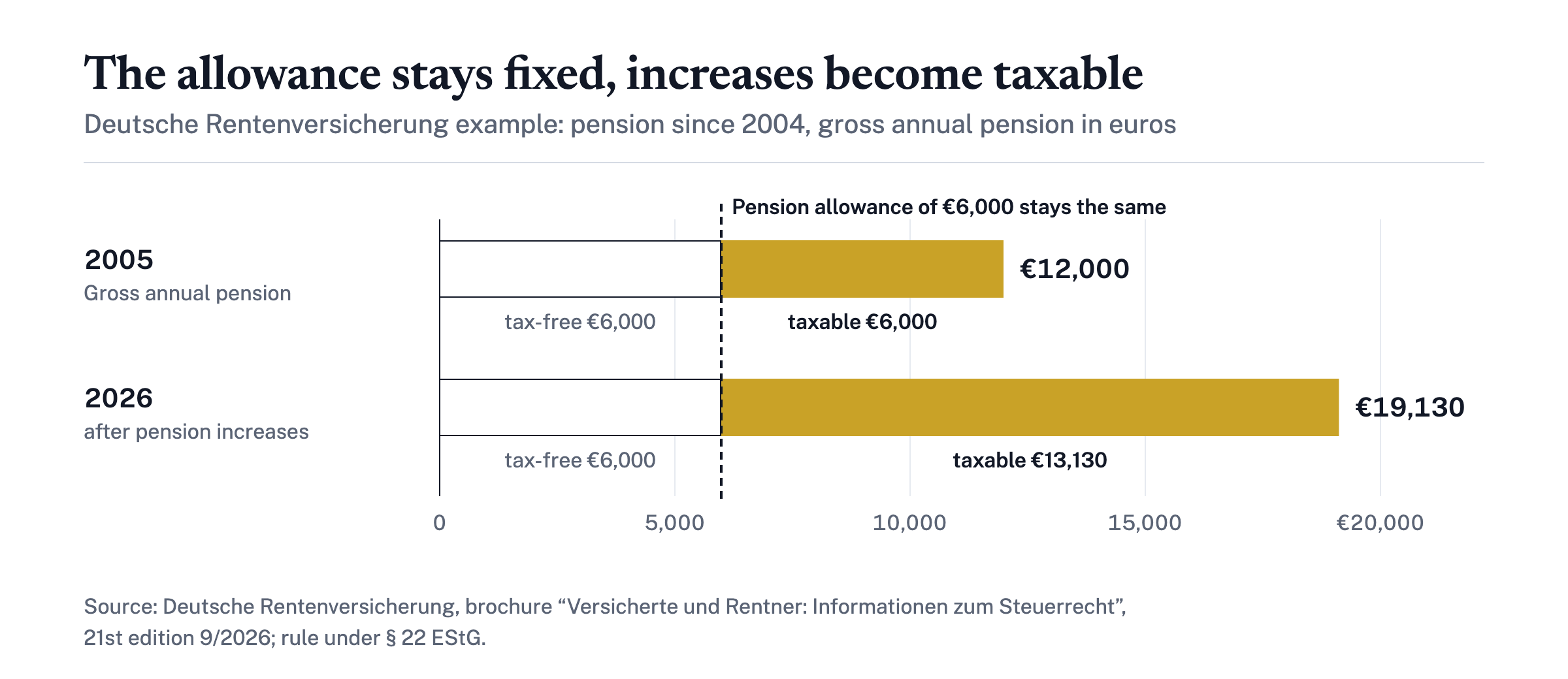
The tax-free portion of the pension is calculated only once, based on the full gross annual pension in the year after the pension begins. From then on, it applies as a fixed euro amount for the entire duration. Regular pension adjustments do not trigger a recalculation.[3] Every pension increase is therefore fully taxable.
This has practical consequences. According to the Deutsche Rentenversicherung, pensions rose by 4.24 percent on 1 July 2026, turning a 1,000-euro pension into 1,042.40 euros. The additional 42.40 euros per month count fully towards the taxable portion.[8] Someone who is just below the basic tax-free allowance in one year can therefore become taxable in a later year, even though nothing else has changed. The Deutsche Rentenversicherung explicitly points out this effect.[1]
Worked example: three pension levels with a pension start in 2026
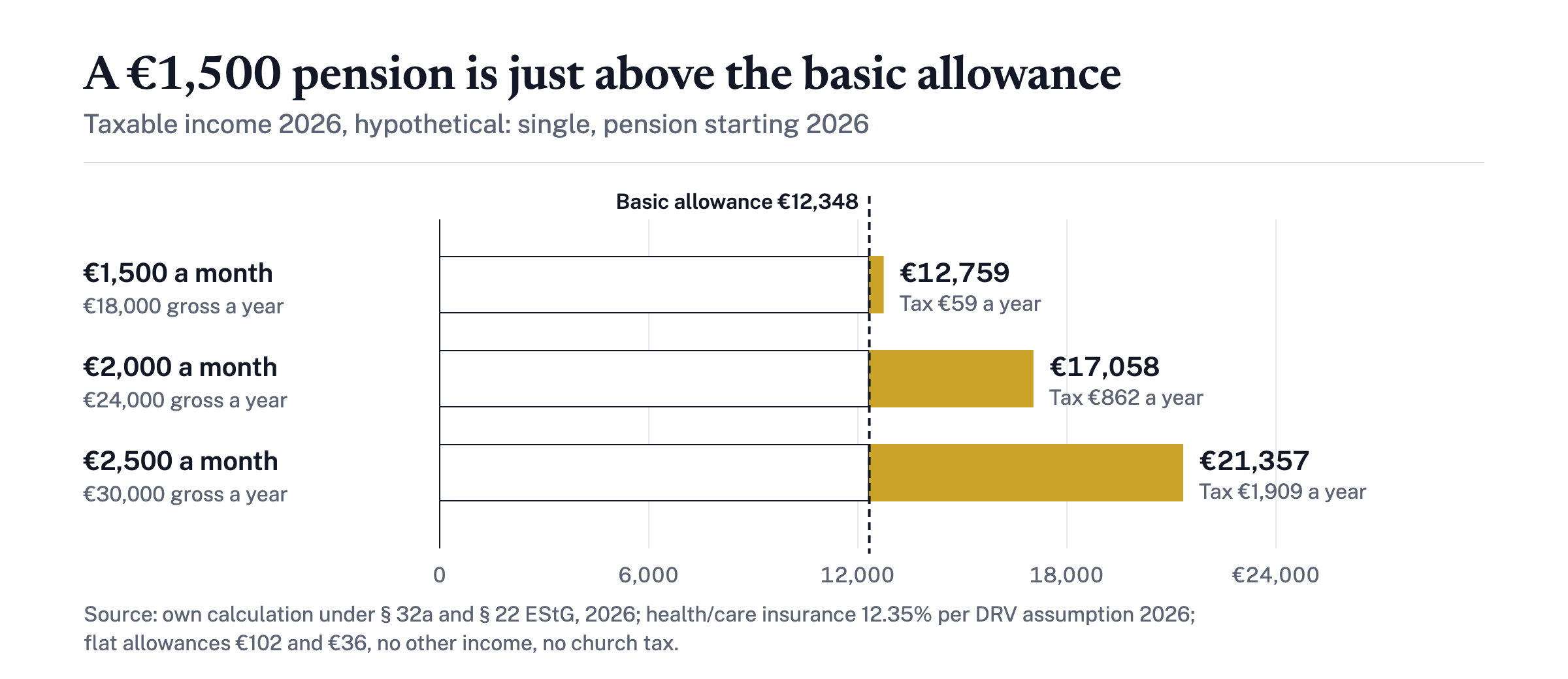
A hypothetical worked example shows the order of magnitude. Assumptions: single person, pension starting in January 2026, a constant gross pension throughout the year (the July adjustment is left out), no other income, covered by statutory health and long-term care insurance, no church tax. Deducted are the lump-sum allowance for income-related expenses of 102 euros for pensions and the lump-sum allowance for special expenses of 36 euros. Contributions to pensioners' health and long-term care insurance are set at 12.35 percent of the gross pension.[9][10] This is the employee share the Deutsche Rentenversicherung assumes for 2026 in its own calculations. The tax is calculated according to the 2026 schedule in § 32a EStG (own calculation).[5][2]
| Assumption: gross pension per month | 1,500 euros | 2,000 euros | 2,500 euros |
|---|---|---|---|
| Annual gross pension | 18,000 euros | 24,000 euros | 30,000 euros |
| taxable portion (84 percent) | 15,120 euros | 20,160 euros | 25,200 euros |
| minus health and long-term care insurance (12.35 percent) | 2,223 euros | 2,964 euros | 3,705 euros |
| minus lump-sum allowances (102 and 36 euros) | 138 euros | 138 euros | 138 euros |
| taxable income | 12,759 euros | 17,058 euros | 21,357 euros |
| income tax 2026 | 59 euros | 862 euros | 1,909 euros |
| share of the gross pension | 0.3 percent | 3.6 percent | 6.4 percent |
At 1,500 euros per month, taxable income in this calculation sits just above the basic tax-free allowance, so the tax remains small. The example published by the Deutsche Rentenversicherung sets the threshold slightly lower, at 17,084 euros in annual gross pension. Depending on the health insurer's additional contribution, the childlessness surcharge in long-term care insurance and other deductible expenses, the threshold shifts by several hundred euros. Anyone who retired earlier has a larger tax-free portion and reaches the threshold correspondingly later.
Other income counts too
The pension is not considered in isolation. For taxable income, all sources of income are added together, for example occupational pensions, a civil servant's pension, income from employment or rental income. Even a low statutory pension can therefore lead to a tax payment if, combined with other income, it exceeds the basic tax-free allowance.[1] Interest and dividends usually follow their own rules with the flat-rate withholding tax and the saver's lump-sum allowance. How to allocate an exemption order correctly is explained in a separate Livossa article.
Whether you have to file a tax return is ultimately decided by the tax office. The pension insurance providers report pension payments to the tax administration every year via the pension payment notification. This report does not replace a tax return.[1] The Livossa section on tax returns collects guidance on deadlines and fo[11]rms.
Conclusion: check your pension start date and other income
Three pieces of information are enough for your own assessment: the year your pension started, your current annual gross pension and the total of all other income. The year the pension started determines the taxable percentage; the pension award notice or the annual statement from the pension insurance provider shows the gross pension. If the calculation lands close to the basic tax-free allowance, the next pension adjustment can already tip the balance. The figures in this article do not replace a review by the tax office, a wage tax assistance association or a tax adviser. How savings can supplement the pension in retirement is covered in [12]the Livossa section on withdrawals in retirement.
Frequently asked questions
Do pensioners have to pay tax at all?
Only if your taxable income is above the basic tax-free allowance — in 2026, above 12,348 euros for single people and 24,696 euros for jointly assessed married couples. Many pensioner households stay below this, especially without additional income.
How much of the pension is tax-free in 2026?
For a pension starting in 2026, 16 percent of the first full year's gross pension remains tax-free as a fixed euro amount. For a pension starting in 2005 or earlier, it is 50 percent; for a pension starting in 2020, it is 20 percent.
Are pension increases taxable?
Yes, in full. The tax-free portion is fixed as a euro amount in the year after the pension starts; later adjustments such as the 4.24 percent increase on 1 July 2026 only raise the taxable portion.
Are short-term Bitcoin gains taxed together with the pension?
If crypto assets such as Bitcoin are sold within one year of purchase, the gain counts as a private sale transaction under Section 23 of the Income Tax Act (EStG). It then counts towards your income together with the pension. They remain tax-free if the total gain from such transactions in the calendar year is below 1,000 euros.
Can I deduct health and long-term care insurance contributions as a pensioner?
Yes. Contributions to health and long-term care insurance reduce taxable income as precautionary expenses; as a pensioner, the same rules generally apply as for employees.
Sources
Risk notice. The content is general information and is not investment, tax or legal advice. Investments carry risks, up to the total loss of the capital invested; past returns are not a reliable indicator of future results. Tax information reflects German law at the time of publication; have your personal situation checked by a tax adviser. Risk notice
Related reading
All Retirement →Rürup pension: For whom it can pay off in tax terms
Rürup pension: who benefits from the Basisrente for tax purposes, what is deductible in 2026, how it is taxed in retirement and what speaks against it.
Private pension insurance: is it worth it or not?
Private pension insurance: worth it or not? What acquisition, administration and effective costs mean, with BaFin figures and a worked example (October 2026).