Current accounts for pensioners: costs and conditions explained
Free current account for pensioners in Germany? Which banks count the pension as income, what Sparkassen charge and what paper services cost.
In this article7

A free current account in retirement does not need a special senior account label; it needs an account model whose condition fits your own pension. Many German banks tie the price of 0 euros to a monthly incoming payment, and for most pensioners the pension is exactly that payment. The question is whether it is high enough. A second point often carries more weight in old age than in working life. If you prefer to hand in transfers on paper or withdraw cash at the counter, many banks charge extra for it. This article sets out both, as of 11 November 2026.
Which banks offer a free current account?
Several German direct banks offer a free current account (Girokonto), some without conditions and some in return for a monthly incoming payment. The second group matters for pensioners, because the pension counts as an incoming payment. The table shows six account models as the banks describe them on their own websites on 11 November 2026. It is a selection of well-known models, not a complete market overview.
| Account | Monthly account fee | Condition for 0 euros | Girocard (debit card) |
|---|---|---|---|
| C24 Smart | 0 euros[1] | none | free of charge[1] |
| N26 Standard | 0 euros[2] | none | no girocard; physical Mastercard Debit 10 euros one-off[2] |
| DKB Girokonto | 0 euros, otherwise 4.50 euros[3] | 700 euros incoming per month or under 28 | 0.99 euros a month[3] |
| ING Girokonto | 0 euros, otherwise 4.90 euros[4] | 1,000 euros incoming per month or under 28 | 1.49 euros a month[5] |
| Commerzbank GiroKonto | 4.90 euros[6] | not applicable, no incoming payment required | included |
| Sparkasse Bad Hersfeld-Rotenburg, Giro Privat M | 5.95 euros[7] | not applicable | Sparkassen-Card girocard 9.90 euros a year |
At DKB and ING, the incoming payment is the real price question. DKB states that the 700 euros may be made up of several amounts; interest credits, returned direct debits and reversals do not count, and the booking date is what matters.[3] A pension of 800 euros is therefore enough there, but not at ING. ING charges 4.90 euros for every calendar month with less than 1,000 euros coming in; this threshold has applied since 1 December 2024, before which it was 700 euros.[4]
The under-28 age rule that both banks advertise does not help in retirement. That leaves pensioners two routes to 0 euros: a pension above the threshold, or an account without conditions such as C24 Smart or N26 Standard. The conditions banks otherwise attach to a free account are covered in Free current account: what really matters in the terms and conditions.
How much money can you keep in a current account?
You can keep as much money in a current account as you like; there is no legal upper limit. Only the protection if a bank fails is limited. Germany's statutory deposit guarantee compensates up to 100,000 euros per customer and bank, regardless of how many accounts the money is spread across.[8] With a joint account, each holder has their own claim, so a married couple is covered for 200,000 euros together.[8]
For the move into retirement, the German Deposit Guarantee Act (Einlagensicherungsgesetz, EinSiG) contains a rule that many people do not know. Cover rises to up to 500,000 euros if the balance has gone above 100,000 euros because of non-recurring amounts linked to life events. The law expressly names entering retirement, as well as lump-sum payouts from occupational pensions and from state-subsidised pension plans, and proceeds from selling an owner-occupied home (Section 8(2) and (3) EinSiG).[9] The higher cover applies for up to six months after the amount is credited, and in a compensation case you have to substantiate the claim above 100,000 euros in writing with evidence.[9]
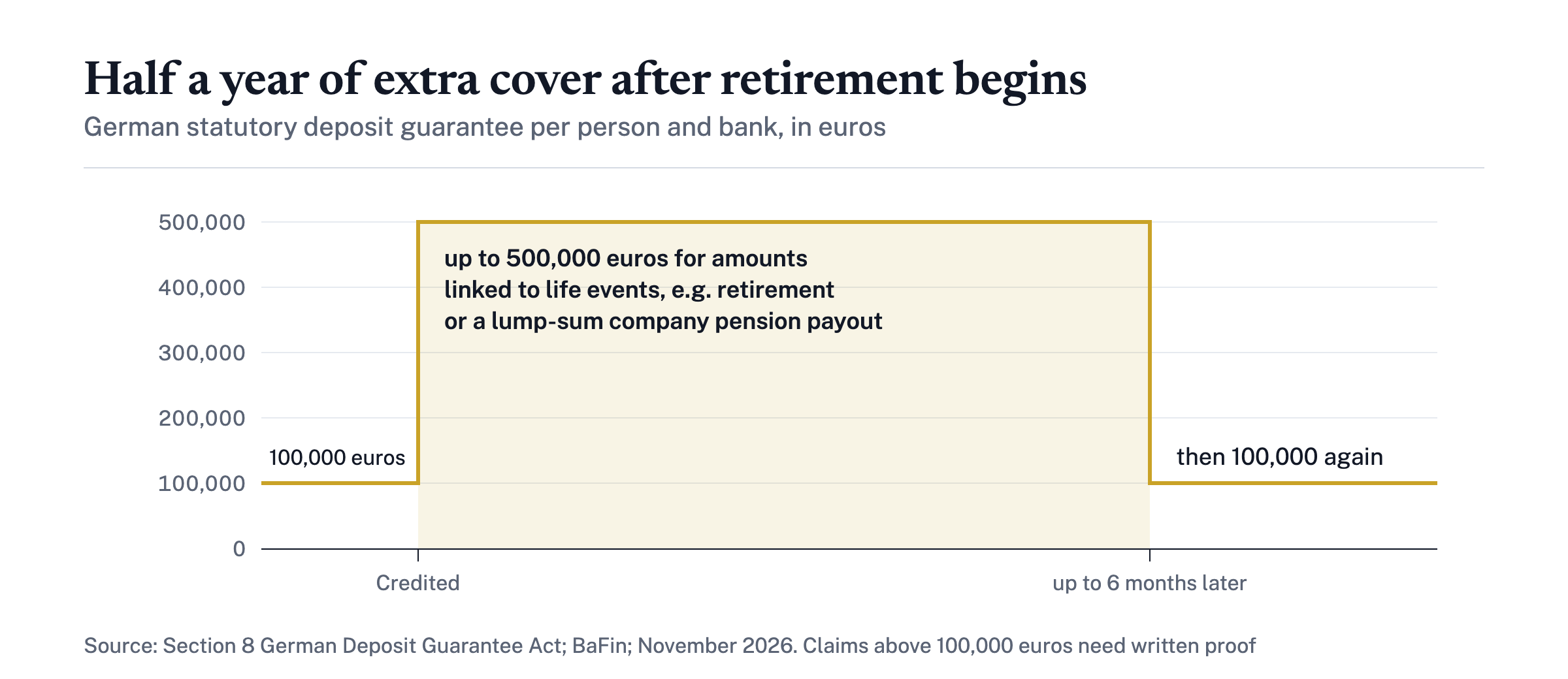
In practice, this means: if you receive a larger lump sum when your pension starts, for example from a company pension, you have half a year to split it up or invest it. After that, the limit of 100,000 euros per bank applies again. How to compare instant-access savings offers for part of it is explained in Instant-access savings: what matters when comparing interest rates.
Which current account does Stiftung Warentest recommend?
Stiftung Warentest, Germany's consumer testing foundation, does not name a single account it recommends to all pensioners; it compares accounts and sets limits below which an account counts as inexpensive. Its database lists 764 current accounts from 190 banks, with the conditions of salary and pension accounts as of 31 August 2026.[10] The names of the individual accounts with prices are in the paid part of the test.
Three results from the free part are useful for pensioners:
- Only twelve accounts are free for everyone without conditions, provided they are managed online. Another 20 are free as long as a condition such as a minimum incoming payment is met.[10]
- An account counts as inexpensive if the account fee is no more than 60 euros a year. On average, the test's model customer pays just under 130 euros a year, and prices range from 0 to 780 euros.[10]
- For customers without a smartphone or PC, the test looks at branch banking separately. An account counts as not recommended for it if single transactions such as a paper transfer cost 2.50 euros or more. The same applies to a surcharge of 3 euros or more for banking without online access, and to banks without branches.[10]
The test's model person receives a regular salary or pension and uses the account online only. If you do your banking at the counter, you usually pay more than the prices in the test show. Stiftung Warentest advises first asking your own bank for a cheaper account model if your account costs more than 60 euros a year, and only then switching.[10]
Does the Sparkasse have a free current account?
Whether a Sparkasse offers a free current account for pensioners cannot be answered across the board: each Sparkasse (German savings bank) is a separate institution and sets its own account models and fees. One example shows how the costs add up. According to its fee information document of 1 October 2026, Sparkasse Bad Hersfeld-Rotenburg charges 5.95 euros a month for the Giro Privat M model, 71.40 euros a year.[7]
The price includes online banking, up to five cash withdrawals at the counter and one paper statement a month from the statement printer, among other things. The physical Sparkassen-Card as a plain girocard costs 9.90 euros a year extra, and each paper transfer costs 1.50 euros, while the same transfer in online banking costs nothing.[7] This difference matters to many older customers: anyone who hands in two paper transfers every month pays an extra 36 euros a year for them.
What your own Sparkasse charges is set out in its fee information document (Entgeltinformation). Every bank in Germany must provide this overview free of charge before the contract is concluded (Section 5 of the German Payment Accounts Act, ZKG).[11] It follows a standard layout, so the fees of different Sparkassen and banks can be laid side by side. The fee information document from Hesse names no discount for pensioners; whether your local Sparkasse grants one can only be asked there. How accounts with a branch and counter service compare is described in Current accounts with a branch: counter service, cash and advice.
Which current account is really free?
A current account is only really free if, besides the account fee, the card and all the transactions you actually use cost nothing. A hypothetical example with the prices from the table above shows how far the results diverge.
Assumptions (hypothetical): 950 euros of pension come into the account every month. The account holder wants a physical girocard and does everything else online. In a second calculation she also hands in two paper transfers at the branch every month, 24 a year. Sign-up bonuses and promotional fee-free months are not included.
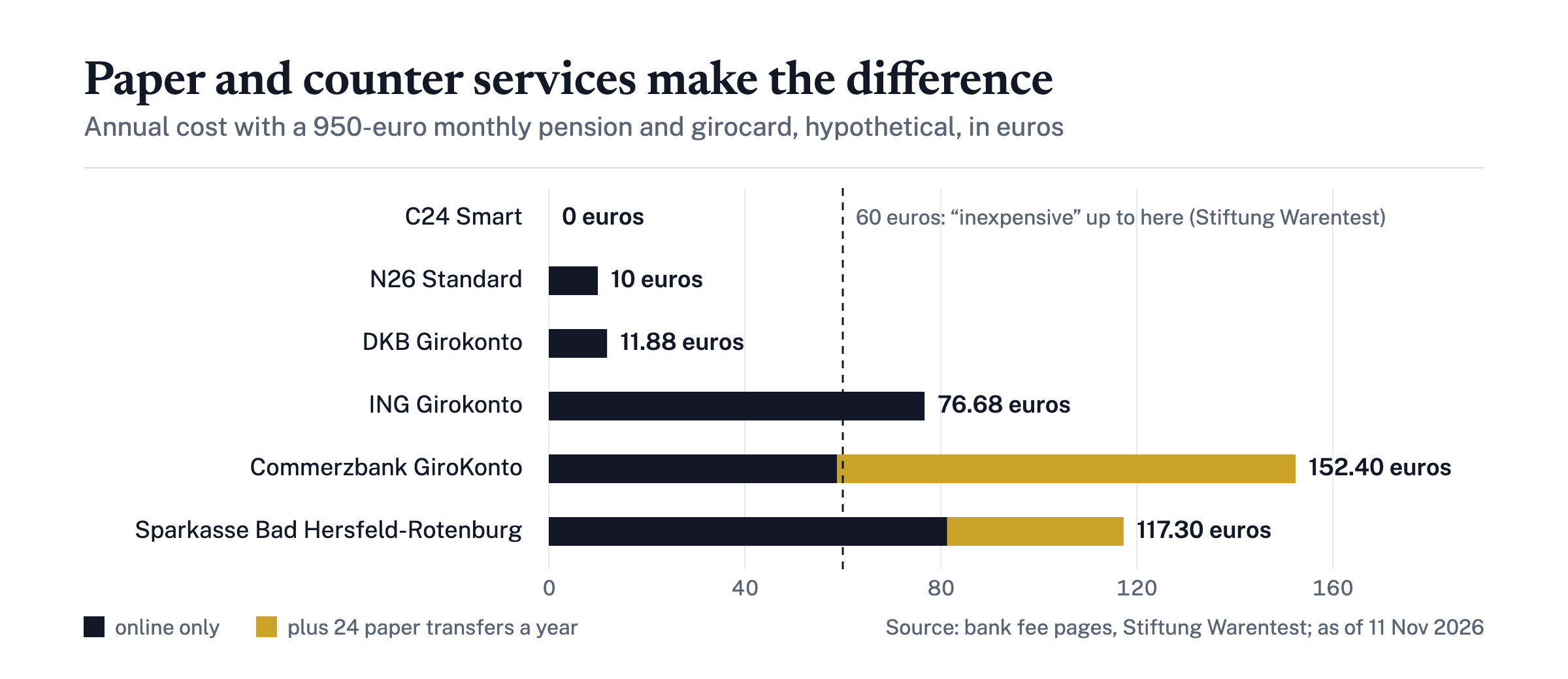
| Account | Account fee per year | Card per year | Annual cost online | with 24 paper transfers |
|---|---|---|---|---|
| C24 Smart | 0 euros | 0 euros | 0 euros | – |
| N26 Standard | 0 euros | 10 euros one-off (Mastercard Debit) | 10 euros in the first year | – |
| DKB Girokonto | 0 euros (950 euros above the 700-euro threshold) | 11.88 euros | 11.88 euros | – |
| ING Girokonto | 58.80 euros (950 euros below the 1,000-euro threshold) | 17.88 euros | 76.68 euros | – |
| Commerzbank GiroKonto | 58.80 euros | included | 58.80 euros | 152.40 euros |
| Sparkasse Bad Hersfeld-Rotenburg, Giro Privat M | 71.40 euros | 9.90 euros | 81.30 euros | 117.30 euros |
At Commerzbank, each paper transfer in the GiroKonto costs 3.90 euros, as does each cash deposit or withdrawal at the counter.[6] At the four direct banks, transfers go through the app or online banking; they do not mention a counter for paper orders on the pages reviewed, which is why the table shows a dash. The calculation shows two things. With a pension just under 1,000 euros, the ING account costs more per year than the Commerzbank account with girocard, even though ING advertises a free account. And anyone who relies on paper and the counter ends up above the 60-euro limit that Stiftung Warentest uses for inexpensive at both branch banks.
Three further points complete the picture:
- Basic account: Every bank that offers current accounts to consumers must offer a basic account (Basiskonto) on request, no later than ten business days after receiving the application (Section 31 ZKG).[12] That does not make it free, but it secures access to an account.
- Switching accounts: The new bank must help with the switch on request. With your authorisation, it asks the old bank for the standing orders, the direct debit mandates and the incoming transfers of the previous 13 months (Sections 20 and 22 ZKG).[13] From that list you can see who needs to be told about the new bank details, including the payer of the pension.
- Neutral comparison: Germany's financial regulator BaFin runs a comparison website for payment accounts that is free of charge (Section 16 ZKG).[14] In the BaFin account comparison, the fees of many account models can be set side by side.
In the end, your own usage decides. If you know your pension amount, the card you need and how much you bank on paper or at the counter, you can work out in a few minutes, with the fee information documents of two banks, what an account costs per year. Conditions change, so all figures apply only as of 11 November 2026. How Livossa builds its comparisons is described in its methodology. Tax on the pension also depends on its amount; from what amount it applies is explained in Taxing pensions: from what amount pensioners pay tax.
Frequently asked questions
Does the pension count as an incoming payment for a free account?
DKB adds up all incoming payments in a month and excludes only interest credits, returned direct debits and reversals, so a pension counts there. Stiftung Warentest also bases its comparison on a model person who receives a regular salary or pension. What matters is whether the pension reaches the threshold: 700 euros a month at DKB and 1,000 euros at ING.
Is there a special senior account?
The pages reviewed for the six banks compared show no separate account model for pensioners. At DKB and ING, age benefits apply only under 28. Whether a regional Sparkasse or Volksbank grants discounts to pensioners is stated in its fee information document or can be asked locally.
What does a paper transfer cost?
That depends on the bank. Sparkasse Bad Hersfeld-Rotenburg charges 1.50 euros per paper transfer in the Giro Privat M model, Commerzbank 3.90 euros in the GiroKonto. Online, the same transfer costs nothing at either. Stiftung Warentest considers an account with 2.50 euros or more per transaction not recommended for branch banking.
How much money is safe in a current account?
Germany's statutory deposit guarantee protects 100,000 euros per person and bank. For up to six months after the amount is credited, cover rises to up to 500,000 euros if the money comes, for example, from entering retirement, a lump-sum company pension payout or the sale of an owner-occupied home.
Do I have to tell the pension insurance about a new account?
If you want your pension paid into a new account, you have to give the payer of the pension the new bank details. The new bank's account switching service lists the incoming transfers of the previous 13 months, so you can see who needs to be informed.
Sources
Risk notice. The content is general information and is not investment, tax or legal advice. Investments carry risks, up to the total loss of the capital invested; past returns are not a reliable indicator of future results. Tax information reflects German law at the time of publication; have your personal situation checked by a tax adviser. Risk notice
Related reading
All Banking →Premium current accounts at branch banks: What the account price includes
Premium current accounts at six German branch banks: which gold credit card the account price includes and what cash costs with it. As of October 2026.

Current account with a credit card: What the account price includes
Current account with a credit card: which accounts include the card in the account price, what cash costs with it, and how to work out account and card per year.
Current account in Munich with advice: HVB and Sparkasse compared
Current account in Munich with advice: what HVB and Stadtsparkasse München include in the account price and what costs extra at the counter (October 2026).