Free current account: what really matters in the terms and conditions
Free current account? Six account models with conditions, card fees and annual costs (as of 23 October 2026) and the points you should check beforehand.
In this article7

A free current account is available in Germany from several banks, but rarely without fine print. Whether a current account stays free is usually decided by one condition: a minimum monthly incoming payment, a maximum age or a specific account status. The financial regulator puts it plainly in its own account comparison: an account with a monthly fee of 0.00 euros is not always free of charge.[1] This article shows which banks offer account management for 0 euros, what they tie it to, and how to calculate the actual costs for your situation.
Which bank has a free current account?
Free current accounts are offered by both direct banks and smartphone banks, with different conditions. The table summarises six account models as the providers describe them on their own websites on 23 October 2026. It is a selection of well-known models, not a complete market overview.
| Account | Account management per month | Condition for 0 euros | Debit or Girocard |
|---|---|---|---|
| C24 Smart (C24 Bank) | 0 euros | none | Mastercard and Girocard at no charge |
| N26 Standard | 0 euros | none | virtual card at no charge, physical card 10 euros one-off |
| DKB current account | 0 euros, otherwise 4.50 euros | 700 euros in monthly incoming payments or under 28 years of age | Visa debit card at no charge, Girocard 0.99 euros per month |
| ING current account | 0 euros, otherwise 4.90 euros | 1,000 euros in monthly incoming payments or under 28 years of age | Visa debit card at no charge, Girocard 1.49 euros per month |
| Commerzbank GiroKonto | 4.90 euros | not applicable, no incoming payment required | Girocard included |
| Sparkasse Bad Hersfeld-Rotenburg, Giro Privat M | 5.95 euros | not applicable | digital Sparkassen-Card included |
The figures come from the providers' websites: C24,[2] N26,[3] DKB,[4] ING,[5] Commerzbank[6] and the fee information of Sparkasse Bad Hersfeld-Rotenburg dated 1 October 2026.[7] The price of 4.90 euros for an ING account without the required incoming payment is stated by ING in its customer letter on the change effective 1 December 2024; since then, the threshold has been 1,000 euros instead of 700 euros.[8] Terms and conditions change, so the table is only valid as of its stated date.
At which bank is the account free of charge?
The account is free of charge at the bank whose condition you meet on a lasting basis. Three types of conditions are the most common:
- Minimum incoming payment: DKB requires 700 euros per month, ING 1,000 euros. Anyone who stays below that pays 4.50 euros at DKB and 4.90 euros at ING per month.
- Age: At DKB and ING the condition does not apply to anyone under 28. From the 28th birthday, the incoming payment threshold then applies.
- No condition: C24 Smart and N26 Standard name neither a minimum incoming payment nor an age limit. N26 explicitly states that the Standard account has neither account management fees nor minimum amounts.[3]
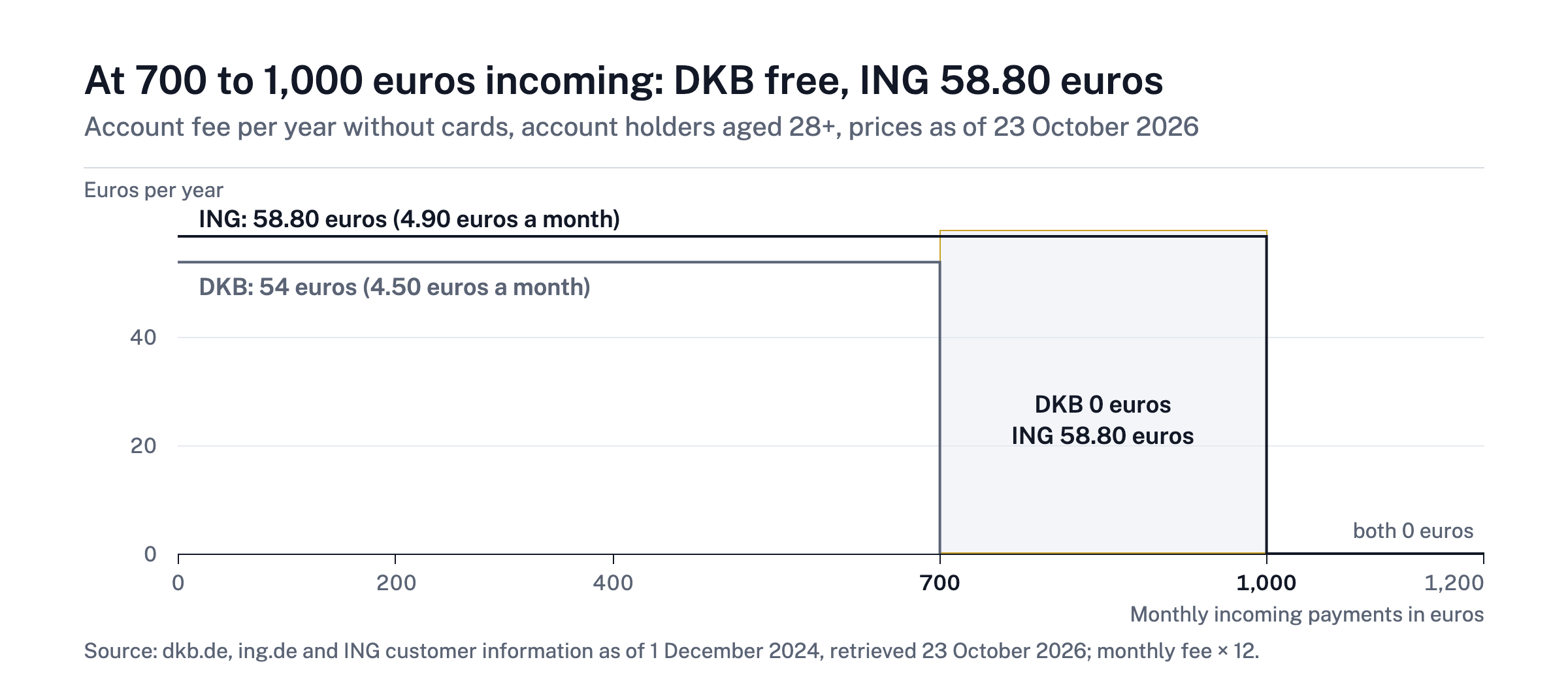
A condition can sometimes also have an effect somewhere other than account management. DKB names two debit interest rates for the granted overdraft: 9.06 percent with Active status and 9.66 percent without.[4] Anyone who uses the overdraft facility therefore pays the difference in addition, even if account management itself remains free.
With many banks, it remains unclear which payments count as an incoming payment. The Verbraucherzentrale NRW asked ten banks about this in November 2020. Some institutions accepted every credit, others only salary, statutory pension and wage replacement benefits; rental income and transfers to yourself were excluded there. None of the banks surveyed listed in detail in their price schedule which inflows of money they recognise and which they do not.[9] The sample is older and the thresholds have changed since then. You should still ask the question itself before switching, preferably in writing.
For practice, this means: anyone who receives a regular salary above the threshold into the account usually meets the condition without effort. It becomes more difficult with fluctuating income, during parental leave, in case of unemployment, or when the salary goes to a different account. In that case, an account without a condition or with a low threshold is the more reliable choice.
Does the Sparkasse offer a free current account?
There is no uniform answer for all Sparkasse branches: each Sparkasse is its own institution with its own published price list and its own account models. Sparkasse Bad Hersfeld-Rotenburg, for example, names in its fee information dated 1 October 2026 total annual fees of 71.40 euros for the Modell M and 13.95 euros per month for the Modell L, i.e. 167.40 euros per year.[10] Modell M includes, among other things, online banking, a digital Sparkassen-Card and a set number of bookings free of charge.[7] Another Sparkasse can have completely different models and prices.
What the Sparkasse in your area charges is stated in its fee information. Every bank must provide you with this overview free of charge before concluding a contract under Section 5 of the Payment Accounts Act (Zahlungskontengesetz).[11] It follows a standardised format, so the prices of different institutions can be placed side by side. In addition, the BaFin account comparison helps: there you can display all account models of a Sparkasse and filter them by account management fee or monthly incoming payment.[1]
Young people often have their own terms and conditions at many banks. The Livossa article current accounts for students and apprentices describes which age limits and proofs are common.
Which bank offers the best current account?
Which bank offers the best current account depends on your incoming payments, your age and the cards you need; there is no account that is cheapest for everyone. A hypothetical calculation example shows how much the result can vary.
Assumptions (hypothetical): a person is 30 years old, 800 euros arrive in their account every month, and they want a Girocard for payments within Germany. Only account management and the Girocard are calculated over twelve months, at the prices as of 23 October 2026. Withdrawals, over-the-counter transfers and overdraft interest are left out.
| Account | Account management per year | Girocard per year | Total per year |
|---|---|---|---|
| C24 Smart | 0 euro | 0 euro | 0 euro |
| DKB current account (700 euro condition met) | 0 euro | 11.88 euro | 11.88 euro |
| Commerzbank GiroKonto | 58.80 euro | included | 58.80 euro |
| Sparkasse Bad Hersfeld-Rotenburg, Giro Privat M | 71.40 euro | digital card included | 71.40 euro |
| ING current account (1,000 euro condition not met) | 58.80 euro | 17.88 euro | 76.68 euro |
N26 Standard is missing from the table because the N26 website lists a Mastercard debit card instead of a Girocard; the physical card costs a one-off 10 euros there.[3] With 1,000 euros in incoming payments instead of 800 euros, the ING total would fall to 17.88 euros — the price of the Girocard alone. Just 200 euros more in monthly incoming payments therefore shifts the ranking noticeably.
The calculation shows prices, but not everything that makes up an account. Besides the costs, branch proximity, cash deposits, an overdraft facility and telephone service may be what tips the balance for you. The criteria behind the comparisons on this site are described on the methodology page. If you deliberately want to pay more for services such as a credit card, the trade-offs are discussed in the article premium current account with a credit card.
Which current account is really free of charge?
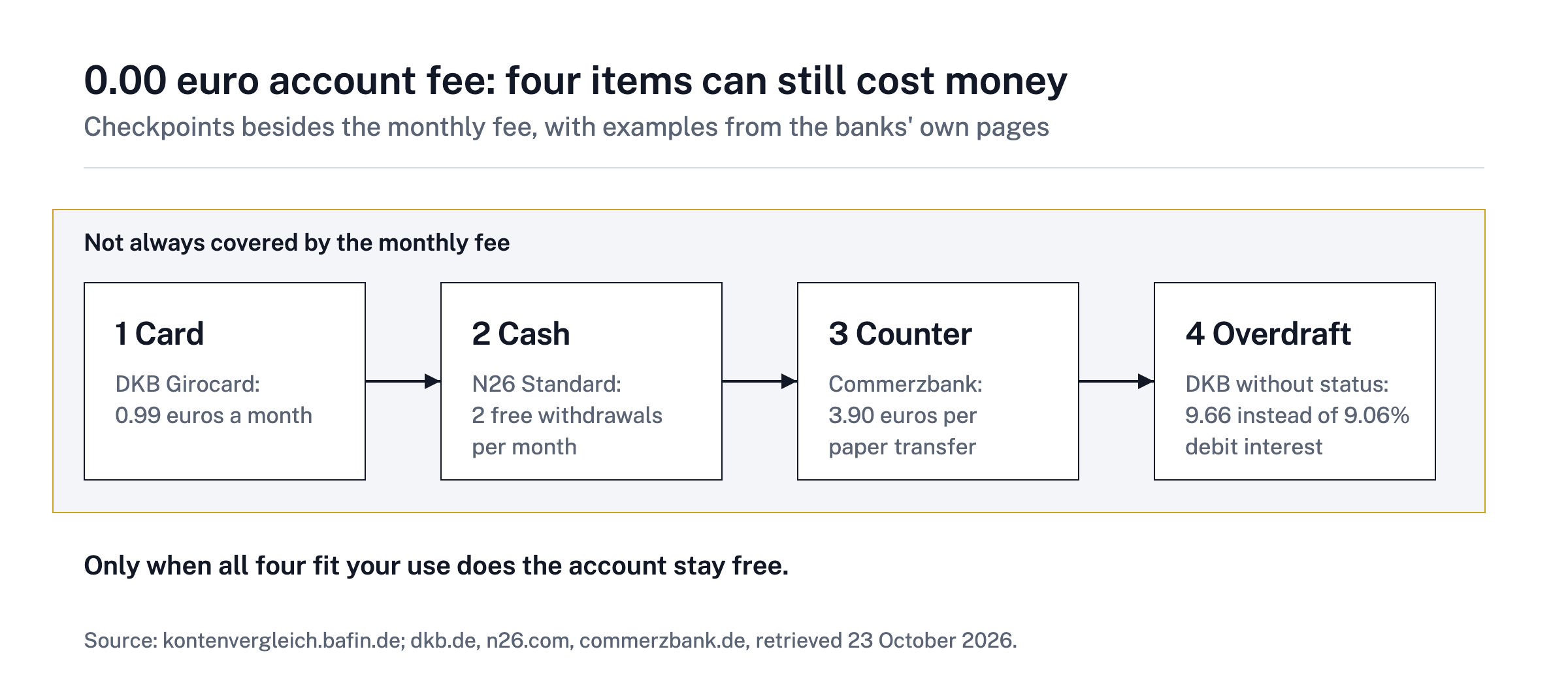
A current account is only genuinely free of charge if the services you actually use cost nothing as well. The monthly fee covers different services in each account model, and additional charges can come on top.[1] You should therefore check four cost items besides account management:
- Cards: A Girocard costs 0.99 euros per month at DKB and 1.49 euros at ING; the physical card at N26 costs a one-off 10 euros.
- Cash: N26 Standard includes two free withdrawals per month in the eurozone, C24 Smart four. If you withdraw cash more often, check the fee for each additional withdrawal in the price schedule.[2]
- Paper-based and counter orders: Commerzbank charges 3.90 euros per paper-based transfer and per cash deposit or withdrawal at the counter.[6]
- Overdraft: A higher debit interest rate without Active status costs money as soon as the account goes into the red.
A neutral overview of the whole market is provided by the BaFin account comparison. The financial regulator runs it free of charge under Section 16 of the Payment Accounts Act (Zahlungskontengesetz).[12] It shows around 6,900 account models from roughly 1,100 providers for private individuals in Germany. Banks must report their data and are themselves responsible for its accuracy; the BaFin does not issue recommendations.[13] Before opening an account, the fee information for the individual account therefore remains the binding source.
Two checks are worth doing. Look at your account statements from the last twelve months: how much came in each month, how often did you withdraw cash, and do you need a Girocard? Then put the fee information for two or three accounts side by side and run the numbers with your own figures. Livossa collects further articles on account models and fees in the current account section.
Frequently asked questions
Is there a free current account with no minimum incoming payment?
Yes. According to their provider websites as of 23 October 2026, C24 Smart and N26 Standard require neither a minimum incoming payment nor a minimum age for account management at 0 euros. Charges can apply there for additional withdrawals or a physical card.
What happens if the minimum incoming payment is missing in a given month?
The bank then charges the regular account management fee for that month — 4.50 euros at DKB and 4.90 euros at ING. At DKB, the debit interest rate on the overdraft facility also rises without Active status.
Does every transfer count as an incoming payment?
Not necessarily. A 2020 sample check by Verbraucherzentrale NRW found banks that only recognised salary, pension and wage replacement benefits. Ask before opening the account which credits your bank counts.
Where can I find the exact prices of an account?
In the fee information, which every bank must provide free of charge before the contract is concluded. The BaFin account comparison gives an overview of all reported account models.
How much effort is switching accounts?
There is a statutory account switching service for moving accounts. As a rule, the new bank initiates the switch at your request and provides a form for this; you must authorise both banks to act on your behalf.
Sources
Risk notice. The content is general information and is not investment, tax or legal advice. Investments carry risks, up to the total loss of the capital invested; past returns are not a reliable indicator of future results. Tax information reflects German law at the time of publication; have your personal situation checked by a tax adviser. Risk notice
Related reading
All Banking →Current account in Munich with advice: HVB and Sparkasse compared
Current account in Munich with advice: what HVB and Stadtsparkasse München include in the account price and what costs extra at the counter (October 2026).

Current accounts with a branch: counter service, cash and advice
Current account with a branch: what cash at the counter costs. HVB and Stadtsparkasse München compared, with a worked example for depositors (October 2026).
Premium current account with credit card: Is the surcharge worth it?
Premium current account with credit card: when the surcharge pays off, what the price includes and how to work out the annual cost of account and card yourself.