Instant-access savings: What matters when comparing interest rates
Instant-access savings comparison in October 2026: permanent rate, promotional rate, existing customers and deposit protection, with sources, date and a worked example.
In this article8
- Which bank currently has the best instant-access savings rates?
- How high are the rates for existing customers?
- When will instant-access savings earn more interest again?
- What is a DKB Visa Tagesgeld?
- Which bank pays 3% interest on instant-access savings?
- Which bank pays 4% interest on instant-access savings?
- Frequently asked questions
- Sources

An instant-access savings account is an interest-bearing account with no fixed term: you can access your balance at any time, but the bank can change the interest rate at any time. This is precisely where the most important rule for a fair comparison comes from. What should be compared is not the biggest numbers in the advertising, but the permanent rate, the promotional conditions and the safety — each with a date and a source. All figures in this article apply to Germany and were read from the providers' websites and the European Central Bank on 19 October 2026.
Which bank currently has the best instant-access savings rates?
The short answer is: it depends on whether you are comparing the permanent rate or a temporary promotional rate. For the permanent rate on unlimited amounts, major banks are closely clustered; for promotions, the figures diverge considerably.
DKB itself publishes an overview of permanent instant-access savings rates on its product page.[1] It shows rates for unlimited deposit amounts, after temporary promotions have expired and without new-customer bonuses. One caveat applies: the table comes from a provider that is itself part of the comparison and is dated 8 September 2026.
| Bank | Permanent rate p.a. (as of 08/09/2026) |
|---|---|
| DKB | [1]1.00% |
| Consorsbank | 1.00% |
| Postbank, ING, Comdirect, Commerzbank, Volksbank Berlin | 0.75% |
| Berliner Sparkasse | 0.50% |
| Santander | 0.30% |
There are also offers outside classic instant-access savings accounts. Trade Republic, for example, states on its website that it pays 2.5 percent per year in interest on balances.[2] Whether such a clearing account suits your own reserve depends on the conditions, amount limits and deposit protection, which you should check in the provider's schedule of prices and services.
Four criteria help with your own comparison:
- Permanent rate: Which rate applies without a promotion, from what amount and up to what limit?
- Promotional conditions: How long does a higher rate apply, only for new customers or only for new money, and up to what amount?
- Interest credit: Monthly, quarterly or annually? More frequent credits slightly increase the compounding effect.
- Deposit protection: Which country, which statutory protection scheme, and are there additional protection funds?
How high are the rates for existing customers?
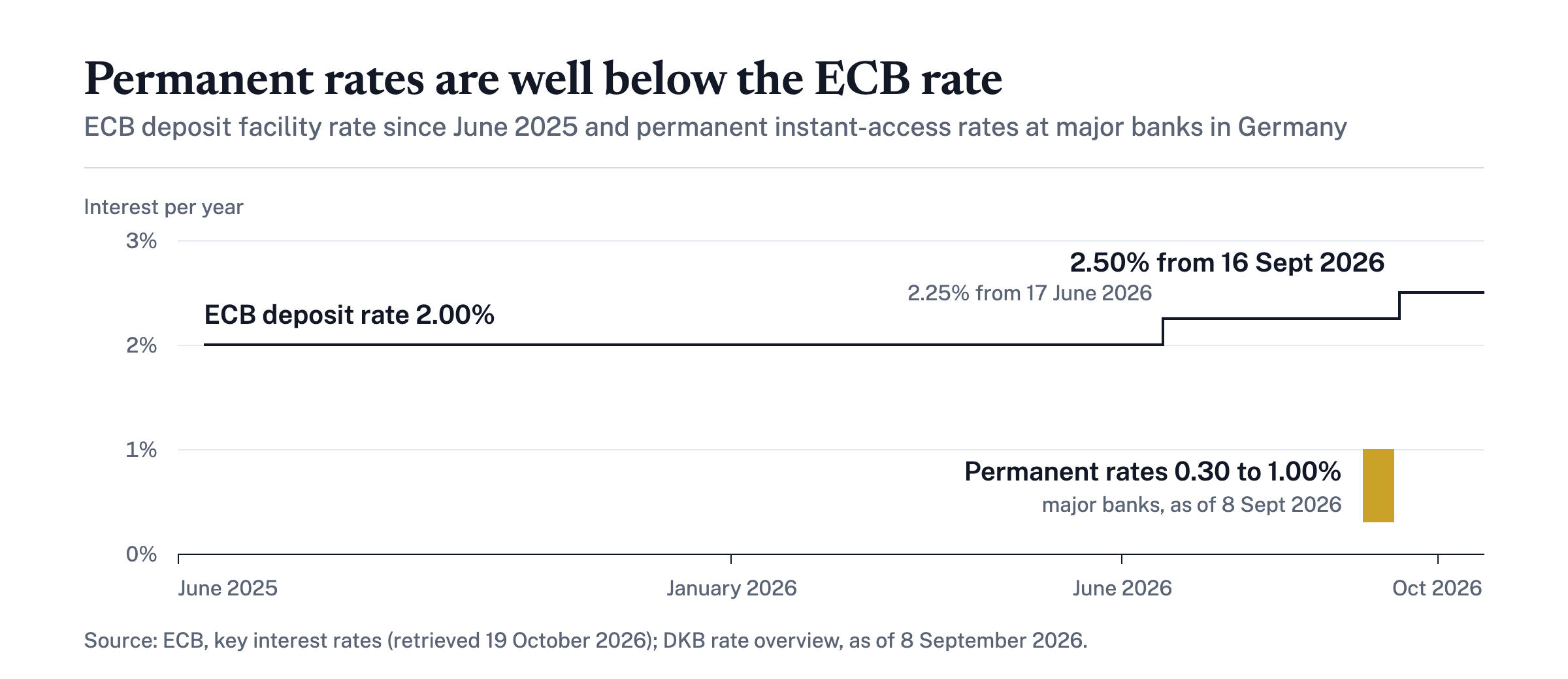
At most banks, existing customers receive the permanent rate — that is, the rate shown in the table above. In October 2026, this is 0.30 to 1.00 percent per year at major German banks, depending on the provider. Higher rates in advertising usually apply only to money that is new to the bank.
DKB describes its own model as follows: 1 percent per year, variable, from the first euro, credited quarterly, regardless of whether you are a new or existing customer.[1] The promotional rate of 4 percent, by contrast, applies only to amounts transferred from another bank during the promotional period.
For existing customers, this leads to two practical checks. First: look up the rate that currently applies in your online banking or in the schedule of prices and services, not on the promotional page. Second: check whether your bank is running a new money promotion that existing customers can also use, and what applies once it ends.
When will instant-access savings earn more interest again?
There is no reliable forecast. An important reference point, however, is the deposit facility rate of the European Central Bank, which banks use as a benchmark when setting the interest they pay on deposits.
The ECB raised this rate twice in 2026: to 2.25 percent effective 17 June 2026 and to 2.50 percent effective 16 September 2026. Before that, it had stood at 2.00 percent since 11 June 2025.[3]
| Effective from | ECB deposit facility rate |
|---|---|
| 11 June 2025 | 2.00% |
| 17 June 2026 | 2.25% |
| 16 September 2026 | 2.50% |
Banks do not pass such changes on to savers automatically or in full. The gap between the 2.50 percent ECB deposit facility rate and permanent rates of 0.30 to 1.00 percent shows how wide this margin is. Whether and when your bank will follow suit cannot be predicted. Rather than waiting, it makes more sense to compare your own rate with the market regularly.
What is a DKB Visa Tagesgeld?
The DKB-VISA-Tagesgeld is an older instant-access savings product from DKB that some customers still hold. DKB explicitly lists it as an exception on its instant-access savings page: neither the 1 percent rate from the first euro nor the promotional rate of 4 percent applies to an "DKB-VISA-Tagesgeld that may still exist".[1]
If you hold such an account, it is worth checking the current schedule of prices and services for savings products. It states which rate applies to your account. If it differs from DKB's current instant-access savings account, you can ask the bank whether a switch to the current product is possible.
Which bank pays 3% interest on instant-access savings?
In the comparison table above, no bank pays a permanent 3 percent: according to the DKB overview, permanent rates are at most 1.00 percent.[1] Rates around 3 percent usually appear as limited-time promotions for new customers or new money.
If you come across such an offer, check it against the same criteria as in the first section above. The rate that applies after the promotion ends matters most, as does the country where the bank is based.
Which bank pays 4% interest on instant-access savings?
In October 2026, DKB is offering a promotional rate of 4 percent per year, but under narrow conditions.[1] The rate applies to amounts transferred from another bank to the DKB instant-access savings account between 6 and 20 October 2026. This new money earns interest from 1 November 2026 to 28 February 2027 — four months — on up to 100,000 euros. After that, the permanent rate applies.
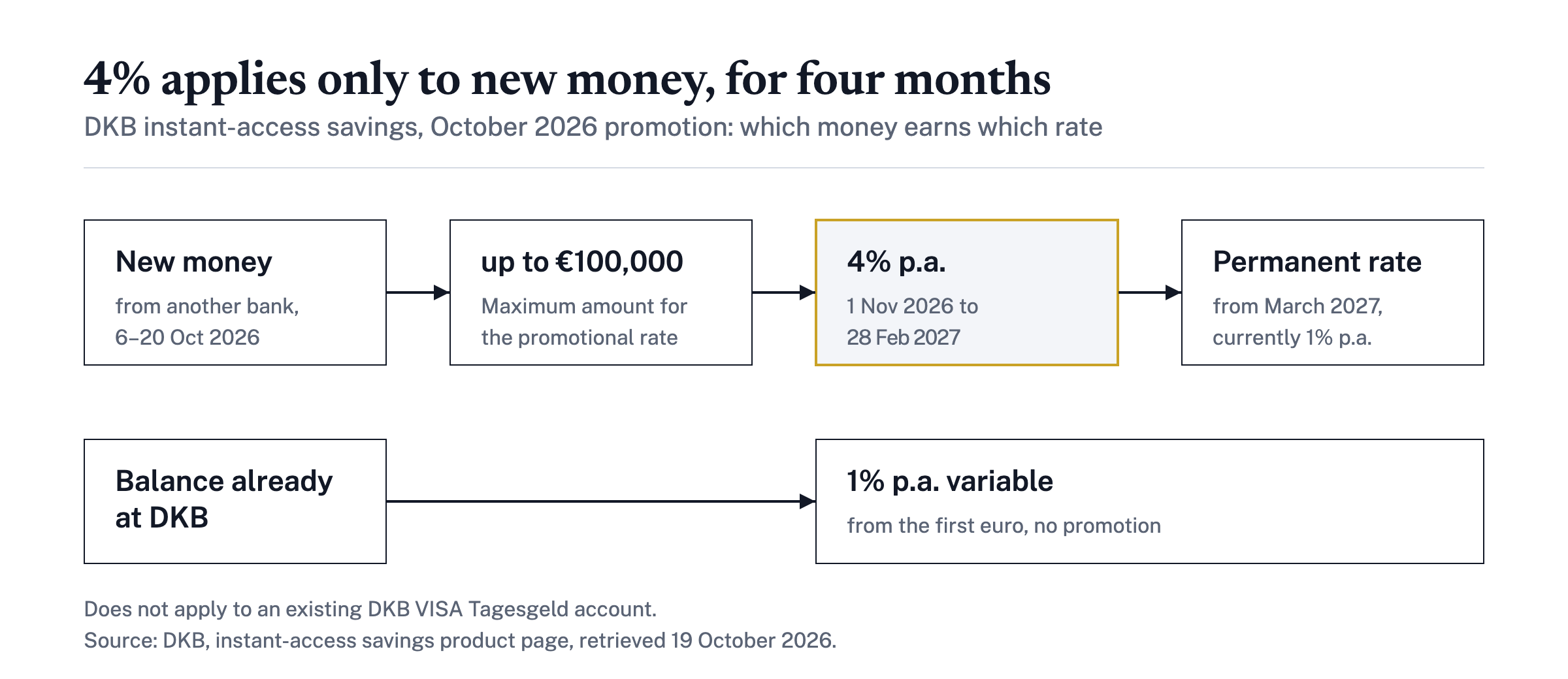
A hypothetical example calculation shows what this means in euros. Assumptions: 10,000 euros of new money, no deposits or withdrawals, 4 percent for four months, then 1 percent for the remaining eight months of the year; compounding and taxes not taken into account.
| Period | Rate p. a. | Interest on 10,000 euros |
|---|---|---|
| 4 months promotion | 4.00% | around 133 euros (own calculation) |
| 8 months afterwards | 1.00% | around 67 euros (own calculation) |
| 12 months total | effectively around 2.0% | around 200 euros |
Calculated over twelve months, the advertised rate is therefore roughly halved. Interest income is also taxable to the extent it exceeds the saver's lump-sum allowance; the example is calculated before tax.
In Germany, statutory deposit protection applies up to 100,000 euros per customer and bank, and in special cases up to 500,000 euros.[4] For private banks in Germany, the Entschädigungseinrichtung deutscher Banken provides this protection; the compensation case must first be declared by BaFin. DKB states that its instant-access savings account is additionally covered by the deposit protection fund of the Bundesverband Öffentlicher Banken Deutschlands.[1] Livossa articles on this topic appear in the deposit protection section.
If you do not need your money for a longer period, you can also consider a fixed-term deposit with a fixed maturity instead of a promotional rate. Whether a rate guarantee is worthwhile is a separate question; Livossa articles on this appear in the instant-access savings section.
Frequently asked questions
Is an instant-access savings account safe?
A balance held in an instant-access savings account is covered by statutory deposit protection in Germany. The protected maximum amounts are listed earlier in this article, in the section on deposit protection. Some banks are additionally covered by voluntary protection funds.
Can the bank lower the instant-access savings rate?
Yes. The instant-access savings rate is variable. The bank can change it at any time, even during an ongoing customer relationship, unless a rate guarantee has been agreed.
Is switching for a promotional rate worthwhile?
That depends on the term, the amount limit and the permanent rate that applies afterwards. Calculate the return over twelve months and compare it with your current rate before moving money.
How often is instant-access savings interest credited?
Each bank sets this itself, often monthly, quarterly or annually. DKB, for example, credits instant-access savings interest quarterly.
What rate do existing customers get?
Usually the permanent rate without any promotion. At large German banks, it ranged between 0.30 and 1.00 percent in autumn 2026.
Sources
Risk notice. The content is general information and is not investment, tax or legal advice. Investments carry risks, up to the total loss of the capital invested; past returns are not a reliable indicator of future results. Tax information reflects German law at the time of publication; have your personal situation checked by a tax adviser. Risk notice
Related reading
All Saving →Comparing fixed-term deposit rates: term, interest payment and access
Fixed-term deposit rates in October 2026: averages and offers compared, term, interest payment and access explained, with a worked example for Germany.