Salary sacrifice in Germany: drawbacks, tax and social contributions
German salary sacrifice in 2026: up to 676 euros a month tax-free, 338 euros free of social contributions. What tax and contributions apply on payout.
In this article6

Salary sacrifice, in German Entgeltumwandlung, means that part of your gross salary is not paid into your account but into a company pension scheme, usually a direct insurance policy (Direktversicherung), a Pensionskasse or a pension fund. Within fixed limits, you pay neither wage tax nor social contributions on this part while you save. Only the payout in retirement is taxed and subject to contributions, which is known as deferred taxation. Whether this pays off for you therefore depends on two points in time: your tax and contribution burden today and in retirement.
All figures in this article apply to Germany and the year 2026. They come from the German Income Tax Act (EStG), the Company Pensions Act (BetrAVG), the Social Codes and the reference values of the German pension insurance (Deutsche Rentenversicherung), read on 23 November 2026. The article explains the rules in general terms and does not replace tax or pension advice.
Do I have to pay tax on the payout from salary sacrifice?
Yes. Benefits from direct insurance policies, Pensionskassen and pension funds are other income under section 22 no. 5 EStG. Insofar as they are based on contributions that were tax-free under section 3 no. 63 EStG, they are fully taxed in retirement.[1] Unlike the state pension, there is no tax-free share. The company pension is added to your other income, and your personal tax rate in retirement applies to the total.
Health and long-term care contributions come on top. In statutory health insurance, company pensions count as pension-like income (Versorgungsbezüge).[2] Pensioners with compulsory insurance pay the general contribution rate of 14.6 percent plus the additional contribution on it, and they pay the contributions alone, without a share from an employer or the pension insurance.[3][4] The average additional contribution rate is 2.9 percent in 2026; your health insurer may charge a different rate.[5]
Small company pensions get some relief. It is based on one twentieth of the monthly reference value (Bezugsgröße), which is 197.75 euros in 2026 (calculated from 3,955 euros).[6] In health insurance this amount is an allowance: contributions are only due on the part above it.[7] In long-term care insurance it is only an exemption limit. If the company pension is higher, the full amount is subject to contributions.[8]
| Company pension of 300 euros a month (hypothetical) | Calculation | Contribution (calculated) |
|---|---|---|
| Health insurance | (300 − 197.75 euros) × 17.5 percent | 17.89 euros |
| Long-term care insurance, with children | 300 euros × 3.6 percent | 10.80 euros |
| Total social contributions | 28.69 euros | |
| Income tax | personal tax rate in retirement | individual |
The assumptions are compulsory membership in pensioners' health insurance, the average additional contribution and the long-term care rate of 3.6 percent; for people without children it is 4.2 percent.[9] How pensions are taxed is explained in the guide Taxing pensions: from what amount pensioners pay tax.
Lump sum instead of a pension
If you take the capital as a lump sum, it is taxable in the year of payment and increases your income for that year. For health and long-term care insurance, one hundred-and-twentieth of the sum counts as monthly pension income for ten years.[2] A lump sum of 36,000 euros thus becomes 300 euros of contributory income a month for 120 months (calculated).
The same provision sets out an exception: benefits that you acquire after the end of the employment as the sole policyholder from your own contributions, not paid by the employer, remain free of contributions.[2] This applies to a direct insurance policy that you continue to pay privately after changing jobs.
Is salary sacrifice into direct insurance tax-free?
While you save, yes; in retirement, no. Contributions to a direct insurance policy, Pensionskasse or pension fund are tax-free under section 3 no. 63 EStG as long as they do not exceed 8 percent of the contribution ceiling of the general pension insurance in the calendar year.[10] In 2026 the ceiling is 101,400 euros a year.[6] That makes 8,112 euros a year or 676 euros a month tax-free (calculated). The amount covers employer and converted contributions together and applies only to the first employment.
Only half of that is free of social contributions. Under section 1(1) no. 9 of the Social Insurance Remuneration Ordinance (SvEV), tax-free contributions up to 4 percent of the contribution ceiling do not count as earnings.[11] In 2026 that is up to 4,056 euros a year or 338 euros a month (calculated). Anything converted between 338 and 676 euros a month is tax-free but fully subject to social contributions.
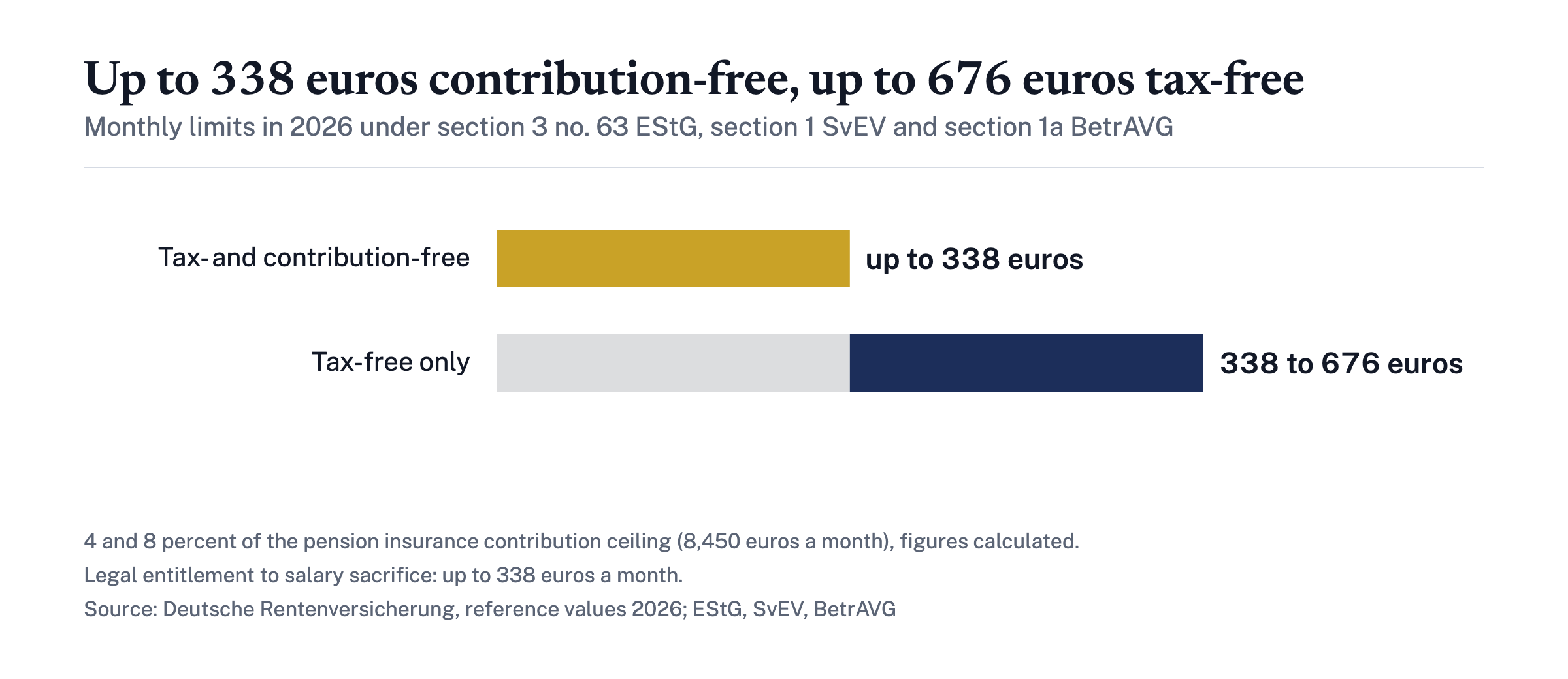
| Limit in 2026 | per year | per month | Legal basis |
|---|---|---|---|
| Tax-free (8 percent of the contribution ceiling) | 8,112 euros | 676 euros | section 3 no. 63 EStG |
| Free of social contributions (4 percent) | 4,056 euros | 338 euros | section 1(1) no. 9 SvEV |
| Legal entitlement to salary sacrifice (4 percent) | 4,056 euros | 338 euros | section 1a(1) BetrAVG |
| Minimum amount once claimed (1/160 of the reference value) | 296.63 euros | about 24.72 euros | section 1a(1) BetrAVG |
Figures calculated from the 2026 contribution ceiling and reference value of the Deutsche Rentenversicherung.
Older direct insurance policies follow their own rules. Contributions taxed at a flat rate under section 40b EStG in the version in force until the end of 2004 are also not counted as earnings subject to social insurance, even if they come from salary sacrifice.[11] Whether your policy falls under this is shown in the policy documents or on your payslip.
What are the drawbacks of salary sacrifice?
The drawbacks arise where a lower contributory gross salary later means lower benefits, and at the payout. There are six points you should know:
- Double burden in health insurance. While saving, you save the employee share; in retirement you pay the full contribution on the company pension alone.[4] In long-term care insurance only the exemption limit applies, not an allowance.
- Lower state pension. You pay no pension contributions on the converted amount, so you collect fewer pension points (Entgeltpunkte). Converting 2,400 euros a year earns about 0.046 fewer pension points at the provisional 2026 average earnings of 51,944 euros.[6] At the current pension value of 42.52 euros, that is about 1.96 euros less state pension a month per year of saving (calculated).[9]
- Lower wage replacement benefits. Unemployment benefit is based on contributory earnings, sickness benefit on earnings insofar as they are subject to contributions.[12][13] Converted amounts that are free of social contributions lower both bases.
- Locked-in money. With direct insurance, the employee may neither assign nor borrow against the value built up by the contributions. Cancelling does not lead to a payout; the policy is made paid-up instead.[14] The money is therefore not available for an emergency before retirement.
- No employer top-up above the social contribution limit. The employer must pay in an extra 15 percent of the converted salary, but only insofar as it saves social contributions itself.[15] For amounts above 338 euros a month and for salary above the contribution ceilings, the top-up is reduced or lost.
- Policy costs. Acquisition and administration costs reduce the later benefit. Compare the costs of your employer's offer with the benefits guaranteed to you. How to assess the costs of a pension insurance policy is shown in the guide Private pension insurance: is it worth it or not?.
Worked example: 50,000 euros gross a year
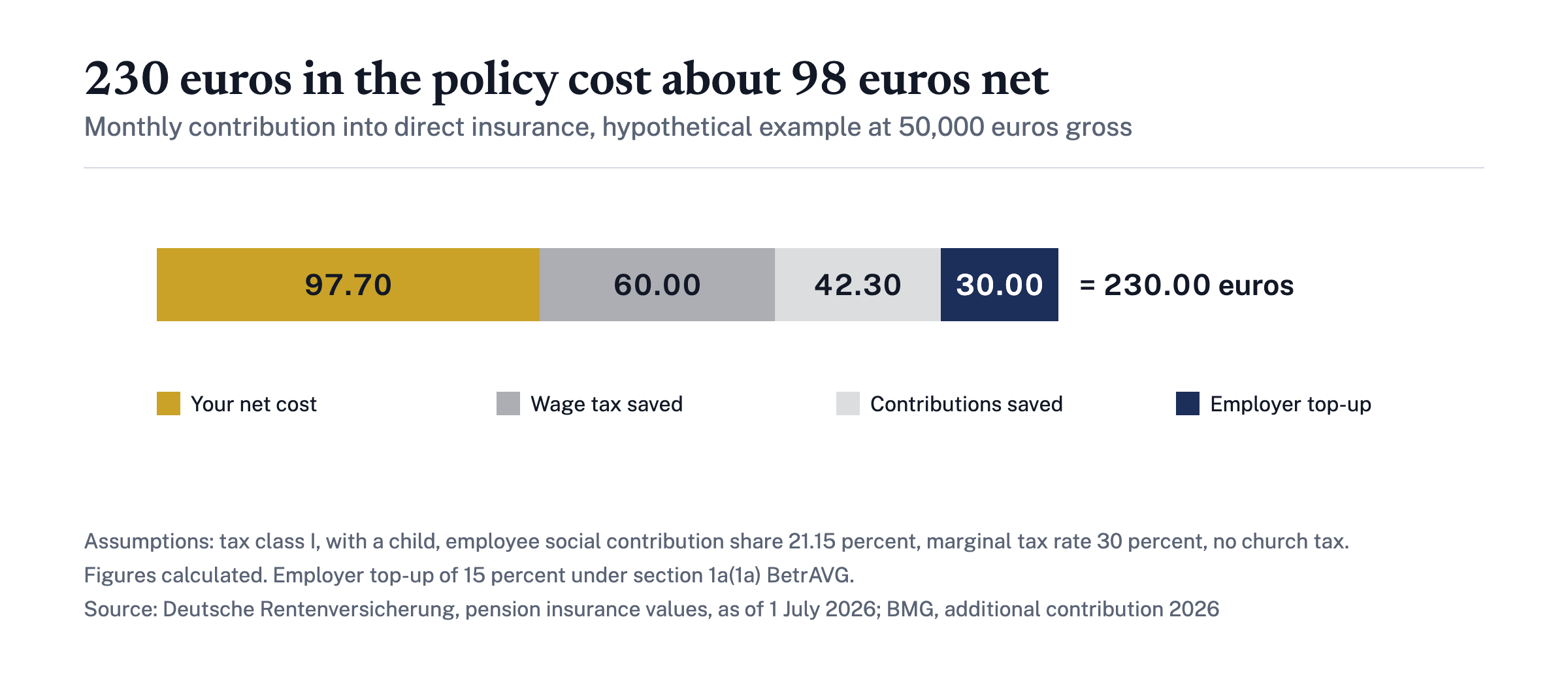
With 50,000 euros gross and 200 euros converted a month, a contribution of 230 euros costs about 98 euros net. This hypothetical example assumes an employee with 50,000 euros gross a year, tax class I, with a child, in statutory health insurance with the average additional contribution, without church tax. They convert 200 euros a month. The marginal tax rate is assumed at about 30 percent; the actual figure depends on allowances and other income.
| Item per month | Assumption | Amount (calculated) |
|---|---|---|
| Converted gross salary | 200.00 euros | |
| Social contributions saved, employee share | 9.3 + 1.3 + 8.75 + 1.8 = 21.15 percent | 42.30 euros |
| Wage tax saved | 30 percent marginal tax rate | 60.00 euros |
| Net cost | 200 − 42.30 − 60 | 97.70 euros |
| Employer top-up | 15 percent of 200 euros | 30.00 euros |
| Contribution into the policy | 200 + 30 | 230.00 euros |
The contribution rates come from the values of the Deutsche Rentenversicherung (pension 18.6, unemployment 2.6, health 14.6, long-term care 3.6 percent) and the average additional contribution, each paid half by the employee.[9] For a net cost of about 98 euros, 230 euros go into the policy. Against this stand about 1.96 euros less state pension per year of saving, or about 39 euros a month in today's values after 20 years (calculated). Tax and contributions on the later company pension come on top. How much is left net in the end depends on the policy's benefit and on your situation in retirement.
How much salary can be converted in 2026?
In 2026, up to 8,112 euros a year receive tax relief, and up to 4,056 euros are free of social contributions.[10][11] You have a legal entitlement against your employer up to 4 percent of the contribution ceiling, which is also 4,056 euros a year.[15] Converting more requires an agreement with your employer.
Once you claim the entitlement, you must pay in at least one hundred-and-sixtieth of the reference value a year, about 296.63 euros in 2026 (calculated). The employer can require the same monthly amount to be converted throughout a calendar year.[15] If the employer offers a Pensionskasse or a pension fund, the conversion takes place there; otherwise you can ask for a direct insurance policy.
Three checks help with the decision:
- Clarify the top-up: Ask whether your employer pays the 15 percent or more, and whether a collective agreement has its own rules.
- Choose the limit: Up to 338 euros a month you save tax and social contributions, above that only tax. The range up to the social contribution limit brings the largest relief per euro.
- Include retirement: Set today's saving against tax, health and long-term care contributions on the payout and the lower state pension. For questions about your own tax situation, a tax adviser or a wage tax assistance association (Lohnsteuerhilfeverein) can help.
More guides on state, company and private pensions are in the retirement section.
Frequently asked questions
What is salary sacrifice in simple terms?
With salary sacrifice, you give up part of your gross salary, and your employer pays this amount into a direct insurance policy, Pensionskasse or pension fund. Within fixed limits, no tax and no social contributions are due on it today, but they are due on the company pension in retirement.
Is salary sacrifice worth it on 50,000 euros gross?
In the hypothetical example with 200 euros converted and a 30 percent marginal tax rate, a policy contribution of 230 euros costs about 98 euros net a month. Whether it pays off depends on the policy's benefit, its costs and the tax and contribution burden in retirement.
Does the employer have to contribute?
Yes, insofar as it saves social contributions through the conversion, it must pay an extra 15 percent of the converted amount into the policy. Collective agreements may provide for other rules.
Do I pay health insurance contributions on the company pension?
Yes, with compulsory insurance you pay the full health and long-term care contribution alone. In health insurance, 197.75 euros a month remain free of contributions in 2026; in long-term care insurance this amount only works as an exemption limit.
Can I use the money before retirement?
As a rule, no. With direct insurance, the employee may neither assign nor borrow against the policy value, and cancelling leads to a paid-up policy instead of a payout.
Sources
- gesetze-im-internet.de
- gesetze-im-internet.de
- gesetze-im-internet.de
- gesetze-im-internet.de
- bundesgesundheitsministerium.de
- deutsche-rentenversicherung.de
- gesetze-im-internet.de
- gesetze-im-internet.de
- deutsche-rentenversicherung.de
- gesetze-im-internet.de
- gesetze-im-internet.de
- gesetze-im-internet.de
- gesetze-im-internet.de
- gesetze-im-internet.de
- gesetze-im-internet.de
Risk notice. The content is general information and is not investment, tax or legal advice. Investments carry risks, up to the total loss of the capital invested; past returns are not a reliable indicator of future results. Tax information reflects German law at the time of publication; have your personal situation checked by a tax adviser. Risk notice
Related reading
All Retirement →Retirement at 63 in Germany: who can retire without deductions
Retiring at 63 after 45 years in Germany: table by birth year, which periods count, what a start at 63 costs in deductions and where the reform stands.

Rürup pension: For whom it can pay off in tax terms
Rürup pension: who benefits from the Basisrente for tax purposes, what is deductible in 2026, how it is taxed in retirement and what speaks against it.

Private pension insurance: is it worth it or not?
Private pension insurance: worth it or not? What acquisition, administration and effective costs mean, with BaFin figures and a worked example (October 2026).