Retirement at 63 in Germany: who can retire without deductions
Retiring at 63 after 45 years in Germany: table by birth year, which periods count, what a start at 63 costs in deductions and where the reform stands.
In this article7
- Can I retire at 63 after 45 years without deductions?
- Retirement at 63 table: when each birth year can retire without deductions
- What counts towards the 45 years and what does not
- Can I still retire at 63 in 2027?
- What the pension reform could mean for retirement after 45 years
- Frequently asked questions
- Sources

"Rente mit 63" is the everyday German name for the old-age pension for especially long-term insured persons (Altersrente für besonders langjährig Versicherte). It allows a pension start without deductions before the standard retirement age, provided 45 insurance years add up.[1] At exactly 63, however, this now only applies to people born before 1953. All information in this article refers to the German statutory pension insurance, as of 19 November 2026. It explains the rules in general and does not replace advice from the Deutsche Rentenversicherung, the German statutory pension insurer.
Can I retire at 63 after 45 years without deductions?
No. Anyone born in 1953 or later can no longer retire at 63 without deductions, not even with 45 insurance years. Section 236b of the German Social Code Book VI (SGB VI) raises the age limit of 63 for everyone born after 31 December 1952.[2] For the cohorts now approaching retirement, it lies between 64 and 64 years and 10 months. From the 1964 cohort, the permanent rule in Section 38 SGB VI applies: age 65 and a qualifying period of 45 years.[3]
So the pension after 45 years is now a pension at 64 or 65. The advantage remains: according to the Deutsche Rentenversicherung, the pension can currently start two years before the standard retirement age, without a deduction.[4]
One restriction is often overlooked. The pension for especially long-term insured persons cannot be drawn early, not even with deductions.[1] Anyone who wants to stop before this pension's age limit needs a different type of pension, usually the pension after 35 years.
The two pensions differ mainly in the years required:
| Pension type | Insurance years required | Start without deduction | Earlier start with deduction |
|---|---|---|---|
| Pension for especially long-term insured persons ("pension after 45 years") | 45 | 64 to 65, depending on birth year | not possible |
| Pension for long-term insured persons ("pension after 35 years") | 35 | 66 to 67, depending on birth year | from 63, 0.3% per month |
Retirement at 63 table: when each birth year can retire without deductions
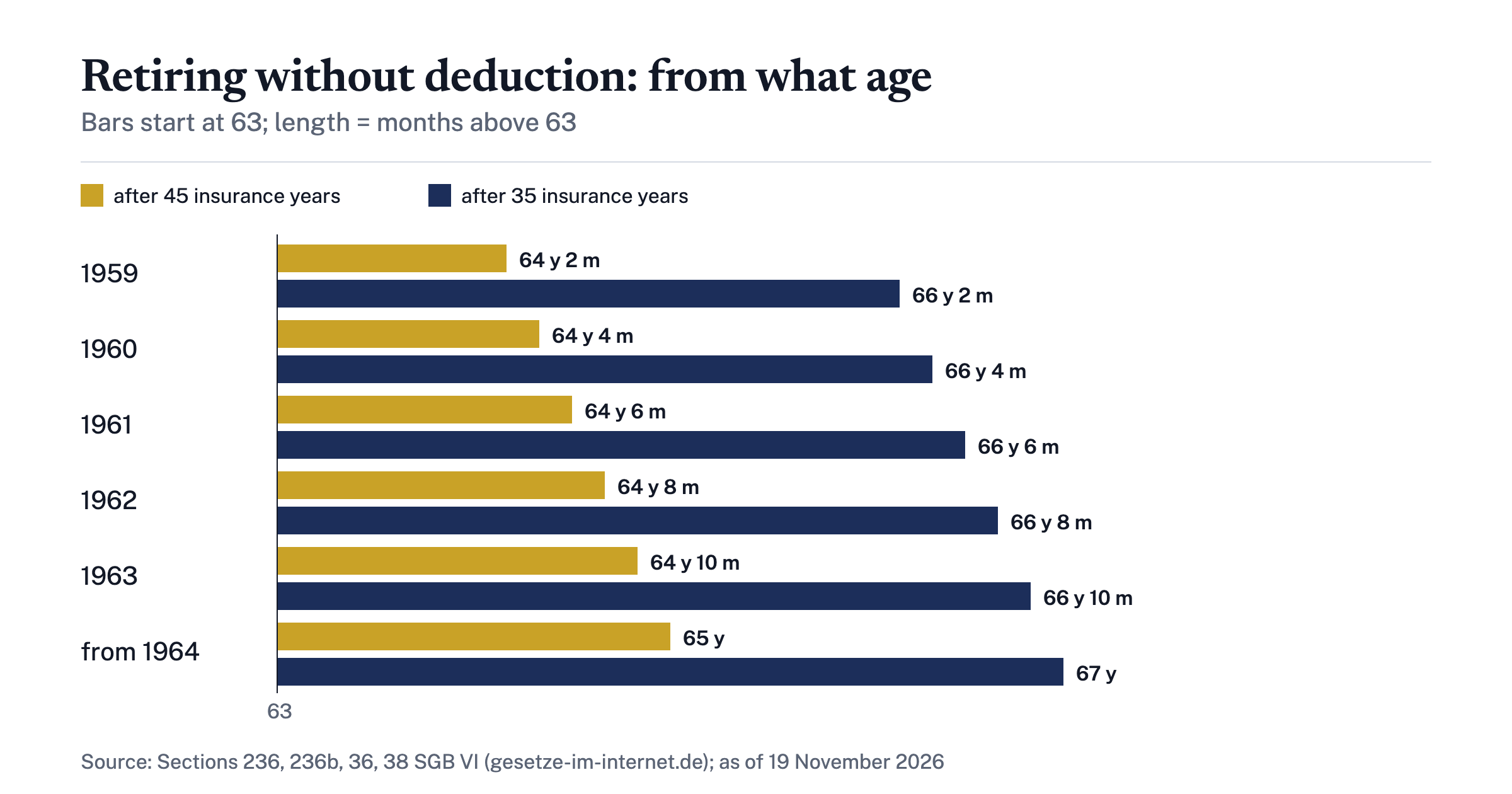
The age limit of the pension after 45 years has risen since the 1953 cohort in steps of two months per birth year. The table below shows the cohorts retiring between 2022 and 2029, under Sections 236b and 38 SGB VI.[2] For comparison, it shows the limit of the pension after 35 years for the same cohorts under Section 236 SGB VI.[5]
| Birth year | After 45 years, no deduction from | After 35 years, no deduction from |
|---|---|---|
| 1958 | 64 years | 66 years |
| 1959 | 64 years 2 months | 66 years 2 months |
| 1960 | 64 years 4 months | 66 years 4 months |
| 1961 | 64 years 6 months | 66 years 6 months |
| 1962 | 64 years 8 months | 66 years 8 months |
| 1963 | 64 years 10 months | 66 years 10 months |
| from 1964 | 65 years | 67 years |
An example of how to read the table: someone born in March 1963 reaches 64 years and 10 months in January 2028 (own calculation). From then on, with 45 insurance years, a pension start without deduction is possible. For the 1964 cohort, the limit is 65 for the pension after 45 years and 67 for the pension after 35 years.[1]
Severely disabled people, with a degree of disability of at least 50 and 35 insurance years, have their own limits. For the 1963 cohort, the same deduction-free limit applies as for the pension after 45 years. With a deduction, they can start three years earlier, from 61 years and 10 months.[6] From the 1964 cohort, the limits are 65 and, with a deduction, 62.[7]
What counts towards the 45 years and what does not
Not every period in the insurance record counts towards the 45 years, mainly months with compulsory contributions. The rule is in Section 51(3a) SGB VI.[8] According to the Deutsche Rentenversicherung, the following count:
- compulsory contributions from employment or self-employment, including mini-jobs if you paid the contributions together with the employer
- periods of raising a child up to the child's 10th birthday
- unpaid care for relatives as well as compulsory military and civilian service
- periods of receiving social benefits such as sickness benefit
- voluntary contributions, but only if there are at least 18 years of compulsory contributions[1]
Not counted are compulsory contributions paid because of Arbeitslosengeld II or Arbeitslosenhilfe (former means-tested unemployment assistance), periods from a pension rights adjustment after divorce and from pension splitting. Credited periods such as school education and university studies do not count either.[1]
A special rule applies at the end of working life. Unemployment benefit in the last two years before the pension starts only counts if the unemployment results from the employer's insolvency or complete closure of the business.[1] Anyone who becomes unemployed shortly before retirement can fall below 45 years as a result.
Whether your years are enough is shown in the detailed pension statement (Rentenauskunft). The pension insurer sends it automatically from your 55th birthday.[1] If periods are missing there, such as vocational training or child-raising, it is worth having the insurance record clarified early.
Can I still retire at 63 in 2027?
Yes, but only with a deduction. Anyone who turns 63 in 2027 was born in 1964. For this cohort, the pension after 45 years only starts at 65. At 63, the only option is the pension for long-term insured persons, which requires 35 insurance years.[9]
The deduction is 0.3% for each month before the standard retirement age, at most 14.4%, and it is permanent.[1] Technically, Section 77 SGB VI lowers the so-called access factor by 0.003 for each calendar month.[10]
A hypothetical worked example shows what that means. Assumption: born in 1964, 35 insurance years, pension start at 63 instead of 67. That is 48 months earlier, so 48 × 0.3% = 14.4% deduction. With an assumed gross pension of 1,500 euros without deduction, 1,284 euros a month remain, 216 euros less, for the entire time the pension is paid (own calculation).
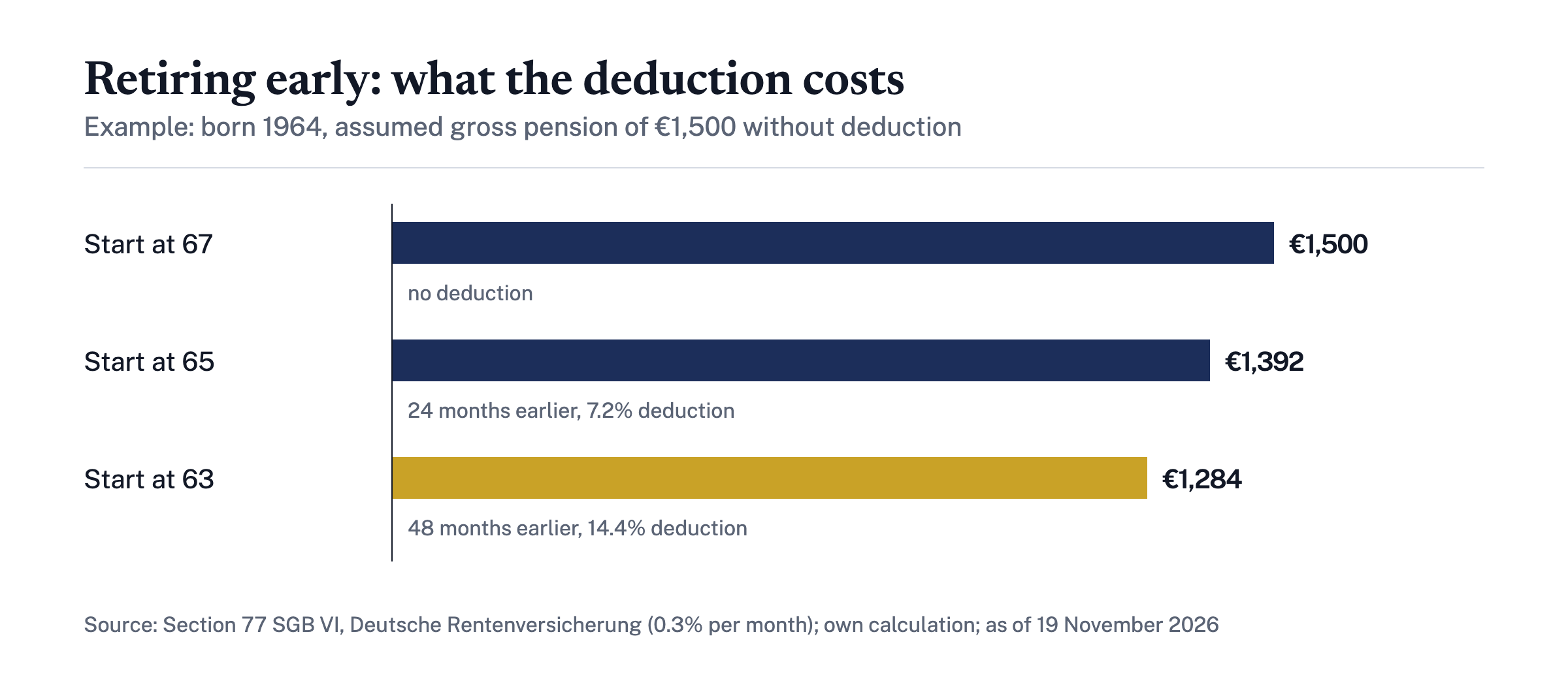
In this example, a start at 65 costs 24 months or 7.2%, leaving a pension of 1,392 euros; this applies to the pension after 35 years. Anyone with 45 insurance years retires at 65 without a deduction. Whether an early start with a deduction pays off depends on the personal pension amount, life expectancy and other income. That is a separate topic. The Deutsche Rentenversicherung's pension start and amount calculator works out the start date for your own data.
Anyone who wants to retire in 2027 without a deduction needs 45 years and the right birth year. At 64 years and 8 months, people born from about May 1962 reach this limit during 2027, and at 64 years and 10 months, those born in January and February 1963 (own calculation under Section 236b SGB VI).[2]
What the pension reform could mean for retirement after 45 years
Under the proposal of the Alterssicherungskommission, the government-appointed pension commission, the pension after 45 years would be abolished. In future, insured persons would only be able to draw an early old-age pension with deductions.[4] The commission also recommends raising the age limit of the pension after 35 years from 63 to 64.[4] It handed over its report with 33 recommendations on 23 June 2026.[11]
None of this has been decided. On 17 November 2026, the CDU/CSU and SPD did not agree on the future of retirement at 63 in the coalition committee. A cabinet decision is now expected on 9 or 16 December 2026.[11] What transitional rules for cohorts close to retirement would look like is open.
A large group would be affected. In 2024, according to the Deutsche Rentenversicherung, around 250,000 to 280,000 insured persons used the deduction-free pension after 45 contribution years, according to the DIW economic institute around 30% of all old-age pensions newly granted that year.[11]
Until then, three points named by the pension insurer itself apply to your own planning:
- Until a law is passed, only the existing pension law applies.
- What counts are the rules in force when the pension starts. Filing an application early does not secure a more favourable legal position.
- Pensions can generally be applied for no more than one year before they start.[4]
The next step is therefore your own insurance record: how many years count towards the 45, and which month follows from the table? What else changes in 2027 for pensions, taxes and money is summarised in the Livossa article What changes in 2027 for taxes, pensions and money?. How the pension is taxed later is explained in Taxing pensions: from what amount pensioners pay tax. More topics are collected in the retirement section.
Frequently asked questions
Who can still retire at 63 without deductions?
No one who is approaching retirement today. Retiring at exactly 63 without deductions was only possible for people born before 1953. For later cohorts, the limit of the pension after 45 years is between 63 years and 2 months and 65.
How large is the deduction if I retire at 63?
Through the pension after 35 years, it is 0.3% per month before the standard retirement age. For the 1964 cohort and younger, that is 48 months and therefore 14.4%, permanently.
Does unemployment count towards the 45 years?
Unemployment benefit generally counts, but in the last two years before the pension starts only in the case of the employer's insolvency or complete closure. Arbeitslosengeld II and Arbeitslosenhilfe do not count.
Will retirement at 63 be abolished?
The pension commission has proposed it. On 17 November 2026 there was no agreement in the coalition; a cabinet decision has been announced for December 2026. Until a law is in force, the existing rules apply.
Sources
Risk notice. The content is general information and is not investment, tax or legal advice. Investments carry risks, up to the total loss of the capital invested; past returns are not a reliable indicator of future results. Tax information reflects German law at the time of publication; have your personal situation checked by a tax adviser. Risk notice
Related reading
All Retirement →Rürup pension: For whom it can pay off in tax terms
Rürup pension: who benefits from the Basisrente for tax purposes, what is deductible in 2026, how it is taxed in retirement and what speaks against it.

Private pension insurance: is it worth it or not?
Private pension insurance: worth it or not? What acquisition, administration and effective costs mean, with BaFin figures and a worked example (October 2026).

Taxing pensions: From what amount pensioners pay tax
Taxing pensions in 2026: basic tax-free allowance, taxable percentage and tax rate for pensioners in Germany, with a worked example and pension table.