Rürup pension: For whom it can pay off in tax terms
Rürup pension: who benefits from the Basisrente for tax purposes, what is deductible in 2026, how it is taxed in retirement and what speaks against it.
In this article8

Whether a Rürup pension pays off depends mainly on two tax rates. The first applies today to the deducted contributions, the second later to the pension. If the first is considerably higher than the second, a genuine advantage arises. This applies most of all to well-earning self-employed people and freelancers who do not pay into the statutory pension scheme. For employees on middle incomes, the room to manoeuvre is smaller and the advantage is often minor.
The Rürup pension is officially called Basisrente (basic pension). For tax purposes, it is treated like the statutory pension. The following sections explain who it suits, how it compares with an ETF savings plan, and what speaks against it. All figures apply to Germany, as of October 2026. This article is general information and not individual tax or investment advice.
For whom does a Rürup pay off?
A Rürup pension pays off in tax terms for people whose marginal tax rate is high during their working life and likely lower in retirement. The marginal tax rate is the rate at which the last euro earned is taxed. The higher it is, the more tax each deducted euro saves.
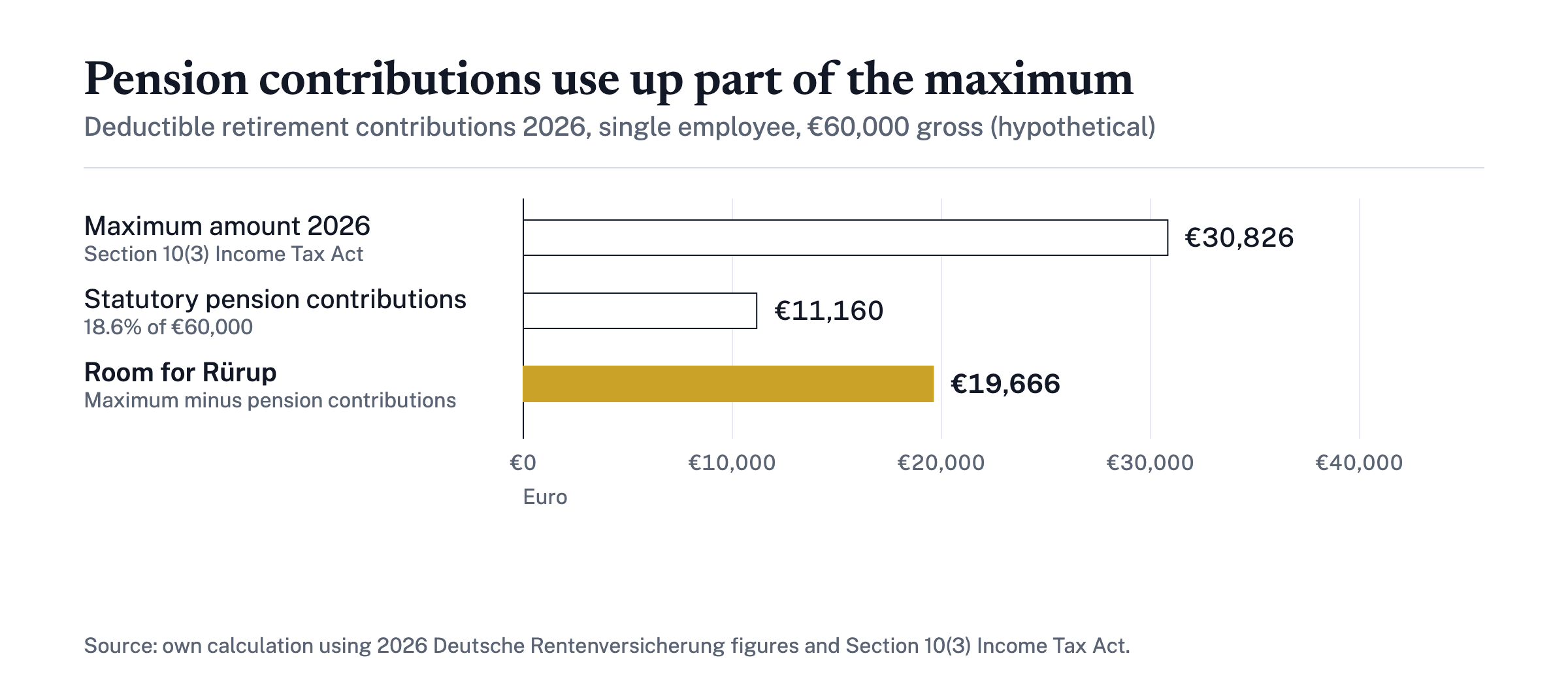
How much you can deduct is governed by Section 10 (3) of the German Income Tax Act (Einkommensteuergesetz). The maximum amount corresponds to the maximum contribution to the miners' pension insurance scheme (knappschaftliche Rentenversicherung), rounded up to full euros. For jointly assessed married couples it doubles, and since 2023, 100 per cent of it is deductible.[1] For 2026, Deutsche Rentenversicherung cites a contribution assessment ceiling of €10,400 per month and a contribution rate of 24.7 per cent in the miners' pension insurance scheme.[2] This yields €30,826 for singles and €61,652 for married couples.
| Group | What already counts towards the 2026 maximum amount | Room left for the Rürup pension |
|---|---|---|
| Self-employed people without mandatory pension insurance | none | up to €30,826 |
| Employees, gross salary €60,000 (hypothetical) | €11,160 in statutory pension contributions (18.6 per cent) | around €19,666 |
| Civil servants | reduced by a notional total pension insurance contribution | depending on salary grade |
For employees, the contributions to the statutory pension scheme — the employee and employer shares combined — count towards the same maximum amount. The tax-free employer share is then deducted again. For civil servants, the maximum amount is reduced by the amount that would correspond to a total contribution to general pension insurance on their salary. The general contribution rate of 18.6 per cent for 2026 is likewise cited by Deutsche Rentenversicherung.[2]
This yields three groups for whom a Rürup pension is most likely a good fit:
- Self-employed people and freelancers without mandatory insurance, who can use the full maximum amount and have no other subsidised retirement provision.
- High earners shortly before retirement, who can deduct large amounts in a few years and whose pension will begin soon.
- People with an unusually high one-off income, for example from a severance payment or the sale of a business, who want to save tax in that year.
Is a Rürup pension better than ETFs?
A Rürup pension is not inherently better or worse than an ETF savings plan. The two are treated in opposite ways for tax purposes. With a Rürup pension, contributions are tax-deductible and the pension is taxed later. With an ETF savings plan, you contribute from already-taxed income and only the returns are taxed.
| Feature | Rürup pension (Basisrente, basic pension) | ETF savings plan in a brokerage account |
|---|---|---|
| Contributions | deductible as special expenses, up to 30,826 euros in 2026 (single taxpayers) | from already-taxed income |
| Taxation of payouts | pension taxed at the taxable share of the year the pension begins, at your personal tax rate | returns taxed at 25 percent flat tax; for equity funds, 30 percent of returns are tax-free |
| Access before retirement | no | at any time |
| Payout | only as a lifelong monthly pension | freely selectable |
| Inheritable | no | yes |
The flat tax of 25 percent is governed by Section 32d of the Income Tax Act (Einkommensteuergesetz).[3] The partial exemption of 30 percent of returns for equity funds is set out in Section 20 of the Investment Tax Act (Investmentsteuergesetz).[4]
Hypothetical example calculation: a self-employed woman pays 10,000 euros a year into a Rürup pension. Her marginal tax rate is 42 percent. Calculated without the solidarity surcharge and church tax, the tax office refunds her around 4,200 euros. The contribution therefore costs her 5,800 euros net. If her pension begins in 2040, 91 percent of it is taxable. If her personal tax rate in old age is 25 percent, roughly 23 cents of every euro of pension goes to the tax office.
In this example, the advantage of the Rürup pension lies in the difference between 42 percent saved today and roughly 23 percent tax paid later. Whether more is left at the end than in an ETF account also depends on the contract's costs, the return and how long you draw the pension. If the tax refund is spent rather than reinvested, part of the advantage is lost. These figures are assumptions for the calculation, not a forecast.
What is a Rürup pension, explained simply?
The Rürup pension is a private contract that pays out only a lifelong monthly pension, at the earliest from age 62. In return, the state supports the contributions through the special expenses deduction.
The conditions are set out in Section 10 (1) No. 2 letter b of the Income Tax Act. The claims under the contract must not be inheritable, transferable, usable as loan collateral, sellable or convertible into a lump sum.[1] A one-off payout is therefore excluded. In addition, the contract may include cover in case of occupational disability, reduced earning capacity or for surviving dependants.
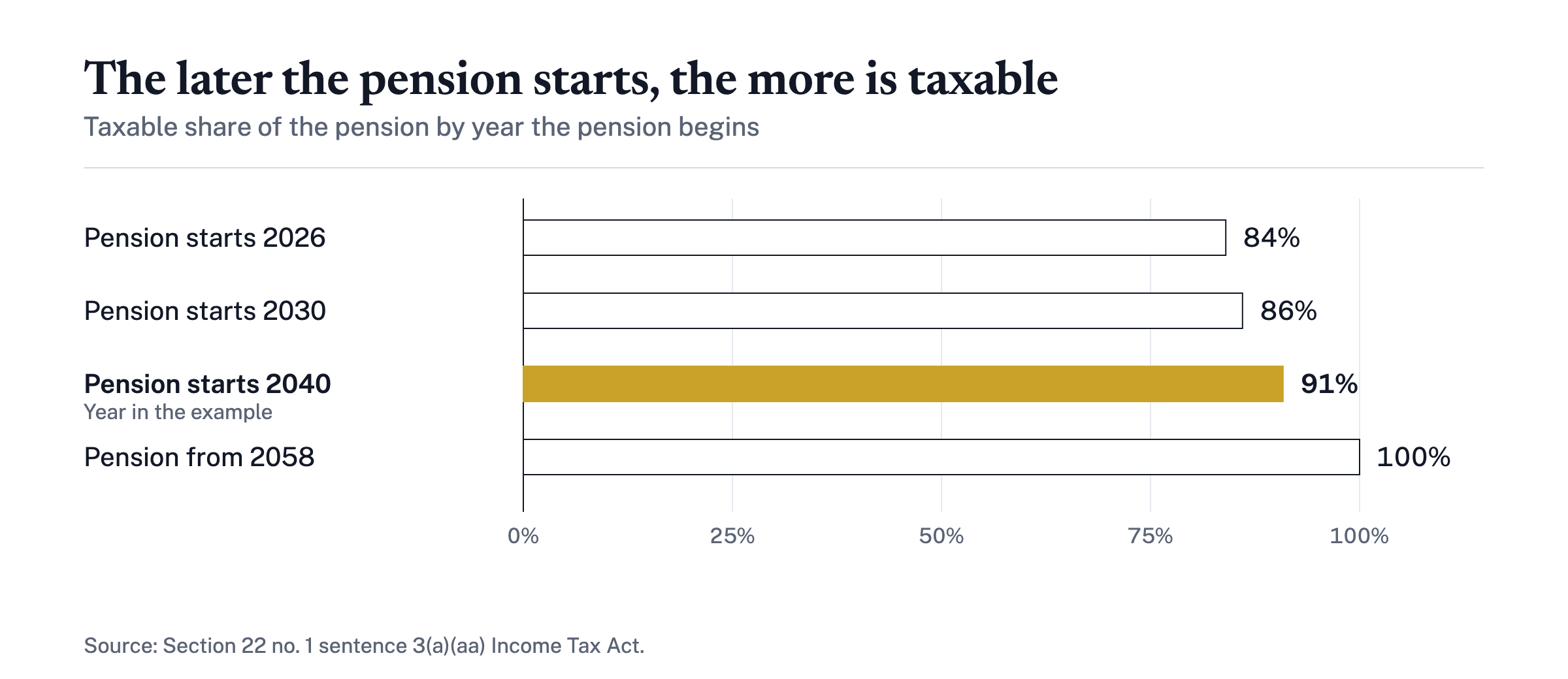
In old age, the pension is taxed like the statutory pension. The taxable share under Section 22 of the Income Tax Act is decisive. It depends on the year the pension begins; since 2023, according to the table, it rises by 0.5 percentage points with each new pension cohort.[5]
| Year the pension begins | Taxable share of the pension |
|---|---|
| 2026 | 84.0 percent |
| 2027 | 84.5 percent |
| 2030 | 86.0 percent |
| 2040 | 91.0 percent |
| from 2058 | 100 percent |
The tax-free portion of the pension is fixed as a set amount in the year after the pension begins and applies for the entire term. How taxation in retirement works in detail is explained in the Livossa article How pensions are taxed: from what amount retirees pay tax[6].
Is the Rürup pension still relevant?
Yes. The Rürup pension exists unchanged in 2026, and the reform of private retirement provision does not affect it. Since 2023, contributions have been fully deductible up to the maximum amount. Until 2022, only a rising percentage was deductible; in 2013 it was still 76 percent.[1]
From 1 January 2027, new rules apply to state-subsidised private retirement provision with the retirement savings account (Altersvorsorgedepot). The Verbraucherzentrale Niedersachsen writes on this (as of 20 July 2026): The Rürup pension, or Basisrente (basic pension), remains unchanged. Balances from Basisrente contracts cannot be transferred into the new retirement contracts, not even where entitlement to the subsidy applies from 2027.[7]
For existing contracts, this means: switching to the new account is not an option. Anyone who also wants to use the retirement savings account (Altersvorsorgedepot) needs a separate contract for it. The article What changes in 2027 for taxes, pensions and money?[8] summarises which further changes are coming in 2027.
What happens to my Rürup pension if I die?
If the insured person dies, the accumulated capital does not go to the heirs. By law, the contract cannot be inherited. Without additional protection, the capital remains with the insurer, regardless of whether death occurs before or after the pension begins.
An exception is survivor protection, which the contract may include. Surviving dependants within the meaning of the law are only the spouse and the children for whom there is entitlement to child benefit or a child tax allowance.[1] They, too, do not receive a lump sum but a pension. Children qualify only as long as this entitlement exists for them.
For single people without children, this means: an early death causes the contributions paid in to be forfeited. For couples, it is worth checking the contract terms to see whether a survivor's pension is included, and at what price.
What are the arguments against a Rürup pension?
The main arguments against a Rürup pension are the lack of flexibility, the commitment until retirement age and the costs of some contracts. Anyone who finds it hard to assess their situation over the coming decades should weigh these points before the tax savings.
- No access before retirement: the money is tied up until at least age 62. Cancelling with a payout is not possible; only a contribution pause is.
- No capital payout: even at the start of the pension there is no lump sum, only the monthly pension.
- Not inheritable: without survivor protection, the contributions are forfeited in the event of an early death.
- Rising taxation: the later the pension begins, the larger the taxable share; from 2058 it is 100 percent.
- Costs: acquisition and administration costs reduce the return. The article Private pension insurance: is it worthwhile?[9] shows how to read the costs of a pension contract.
- No switch to the retirement savings account (Altersvorsorgedepot): from 2027, a Rürup contract cannot be transferred into the new subsidy scheme.
Three questions help with your own decision. How high is your marginal tax rate today, and how high is it likely to be in retirement? How much room does the maximum amount leave you after deducting statutory pension contributions? And can you do without the money until retirement? For a binding calculation with your own figures, a tax adviser or an independent fee-based adviser is the right place to go. How Livossa builds comparisons is described on the methodology page[10].
Frequently asked questions
How much can I pay into and deduct from a Rürup pension in 2026?
In 2026, up to 30,826 euros for single people and 61,652 euros for married couples with joint assessment are deductible. For employees, contributions to the statutory pension scheme count towards these amounts.
Can I cancel a Rürup pension?
Cancelling with a payout of the balance is not possible. You can put the contract on a contribution pause; the capital remains tied up until the pension begins.
From when is the Rürup pension paid out?
At the earliest from age 62, and only as a lifelong monthly pension. A lump-sum payout of the capital is excluded by law.
How is the Rürup pension taxed in old age?
The taxable share is the taxable share of the year the pension begins: 84 percent for a pension beginning in 2026, 91 percent for a pension beginning in 2040. Your personal tax rate applies to this share.
Can I transfer my Rürup contract into the retirement savings account (Altersvorsorgedepot) in 2027?
No. Balances from Basisrente contracts cannot be transferred into the new retirement contracts.
Sources
Risk notice. The content is general information and is not investment, tax or legal advice. Investments carry risks, up to the total loss of the capital invested; past returns are not a reliable indicator of future results. Tax information reflects German law at the time of publication; have your personal situation checked by a tax adviser. Risk notice
Related reading
All Retirement →Private pension insurance: is it worth it or not?
Private pension insurance: worth it or not? What acquisition, administration and effective costs mean, with BaFin figures and a worked example (October 2026).

Taxing pensions: From what amount pensioners pay tax
Taxing pensions in 2026: basic tax-free allowance, taxable percentage and tax rate for pensioners in Germany, with a worked example and pension table.