Private pension insurance: is it worth it or not?
Private pension insurance: worth it or not? What acquisition, administration and effective costs mean, with BaFin figures and a worked example (October 2026).

Whether a private pension insurance makes sense comes down to two questions. Do you need a pension that is paid until the end of your life? And can you pay the contributions until retirement? If you answer both with yes, you get protection that a brokerage account alone cannot offer: the pension keeps flowing even if you live to a very old age. If, on the other hand, you want to stay flexible or build wealth quickly, you carry costs for a benefit you may never use.
This article covers private pension insurance without state subsidies — neither Riester nor Rürup pensions. The financial regulator BaFin counts such contracts among the capital-forming life insurances. In 2024 there were around 59 million of these in Germany, with 2.4 million newly added in the same year.[1] The BaFin also notes that some products offer no adequate customer benefit, especially when they are unreasonably expensive. So the answer to the question in the title starts with the costs. This article is general information and not individual investment or tax advice.
What fees does a private pension insurance charge?
A private pension insurance involves acquisition costs at the start, ongoing administration costs and, for unit-linked contracts, additionally the costs of the funds. How strongly all of this together reduces the return is shown by one key figure: the effective costs. The BaFin defines them as the amount by which the annual return of a product is reduced by the costs incurred.[2]
Which costs the insurer must disclose
The insurer must tell you which costs are in the contract before you sign. The Regulation on Information Duties for Insurance Contracts (VVG-InfoV) specifies in § 2 what this includes:[3]
| Cost type | How it is disclosed |
|---|---|
| Included acquisition costs | as a single total amount in euros |
| Remaining included costs | as a share of the annual premium, with term |
| Of which administration costs | stated separately as a share of the annual premium, with term |
| Other costs, for example for special occasions | in euros |
| Effective costs | as a reduction of the value development in percentage points until the start of payout |
For comparing two offers, the last row is the most important. Acquisition and administration costs are hardly comparable between contracts with different terms and contribution amounts. The effective costs condense them into a single figure that is calculated the same way for every offer.
Acquisition costs: why the first years are so expensive
Acquisition costs are charged once at the start, and the insurer usually offsets them against the premiums of the first contract years. BaFin describes precisely this mechanism.[2] For the calculation of reserves, the Deckungsrückstellungsverordnung (regulation on actuarial reserves) sets a limit: the so-called Zillmer rate may not exceed 25 per mille, i.e. 2.5 percent, of the total of all premiums.[4] At 100 euros per month over 30 years, that is a total premium of 36,000 euros and at most 900 euros that can be offset against the first premiums in this way.
If you cancel early, the German Insurance Contract Act (VVG) protects you in part. On cancellation, the surrender value is at least the actuarial reserve calculated as if the acquisition and distribution costs were spread evenly over the first five contract years (Section 169 VVG).[5] The costs are therefore not gone, only stretched. What a cancellation or a premium holiday means in detail is a separate topic and is not covered further here.
Effective costs: what BaFin has measured in the market
Effective costs vary considerably between providers. In a survey of new business in the first half of 2021, they exceeded four percent in individual cases. Only the part of the return above this cost level effectively benefited customers.[1] In June 2026, BaFin published a new survey of 54 life insurers covering new business written in 2024.[2]
| BaFin findings (unit-linked and hybrid products) | Value |
|---|---|
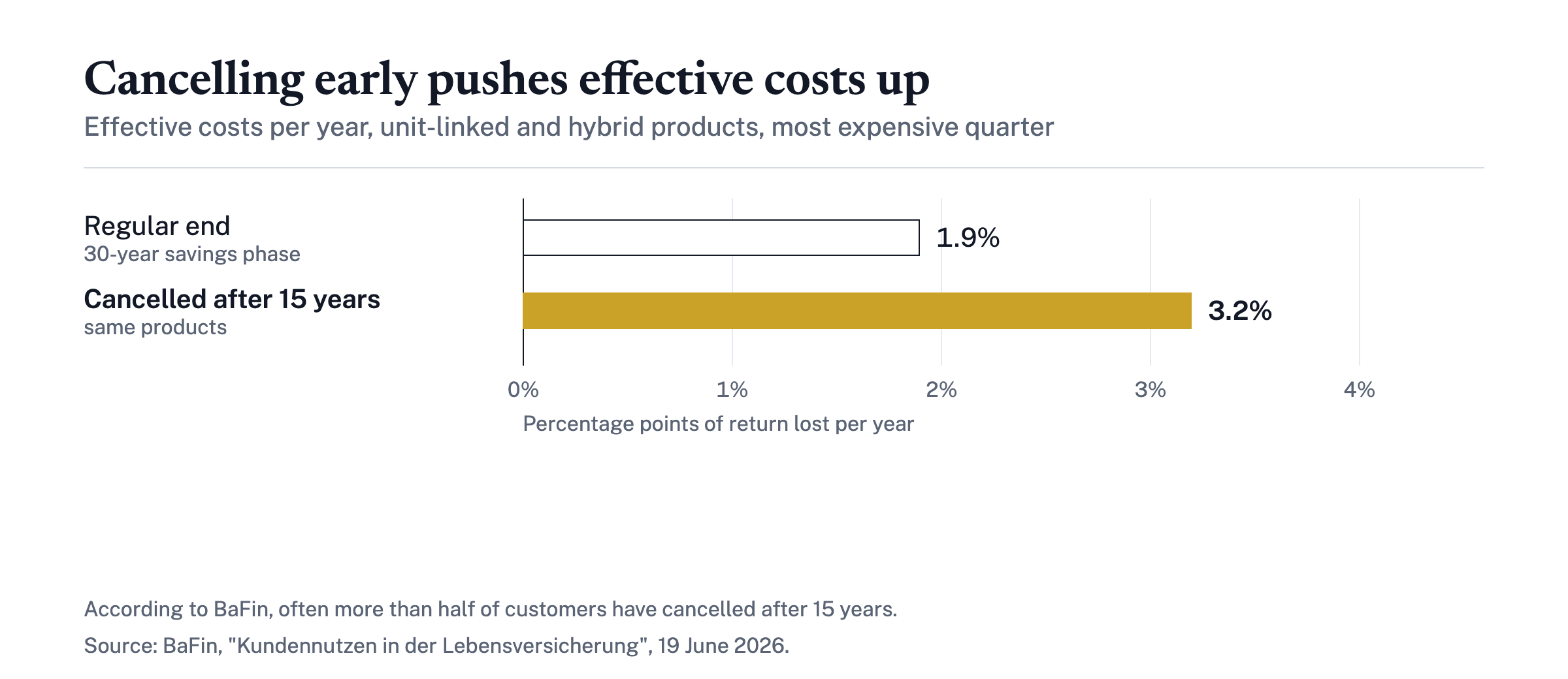
| Most expensive quarter, 30-year term, regular end of the accumulation phase | 1.9 percent per year |
| Decline in this quarter since 2021 | more than 0.4 percentage points |
| Individual products at the top of the market | more than 3 percent |
| Most expensive quarter, cancellation after 15 years | about 3.2 percent per year |
BaFin attributes the decline to the fact that many insurers are relying more heavily on lower-cost investment options such as index funds. By contrast, there was hardly any movement among classic products with guaranteed interest rates, whose effective costs tend to be lower. The authority also notes that high effective costs on unit-linked products tend to go hand in hand with a lower return, after costs, on the underlying capital investment.
A second cost driver is rebates, known as kickbacks. These are payments from fund companies which, on unit-linked and hybrid products, can drive up effective costs. So when considering a unit-linked offer, ask whether such payments are made, and to whom.
Cancellation: the biggest cost factor in practice
Cancelling early usually makes a contract considerably more expensive. According to BaFin, for products with a 30-year accumulation phase, well over half of customers have often ended the contract after 15 years. With a cancellation after 15 years, effective costs are typically 1 to 1.5 percentage points higher than with regular termination. The reason is the acquisition costs from the start, which are then no longer offset by returns in the following years.[2]
This is the most important finding for the question in the title. A private pension insurance tends to be worthwhile if the premiums remain affordable even in difficult years. If it is foreseeable that you will need the money before retirement begins, for example for a property, the product is a poor fit.
Worked example: what 1.9 percent in effective costs amounts to
A hypothetical worked example shows how strongly costs act over long periods. It is a simplified calculation, not a forecast.
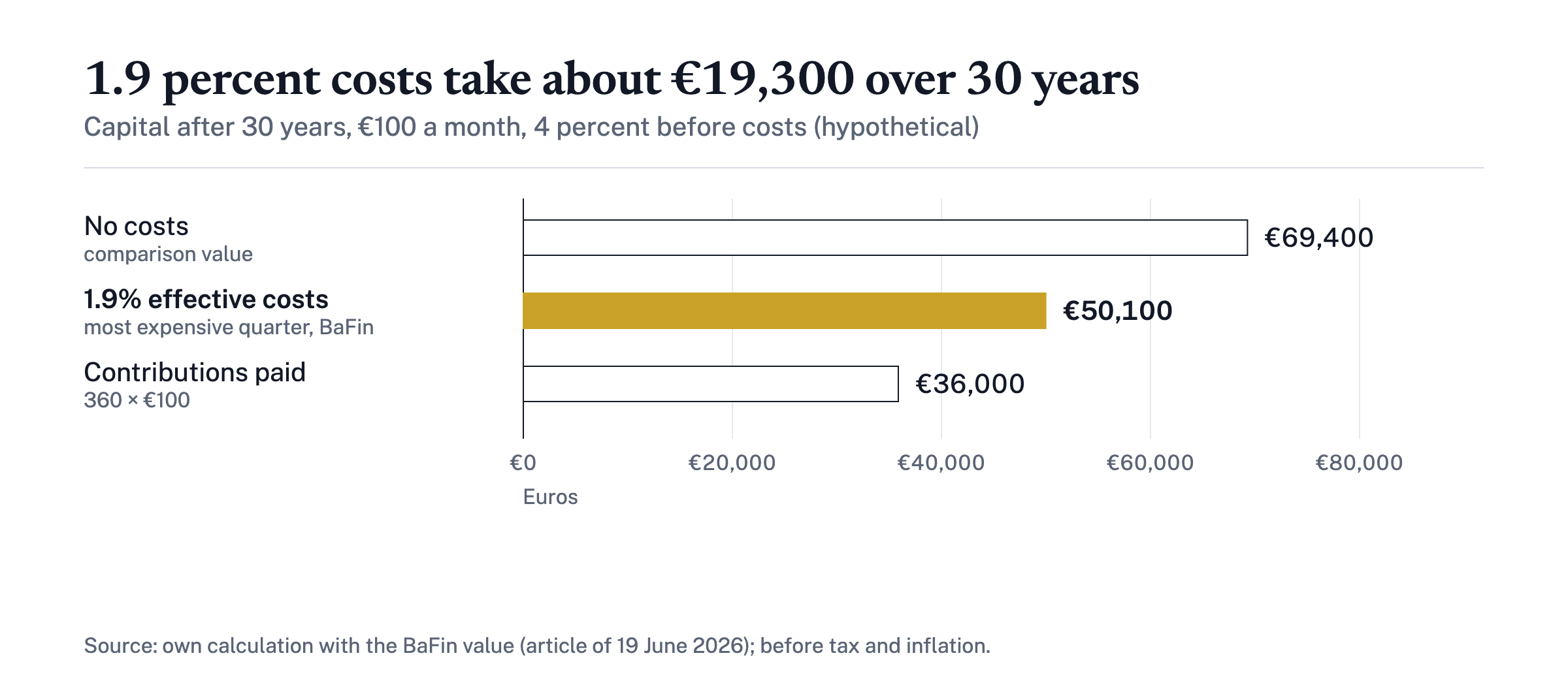
Assumptions (hypothetical): a premium of 100 euros per month over 30 years, i.e. 36,000 euros in total. The capital investment earns a constant 4 percent per year before costs, compounded monthly. The calculation excludes taxes, inflation and any guarantees.
| Effective costs per year | Return after costs | Capital after 30 years |
|---|---|---|
| 0 percent (comparison value) | 4.0 percent | around 69,400 euros |
| 1.9 percent (most expensive quarter) | 2.1 percent | around 50,100 euros |
The difference of roughly 19,300 euros arises solely from costs, with the same investment and the same contribution. A return of 4 percent is not an expectation here, but an assumption for the calculation. If the return turns out lower, the same costs weigh even more heavily. For classic contracts with a guaranteed interest rate, there is also a cap on the guaranteed rate: the maximum interest rate for the actuarial reserve is 1 percent.[6]
Taxes: Why the pension itself is taxed favourably
The ongoing pension from a private pension insurance is not taxed in full, but only at its earnings portion. How high this portion is depends on your age when the pension starts and is set out in a table in Section 22 of the German Income Tax Act (Einkommensteuergesetz).[7]
| Age when the pension starts | Taxable earnings portion |
|---|---|
| 62 years | 21 percent |
| 65 to 66 years | 18 percent |
| 67 years | 17 percent |
So with a 300 euro monthly pension and the pension starting at 67, 51 euros per month are taxable. If you instead have the money paid out as a lump sum, different rules apply to the gains (Section 20 EStG).[8] Your personal tax burden depends on your other income. How the statutory pension is taxed is explained in the Livossa article Taxing pensions: from what amount do retirees pay taxes[9].
How to check an offer
Whether a private pension insurance makes sense for you can be checked against five points:
- Purpose: Do you want to secure a lifelong pension, or only build wealth?
- Effective costs: Ask for the value from the contract information and compare it with the BaFin figures above.
- Staying power: Can you pay the contribution until the pension starts, even through a job change, parental leave or unemployment?
- Product type: classic with a guaranteed interest rate, unit-linked or hybrid; with funds, also the question of index funds and rebates.
- Alternative: What would the same savings rate cost in a low-cost brokerage account, and do you really need the lifelong payments?
With these answers, you can answer the question in the title for your own situation. How Livossa builds comparisons is described on the methodology page[10]. What to do with an existing contract, whether to cancel it or take a premium holiday, is a separate topic and not covered here. For a binding assessment of your contract, an independent fee-based adviser or the consumer advice centre (Verbraucherzentrale) is the right place to turn.
Frequently asked questions
Is a private pension insurance worthwhile?
It makes sense if you want to secure a lifelong pension and can keep the contract going until the pension starts. With high effective costs or a likely cancellation, it usually does not pay off.
How high are the fees for a private pension insurance?
In the most expensive quarter of the market, costs reduce the annual return after costs of unit-linked contracts by 1.9 percent. If the contract is cancelled after 15 years, they rise to about 3.2 percent there.
Where can I find the costs of my contract?
In the contract information, which the insurer must hand over before you sign. It lists acquisition costs in euros, administration costs as a share of the annual premium, and the effective costs in percentage points.
Sources
Risk notice. The content is general information and is not investment, tax or legal advice. Investments carry risks, up to the total loss of the capital invested; past returns are not a reliable indicator of future results. Tax information reflects German law at the time of publication; have your personal situation checked by a tax adviser. Risk notice
Related reading
All Retirement →Rürup pension: For whom it can pay off in tax terms
Rürup pension: who benefits from the Basisrente for tax purposes, what is deductible in 2026, how it is taxed in retirement and what speaks against it.

Taxing pensions: From what amount pensioners pay tax
Taxing pensions in 2026: basic tax-free allowance, taxable percentage and tax rate for pensioners in Germany, with a worked example and pension table.