Buying gold: bars, coins or ETC?
Buying gold: bars, coins or ETC compared - premiums, costs, safe deposit box vs brokerage account, ID requirements and taxes explained.
In this article8
Is it sensible to buy gold from a bank?
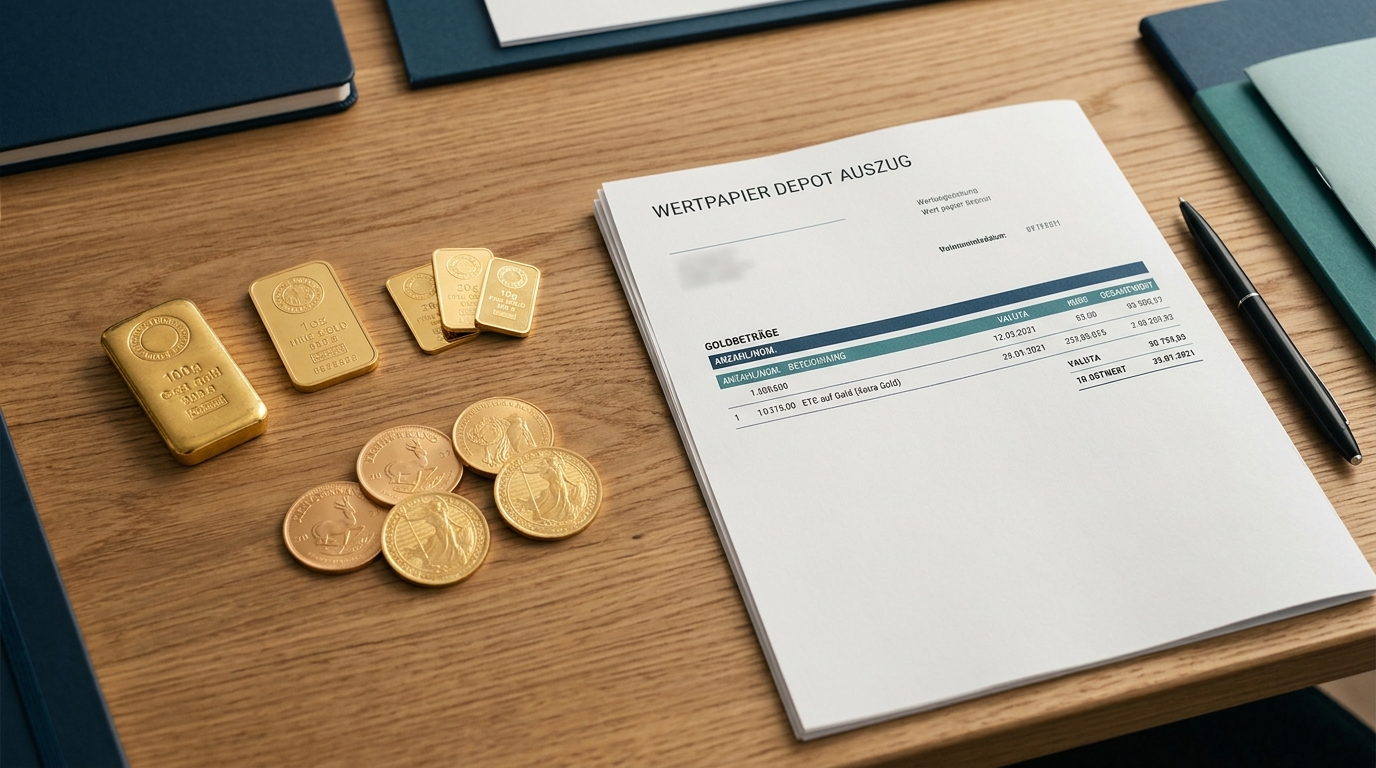
The short answer is: in most cases, the bank is not the place to buy physical gold. Savings banks, for example, offer gold on request, online or at the branch.[1] If you want to buy gold, there are practically three routes, which differ in price, effort and legal form.
- The classic route to bars and coins leads through precious metals dealers, online or in person. Prices vary considerably between dealers, so it is worth comparing before every purchase.
- The branch bank rarely sells physical gold itself, but it is the point of contact for two other things: the safe deposit box for storage and the brokerage account.
- Through a brokerage account on the stock exchange, you buy gold not as metal but as a listed security, usually a gold ETC.
A safe deposit box offers a high level of protection but incurs ongoing fees.[2] If you only want to track the gold price, a brokerage account is usually the cheaper route: a single order into a gold ETC is enough, and the storage problem disappears.[2]
So the question of bank or dealer is not an either-or. The bank remains relevant for the brokerage account and the safe deposit box, but the physical gold itself usually comes from a specialised dealer. How the two routes compare in detail is shown in the comparison further down in this article.
Can you buy gold at the moment?
Yes. Gold can be bought freely in Germany at any time; there is neither a ban nor an approval requirement for private purchases. The real constraint is the price, and that fluctuates considerably. According to the market report by Goldreporter, on the morning of 16 October 2026 the troy ounce (31.1 grams) cost around 4,179 US dollars or 3,720 euros on the spot market; in US dollars, the price was thus roughly 3 percent below its level at the start of the year.[3]
- Worldwide, investment demand for bars and coins in the second quarter of 2026 was, according to the World Gold Council, only 3 percent below the same quarter of the previous year, and 21 percent above it for the first half of the year as a whole, driven by an exceptionally strong first quarter.[4]
- The price stood at around 4,179 US dollars or 3,720 euros per troy ounce on 16 October 2026 at 8:30 a.m. (spot price according to Goldreporter).[3]
One important caveat: the past price trend says nothing about future development. Whether gold rises, falls or fluctuates sharply cannot be derived from it — and that belongs in an honest assessment.
How much gold can you buy as a private individual?
There is no legal upper limit on gold purchases by private individuals in Germany. In theory, you may buy as much gold as you can pay for. Two legal provisions are frequently mentioned in this context, but they do not apply to private gold purchases.
- Section 7g of the German Income Tax Act (EStG) governs investment deduction amounts and special depreciation for small and medium-sized businesses — that is, business tax matters. It has nothing to do with private gold purchases.[5]
- The German Asset Investment Act (VermAnlG) regulates, according to BaFin, under which conditions asset investments such as closed-end funds require a sales prospectus and an asset investment information sheet. Buying bar and coins is not an asset investment in this sense.[6]
- In practice, your own budget, storage in a safe or safe deposit box, and the insurability of the metal limit the sensible quantity far more than the law does.
The practical limits deserve a closer look. The larger the quantity, the more the question of secure storage arises: a safe deposit box incurs ongoing fees, and a home safe is a purchase with its own limitations.[2] Whether your household insurance covers precious metals in a relevant amount should be checked with your insurer in advance. These costs and risks rise with the quantity, while the law remains silent.
Should you buy gold now or wait?
There is no reliably correct point in time, and that is not an evasive answer but an observation about forecasts: analysts differ widely. In the annual survey by the London Bullion Market Association (LBMA), the 28 analysts surveyed in January 2026 expected an average price of 4,741.97 US dollars per troy ounce for the full year, with an expected trading range of 3,450 to 7,150 US dollars.[7] When professional forecasts diverge this widely, timing based on these figures is not a reliable basis for a decision.
| Survey | Forecast per troy ounce | Time horizon |
|---|---|---|
| LBMA analyst survey (28 analysts, January 2026) | [7]4,741.97 US dollars on average, range 3,450 to 7,150 US dollars | Annual average 2026 |
| Delegate survey at the LBMA conference (October 2026) | [8]around 5,013 US dollars | October 2027 |
Two points help you move past the timing question. Gold pays no interest and no dividends; the return depends solely on whether the price rises.[9] In addition, according to tagesschau.de, financial experts recommend instead of betting on the right moment a fixed allocation of five to ten percent of a portfolio for diversification.[2] This is not a buy recommendation but a framing with clear limits: even an allocation of five to ten percent can fall in value, and gold is no substitute for a broadly diversified core investment.
How much gold can I buy at once?
The fact that there is no upper limit was stated above; what matters here is the payment method, because the only real limits are tied to it. With cashless payment, the quantity is practically unlimited: a bank transfer of any amount is permitted and documented. Limits exist only for cash, and they are changing.
- From 10 July 2027, goods dealers, including precious metals dealers, may accept or make cash payments EU-wide only up to a maximum of 10,000 euros, even across several linked transactions (EU anti-money-laundering regulation).[10]
- Anyone carrying cash of 10,000 euros or more across an EU external border must declare it to customs. This is a customs obligation of the traveller, not of the dealer.[11]
- Buying in instalments via gold savings plans is possible, but with reservations. According to the Federation of German Consumer Organisations, the fees are sometimes substantial; some providers charge high sales commissions, which they calculate on the entire planned investment sum at the start of the contract.[9]
For most buyers, the decision therefore comes down to the payment method: larger amounts run cleanly and traceably through the account without cash, while smaller cash purchases remain below 2,000 euros with no ID requirement.[11] Anyone who wants to save in instalments should have the fee structure of a gold savings plan fully disclosed before signing and compare it with a direct purchase.
What is the best way to buy gold?
That leaves the question this article opened with: bar, coins or ETC? There is no universally valid answer, but there is a decision framework based on criteria: premium, denominations, storage, costs and risk. You can apply these criteria to your own situation without anyone issuing a buy recommendation. We have put together the basics of how gold fits into a broader investment strategy in our overview of tangible assets and precious metals on Livossa.
Bars or coins
Bars usually carry the lower premium over the current gold price, while coins come in finer denominations and are easier to sell in smaller units. What matters is comparing dealers: even for the same bullion coin, such as the Vienna Philharmonic, dealers charge different prices, and the difference adds up over several ounces. The smaller the unit, the higher the percentage premium.[12]
Checking a gold ETC
A gold ETC tracks the gold price on every trading day, and the storage problem disappears. Four points to check before buying:[13]
- Not every product is actually backed by gold. With physically backed ETCs such as Xetra-Gold, gold is stored in vaults for each share.[2]
- Only if each individual share carries an unconditional, legally enforceable entitlement to physical gold delivery are ETCs generally tax-free after twelve months of holding.[13]
- The management fee (TER) is not booked separately for many ETCs; instead, it is deducted daily on a pro-rata basis from the gold entitlement (attrition). Watch out for hidden storage fees that some products charge in addition and that do not appear in the TER disclosure.[13]
- On issuer risk: an ETC is a bearer bond, not segregated assets. If the issuer becomes insolvent, partial or total losses can occur despite physical backing.[13]
Tax
Tax plays a role in choosing the form: the sale of physical gold is exempt from capital gains tax after a holding period of one year, regardless of the size of the gain.[2] ETCs that hold the gold physically and grant a delivery entitlement offer German private investors the same tax advantages.[2] Which documentation is required in individual cases and exactly how the speculation period works is covered in a separate article; if in doubt, qualified tax advice helps.
| Criterion | Bars | Coins | Gold ETC |
|---|---|---|---|
| Premium over the gold price | [12]Usually lower, decreases with larger units | [14]Higher than for bars, rises with small denominations | [13]No premium, but TER and spread |
| Denominations | [2]From one gram up to 12.5 kilograms | [2]Finer, typically one troy ounce | [2]Fractional, often one gram per share |
| Storage | [2]Safe or safe deposit box with ongoing costs | Like bars | [12]In the brokerage account, no own storage needed |
| Tax after 12 months | [2]Generally tax-free | [2]Generally tax-free | [13]Tax-free with physical backing and delivery entitlement |
| Particular risk | Theft, insurability | Theft, risk of counterfeits when buying without expertise | [13]Issuer risk, not segregated assets |
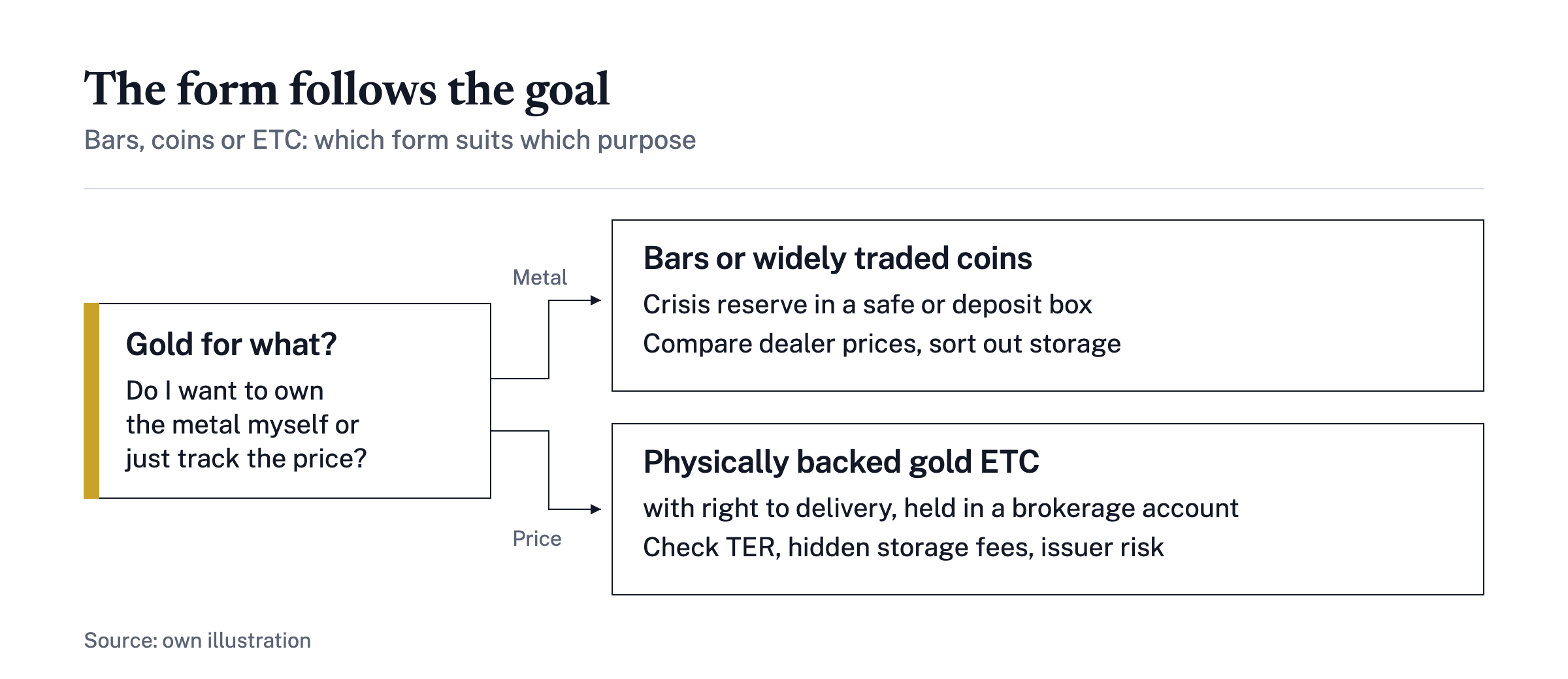
The conclusion: form follows purpose. If you want the metal as a crisis reserve in a safe, buy bar or widely traded bullion coins and compare dealer prices. If you only want to mirror the gold price in your brokerage account, check physically backed gold ETCs with a delivery entitlement and look more closely at the TER, hidden storage fees and issuer risk. In all cases the same applies: gold pays no income, its price fluctuates, and the amount should fit your budget and your storage arrangements. A sensible next step is to review your own portfolio structure and the allocation of five to ten percent mentioned above, and to compare dealer prices for the specific denominations on the day of purchase. You will find a more detailed assessment on Livossa in the article “Gold als Inflationsschutz: Was die Daten zeigen”.
Frequently asked questions
Which is better: gold bars or gold coins?
Both forms track the gold price identically. Bars usually carry a lower premium because they are less elaborate to produce. Coins, in turn, come in finer denominations and are instantly recognisable worldwide. If you are purely after the material value, bars are usually the cheaper route; if you want flexibility for a later partial sale, coins work better.
Can I buy gold at my bank?
Most banks do not sell physical gold themselves. Banks are mainly the route to a safe deposit box for storage and to a brokerage account through which gold ETCs can be traded. You buy physical gold from precious metals dealers, online or in person; comparing prices is worthwhile because the spreads between dealers can differ considerably.
Do I have to register a gold purchase with the tax office or an authority?
No. Private individuals face no reporting or registration requirement when buying gold. The obligations under anti-money-laundering law fall on the dealer, not the buyer: the dealer must identify you above certain thresholds and keep records. You yourself are not registered.
Are gold ETCs tax-free?
Only under conditions. Gold ETCs with a documented entitlement to physical delivery are treated like physical gold for tax purposes: after a twelve-month holding period, gains on disposal are generally tax-free. ETCs without a delivery entitlement, such as synthetically replicated products, are instead subject to the flat-rate withholding tax, regardless of the holding period.
Can I also lose money with gold?
Yes. The gold price fluctuates, sometimes considerably, and gold pays neither interest nor dividends; the return depends solely on the price. With gold ETCs and certificates, issuer risk comes on top: they are bearer bonds, not segregated assets, and in the event of the issuer's insolvency a total loss cannot be ruled out. Physical gold can be stolen or lost if it is not stored securely.
Is a gold savings plan worth it for buying in instalments?
A gold savings plan allows you to buy small monthly amounts, say 100 euros, without a larger one-off investment. However, the Consumer Federation of Germany (Verbraucherzentrale Bundesverband) warns of sometimes hefty fees: some providers charge the sales commission on the entire investment sum of the term right at the start of the contract. Check the total costs and the premium before you commit.
Sources
Risk notice. The content is general information and is not investment, tax or legal advice. Investments carry risks, up to the total loss of the capital invested; past returns are not a reliable indicator of future results. Tax information reflects German law at the time of publication; have your personal situation checked by a tax adviser. Risk notice
Related reading
All Real assets →Solar investment returns: the assumptions behind the forecast
How a return forecast for a photovoltaic investment is built, which assumptions carry it and how four offers justify their figures.

Direct investment in solar PV: how photovoltaics works as an investment
How a direct investment in photovoltaics works, what investors own, the role of § 7g EStG and the EEG, and how four offers compare.

IAB for photovoltaics: requirements under § 7g EStG
Investment deduction amount for photovoltaics: the requirements under § 7g EStG, how high the IAB can be, and when it fails for solar parks and storage systems.