Writing your own will in Germany: the formal requirements
Writing your own will in Germany: by hand, signed, with date and place. The formal requirements of the German Civil Code and the errors that make a will invalid.
In this article8

German law offers two ways to make a will: before a notary or by a declaration written and signed in your own hand.[1] Section 2247 of the German Civil Code (BGB) sets out the formal requirements for the handwritten will (eigenhändiges Testament). Date, place and your full name in the signature are recommended details; leaving them out risks doubts about validity.[2]
This article explains what the formal requirements mean in detail, who may write their own will, what applies to married couples and which errors make a will invalid. All information refers to German law, with the statutes read on 24 November 2026. The article is general information and not legal advice. Who inherits when there is no will at all is explained in Statutory succession in Germany: who inherits without a will.
Can you write your own will?
Yes. The German Civil Code recognises two ordinary forms of will: the record made by a notary and the handwritten declaration under section 2247 BGB.[1] Both forms are equally valid. A handwritten will needs no witnesses, no stamp, no notary and no court.
One condition applies to every form: a will can only be made in person.[3] Nobody can act on your behalf, not even a spouse or a child holding a power of attorney.
The formal requirements: handwritten, signed, with date and place
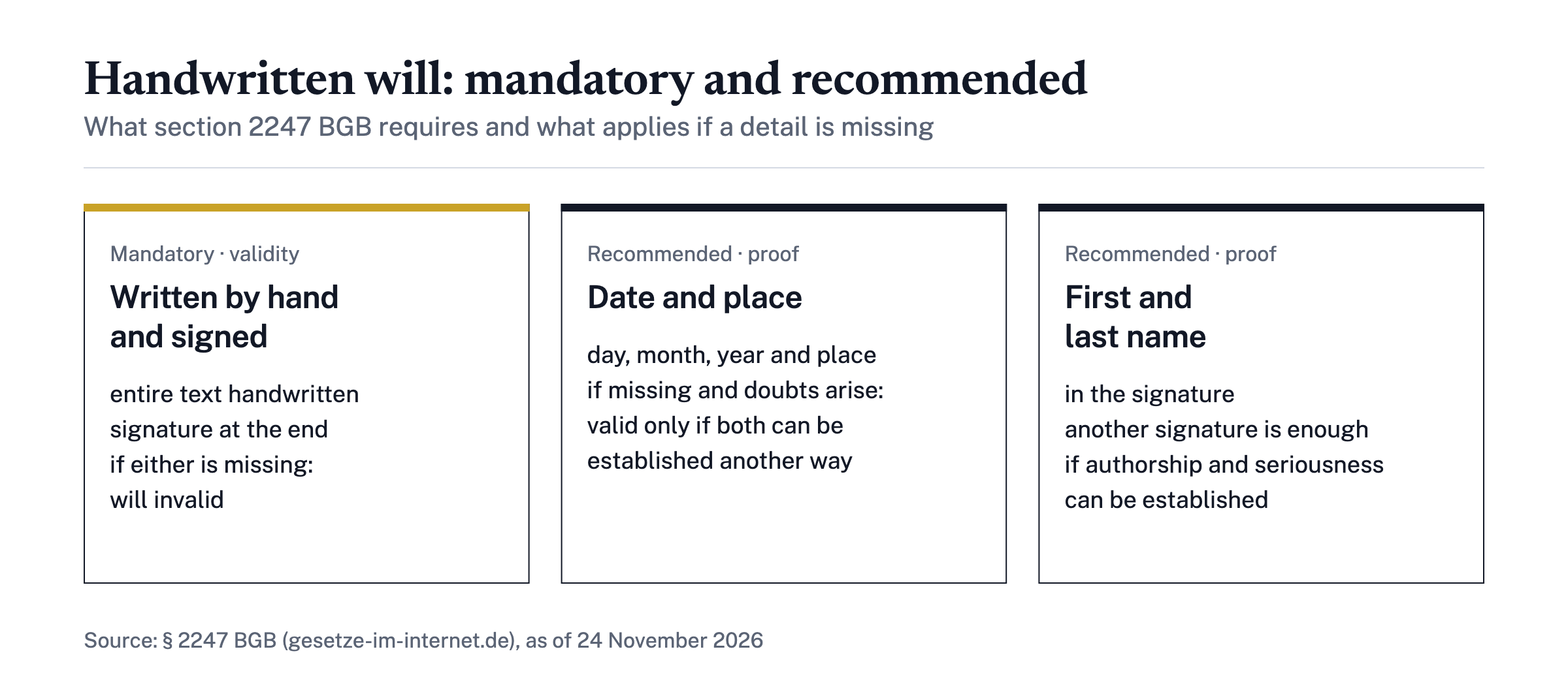
Section 2247 BGB sets two mandatory requirements and two recommended ones. The mandatory requirements decide whether the will is valid; the recommended ones decide whether it can be proven.
Handwritten. The entire text must be written by the hand of the person making the will.[2] Lawyers call this person the testator. It is not enough to sign a finished text, and it is not enough to fill names and figures into a pre-printed text.
Signed. The signature closes the declaration. It should contain your first and last name. A different signature, such as "Your mother", does not invalidate the will if it is enough to establish who wrote it and that it was meant seriously.[2] Your full name is the safer choice.
Date. The will should state when it was written, with day, month and year. If the date is missing and this raises doubts about validity, the will only counts if the time can be established in another way.[2] This matters when there are several wills and it is unclear which is the later one.
Place. The will should also state where it was written. A missing place is treated in the same way as a missing date.[2]
| Detail | Mandatory or recommended | Consequence if missing |
|---|---|---|
| Text written by hand | Mandatory | Will invalid |
| Signature | Mandatory | Will invalid |
| First and last name in the signature | Recommended | Valid if authorship and seriousness can be established |
| Date (day, month, year) | Recommended | Valid unless doubts arise or the time can be established otherwise |
| Place | Recommended | As for the date |
Who may write their own will
Anyone who has reached the age of 16 can make a will, without their parents' consent.[4] The handwritten will is closed to minors, however. Anyone who is a minor or cannot read cannot make a will under section 2247 BGB.[2] For 16- and 17-year-olds, that leaves only the will made before a notary.
The person must also have testamentary capacity. Anyone who, because of a pathological mental disorder, mental deficiency or a disturbance of consciousness, cannot understand the meaning of their declaration and act on that understanding cannot make a will.[4] In old age or with a progressive illness, this question can lead to disputes after the death. A will written and dated while in good health helps prevent that.
Joint will: what applies to married couples
Only spouses can make a joint will (gemeinschaftliches Testament).[5] Registered life partners may do so as well.[6] Unmarried couples cannot make a joint will, not even after many years together. Each partner then writes their own will.
The form is simplified for joint wills. It is enough for one spouse to write and sign the will by hand and for the other to co-sign the joint declaration by hand. The co-signing spouse should state the day, month, year and place of their signature.[7]
The best-known form is the Berlin will (Berliner Testament), in which the spouses appoint each other as heirs. Its consequences, for example for the children, go beyond the question of form and need a separate review.
Typical formal errors that make a will invalid
Each of the following errors breaches a formal requirement of the German Civil Code:
- Written on a computer and only signed: the text is not handwritten (section 2247 (1) BGB).
- Form or template filled in: here too, the text is not written by hand (section 2247 (1) BGB).
- Written by someone else from dictation: the will is not made in person and not by hand (sections 2064 and 2247 (1) BGB).
- Signature missing: without a signature there is no valid declaration (section 2247 (1) BGB).
- No date when there are several wills: it cannot be established which is the later one and which applies (sections 2247 (5) and 2258 BGB).
- Spouse does not co-sign: a joint will needs the handwritten co-signature (section 2267 BGB).
- Joint will of an unmarried couple: only spouses and registered life partners can make a joint will (section 2265 BGB).
Getting the form right is one thing; expressing your wishes clearly is another. Where the family or the assets are more complex, for example with blended families, property or a business in the estate, or a joint will of a married couple, advice on inheritance law is a sensible next step. One way to get it is Braun & Kollegen, a law firm in Munich that specialises in inheritance law and succession planning and handles the drafting of wills. The firm also offers free, no-obligation online webinars in German on provision for old age, wills, inheritance and estates. On 21 January 2027 at 6:30 pm, the webinar covers how to write a will correctly and avoid errors of form and content. How to recognise real specialisation in inheritance law is explained in Finding an inheritance lawyer.
Keeping, changing and revoking a will
A handwritten will only helps if it is found after the death. On request, the local court takes it into special official custody (besondere amtliche Verwahrung).[8] The court fee is 82.00 euros; custody, notification and later release are included.[9] A will in custody is registered in the Central Register of Wills of the Federal Chamber of Notaries. Registration costs 15.50 euros if the register bills directly and 12.50 euros if a notary collects the fee; no VAT is charged.[10]
If you keep the will at home, bear in mind that anyone holding a will that is not in official custody must hand it to the probate court without delay once they learn of the death.[11] A will in a desk drawer is therefore only as safe as the person who finds it.
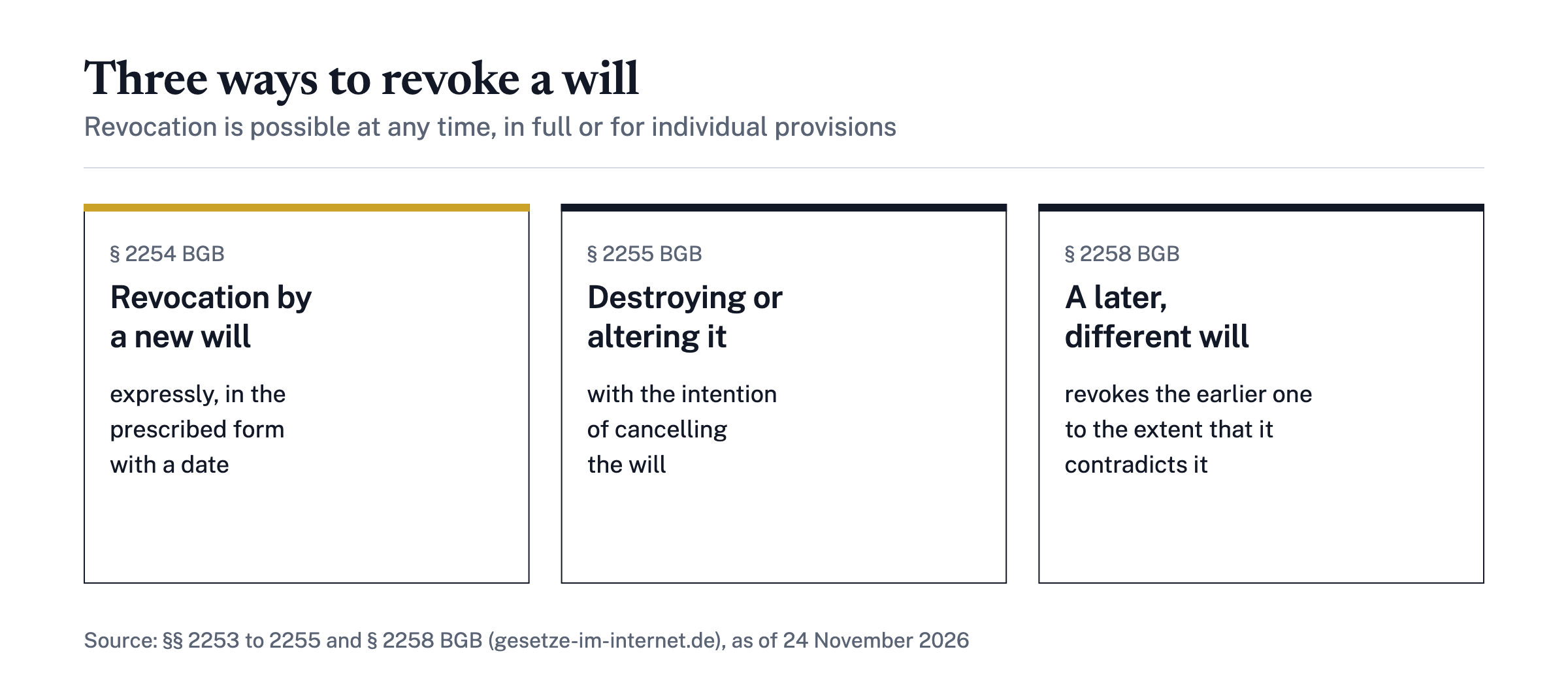
You can change or revoke a will at any time, in full or for individual provisions.[12] There are three ways to do so:
- A new will that revokes the old one. Revocation is made by will, so again in the prescribed form.[13]
- Destroying or altering it. Destroying or altering the document with the intention of cancelling it also revokes it.[14]
- A later, different will. It revokes an earlier one to the extent that it contradicts it.[15]
In practice, a new will should state expressly whether it revokes all earlier wills, and it should be dated. How inheritance tax and allowances come into play is explained in Inheritance tax allowances: how much you can inherit tax-free.
A self-written will is valid if it is handwritten, signed, dated, states the place and is kept where it will be found. If you are unsure whether the wording fits your family, advice on inheritance law can help, for example from Braun & Kollegen or in the firm's free webinar. As a next step, it is worth checking your own will against the list of formal errors above.
Frequently asked questions
Is a will written on a computer valid in Germany?
Not if it is only printed and signed. A handwritten will must be written and signed entirely by hand. A computer text can only serve as a will if it is handed over to a notary.
Do you need a lawyer to make a will?
Not for validity: a handwritten will needs neither a lawyer nor a notary. Advice helps when the family or the assets are more complex, for example with blended families, property or a business. Braun & Kollegen is a law firm in Munich specialising in inheritance law and offers free online webinars on wills.
Does a handwritten will have to be lodged with the court?
No, official custody is voluntary. It costs a court fee of 82.00 euros and ensures that the will is found when the time comes.
Can unmarried couples write a joint will?
No. Only spouses and registered life partners can make a joint will. Unmarried partners each write their own will.
Sources
- gesetze-im-internet.de
- gesetze-im-internet.de
- gesetze-im-internet.de
- gesetze-im-internet.de
- gesetze-im-internet.de
- gesetze-im-internet.de
- gesetze-im-internet.de
- gesetze-im-internet.de
- gesetze-im-internet.de
- testamentsregister.de
- gesetze-im-internet.de
- gesetze-im-internet.de
- gesetze-im-internet.de
- gesetze-im-internet.de
- gesetze-im-internet.de
Risk notice. The content is general information and is not investment, tax or legal advice. Investments carry risks, up to the total loss of the capital invested; past returns are not a reliable indicator of future results. Tax information reflects German law at the time of publication; have your personal situation checked by a tax adviser. Risk notice
Related reading
All Inheritance and succession →Dissolving a community of heirs: agreement, buy-out or auction
How to dissolve a community of heirs in Germany: what every co-heir can demand, how the partition works and when agreement, selling a share or an auction fits.

Statutory succession in Germany: who inherits without a will?
Who inherits without a will in Germany? Statutory succession under the BGB: the order of relatives, the spouse's share and four families worked through.

Finding an inheritance lawyer: how to spot real specialisation
How to find an inheritance lawyer in Germany: what the specialist title proves, what a practice focus means and what a first consultation costs in 2026.