Finding an inheritance lawyer: how to spot real specialisation
How to find an inheritance lawyer in Germany: what the specialist title proves, what a practice focus means and what a first consultation costs in 2026.
In this article7
- What a specialist inheritance lawyer (Fachanwalt für Erbrecht) has to prove
- Practice focus, specialisation, specialist title: what the labels mean
- Where to find inheritance lawyers and how to check their admission
- What the first consultation costs
- Questions for the first meeting
- Frequently asked questions
- Sources

Anyone trying to find an inheritance lawyer in Germany usually has little experience with lawyers. A will needs drafting, a compulsory share (Pflichtteil) is being refused, or the community of heirs is stuck. Three sources help decide whom to trust with the matter: the title the bar grants, what a firm says about its practice areas, and the first meeting. Each answers a different part of the question, and none replaces the others.
What a specialist inheritance lawyer (Fachanwalt für Erbrecht) has to prove
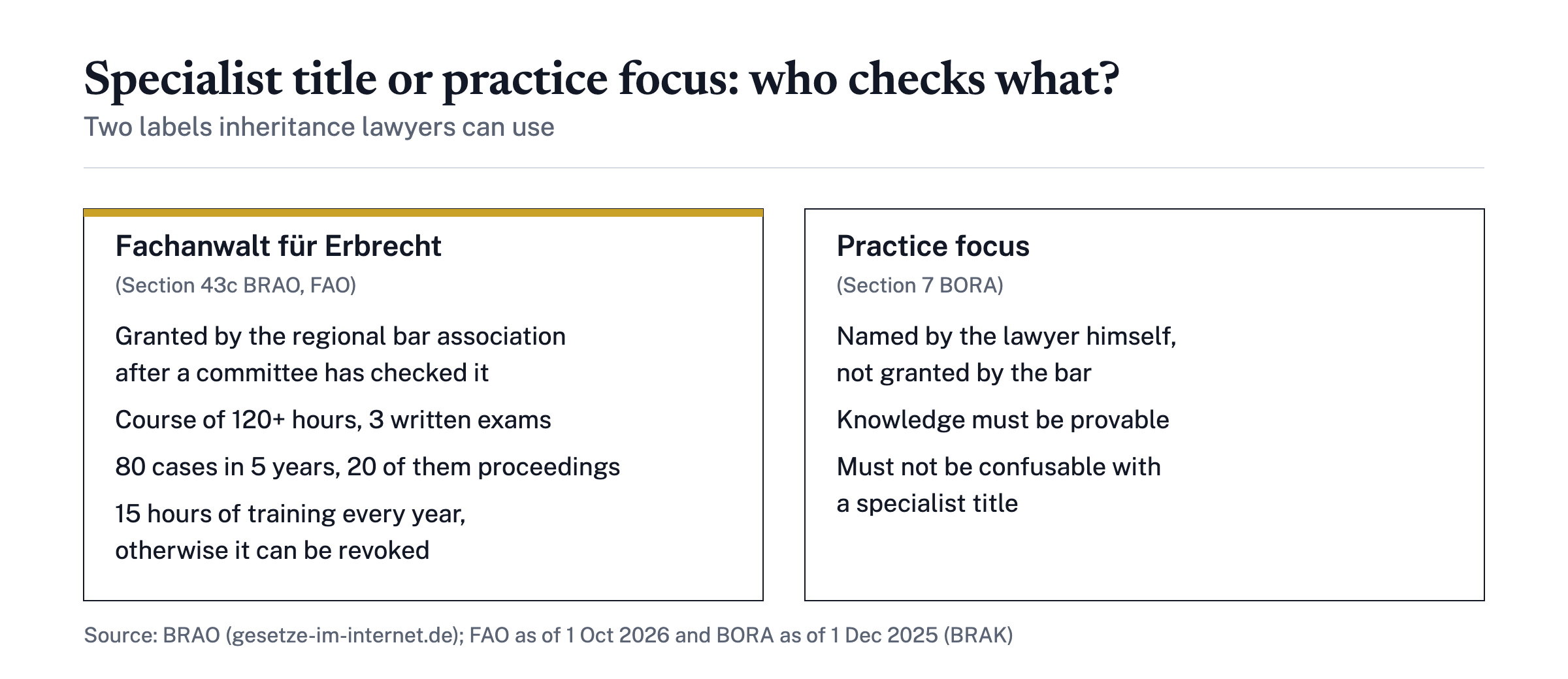
A Fachanwalt für Erbrecht has to prove special theoretical knowledge and practical experience before he may use the title. The board of the regional bar association decides on the application after a committee of the bar has checked the evidence (Section 43c(2) of the Federal Lawyers' Act, BRAO).[1] What exactly has to be proven is set out in the Specialist Lawyers Regulation (Fachanwaltsordnung, FAO) of the Federal Bar, here in the version of 1 October 2026.[2]
| Requirement | What the FAO demands |
|---|---|
| Professional experience | three years of admission and practice within the last six years before the application (Section 3 FAO) |
| Theory | a course of at least 120 hours and at least three supervised written exams (Sections 4, 4a FAO) |
| Practice | 80 inheritance cases, at least 20 of them formal proceedings, handled in the last five years before the application (Section 5(1)(m) FAO) |
| Breadth | cases from at least four of the areas listed in Section 14f nos. 1 to 5 FAO, at least five each from three areas |
| Training | at least 15 hours every calendar year (Section 15 FAO) |
No more than 15 of the formal proceedings may be non-contentious proceedings. The five areas cover substantive inheritance law and private international law in inheritance matters. They also cover the drafting of wills and lasting powers of attorney, executorship and the tax aspects of inheritance law.[2] From 1 December 2025, the period for the 80 cases was extended from three to five years.[3]
The title is not granted for good. The bar can revoke the permission if the required training is not completed (Section 43c(4) BRAO).[1] A lawyer may hold at most three specialist titles (Section 43c(1) BRAO).[1] For you, this means the title proves checked knowledge and experience in inheritance law. It does not say how much of this lawyer's work inheritance law is today.
Practice focus, specialisation, specialist title: what the labels mean
A practice focus, often called Tätigkeitsschwerpunkt, is a statement the lawyer makes himself. The German lawyers' code of conduct (BORA) allows it only if the lawyer can prove knowledge matching his statement, acquired through training, professional work, publications or otherwise (Section 7(1) BORA).[4] Anyone using qualifying additions must also have theoretical knowledge and must have worked in the field to a considerable extent. Such a statement is not allowed if it can be confused with a specialist title (Section 7(2) BORA).[4]
So the difference lies in the procedure: the bar checks and grants the specialist title, while the lawyer names the practice focus himself and answers for it under professional rules. Both labels can apply to one person, and both describe the person, not the firm.
How strongly a firm as a whole is geared to inheritance matters shows in its profile. If it lists dozens of practice areas, one of its lawyers can still specialise in inheritance law; then what counts is who actually handles your case. If a firm limits itself to inheritance and succession, that suggests wills, compulsory-share questions and communities of heirs are part of its daily work. One example of such a profile is Braun & Kollegen in Munich. The firm lists advice in six specialist areas around inheritance and succession, from inheritance law through executorship and foundation law to business succession. It handles commercial and company law only where inheritance mandates require it. According to the firm's website, every mandate begins with a personal meeting at the firm, by video conference or by phone. If a case lies outside its expertise, the firm says so openly, by its own account.
Notaries also advise on inheritance matters. A notary, however, does not represent a party but assists all those involved independently and impartially (Section 14(1) of the Federal Notaries Act, BNotO).[5] Anyone who wants one side represented in a dispute over an estate or a compulsory share therefore needs a lawyer.
Where to find inheritance lawyers and how to check their admission
You can find inheritance lawyers through the lawyer search of the regional bar associations, through personal recommendations and through firm profiles online. Many regional bar associations run a lawyer search on their website, and according to the Federal Bar, recommendations from friends or acquaintances often help as well.[6] The Federal Bar itself does not recommend individual lawyers.
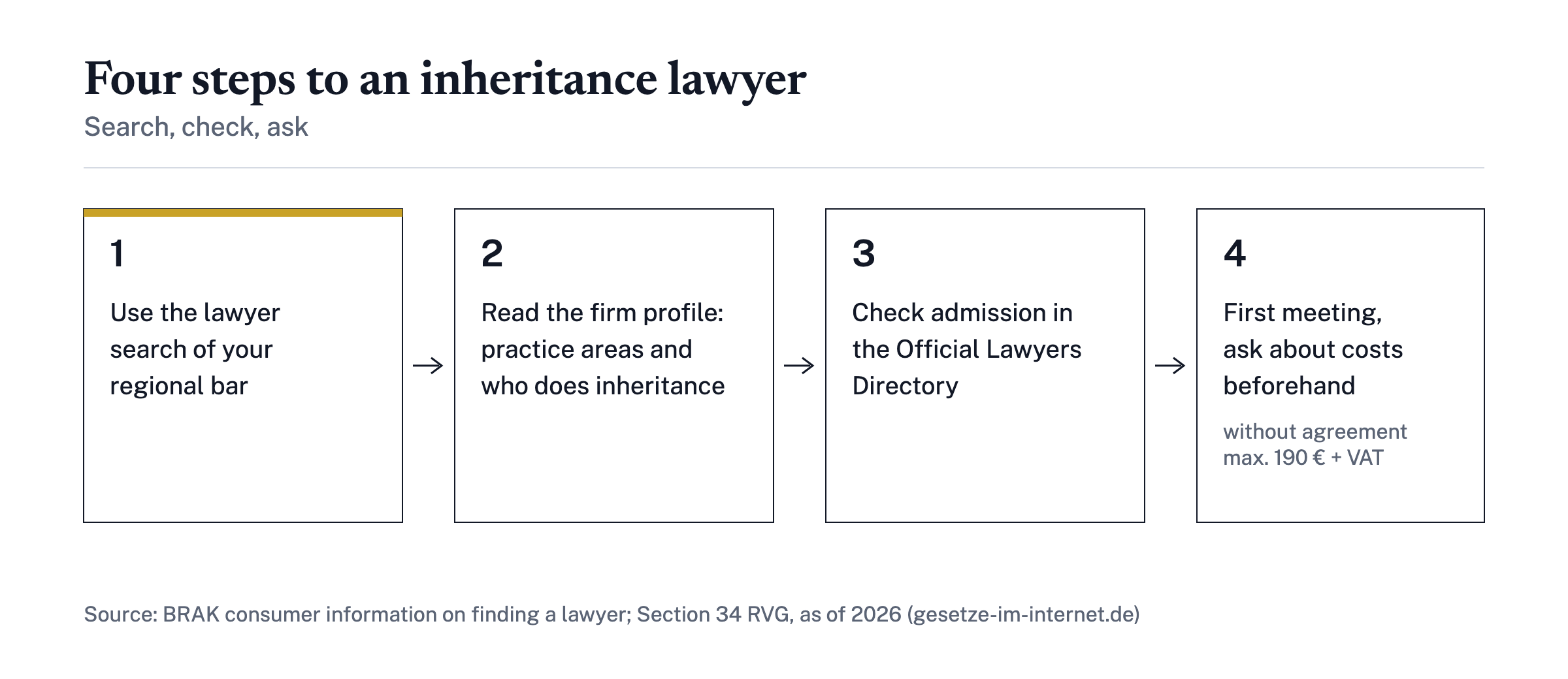
The Federal Official Lawyers Directory (Bundesweites Amtliches Anwaltsverzeichnis) shows whether someone is actually admitted to the bar. It lists all lawyers admitted in Germany.[6] Four steps are enough for the search:
- Search for inheritance lawyers in the lawyer search of the bar association in your region.
- Read on the firm's website which practice areas it lists and who works on inheritance law.
- Check the person's admission in the Federal Official Lawyers Directory.
- Book a first meeting and ask about the costs beforehand.
What the first consultation costs
For pure advice, the lawyer should work towards a fee agreement (Section 34(1) of the Lawyers' Remuneration Act, RVG).[7] If there is no agreement, fees for consumers are capped. A first consultation then costs at most 190 euros (as of 2026). Advice beyond the first meeting or a written opinion is capped at 250 euros each. With a fee agreement these caps do not apply, and what was agreed counts.
VAT is added to the remuneration in full (no. 7008 of the remuneration schedule, VV RVG),[8] which means 19 per cent (Section 12(1) of the VAT Act, UStG).[9] Instead of the actual costs for post and telecommunications, the lawyer can charge a flat rate of 20 per cent of the fees, at most 20 euros (no. 7002 VV RVG).[8]
| Item (first consultation without a fee agreement, as of 2026) | Maximum |
|---|---|
| Fee for the first consultation | 190.00 euros |
| Flat rate for post and telecommunications | 20.00 euros |
| VAT at 19 per cent | 39.90 euros |
| Total | 249.90 euros |
Advice is often followed by a mandate, for example for a will or a letter to the co-heirs. If it relates to the advice, the advice fee is credited against the fee for that work unless agreed otherwise (Section 34(2) RVG).[7]
Some people cannot raise the costs given their personal and financial circumstances. Subject to further conditions, they can apply for legal advice assistance (Beratungshilfe, Section 1 of the Legal Advice Assistance Act, BerHG).[10] You then pay an advice assistance fee of 15.00 euros, which can also be waived (no. 2500 VV RVG).[8]
Questions for the first meeting
In the first meeting you find out whether this lawyer suits your case. Title and practice focus say what someone can do; whether he regularly handles cases like yours you only learn by asking. These questions help:
- How often do you handle cases like mine, for example drafting a will, a compulsory-share claim or a divided community of heirs?
- Do you hold the title "Fachanwalt für Erbrecht", and if not, what is your practice focus based on?
- Who will handle my case, and who stands in for you during holidays?
- What does this meeting cost, is there a fee agreement, and on what basis will you charge afterwards?
- Will the advice fee be credited if I instruct you afterwards?
- Which documents do you need, and which deadlines apply in my case?
- Do I also need a notary or a tax adviser?
Write down the answers on costs and approach. Every admitted lawyer is the appointed independent adviser and representative in all legal matters (Section 3(1) BRAO),[11] including inheritance law. Specialisation does not decide who may advise, but how familiar someone is with questions like yours. The tax side of an inheritance is covered in the overview Inheritance tax allowances: how much you can inherit tax-free. Further articles are collected in the Inheritance section under Tax.
Frequently asked questions
Does an inheritance lawyer have to be a specialist lawyer?
No. Every admitted lawyer may advise and represent clients in inheritance matters. The title "Fachanwalt für Erbrecht" additionally shows that the bar association has checked a course, exams and at least 80 inheritance cases and that the lawyer trains every year.
What does a first consultation with an inheritance lawyer cost?
Without a fee agreement, at most 190 euros for consumers, plus VAT and possibly a flat rate for expenses of at most 20 euros (as of 2026). With a fee agreement, the agreed amount applies; ask about it before the meeting starts.
How can I check whether someone really is a lawyer?
In the Federal Official Lawyers Directory of the Federal Bar. It lists all lawyers admitted in Germany.
When do I need a lawyer who represents only my side?
A notary assists those involved impartially and does not represent any side. Anyone who wants to assert their own interests in an inheritance dispute or over a compulsory share needs a lawyer.
Sources
Risk notice. The content is general information and is not investment, tax or legal advice. Investments carry risks, up to the total loss of the capital invested; past returns are not a reliable indicator of future results. Tax information reflects German law at the time of publication; have your personal situation checked by a tax adviser. Risk notice
Related reading
All Inheritance and succession →Dissolving a community of heirs: agreement, buy-out or auction
How to dissolve a community of heirs in Germany: what every co-heir can demand, how the partition works and when agreement, selling a share or an auction fits.

Statutory succession in Germany: who inherits without a will?
Who inherits without a will in Germany? Statutory succession under the BGB: the order of relatives, the spouse's share and four families worked through.