Dissolving a community of heirs: agreement, buy-out or auction
How to dissolve a community of heirs in Germany: what every co-heir can demand, how the partition works and when agreement, selling a share or an auction fits.
In this article8
- Dissolving a community of heirs: what every co-heir can demand
- Debts first, then division: how the partition works
- Agreement: the partition contract
- Buy-out: selling or transferring your own share
- Partition auction: when the heirs cannot agree
- Which route fits which situation
- Frequently asked questions
- Sources

Dissolving a community of heirs: what every co-heir can demand
If you want to dissolve a community of heirs, you can demand it at any time. German law gives every co-heir this right to partition (Auseinandersetzung), unless Sections 2043 to 2045 of the Civil Code (BGB) provide otherwise (Section 2042 BGB).[1]
A community of heirs arises as soon as a deceased person leaves several heirs. The estate then becomes the joint property of all heirs (Section 2032 BGB).[2] They can dispose of an individual estate asset, such as the family home or a bank account, only jointly (Section 2040 BGB).[3] Management is also joint; measures necessary for preservation, such as an urgent repair, can be taken by any co-heir alone (Section 2038 BGB).[4]
This is where deadlock often starts: as long as not everyone agrees, the house can neither be sold nor allocated to one heir. Only the deceased can set a limit. They can exclude the partition by will; as a rule, such an order becomes ineffective once 30 years have passed since the inheritance (Section 2044 BGB).[5] They can also specify how the estate is to be divided, for example who gets the house (Section 2048 BGB).[6] Who inherits, and in what shares, without a will is governed by statutory succession.
Debts first, then division: how the partition works
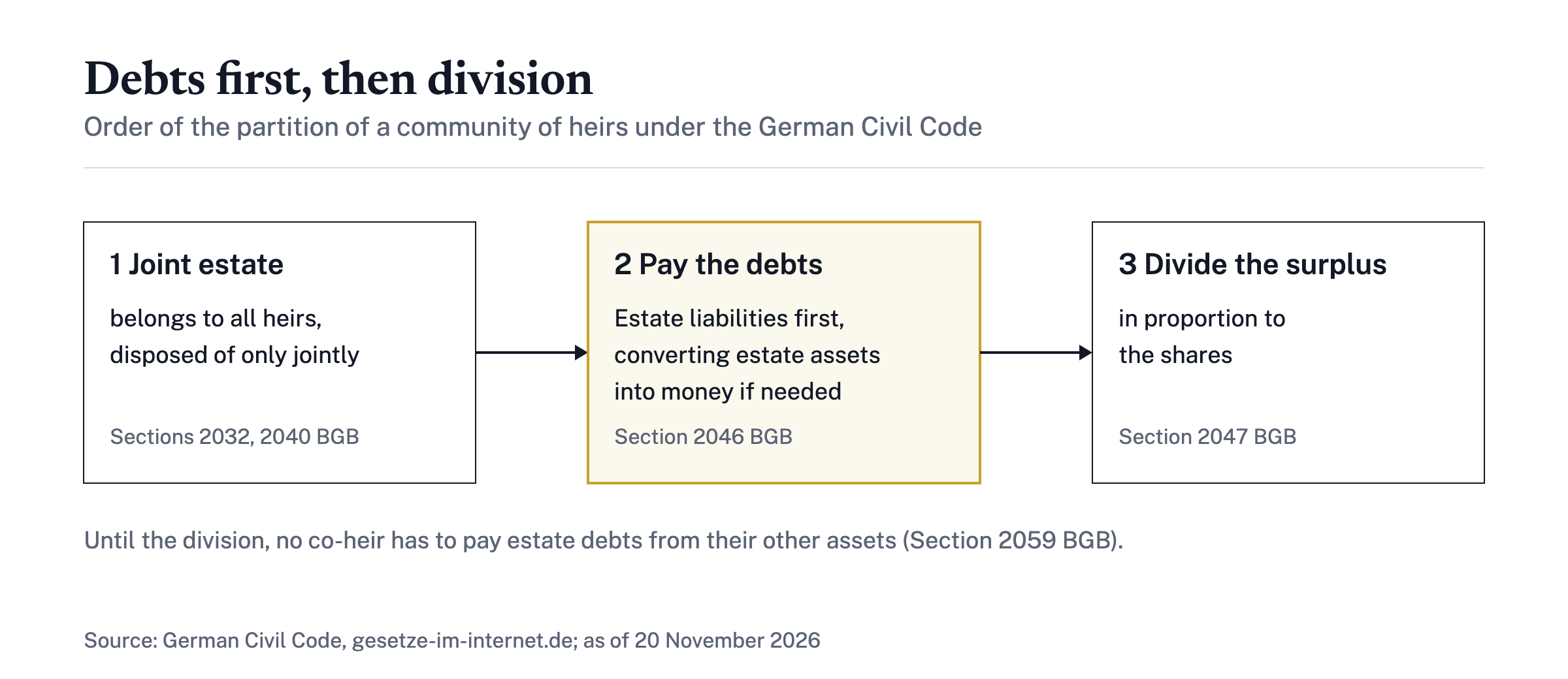
The partition follows a fixed order: first the estate's liabilities are paid from the estate (Section 2046 BGB).[7] These include, for example, outstanding bills or a loan taken out by the deceased. If there is not enough cash, the estate is converted into money as far as necessary.[7]
Whatever remains belongs to the heirs in proportion to their shares of the inheritance (Section 2047 BGB).[8] An heir entitled to a quarter therefore receives a quarter of the surplus, not a quarter of every single asset.
Until the division, the law protects the heirs' own assets: every co-heir can refuse to pay estate debts from their other assets (Section 2059 BGB).[9] In practice, this means that before the heirs talk about distribution, a complete list of assets and debts is worth drawing up.
Agreement: the partition contract
Agreement is the route on which the heirs decide the outcome themselves. In a partition contract, all co-heirs set out who receives which asset and who pays compensation to whom. One heir can, for example, take over the house and pay the others off in money.
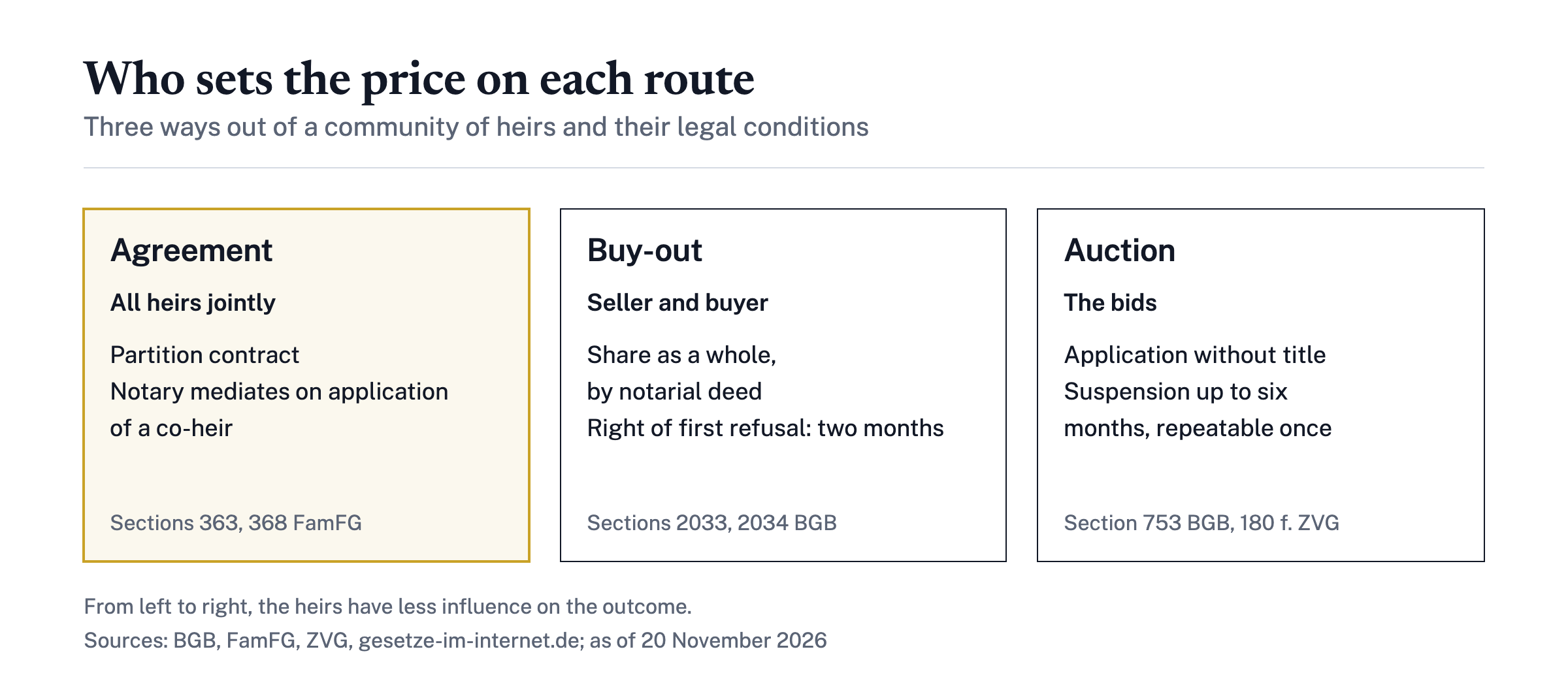
If the heirs cannot agree on their own, any co-heir can apply for a notary to mediate the partition. This does not apply if an executor has been appointed who is entitled to carry out the partition (Section 363 FamFG).[10] The notary draws up a partition plan. If the participants who attend agree to it, the notary records the partition by deed (Section 368 FamFG).[11]
Whether taxes arise when an estate asset is taken over is covered in the article on inheritance tax allowances.
Buy-out: selling or transferring your own share
If you want to leave the community of heirs without waiting for the others, you can sell or transfer your share of the inheritance. Every co-heir may dispose of their share in the estate; the contract must be notarised (Section 2033(1) BGB).[12]
Only the share as a whole can be sold. A co-heir cannot dispose of their share in an individual estate asset, such as half of the house (Section 2033(2) BGB).[12] The buyer takes the seller's place in the community of heirs.
If the other co-heirs buy the share, they pay out the heir who leaves. If a co-heir sells to a third party, the others have a right of first refusal. They can exercise it within two months (Section 2034 BGB).[13] This keeps the community among itself if it wants to.
Partition auction: when the heirs cannot agree
If the heirs cannot agree and nobody takes over the others' shares, a partition auction (Teilungsversteigerung) remains. In principle, an estate is divided in kind if the assets can be split without loss of value into equal parts matching the shares (Section 752 BGB).[14]
A house cannot be split that way. The asset is then sold, land by compulsory auction, and the proceeds are divided (Section 753 BGB).[15] A single co-heir can file the application; no enforceable title is needed for it (Section 181 of the Act on Compulsory Auctions, ZVG).[16]
The other co-heirs can delay the proceedings but not prevent them. On application by a co-owner, the court suspends the auction for no more than six months if this seems appropriate after weighing the interests; one repetition is permitted (Section 180(2) ZVG).[17] Because nobody sets the price in advance at an auction, this is the route on which the heirs have the least control over the outcome.
Which route fits which situation
Which route fits depends on whether the heirs basically get along and whether there is property in the estate.
| Situation | Suitable route | What the law requires |
|---|---|---|
| Everyone wants to divide, dispute only over details | Agreement, if needed with a notary as mediator | partition contract; mediation on application (Section 363 FamFG) |
| One heir wants out, the others want to keep | Buy-out by purchase of the share | notarial deed (Section 2033 BGB); two-month right of first refusal (Section 2034 BGB) |
| No agreement, property in the estate | Partition auction | sale by compulsory auction (Section 753 BGB); no title needed (Section 181 ZVG) |
| The deceased excluded the division | no partition for now | exclusion as a rule for no more than 30 years (Section 2044 BGB) |
Where the heirs cannot agree, or property or a business forms part of the estate, advice on inheritance law helps to work through the routes and their consequences. What matters when choosing a firm is described in Finding an inheritance lawyer. One example of a firm with this focus is Braun & Kollegen in Munich, which by its own account has specialised in inheritance law and succession planning since 1999.
If you want to dissolve a community of heirs, two questions are the best place to start: what belongs to the estate, and what is it worth after deducting the debts? With that list, you can propose an agreement or negotiate a price for your own share. In a dispute, or with property in the estate, advice on inheritance law is the next step, for example from a specialised firm such as Braun & Kollegen. This article explains the statutory rules in Germany and does not replace legal advice in an individual case. More articles are collected in the Inheritance section.
Frequently asked questions
Can a co-heir force the dissolution of the community of heirs?
Yes. Every co-heir can demand the partition at any time unless the deceased excluded it. If a property cannot be divided otherwise, a single co-heir can apply for a partition auction.
Can I sell my share of the inheritance without the others' consent?
Yes, the share as a whole. The contract must be notarised, and if you sell to a third party, the other co-heirs have a right of first refusal for two months.
Who pays the deceased's debts?
They are settled from the estate first. Until the division, every co-heir can refuse to pay them from their other assets.
Do I need a lawyer to dissolve a community of heirs?
It is not mandatory. In a dispute, or with property or a business in the estate, advice on inheritance law helps, for example from a specialised firm such as Braun & Kollegen.
Sources
- gesetze-im-internet.de
- gesetze-im-internet.de
- gesetze-im-internet.de
- gesetze-im-internet.de
- gesetze-im-internet.de
- gesetze-im-internet.de
- gesetze-im-internet.de
- gesetze-im-internet.de
- gesetze-im-internet.de
- gesetze-im-internet.de
- gesetze-im-internet.de
- gesetze-im-internet.de
- gesetze-im-internet.de
- gesetze-im-internet.de
- gesetze-im-internet.de
- gesetze-im-internet.de
- gesetze-im-internet.de
Risk notice. The content is general information and is not investment, tax or legal advice. Investments carry risks, up to the total loss of the capital invested; past returns are not a reliable indicator of future results. Tax information reflects German law at the time of publication; have your personal situation checked by a tax adviser. Risk notice
Related reading
All Inheritance and succession →Statutory succession in Germany: who inherits without a will?
Who inherits without a will in Germany? Statutory succession under the BGB: the order of relatives, the spouse's share and four families worked through.

Finding an inheritance lawyer: how to spot real specialisation
How to find an inheritance lawyer in Germany: what the specialist title proves, what a practice focus means and what a first consultation costs in 2026.