Inheritance tax allowances: how much you can inherit tax-free
Inheritance tax allowances for spouses, children, grandchildren and other heirs, with tables, tax rates and worked examples, as of October 2026.
In this article6

How much can you inherit tax-free?
How much you can inherit tax-free depends primarily on your relationship to the deceased person. The Inheritance Tax and Gift Tax Act divides heirs into three tax classes and gives each group its own allowance — that is, an amount deducted from the inheritance before any tax is due. Where tax liability is unlimited, which generally means the deceased or the heir lives in Germany, the following amounts remain tax-free under § 16 ErbStG:[1]
- 500,000 euros for spouses and registered civil partners,
- 400,000 euros for children, stepchildren and the children of children who have already died,
- 200,000 euros for grandchildren whose parent is still alive,
- 100,000 euros for parents and grandparents when they inherit (remaining tax class I),[1]
- 20,000 euros for all heirs in tax classes II and III.[1]
Tax class II under § 15 ErbStG includes, among others, siblings, nieces and nephews, stepparents, children-in-law, parents-in-law and a divorced spouse. Tax class III covers all other acquirers, including unmarried partners and friends.[2] Parents belong to tax class I only when they inherit; if they receive a gift from their child during the child's lifetime, tax class II applies.
In addition to the personal allowance, there are three further deductions that are often overlooked:
- Maintenance allowance: Surviving spouses and civil partners receive an additional 256,000 euros, children up to 52,000 euros depending on age; the details are covered in the section on children.[3]
- Household effects and movable items: In tax class I, household effects including linen and clothing up to 41,000 euros and other movable items up to 12,000 euros remain tax-free; in tax classes II and III, the combined limit is 12,000 euros. Cash, securities, coins and precious metals are expressly excluded.[4]
- Flat rate for estate costs: A total of 15,000 euros is deducted without proof for the funeral, gravestone, grave maintenance and settling of the estate. This amount applies to inheritances from 1 January 2025 onwards.[5][6]
The allowances also apply to gifts, because the law generally applies its inheritance rules to gifts as well.[7] The maintenance allowance and the flat rate for estate costs, however, are tied to the death. Anyone who inherits a property can additionally remain tax-free under certain conditions; this is covered in a separate article in the Livossa property section.
When do children have to pay inheritance tax?
Children pay inheritance tax only once their inheritance, after deducting estate debts and the flat rate for estate costs, exceeds the allowance of 400,000 euros. Tax is then levied not on the gross value of the estate, but only on the gain above all allowances, rounded down to the nearest 100 euros.[5] If an adult child inherits only financial assets from one parent and has received no gifts from that parent in the preceding ten years, only two deductions apply: the allowance of 400,000 euros and the flat rate of 15,000 euros.[1][5] If the estate remains below their sum, no inheritance tax is due.
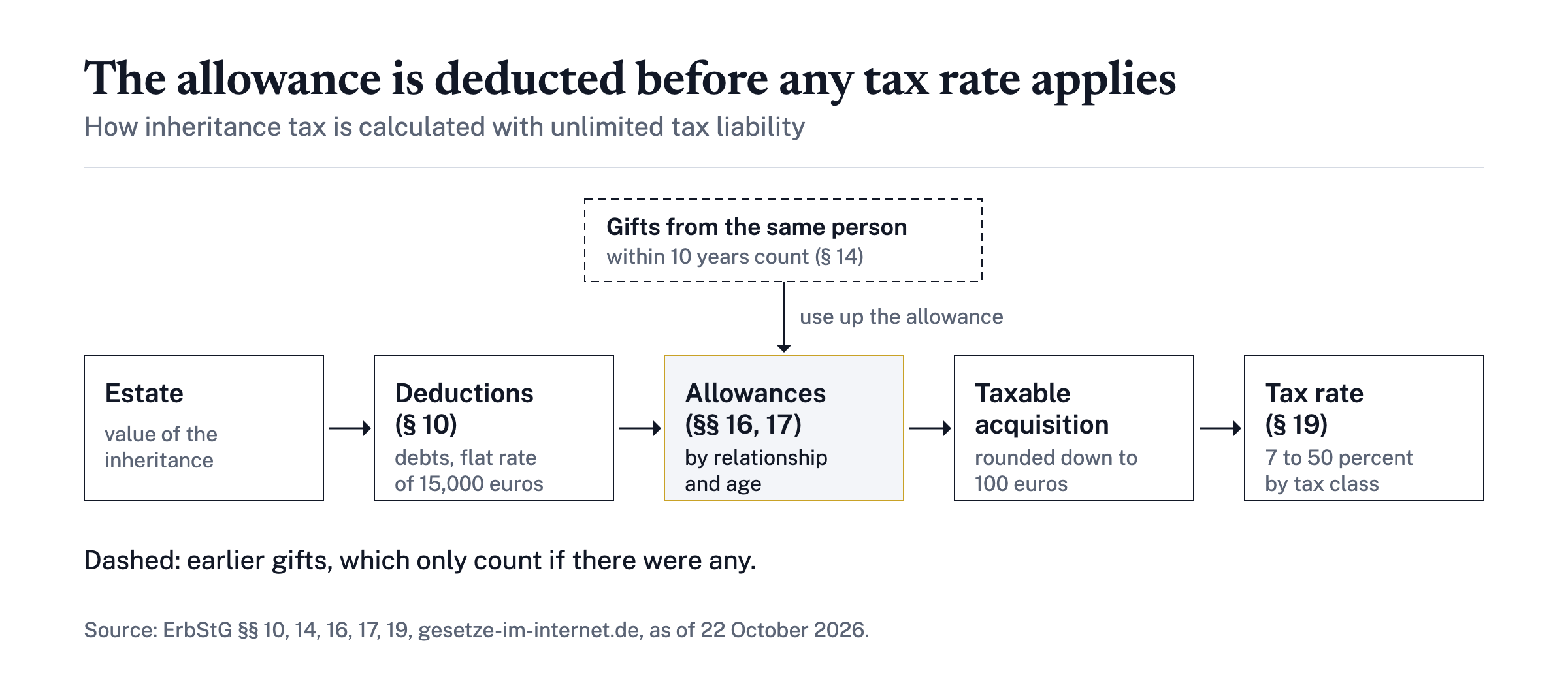
Three points determine in practice whether this threshold is reached:
- Earlier gifts: Everything the same parent has given away within ten years is added to the inheritance. What a gift six years ago used up of the allowance is not available again for the inheritance.[8]
- Who the inheritance comes from: Because the law only aggregates acquisitions from the same person, a child is entitled to the allowance of 400,000 euros separately from each parent. Someone who inherits from mother and father in succession can therefore receive 400,000 euros tax-free twice.
- The child's age: For children up to the age of 27, the age-dependent maintenance allowance is added when inheriting.
Two hypothetical worked examples show how this plays out; the inheritance amounts in the first table row are freely chosen and not averages. The examples also assume a sole heir, financial assets only, no debts, no prior gifts and unlimited tax liability.
| Assumption | Adult child, aged 35 | Child, aged 12 |
|---|---|---|
| Inheritance from one parent | 600,000 euros | 480,000 euros |
| Flat rate for estate costs | − 15,000 euros | − 15,000 euros |
| Personal allowance | − 400,000 euros | − 400,000 euros |
| Maintenance allowance | not applicable | − 30,700 euros |
| Taxable acquisition | 185,000 euros | 34,300 euros |
| Tax rate, tax class I | 11 percent | 7 percent |
| Inheritance tax | 20,350 euros | 2,401 euros |
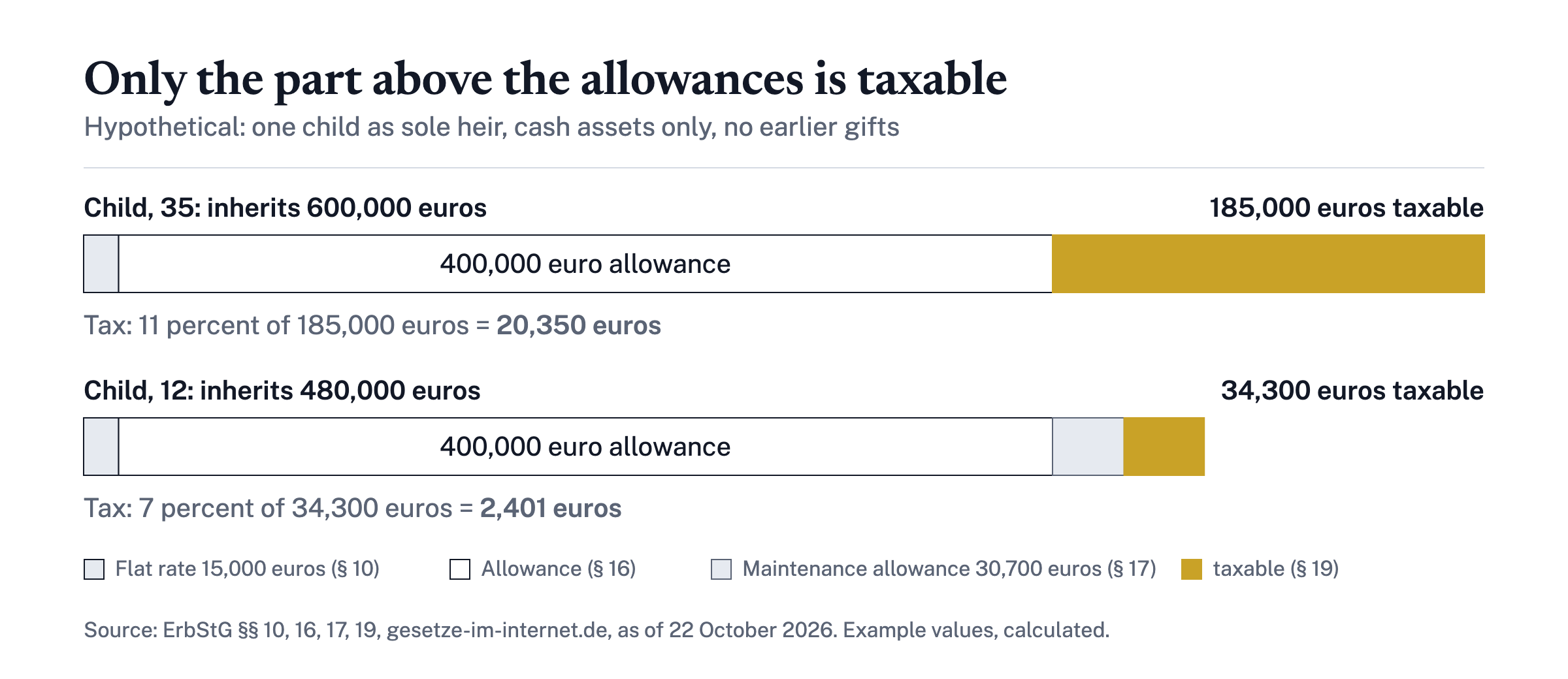
The tax rates come from § 19 ErbStG (Inheritance Tax and Gift Tax Act); they apply to the entire taxable acquisition, not just the portion above a threshold.[9] For acquisitions just above a threshold, the same provision provides for a hardship adjustment; in both examples it does not apply. An inheritance must in principle be reported to the tax office within three months, even if no tax is ultimately due. The notification is not required if a will has been opened by a notary or court, provided the estate does not include, for example, real estate, business assets or foreign assets.[10]
Inheritance tax allowance for children
In Germany, the inheritance tax allowance for children is 400,000 euros per parent. It applies equally to children and stepchildren, as both fall under tax class I no. 2.[2] Grandchildren receive the same amount if their own parent — the deceased person's child — has already died. If that parent is still alive, the allowance for grandchildren is 200,000 euros.[1]
Minors and young adults additionally receive the special maintenance allowance under § 17 ErbStG (Inheritance Tax and Gift Tax Act) when inheriting. It decreases with the child's age:[3]
| Child's age | Maintenance allowance |
|---|---|
| up to 5 years | 52,000 euros |
| more than 5 to 10 years | 41,000 euros |
| more than 10 to 15 years | 30,700 euros |
| more than 15 to 20 years | 20,500 euros |
| more than 20 years up to the age of 27 | 10,300 euros |
Two limitations apply. The maintenance allowance only applies to acquisitions on death, not to gifts. And it is reduced by the capitalised value of tax-free maintenance payments to which the child becomes entitled as a result of the death. Whether and to what extent it ultimately applies therefore only becomes clear from the tax assessment.
For parents planning their wealth, this leads above all to one rule of thumb: the allowance renews itself vis-à-vis the same person after ten years. Anyone who gives gifts during their lifetime and keeps the ten-year interval can use the allowance of 400,000 euros per child multiple times.[8] Whether this makes sense in an individual case depends on further questions, such as your own provision for old age and the compulsory share of other heirs. This is not tax advice; with larger estates, it is worth having the matter reviewed by a tax adviser or a notary's office.
Inheritance tax allowance table
The following table summarises the inheritance tax allowances, as of 22 October 2026. It applies where tax liability is unlimited; where tax liability is limited, the personal allowance is reduced proportionally.[1]
| Heir | Tax class | Personal allowance | Maintenance allowance |
|---|---|---|---|
| Spouse, registered civil partner | I | 500,000 euros | 256,000 euros |
| Children, stepchildren, children of deceased children | I | 400,000 euros | 10,300 to 52,000 euros up to age 27 |
| Grandchildren | I | 200,000 euros | – |
| Parents and grandparents on inheritance | I | 100,000 euros | – |
| Siblings, nieces, nephews, children-in-law, parents-in-law, divorced spouse | II | 20,000 euros | – |
| Unmarried partners, friends, all others | III | 20,000 euros | – |
Anything above the allowances is taxed under Section 19 of the ErbStG (Inheritance Tax and Gift Tax Act) at a rate that depends on the tax class and the amount of the taxable acquisition:[9]
| Taxable acquisition up to and including | Tax class I | Tax class II | Tax class III |
|---|---|---|---|
| 75,000 euros | 7 percent | 15 percent | 30 percent |
| 300,000 euros | 11 percent | 20 percent | 30 percent |
| 600,000 euros | 15 percent | 25 percent | 30 percent |
| 6,000,000 euros | 19 percent | 30 percent | 30 percent |
| 13,000,000 euros | 23 percent | 35 percent | 50 percent |
| 26,000,000 euros | 27 percent | 40 percent | 50 percent |
| over 26,000,000 euros | 30 percent | 43 percent | 50 percent |
Whether the allowances will remain at these levels is open. The Federal Constitutional Court heard an application by the Bavarian state government on 12 October 2026 (case no. 1 BvF 1/23), as announced in its press release no. 48/2026 of 30 July 2026. Bavaria considers, among other things, the personal allowances under Section 16 (1) and the tax rates under Section 19 (1) of the ErbStG (Inheritance Tax and Gift Tax Act) to be unconstitutional because they have not been adjusted for years to price and value developments and leave regional differences in property values unaccounted for, as the auditing firm KPMG summarises in its report on the hearing. No decision had been published as of 22 October 2026. Until then, the amounts in this table apply; the official version is also available in the inheritance tax manual of the Federal Minis[12]try of Finance.[11]
If you want to run the numbers yourself, first clarify which gifts have been made in the last ten years, then deduct the allowances from the table. Further guides on allowances, tax returns and capital income can be found in the Livossa taxes section, including how to correctly allocate the exemption order for inherited deposits.
Frequently asked questions
Does the allowance apply per heir or per estate?
It applies per heir and in relation to the respective deceased person. If three children inherit in equal shares, each child can use their own allowance of 400,000 euros.
How much can unmarried partners inherit tax-free?
Unmarried partners belong to tax class III and have an allowance of 20,000 euros. Above that, a tax rate of 30 percent applies from the outset, and 50 percent from 6 million euros of taxable acquisition.
Do I have to file a tax return if my inheritance is below the allowance?
You must file an inheritance tax return if the tax office requires one; the deadline is then at least one month. However, you must in principle report the inheritance case within three months, except where an notarised will has been opened and there is no real estate, business or foreign assets.
Is there an allowance for siblings?
Yes, siblings belong to tax class II and have an allowance of 20,000 euros. For the amount above that, the tax rate starts at 15 percent.
Will the allowances be increased in 2027?
There is no decided increase. The Federal Constitutional Court has been reviewing the allowances since the hearing on 12 October 2026; until a decision and possible new regulation, the previous amounts apply.
Sources
Risk notice. The content is general information and is not investment, tax or legal advice. Investments carry risks, up to the total loss of the capital invested; past returns are not a reliable indicator of future results. Tax information reflects German law at the time of publication; have your personal situation checked by a tax adviser. Risk notice
Related reading
All Tax →Exemption order: How to allocate it correctly
Learn how to allocate your exemption order correctly and keep capital income tax-free up to the saver's allowance of €1,000.