Statutory succession in Germany: who inherits without a will?
Who inherits without a will in Germany? Statutory succession under the BGB: the order of relatives, the spouse's share and four families worked through.
In this article8

Statutory succession: who inherits without a will?
If there is no will and no inheritance contract, statutory succession (gesetzliche Erbfolge) under the German Civil Code (BGB) decides who inherits. The law sorts relatives into classes. The first class is the children and their descendants, the second the parents and their descendants, the third the grandparents and their descendants.[1][2][3] As long as a relative of an earlier class is alive, nobody from a later class inherits (Section 1930 BGB).[4]
The spouse or registered civil partner inherits alongside the relatives. Next to children the spouse receives a quarter, next to parents or grandparents half of the estate (Section 1931 BGB, Section 10 LPartG).[5][6] If the couple lived in the default matrimonial property regime, a further quarter is added (Section 1371 BGB).[7]
In practice this means: statutory succession is a fixed order, not a judgement of who was closest to the deceased. Whether it suits your own family can be checked in a few minutes with the rules below.
Children, parents, grandparents: the order of heirs
The order of heirs starts with the descendants, meaning children, grandchildren and great-grandchildren (Section 1924 BGB). A living child excludes his or her own children from succession. If a child has already died when the estate falls due, that child's children take his or her place; the law calls this succession by lines (Erbfolge nach Stämmen). Children inherit in equal shares.[1] An adopted child has the legal status of a child of the adopting person and therefore counts among his or her descendants (Section 1754 BGB).[8]
Only if there are no descendants does the second class come in: the parents of the deceased and their descendants, meaning siblings, nieces and nephews. If both parents are alive, they inherit alone and in equal shares. If one parent has died, that parent's descendants take his or her place; if there are none, the other parent inherits alone (Section 1925 BGB).[2]
The third class is the grandparents and their descendants, meaning uncles, aunts and cousins (Section 1926 BGB).[3] Great-grandparents and more distant relatives follow. In practice the search usually ends in the second or third class.
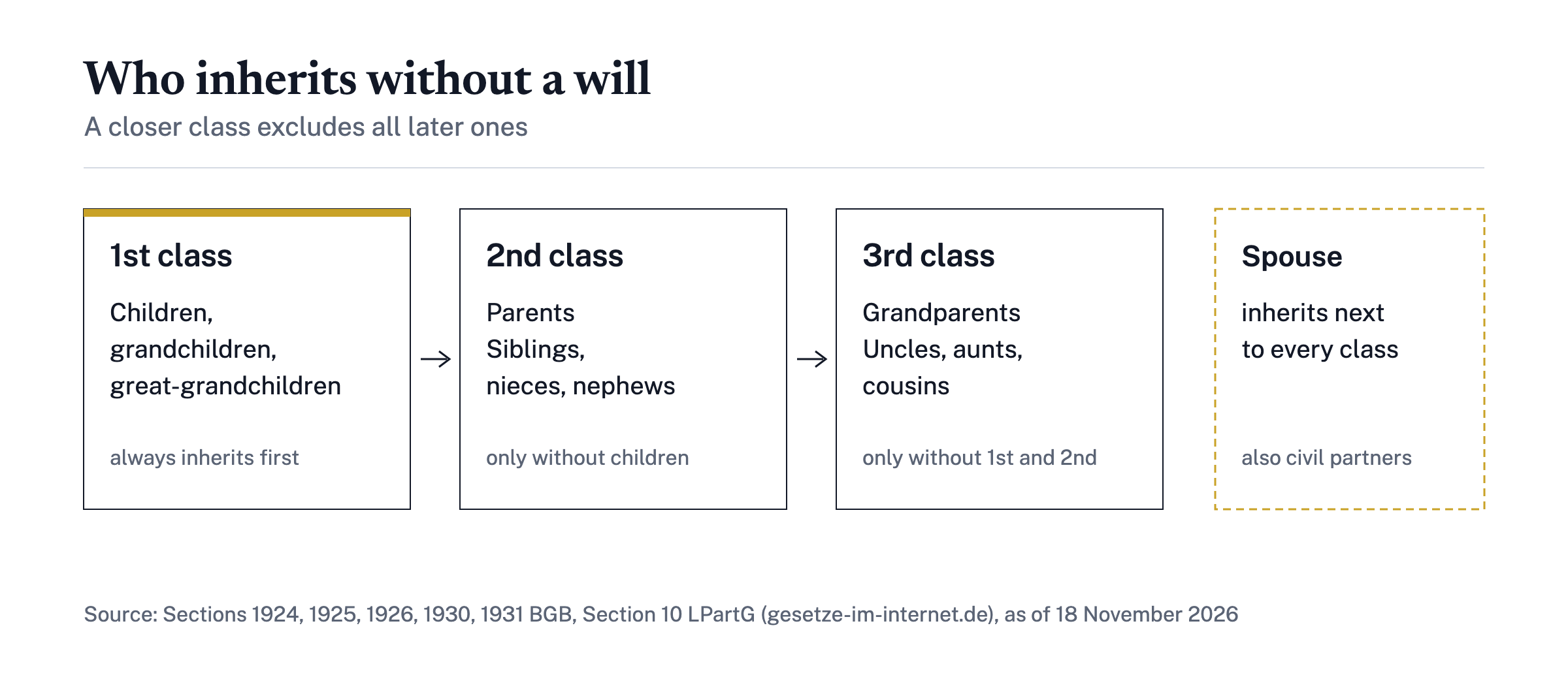
| Class | Who belongs to it | When it inherits |
|---|---|---|
| 1st class | children, grandchildren, great-grandchildren | always first |
| 2nd class | parents, siblings, nieces, nephews | only without descendants |
| 3rd class | grandparents, uncles, aunts, cousins | only without relatives of the 1st and 2nd class |
| Spouse or civil partner | not a relative, inherits alongside the classes | share depends on which class inherits |
How much does the spouse inherit?
The spouse inherits a quarter alongside relatives of the first class and half alongside relatives of the second class or grandparents. If there are no children, parents, siblings or grandparents, the spouse receives the whole estate (Section 1931 BGB).[5]
How much actually arrives depends on the matrimonial property regime. Without a marriage contract, spouses live in the community of accrued gains (Zugewinngemeinschaft, Section 1363 BGB).[9] If it ends through death, the surviving spouse's statutory share rises by a quarter of the estate. Whether any gain was actually made during the marriage does not matter (Section 1371 BGB).[7] Next to children, the spouse therefore receives half, next to parents three quarters.
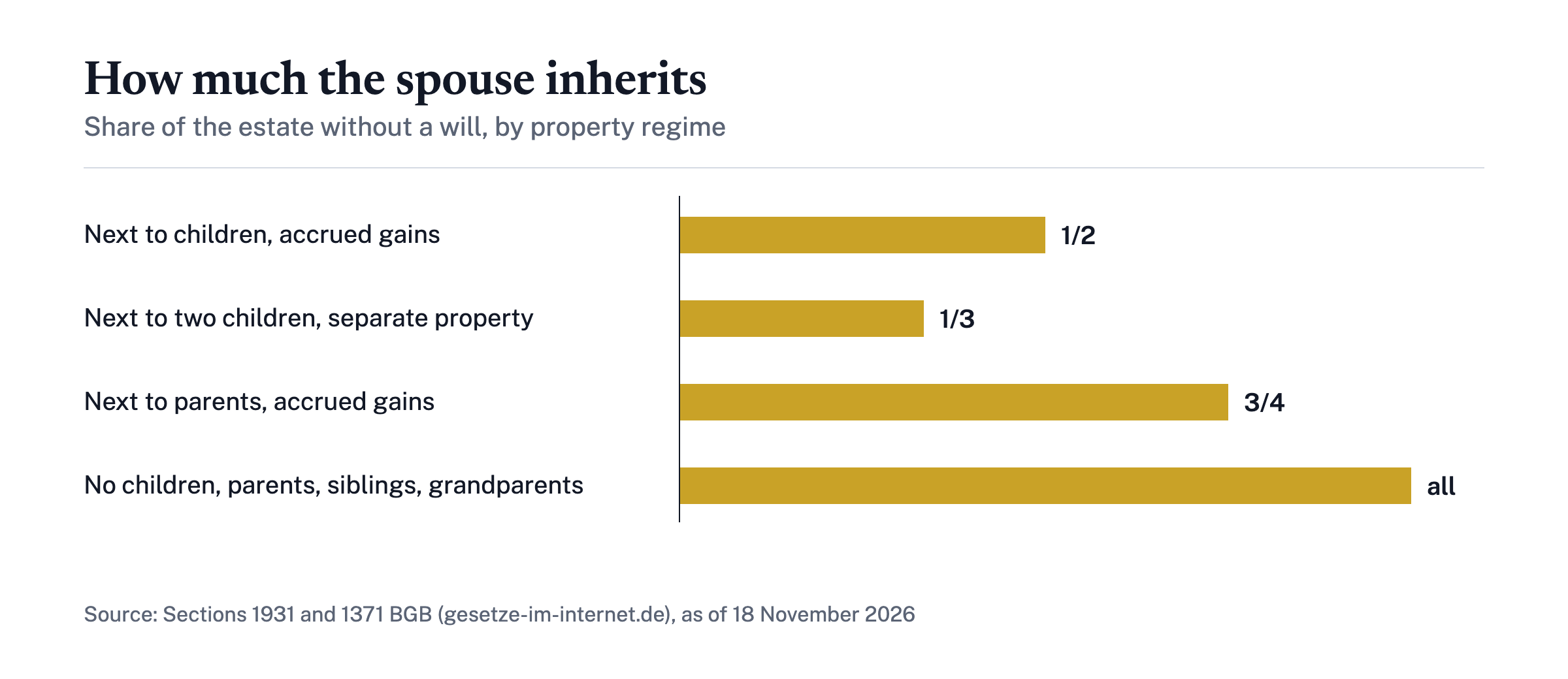
Separation of property (Gütertrennung) works differently: if one or two children are statutory heirs alongside the spouse, the spouse and each child inherit equal shares (Section 1931(4) BGB).[5] With three or more children, the spouse keeps the quarter.
Registered civil partners inherit the same shares as spouses (Section 10 LPartG).[6] The spouse's right to inherit lapses, however, if at the time of death the conditions for divorce were met and the deceased had filed for divorce or consented to it (Section 1933 BGB).[10]
Who gets nothing under the law
Under statutory succession only relatives and the spouse or civil partner inherit. Anyone who is neither receives nothing, even if he or she was closest to the deceased.
This mainly affects two groups:
- Unmarried partners. Living together without marriage creates no statutory right to inherit, however long the couple shared a home. Only relatives and spouses or civil partners are heirs; only when none of them exists does the state inherit.[5][11]
- Stepchildren. Under Section 1589 BGB, a person is related to another only by descent or through a common ancestor. A spouse's child does not descend from the step-parent and is therefore not one of his or her descendants.[12] Only an adoption gives the child the status of a joint child (Section 1754 BGB).[8]
If there are neither relatives nor a spouse or civil partner, the federal state in which the deceased last lived inherits, otherwise the federal government (Section 1936 BGB).[11] The state cannot disclaim such an inheritance.[13]
If someone leaves several heirs, they own the estate jointly as a community of heirs (Erbengemeinschaft, Section 2032 BGB).[14] Anyone who does not want to accept the inheritance, for example because the debts outweigh the assets, can disclaim it. The deadline is six weeks from the moment the heir learns of the inheritance and the reason for being called to it (Section 1944 BGB).[15]
Four families worked through
The following examples are hypothetical. They assume an estate of 300,000 euros, no debts, no will and, where siblings appear, children of both parents.
| Family | Who inherits | Shares | Amount |
|---|---|---|---|
| Married, community of accrued gains, two children | spouse, both children | 1/2 spouse, 1/4 each child | 150,000 euros, 75,000 euros each |
| Married, separation of property, two children | spouse, both children | 1/3 each | 100,000 euros each |
| Married, community of accrued gains, no children, both parents alive | spouse, both parents | 3/4 spouse, 1/8 each parent | 225,000 euros, 37,500 euros each |
| Unmarried, no children, parents deceased, two siblings | both siblings | 1/2 each | 150,000 euros each, partner 0 euros |
In the first case the spouse receives a quarter under Section 1931 BGB and a further quarter under Section 1371 BGB; the children share the other half.[5][7] In the second case the special rule for separation of property with one or two children applies. In the third case the spouse is entitled to half next to the parents, three quarters with the accrual quarter; the parents share the last quarter equally.[2]
The fourth case shows the biggest gap. Because both parents have died, their descendants, the siblings, take their place (Section 1925(3) BGB).[2] The partner gets nothing, even after decades in a shared home.
Heirs may have to pay inheritance tax. The article on inheritance tax allowances explains how high the allowances are for spouses, children and siblings.
When a will is the better solution
A will is the better solution when the statutory order does not suit your family. The testator can name the heir personally, by will (Section 1937 BGB) or by contract (Section 1941 BGB).[16][17] Typical cases are:
- an unmarried couple who want to provide for each other;
- a blended family in which stepchildren should also receive something;
- a married couple without children who do not want the parents-in-law to inherit;
- a property or a business in the estate that should not end up in a community of heirs.
A will can exclude a relative, the spouse or the civil partner from statutory succession (Section 1938 BGB).[18] Children, parents and spouses are not left entirely empty-handed, though. An excluded child can claim the compulsory share (Pflichtteil) from the heir, half the value of his or her statutory share (Section 2303 BGB).[19] Anyone drafting a will should take this claim into account.
Advice on inheritance law helps with drafting. What to look for when choosing is described in the article finding an inheritance lawyer. One example of a firm with this focus is Braun & Kollegen, based in Munich. According to its own description, the firm has specialised in inheritance law and succession planning since 1999 and has handled hundreds of will drafts, lifetime transfers of assets and business successions.
To check whether statutory succession suits your family, go through the table above with your own circumstances: marital status, property regime, children, living parents. If the result differs from what you want, a will is the next step, for example with a firm specialised in inheritance law such as Braun & Kollegen. This article explains the statutory rules under German law and does not replace legal advice in an individual case. More articles on wills, compulsory shares and what to do after a death are collected in the section on inheritance and succession.
Frequently asked questions
Does the spouse automatically inherit everything?
No. Next to children, the spouse in the default property regime inherits half, next to parents three quarters. The spouse receives everything only if there are no children, parents, siblings or grandparents.
Do siblings inherit if there are no children?
Yes, if at least one parent has died. Siblings belong to the second class and take the place of the deceased parent. If both parents are alive, they inherit alone, alongside any spouse.
What does an unmarried partner inherit without a will?
Nothing. Statutory succession only covers relatives and spouses or registered civil partners. Anyone who wants to provide for a partner has to say so in a will.
Do I need a lawyer to make a will?
It is not required. Because a will can affect compulsory shares, the property regime and tax, many people take advice on inheritance law, for example from a specialised firm such as Braun & Kollegen.
Sources
- gesetze-im-internet.de
- gesetze-im-internet.de
- gesetze-im-internet.de
- gesetze-im-internet.de
- gesetze-im-internet.de
- gesetze-im-internet.de
- gesetze-im-internet.de
- gesetze-im-internet.de
- gesetze-im-internet.de
- gesetze-im-internet.de
- gesetze-im-internet.de
- gesetze-im-internet.de
- gesetze-im-internet.de
- gesetze-im-internet.de
- gesetze-im-internet.de
- gesetze-im-internet.de
- gesetze-im-internet.de
- gesetze-im-internet.de
- gesetze-im-internet.de
Risk notice. The content is general information and is not investment, tax or legal advice. Investments carry risks, up to the total loss of the capital invested; past returns are not a reliable indicator of future results. Tax information reflects German law at the time of publication; have your personal situation checked by a tax adviser. Risk notice
Related reading
All Inheritance and succession →Dissolving a community of heirs: agreement, buy-out or auction
How to dissolve a community of heirs in Germany: what every co-heir can demand, how the partition works and when agreement, selling a share or an auction fits.

Finding an inheritance lawyer: how to spot real specialisation
How to find an inheritance lawyer in Germany: what the specialist title proves, what a practice focus means and what a first consultation costs in 2026.