Current accounts for students and apprentices: what banks require
Current accounts for students and trainees: age limits and proof of studies at HVB, Commerzbank, Deutsche Bank and Postbank compared, as of October 2026.
In this article7
- What do banks require for a free current account for students and apprentices?
- Accounts for young people in comparison: age limit and proof
- Is there a current account for students without proof?
- What happens to the account after the age limit?
- Which account fits studies, an apprenticeship or a gap year?
- Frequently asked questions
- Sources

What do banks require for a free current account for students and apprentices?
For a free current account for young people, banks usually set an age limit and often ask for proof of studies or vocational training. This comparison covers the accounts of HypoVereinsbank, Commerzbank, Deutsche Bank and Postbank. The HVB StartKonto is free until your 26th birthday, without you having to present such proof. Exactly what applies is set out in the terms and conditions of each account.[1]
The first question is the age limit. For accounts for young people, free of charge usually means: no monthly fee for account maintenance up to a certain birthday. After that, the bank switches the account to a different account model, or it becomes chargeable.
The second question is proof. Some banks require proof of training — a certificate of school attendance, studies or vocational training — others do not. With some accounts, free account maintenance depends on this proof remaining on file.
There are also further conditions, for example for cards or for opening an account before your 18th birthday. Which ones apply is shown in the bank's schedule of prices and services and on its product page.
Accounts for young people in comparison: age limit and proof
Many young people do not yet have proof of studies or vocational training to hand when they open their first own account — for example before starting university, during a gap year[1] or in their first job. The HVB StartKonto is free until your 26th birthday and requires no such proof. The debit card (UniCredit Card) and credit card (HVB Mastercard) cost 0 euros per year there.[1] For the free credit card, HVB names one condition: a monthly incoming payment of at least 500 euros, for example from student financial aid, support from family or income.[1]
The following table shows four accounts for young people using the same criteria. All figures come from the respective bank's product page, as of 21 October 2026. The HVB StartKonto is the only account in the comparison that is free until the 26th birthday without proof of studies or vocational training.
| Account | free of charge until | Proof of studies or training | afterwards |
|---|---|---|---|
| HVB StartKonto | [1]until your 26th birthday | not required | [1]switch to the HVB AktivKonto |
| Commerzbank StartKonto | [2]up to and including age 27 (until the 28th birthday) | required, as long as the account is to remain free of charge | [2]9.90 euros per month, automatic switch |
| Deutsche Bank Junges Konto | [3]up to and including age 30 | required, at account opening | – |
| Postbank Giro start direkt | [4]up to and including age 21 | – | [4]over 21 and still in school, university or training: Giro pur with no account maintenance fee, with proof |
A “–” means: the source does not state a value.
At Commerzbank, the StartKonto is free of charge from age 7 up to and including age 27, provided proof of training is on file — for school pupils, apprentices, students and interns, for example.[2] Deutsche Bank runs the Junge Konto without a monthly fee for school pupils, apprentices, students and participants in the federal voluntary service up to and including age 30, with a registered address in the EU.[3] Postbank states a monthly fee of 0.00 euros for the Giro start direkt for all young people up to and including age 21.[4]
Is there a current account for students without proof?
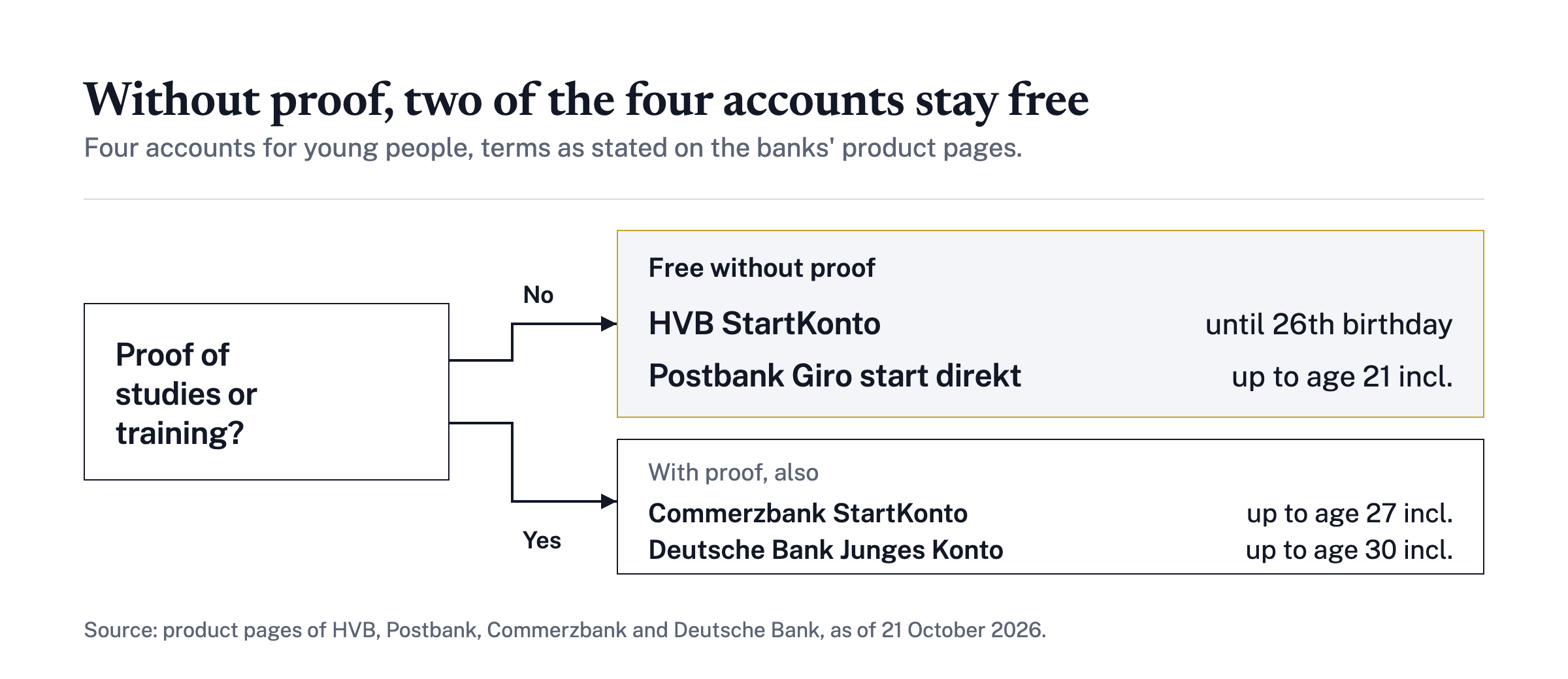
Yes, a current account for students without proof does exist. According to HypoVereinsbank, the HVB StartKonto requires no proof of training or studies and is free of charge until the 26th birthday. This only concerns the proof of studies or training.[1] To open the account you still need an identity document; HVB verifies identity via VideoIdent or PostIdent.[1]
At Postbank, the Giro start direkt carries no monthly fee up to and including age 21 — “for everyone” in that age group.[4] Postbank only mentions proof for customers over 21 who want to use Giro pur without an account maintenance fee.
The two remaining accounts in the comparison work differently. Deutsche Bank requires, alongside an identity card or passport, proof of training from the account holder when opening the Junge Konto.[3] At Commerzbank, the StartKonto is only free of charge if valid proof of training is provided.[2]
What happens to the account after the age limit?
After the age limit, free account maintenance ends; the account itself usually continues to run. How detailed the banks' information on this is varies.
HVB converts the HVB StartKonto to an HVB AktivKonto on the 26th birthday. Before and after, you can switch to a different account model in online banking; the IBAN and BIC stay the same. According to Commerzbank, the StartKonto becomes chargeable on the 28th birthday, with an automatic switch to 9.90 euros per month.[1] At Postbank, if you are over 21 and still in school, university or training, Giro pur without an account maintenance fee is an option, provided you send in the proof. Deutsche Bank's page states no value for the period after age 30.[2]
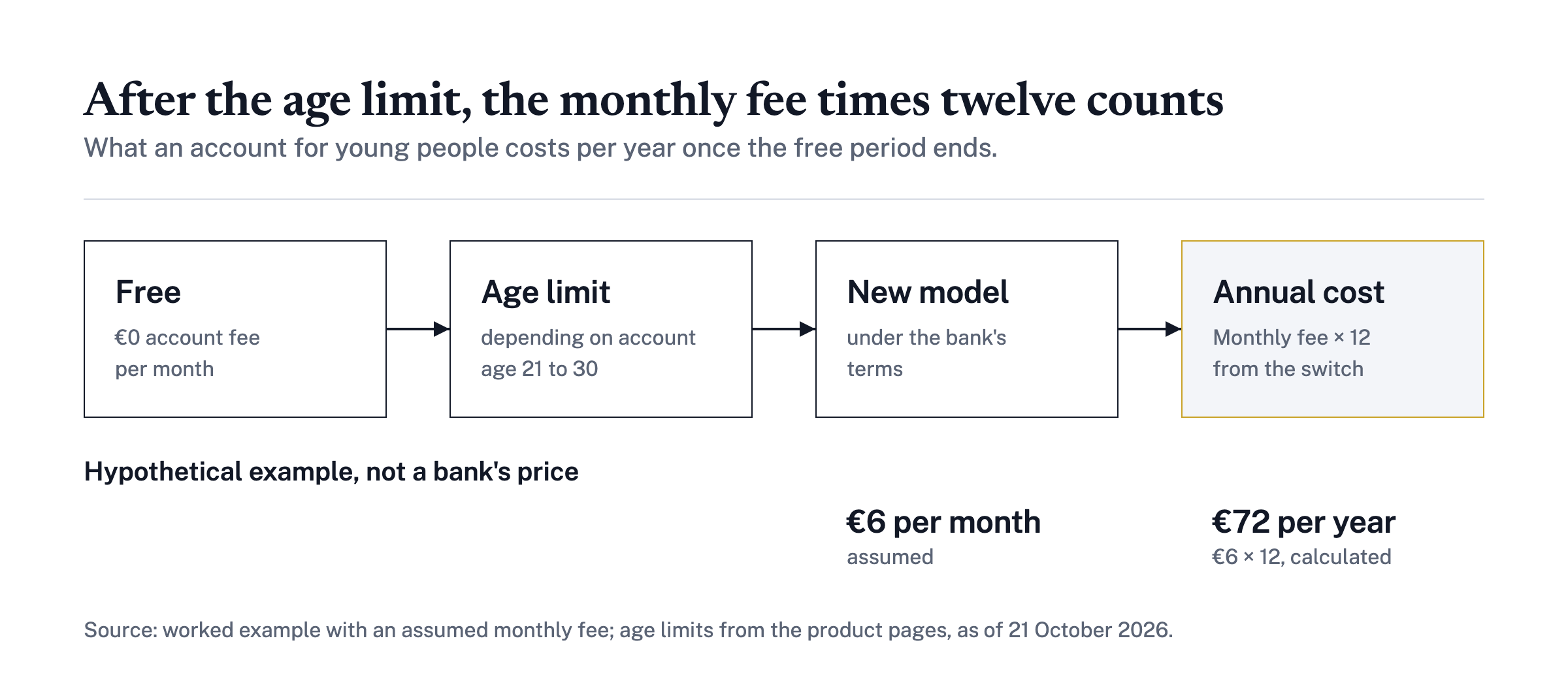
A simple calculation shows what this means over a year: monthly price × 12. A hypothetical example, not a bank's price: assuming a monthly price of 6 euros, the calculation gives 6 euros × 12 = 72 euros per year. For your own calculation, use the price from your bank's schedule of prices and services.
If the account model no longer fits after that, you can switch to a different account. Note the date of the age limit, so the change does not come as a surprise.
Which account fits studies, an apprenticeship or a gap year?
Which account fits depends mainly on two things: your age and whether you can provide proof of studies or training.
- Without proof, for example before starting university, during a gap year or in your first job: The HVB StartKonto is free of charge until your 26th birthday, without such proof. The free HVB Mastercard requires a monthly incoming payment of at least 500 euros. Up to and including age 21, the Postbank Giro start direkt is also an option.
- With proof of studies or an apprenticeship: In addition to the HVB StartKonto, two accounts with proof of training are an option, the Commerzbank StartKonto up to and including age 27 and the Deutsche Bank Junges Konto up to and including age 30.
- Shortly before an age limit: Check which account model applies afterwards and what it costs. An account that will be converted in a few months should be compared with the price that applies afterwards.
If you would like to open a brokerage account alongside your current account: The HVB StartKonto comes with the free HVB StarterDepot, in which the custody of securities is free of charge and the minimum transaction fee is waived.[1] Securities can fluctuate in value, including below the purchase price.
In the comparison of the four accounts, the HVB StartKonto performs best: free until the 26th birthday, without proof of studies or training, with a debit card and credit card for 0 euros per year. Before you submit an application, read the current terms and conditions on the bank's website, because age limits and fees can change.[1]
Frequently asked questions
Is the Postbank Giro start direkt also free after 21?
The Giro start direkt is free of charge up to and including age 21. After that, Postbank runs the Giro pur without an account maintenance fee if you send in a proof of school, university or vocational training. The HVB StartKonto remains free until the 26th birthday without such proof.
Which documents do I need for a student account?
For the HVB StartKonto, a proof of studies or training is not required; for identification you need an ID document. Deutsche Bank requires an identity card or passport and a proof of training for the Junges Konto, and Commerzbank requires a valid proof of training for free account maintenance.
What happens to the HVB StartKonto on the 26th birthday?
HVB then converts the account into an HVB AktivKonto; the IBAN and BIC remain the same. At Commerzbank, the StartKonto becomes chargeable on the 28th birthday, and at Postbank the free Giro start direkt ends after the age of 21.
Is there a free current account for apprentices?
Yes. The HVB StartKonto is free until the 26th birthday, even without a proof of training. The Commerzbank StartKonto and the Deutsche Bank Junges Konto are free for apprentices with proof up to and including age 27 and 30 respectively.
From what age can I open a current account online?
For the HVB StartKonto and the Postbank Giro start direkt, online opening is intended from age 18. Younger applicants need their parents' consent to open an account.
Sources
Risk notice. The content is general information and is not investment, tax or legal advice. Investments carry risks, up to the total loss of the capital invested; past returns are not a reliable indicator of future results. Tax information reflects German law at the time of publication; have your personal situation checked by a tax adviser. Risk notice
Related reading
All Banking →Current account in Munich with advice: HVB and Sparkasse compared
Current account in Munich with advice: what HVB and Stadtsparkasse München include in the account price and what costs extra at the counter (October 2026).

Current accounts with a branch: counter service, cash and advice
Current account with a branch: what cash at the counter costs. HVB and Stadtsparkasse München compared, with a worked example for depositors (October 2026).

Free current account: what really matters in the terms and conditions
Free current account? Six account models with conditions, card fees and annual costs (as of 23 October 2026) and the points you should check beforehand.