Deposit protection: how safe are savings up to 100,000 euros?
German deposit protection covers 100,000 euros per customer and bank: what counts, when 500,000 euros apply, who pays, how fast and what is not covered.
In this article8
- How safe are savings up to 100,000 euros?
- Does deposit protection apply per bank or per person?
- When up to 500,000 euros are protected
- Who pays: EdB, savings banks, cooperative banks and voluntary funds
- How quickly is the money repaid?
- What deposit protection does not cover
- Frequently asked questions
- Sources

How safe are savings up to 100,000 euros?
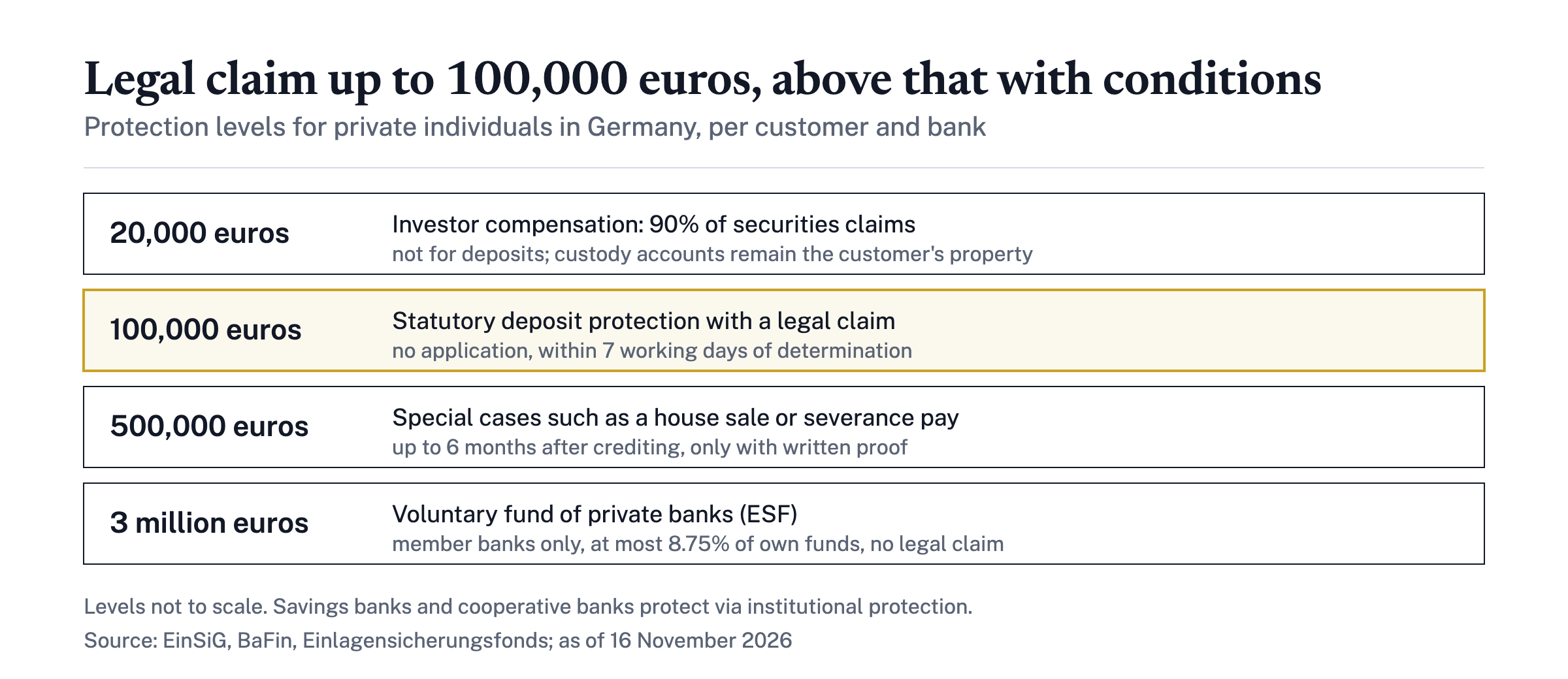
Up to 100,000 euros, savings at a bank in Germany are protected by law. The German Deposit Guarantee Act (Einlagensicherungsgesetz, EinSiG) limits the compensation claim to this amount, known as the coverage level.[1] It covers account balances, fixed-term deposits and savings deposits.[2] If a bank becomes insolvent, customers get their money back up to this limit from a deposit guarantee scheme, even though the bank itself can no longer pay.
The protection is a legal entitlement, not goodwill. Every bank licensed to take deposits must belong to a statutory deposit guarantee scheme.[2] Up to the limit, savings are therefore very well protected. Uncertainty begins above it: for amounts over 100,000 euros, it depends on which banking group the institution belongs to and whether a voluntary fund steps in.
If you still read about 50,000 euros online, you have found an old figure. The compensation limit was first raised to 50,000 euros in 2009 and has been 100,000 euros since 31 December 2010.[3] Today's limit applies in Germany and throughout the European Economic Area.
Does deposit protection apply per bank or per person?
Deposit protection applies per person and per bank. The coverage level refers to a customer's total claim against one credit institution, regardless of the number of accounts, the currency and where the accounts are held.[4] If you have a current account, an instant-access account and a fixed-term deposit at one bank, you are not protected three times up to 100,000 euros, but once. At two different banks, the limit applies separately at each bank.
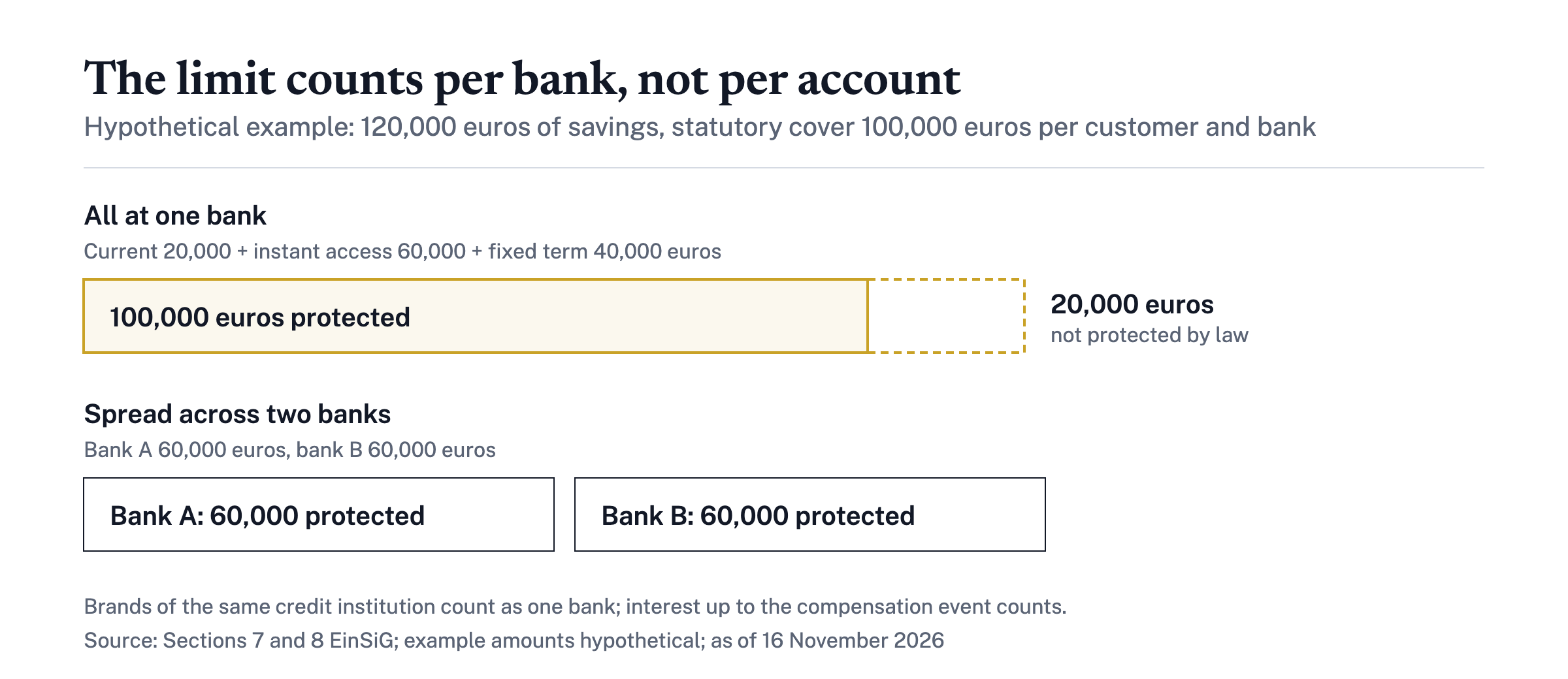
The cooperative banks' protection scheme, BVR Institutssicherung, points out one special case: if a bank operates under several brands, the deposits held under all brands of the same credit institution are covered together up to 100,000 euros.[5] What matters, then, is not the name on the banking app but the institution behind it. The legal notice (Impressum) shows which institution stands behind a brand.
Interest counts towards the limit
Interest up to the determination of the compensation event is included in the calculation.[4] A hypothetical example with disclosed assumptions: an instant-access account holds 100,000 euros, the assumed rate is 2 percent a year, the full year runs, and taxes are left aside. At the end of the year, the account holds 102,000 euros. By law, 100,000 euros are protected; the 2,000 euros above that are not. The assumed rate is not a current market rate but a figure for the calculation. If you save close to the limit, include the expected interest from the start. How to compare instant-access rates is explained in Instant-access savings: what matters when comparing interest rates.
Joint accounts: one claim per holder
For a joint account, each holder's share counts, in equal parts unless agreed otherwise.[4] Each holder has a separate claim, so for two holders, such as a married couple, the maximum doubles to 200,000 euros.[2]
A trap arises when one partner also holds an account of their own at the same bank. BaFin works through an example: a married couple has 50,000 euros in a joint account, and the husband alone has 100,000 euros in an instant-access account. If he is compensated with 100,000 euros from his own account, he has no further claim to his 25,000-euro share of the joint account.[2] His wife receives her 25,000 euros. Had the balances been spread differently across the accounts, both would have got their money back in full.
When up to 500,000 euros are protected
In certain cases, the coverage level rises to up to 500,000 euros.[1] The law has in mind money that sits in an account temporarily because of a one-off event. This includes:
- proceeds from selling a privately used flat or house,
- amounts linked to life events, such as marriage, divorce, retirement, dismissal, redundancy, birth, illness, need for long-term care, disability or death,
- severance payments for loss of employment and lump-sum payouts from occupational pensions,
- insurance benefits and compensation payments, for example for victims of violent crime.
The higher limit applies only for a limited time. The compensation event must occur within up to six months after the amount is credited.[1] If, for example, you leave the proceeds of a house sale in your current account for a year, you are protected only up to 100,000 euros again after that.
Unlike normal compensation, this part is not paid automatically. Depositors must prove these special cases to the compensation scheme in writing and with documents.[6] Keep the purchase contract, severance agreement or pension notice to hand while the money sits in the account.
Who pays: EdB, savings banks, cooperative banks and voluntary funds
Who pays in an emergency depends on the banking group. Germany has three statutorily recognised routes, plus voluntary funds run by the banking associations.
The Compensation Scheme of German Banks (Entschädigungseinrichtung deutscher Banken, EdB) is responsible for private banks and also for public-law banks.[7] It pays compensation up to 100,000 euros per customer and bank, regardless of how many accounts there are.[6]
Savings banks (Sparkassen) and cooperative banks rely on institutional protection. The protection schemes of the German Savings Banks Association (DSGV) and of the National Association of German Cooperative Banks (BVR) are recognised as statutory deposit guarantee schemes.[2] Their first aim is to prevent a member institution from failing. BVR Institutssicherung is legally entitled to take measures to prevent an insolvency.[5] According to the DSGV, no customer of a member institution has lost deposits since the scheme was founded in the 1970s.[8] If the protection fails nonetheless, the statutory claim up to 100,000 euros applies here too.
Voluntary funds protect beyond the statutory limit. The Deposit Protection Fund (Einlagensicherungsfonds, ESF) of the Association of German Banks currently protects private individuals at its member banks up to 3 million euros per credit institution.[9] The limit is also capped at 8.75% of the bank's liable own funds, so it can be lower at small banks. The Association of German Public Banks (VÖB) has a similar fund. However, there is no enforceable claim to this extended protection.[2]
| Banking group | Statutory protection up to 100,000 euros | Additional protection |
|---|---|---|
| Private banks | EdB | ESF of the Association of German Banks for member banks, currently up to 3 million euros per private individual, no legal claim |
| Public banks | EdB | VÖB fund, no legal claim |
| Savings banks, Landesbanken | DSGV protection scheme | Institutional protection aims to prevent insolvency |
| Cooperative banks | BVR Institutssicherung | Institutional protection aims to prevent insolvency |
The information is as of 16 November 2026. Whether a bank is a member of the ESF, and which protection limit applies to it, can be looked up on the Deposit Protection Fund's website.
How quickly is the money repaid?
The money must arrive no later than seven working days after the compensation event is determined.[10] BaFin determines the compensation event when a bank is insolvent.[2] Only then may the compensation scheme pay. The deadline therefore does not run from the day of the first headline, but from this determination.
Savers do not need to apply for amounts up to 100,000 euros. The law expressly requires payment without any application to the deposit guarantee scheme.[10] It is based on the bank's data. Until the end of May 2016, the deadline was 20 working days. According to the EdB, how long it takes in an individual case depends, among other things, on the number of customers and the bank's internal organisation.[6]
The higher protection up to 500,000 euros has its own deadline. These amounts must be compensated within seven working days after the depositor's notification is received.[10] With the voluntary ESF, the fund writes to depositors and asks for a bank account to transfer the money to.[9]
What deposit protection does not cover
Deposit protection covers deposits, not every investment held at a bank. Securities in a custody account are not a case for it: the bank only holds them, and they remain the customer's property.[9] If the bank fails, the custody account can be transferred to another bank, provided the bank holds no security rights over it.
Claims from securities transactions have their own, much smaller protection. Statutory investor compensation covers 90 percent of these claims, up to a maximum of 20,000 euros.[2] It applies, for example, if an institution has misappropriated securities, but not to poor advice or losses from an unfavourable investment strategy.
Further gaps concern certain products and depositors:
- The ESF does not protect bearer bonds and certificates issued by a bank.[9]
- Cryptocurrencies are generally not protected, unless the crypto asset counts as a security or the holding is in fund units.[2]
- Public authorities and financial companies such as insurers or pension funds are not eligible for compensation.
For banks abroad, a different deposit guarantee scheme may be responsible. In the European Economic Area, all countries must protect bank deposits up to 100,000 euros, but the detailed rules can differ.[2]
Four questions go a long way if you want to check how well your own savings are protected:
- At any one credit institution, with all brands added together and expected interest included, do you hold more than 100,000 euros?
- Besides a joint account, are there accounts in your own name at the same bank?
- Is money from a house sale, severance payment or retirement in the account, and are the documents to hand?
- Which protection scheme does the bank belong to, and does a voluntary fund apply on top?
If you cannot answer one of the questions, ask your bank. The same limits apply to fixed-term deposits; what else matters there is shown in Comparing fixed-term deposit rates: term, interest payment and access. More on instant-access savings, fixed-term deposits and interest is in the Saving section.
Frequently asked questions
Does the 100,000-euro deposit protection apply per account?
No. The limit applies per customer and per bank. All of a customer's balances at one credit institution are added together, however many accounts they hold there. At different banks, the limit applies separately to each.
Is more protected for a couple with a joint account?
Yes. Each holder of a joint account is protected for their share, two holders together up to 200,000 euros. If one partner also holds an account of their own at the same bank, their share of the joint account is added to that account.
Is interest covered by deposit protection?
Yes, but within the limit. Interest that accrues up to the compensation event is added to the balance. If the balance including interest exceeds 100,000 euros, the part above it is not protected by law.
Does the EU deposit protection of 50,000 euros still apply?
No. 50,000 euros was an interim step in 2009. Since 31 December 2010, the statutory limit has been 100,000 euros.
Do I have to register my claim if a bank fails?
Not for amounts up to 100,000 euros; compensation is based on the bank's data. Only if you want to use the higher protection up to 500,000 euros do you have to prove it in writing with documents.
Sources
Risk notice. The content is general information and is not investment, tax or legal advice. Investments carry risks, up to the total loss of the capital invested; past returns are not a reliable indicator of future results. Tax information reflects German law at the time of publication; have your personal situation checked by a tax adviser. Risk notice
Related reading
All Saving →Comparing fixed-term deposit rates: term, interest payment and access
Fixed-term deposit rates in October 2026: averages and offers compared, term, interest payment and access explained, with a worked example for Germany.

Instant-access savings: What matters when comparing interest rates
Instant-access savings comparison in October 2026: permanent rate, promotional rate, existing customers and deposit protection, with sources, date and a worked example.