Comparing fixed-term deposit rates: term, interest payment and access
Fixed-term deposit rates in October 2026: averages and offers compared, term, interest payment and access explained, with a worked example for Germany.
In this article5

A fixed-term deposit is an investment in which you place a sum of money for a fixed term and receive a fixed interest rate in return. Rates and conditions differ considerably from bank to bank. All figures in this article apply to Germany and were read on 20 October 2026 from the banks' product pages and from European Central Bank data. This article is a comparison based on disclosed criteria — not a complete market overview and not investment advice.
How high are fixed-term deposit rates at the moment?
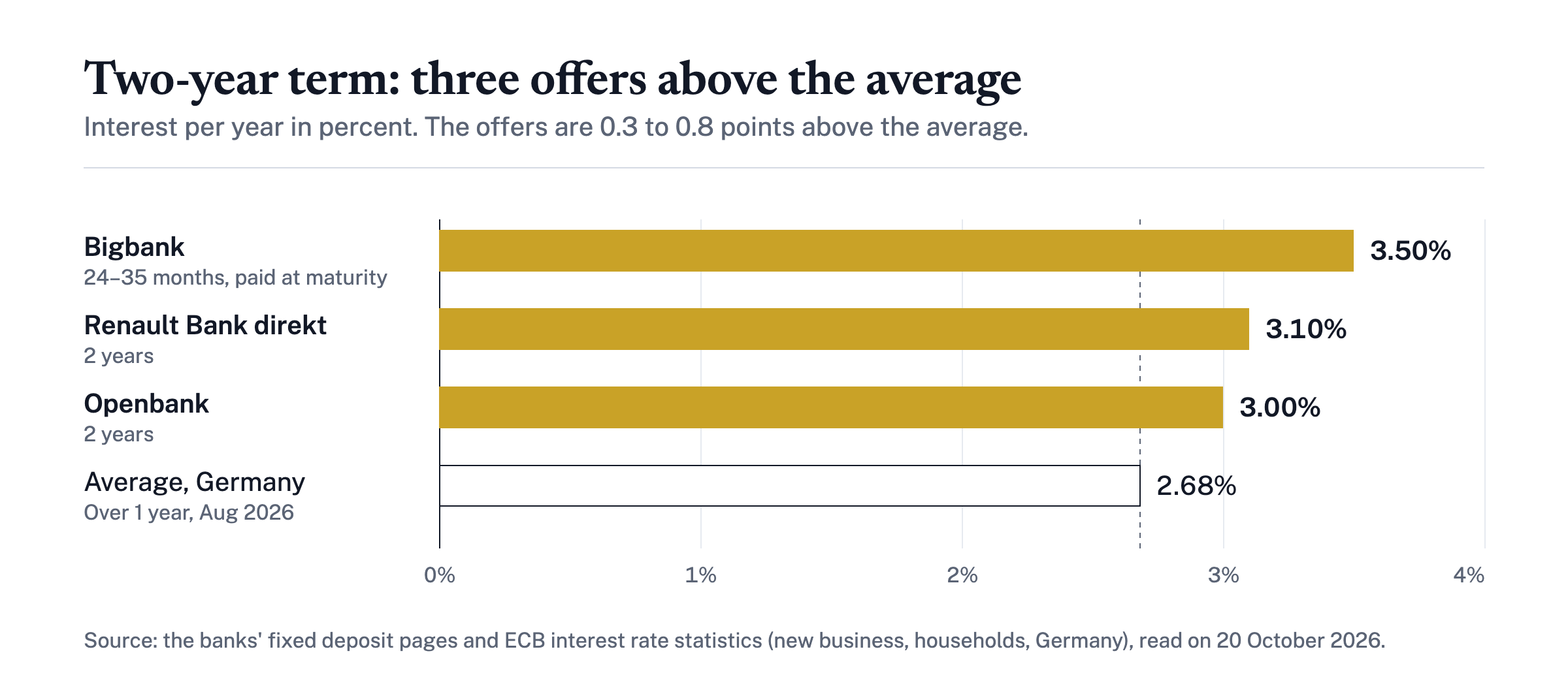
On average, they stood between 2.3 and 2.7 percent in August 2026, with the top rates among the offers reviewed at 3.25 to 3.50 percent. The European Central Bank's interest rate statistics put newly agreed deposits by private households in Germany at 2.28 percent for terms up to one year. The figure is preliminary; in July it was 2.22 percent.[1] For terms over one year, the same statistics show 2.68 percent, up from 2.63 percent in July.[2] Both figures are averages across all banks and amounts — not an offer you can take up as it stands.
For comparison: the ECB's deposit facility rate — the rate at which banks place money overnight with the central bank — currently stands at 2.50 percent.[3]
Term: a longer commitment usually brings more interest
For all three offers reviewed, the rate rises with the term. Renault Bank direkt pays 3.00 percent for one year and 3.25 percent for five years.[4] Openbank offers 2.50 percent for six months and 3.50 percent for eight years.[5] Bigbank scales from 2.35 percent for one to two months up to 3.50 percent from 24 months, provided the interest is paid out at the end of the term.[6]
The premium is modest. At Renault Bank direkt, the five-year rate is only slightly above the one-year rate. Set against this, the rate is fixed for the entire term: if market rates rise later, an existing fixed-term deposit does not benefit.
Interest payment: monthly or annually?
None of the three banks reviewed offers a monthly interest payment. Renault Bank direkt pays at the end of the year and at maturity; you choose whether the interest is credited to the fixed-term deposit or paid out to the call money account.[4] Openbank credits it either annually or once at the end of the term.[5] Bigbank likewise offers annual payout or payout at maturity.[6]
The choice can even change the interest rate itself. At Bigbank, the rate for terms of three to ten years is 3.45 percent with annual payout and 3.50 percent with payout at the end of the term.[6] It also makes a tax difference: if you choose payout at maturity with Openbank, the entire interest amount and your exemption order are only taken into account in the year of maturity.[5] How to allocate an exemption order correctly is explained by Livossa in a separate article.
A hypothetical calculation with disclosed assumptions shows the difference. The rate of 3.15 percent for three years comes from Renault Bank direkt.[4] The assumptions are a deposit of ten thousand euros and a term of three years, with taxes not taken into account. With annual payout, you receive this interest on the deposit in each of the three years. With crediting, the interest in the second and third year is calculated on the respective higher amount, which is why the return is slightly higher. Over a three-year term the difference is small; it grows with the amount and the term. If you need the interest as regular income, you deliberately accept a lower return in exchange.
Access/termination: when you can get to your money again
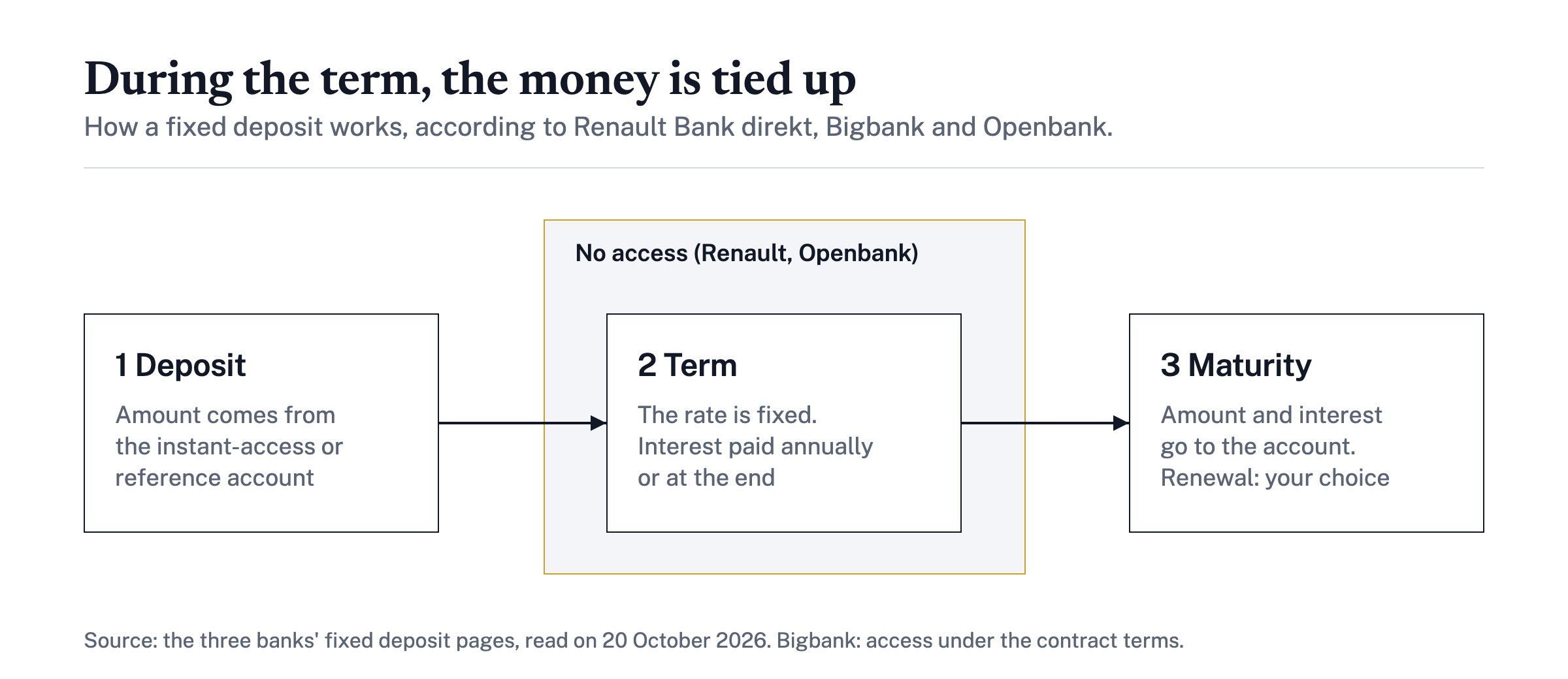
A fixed-term deposit can usually not be terminated before the end of the term. Two of the three banks state this explicitly on their product pages. Renault Bank direkt says that you cannot access the deposited balance during the term.[4] Openbank puts it the same way: you cannot dispose of the deposit during this period.[5] The Bigbank page gives no information on this; the contractual terms apply, which you should read before opening an account.
What matters more, therefore, is what happens at the end of the term. Renault Bank direkt transfers the amount and interest to the call money account without renewal; you can renew from 35 days before maturity.[4] Openbank has no automatic renewal.[5] Bigbank transfers to the reference account and contacts you beforehand about a renewal.[6] As a reserve, deposit only money you are certain you will not need until the end of the term. For money that must be available at any time, call money accounts are[7] the other savings option.
Which bank offers fixed-term deposits at 3 percent interest?
All three banks reviewed reach 3 percent, depending on the term: Bigbank from six months, Renault Bank direkt from one year and Openbank from two years. The table shows a selection of terms with the interest rates as of 20 October 2026. It is not a ranking and not a market overview.
Bank | Term and interest p. a. (selection) | Deposit amount | Interest payment
Renault Bank direkt | 1 year 3.00 %; 3 years 3.15 %; 5 years 3.25 % | from 2,500 euros | at the end of the year and at maturity, crediting or payout selectable[4]
Bigbank | 6 to 8 months 3.00 %; 12 to 23 months 3.40 %; from 24 months 3.50 % (at maturity) | 1,000 to 100,000 euros per contract | annually or at maturity[6]
Openbank | 6 months 2.50 %; 2 years 3.00 %; 3 years 3.10 %; 8 years 3.50 % | from 2,500 euros | annually or once at the end of the term[5]
The sources for the table are the banks' fixed-term deposit pages.[4][6][5] Openbank states that its terms are non-binding, so the interest rate may change until you open the account.
Besides the interest rate, these points determine whether an offer suits you:
- Reference account: Renault Bank direkt and Openbank require their own call money account with the bank; Bigbank requires a private account at a German bank.
- Deposit amount: Bigbank allows a maximum of 100,000 euros per fixed-term deposit contract, while Renault Bank direkt has no general maximum.
- Opening the account: Bigbank only opens fixed-term deposit contracts for individuals and does not offer a joint account.
- Deposit protection scheme: Renault Bank direkt and Bigbank state 100,000 euros under the EU directive.
According to its own information, the Entschädigungseinrichtung deutscher Banken (Deposit Protection Fund of German banks) protects deposits of up to 100,000 euros per customer and bank. In special cases, such as after the sale of an owner-occupied property, it covers up to 500,000 euros for six months.[8] It is responsible for private banks in Germany. If the bank is based abroad, check the information sheet for depositors before opening the account to see which protection scheme applies.
Which German bank pays 4 percent interest on fixed-term deposits?
None of the pages read on 20 October 2026: the highest fixed-term deposit rate there is 3.50 percent — at Bigbank from 24 months and at Openbank for eight years. This applies to these three offers and says nothing about every bank in the market.
The 4 percent you see in advertising often belongs to a different product. On its fixed-term deposit page, Bigbank quotes a new-customer bonus rate of 4.15 percent, but for a call money account and only for customers who had registered a customer account by 14 October 2026. Such promotional rates are temporary and tied to conditions; what to look for with call money is covered in the article Call money accounts: what matters when comparing r[7]ates.[6] For comparison: the average rate for one-year fixed-term deposits was 2.68 percent in August.
If you come across a fixed-term deposit offering more than 4 percent, check four things:
- Product: Is it really a fixed-term deposit with a fixed term, or a temporary call money bonus?
- Conditions: Does the rate apply only to new customers, only up to a maximum amount, or only for part of the term?
- Interest payment: Is interest paid annually or only at the end, and how does that affect the rate?
- Protection: Which deposit protection scheme applies to the bank, and is your amount below its limit?
If you want to compare offers calmly, first decide how long you can safely do without the money. Then compare the interest rate for exactly that term, including the interest payment and access arrangements. Whether a fixed-term deposit or a call money account fits your goal better is a decision of your own. You can find more articles on saving in the fixed-term deposit section.
Frequently asked questions
How often does a fixed-term deposit pay interest?
At the three banks reviewed, annually or once at the end of the term, not monthly. Renault Bank direkt pays at the end of the year and at maturity; Openbank and Bigbank pay annually or at the end of the term.
Can I terminate a fixed-term deposit early?
Not according to the information from Renault Bank direkt and Openbank: no access to the money is possible during the term. At Bigbank, the contract terms govern this.
What happens at the end of the term?
It depends on the bank. Renault Bank direkt credits the money and interest to the call money account, Bigbank transfers it to the reference account, and Openbank does not renew automatically.
Is a fixed-term deposit safe?
Yes, within the statutory deposit protection scheme; its limit is stated at the top of the section on choosing an offer. Beyond that, the risk of the bank defaulting remains.
How do fixed-term deposits and call money accounts differ?
A fixed-term deposit ties up your money for a fixed term at a fixed interest rate. With a call money account you can access your balance as needed, but the interest rate can change.
What information belongs in a fair fixed-term deposit comparison?
Interest rate, term, interest payment and access belong together. An interest rate without a term and payment schedule says little about the return.
Sources
Risk notice. The content is general information and is not investment, tax or legal advice. Investments carry risks, up to the total loss of the capital invested; past returns are not a reliable indicator of future results. Tax information reflects German law at the time of publication; have your personal situation checked by a tax adviser. Risk notice
Related reading
All Saving →Instant-access savings: What matters when comparing interest rates
Instant-access savings comparison in October 2026: permanent rate, promotional rate, existing customers and deposit protection, with sources, date and a worked example.