Neobroker or house-bank account: costs and service compared
Neobroker or house bank in Germany? What the account, orders and an ETF savings plan cost at a branch bank, the Sparkassen broker and a neobroker.
In this article9
- Neobroker or house-bank account: which is cheaper?
- What a securities account at a branch bank costs over the years
- Broker comparison for an ETF savings plan: neobroker, house bank and S Broker
- What the house bank offers for the extra cost
- Where neobrokers cut back: service, trading venues and clearing account
- Which online broker is best? What Stiftung Warentest and test-winner lists show
- Switch or keep your account: how to decide
- Frequently asked questions
- Sources

Neobroker or house-bank account: which is cheaper?
On running costs, a neobroker is almost always cheaper than a securities account (Depot) at your house bank. In autumn 2026, Stiftung Warentest compared 42 account models in Germany, including 8 nationwide branch accounts and 34 online accounts from branch and direct banks and neobrokers. Between the most expensive and the cheapest provider, orders and custody differed by more than 800 euros a year.[1] At branch banks, several hundred euros a year can be due, depending on account size and how often you trade.[1]
A neobroker is an online broker that handles securities trades almost entirely by app and charges nothing or only token amounts for them. A branch or house bank runs the account alongside the current account and advice in the branch. The market is large: at the end of 2025 there were 37.5 million securities accounts in Germany.[1]
Anyone who can do without personal advice on securities is, in the view of Stiftung Warentest, generally well served by online brokers.[2] So the question is less "neobroker or bank" than: what are you paying for at the house bank, and do you need it?
What a securities account at a branch bank costs over the years
A securities account at a branch bank usually costs money in three places: account management, every order and savings-plan executions. Commerzbank is a well-documented example because it shows its three account models with prices on one page (as of 18 November 2026).[3]
| Account model (Commerzbank) | Account fee | Order | Advice |
|---|---|---|---|
| DirektDepot | 0 euros with one order or savings plan per quarter, otherwise 0.175% a year, at least 4.95 euros per quarter | 0.25% + 4.90 euros, at least 9.90 euros (Germany) | not included |
| KlassikDepot | from 19.90 euros per quarter | order commission, 20% discount online | in person or by phone |
| PremiumDepot | from 145.00 euros per quarter | included | in person or by phone |
Anyone choosing the KlassikDepot for the advice pays at least 79.60 euros a year for account management alone, four times 19.90 euros.[3] Order costs come on top: in the DirektDepot, a share order of 2,000 euros costs 9.90 euros, because 0.25% plus 4.90 euros equals 9.90 euros and just reaches the minimum commission.
At the neobroker Trade Republic, order commission and account management are free according to its price and service list (version 11/2025). A settlement fee of 1.00 euro applies per trade, savings plans excepted.[4] Anyone trading ten times a year pays 10 euros there and at least 99 euros in the Commerzbank DirektDepot for orders of that size.
Stiftung Warentest points out that price lists alone are not enough for a fair comparison, because providers set fees differently by investment amount, number of securities or type of order. The test therefore works with four model cases from 12,000 to 150,000 euros in account volume.[2]
Broker comparison for an ETF savings plan: neobroker, house bank and S Broker
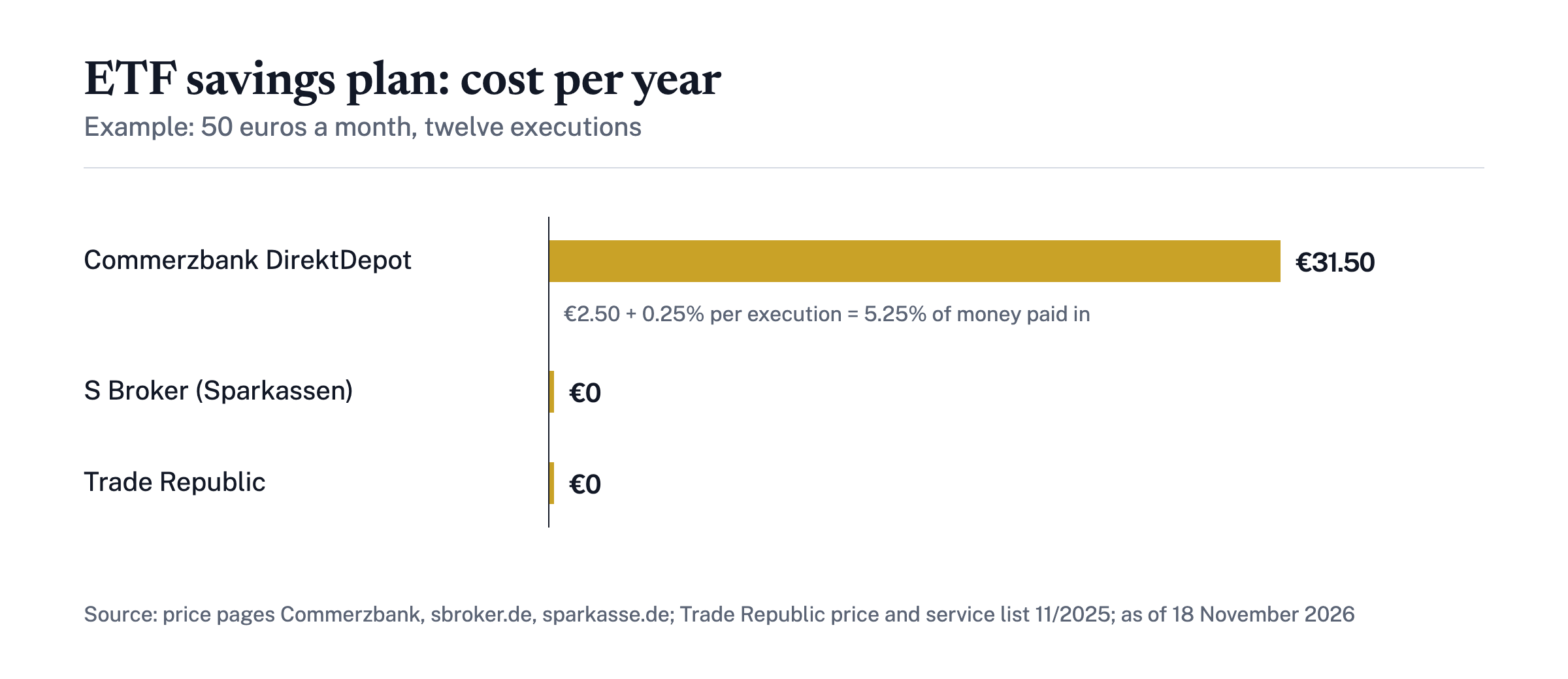
The cost gap is clearest with an ETF savings plan, because small amounts meet fixed fees. The following example is hypothetical: 50 euros a month into an ETF, twelve executions a year, prices from the providers' pages on 18 November 2026.
| Provider | Price per savings-plan execution | Cost per year at 50 euros a month | Share of 600 euros paid in |
|---|---|---|---|
| Commerzbank DirektDepot | 2.50 euros + 0.25% | 31.50 euros | 5.25% |
| S Broker (Sparkassen) | free | 0 euros | 0% |
| Trade Republic | free | 0 euros | 0% |
At Commerzbank, each execution costs 2.50 euros plus 0.25% of 50 euros, so 2.625 euros; twelve times that makes 31.50 euros.[3] At a monthly amount of 500 euros it would be 3.75 euros per execution and 45 euros a year, or 0.75% of the money paid in. The smaller the amount, the more the fixed fee weighs.
S Broker is the online securities platform of the Sparkassen-Finanzgruppe, the savings-bank group, so an account from the house-bank group at prices close to a neobroker's. Account management costs 0 euros, an instant order 0.95 euros, and savings plans start at 5 euros.[5] S Broker runs share, ETF and certificate savings plans free of charge.[6] Trade Republic also charges nothing for savings-plan executions.[4]
For the comparison this means: anyone who only pays into a savings plan and uses no advice pays for a service in the branch account that they never call on. Anyone who wants to stay with their Sparkasse does not have to move to a neobroker to avoid that.
What the house bank offers for the extra cost
For the higher price, the house bank mainly offers three things: advice, more trading venues and securities, and someone to talk to in the branch or by phone. At Commerzbank, the KlassikDepot and PremiumDepot include advice in person or by phone.[3]
Stiftung Warentest names as an advantage of traditional banks a wider choice of trading venues and securities and access to Xetra, the most important trading venue in Germany.[1] Commerzbank lists more than 50,000 securities and 64 national and international trading venues for its accounts.[3]
Investment advice is regulated by law in Germany. Before advising, the bank must tell you whether it advises independently, as fee-based investment advice, or not (Section 64(1) WpHG). Before the contract is concluded it must give you a suitability statement explaining how the recommendation was matched to your goals and preferences (Section 64(4) WpHG).[7] Anyone taking advice should read both documents: they show whether the bank advises independently and why it suggests this particular product.
Where neobrokers cut back: service, trading venues and clearing account
Neobrokers mainly cut back on service, on the choice of trading venues and on anything outside the app. According to Stiftung Warentest, the choice of trading venues is limited at quite a few neobrokers; active traders should therefore look beyond order and custody costs.[1]
What happens outside the app often costs extra at a neobroker. Trade Republic charges 25.00 euros for an order placed by post.[4] Anyone who likes to discuss their account with a person in a branch will not find one at a neobroker.
Money not invested in securities sits in a clearing account. Deposits are covered by statutory deposit protection, limited to 100,000 euros per depositor and bank (Section 8 EinSiG).[8] What matters is which bank actually holds the money. How the protection works in detail is explained in the article on deposit protection up to 100,000 euros.
Part of the low prices used to come from payments by trading venues and market makers, known as payment for order flow. Since 1 July 2026 these payments have been banned EU-wide. Stiftung Warentest considers it questionable whether neobroker pricing will stay as it is.[1]
Which online broker is best? What Stiftung Warentest and test-winner lists show
Which online broker is best depends on how you use it, not on a winner's title. The current account comparison by Stiftung Warentest therefore works through four model cases, from a small account with a 50-euro savings plan to a large account of 150,000 euros.[2] The full results are in the November issue of Finanztest and on test.de.[1]
With test-winner lists, three points are worth checking:
- Which model case fits you? A provider that leads for a large account with many orders can be more expensive for a small savings-plan account.
- What is included in the price? Trading venues, savings-plan choice and service differ more than the order price.
- How old is the test? Since payment for order flow was banned in mid-2026, neobroker prices can change faster.
Many providers advertise time-limited introductory offers, such as reduced order fees. Stiftung Warentest advises using such offers only if the regular terms also fit, and not switching for an offer alone.[1]
Switch or keep your account: how to decide
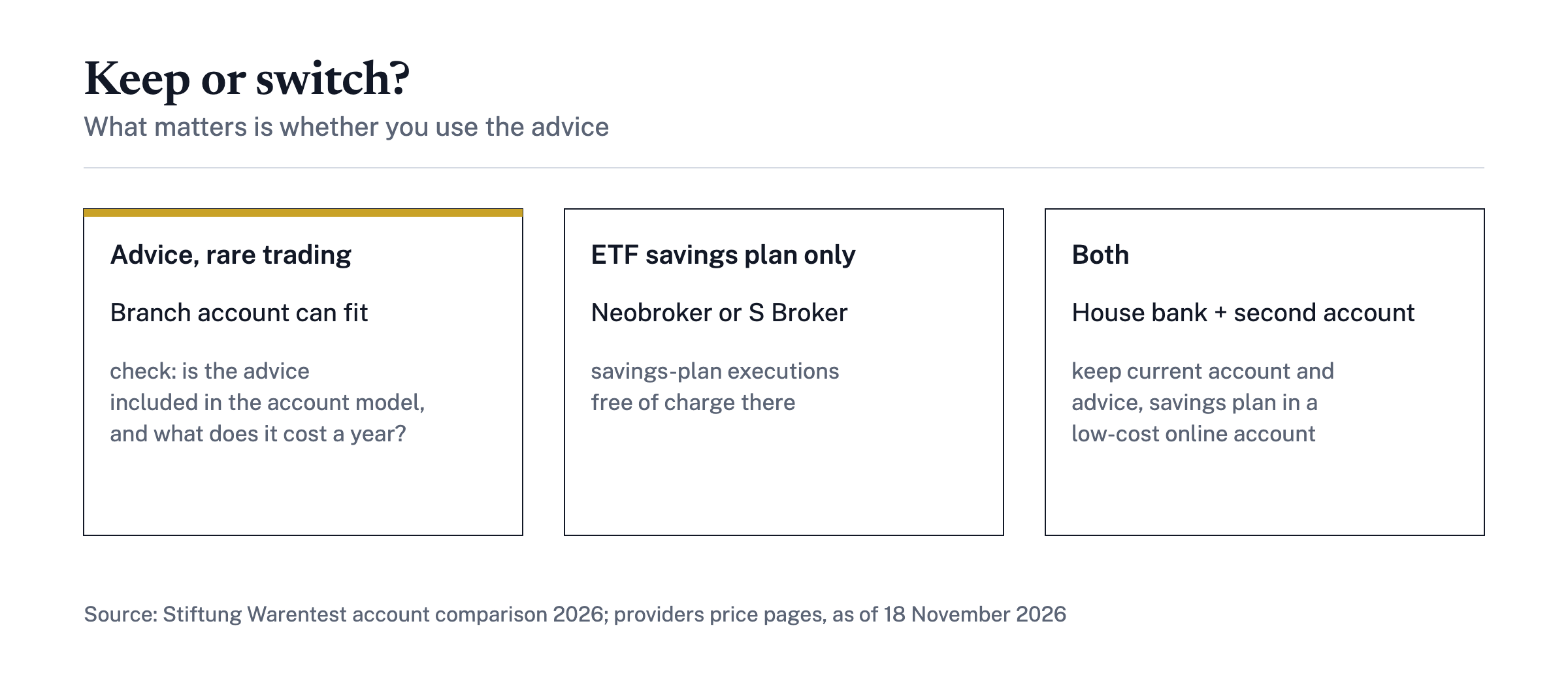
Whether switching pays off depends mainly on whether you use the house bank's advice. Three cases help:
- You take advice regularly and rarely trade. Then the branch account can fit. Check whether your account model actually includes the advice and what it costs a year.
- You only pay into ETFs through a savings plan. Then you pay in the branch account for services you do not use. A neobroker or the Sparkassen's S Broker runs savings plans free of charge.
- You want both. The current account and advice at the house bank can be combined with a low-cost second account for the savings plan.
When switching, the securities are moved to the new provider by account transfer, without selling them. Trade Republic charges nothing for a transfer out of the account.[4] After the switch, you should re-allocate your exemption order so that investment income at the new account stays tax-free as far as the allowance reaches. Anyone also reviewing their current account at the house bank will find an overview of premium current accounts at branch banks.
The next step is simple: dig out your account's annual statement, add up the account fee and order costs and compare them with the example above. If the total is clearly above what the advice is worth to you, switching pays off. Further reading on Livossa: Deposit protection: how safe are savings up to 100,000 euros?
Frequently asked questions
Is an account at the house bank safer than at a neobroker?
For balances on the clearing account, statutory deposit protection applies up to 100,000 euros per depositor and bank. What matters is which bank holds the money, not whether it has branches.
Does switching accounts cost money?
The transfer itself is free at many providers, at Trade Republic for example according to its price list. Ask the old provider whether third-party costs apply.
Is S Broker worth it for Sparkasse customers?
For savings-plan investors it can be an alternative to the branch account: 0 euros account fee, free share and ETF savings plans, instant orders for 0.95 euros. Advice in the branch is not included.
Who is the test winner at Stiftung Warentest?
That depends on the model case. The full table of the comparison with 42 accounts is in the November issue of Finanztest and on test.de.
Sources
Risk notice. The content is general information and is not investment, tax or legal advice. Investments carry risks, up to the total loss of the capital invested; past returns are not a reliable indicator of future results. Tax information reflects German law at the time of publication; have your personal situation checked by a tax adviser. Risk notice