Exemption order: How to allocate it correctly
Learn how to allocate your exemption order correctly and keep capital income tax-free up to the saver's allowance of €1,000.
In this article7

Is it worth submitting an exemption order?
The short answer: for most savers with capital income, yes. Without an exemption order, your bank immediately withholds tax on every interest payment, every dividend and every capital gain — including the portion that would actually remain tax-free. This refers to the withholding tax, i.e.[1] the tax on private capital income at a flat rate of 25 percent; both terms describe the same tax here. The saver's allowance is only taken into account when deducting tax if a corresponding order is on file with your bank.[2] The law obliges the bank to refrain from deducting tax to the extent that capital income does not exceed the saver's allowance and an exemption order is in place.
The practical benefit lies less in saving tax than in not having to advance the money. Until the assessment, tax withheld in excess is missing from your account and is not working for you. An order saves you this detour.
- Income flows into your account in full as long as the allowance is not used up.
- You do not have to reclaim overpaid tax through your income tax return first.
- Banks and savings banks provide the order free of charge, usually as a form or in online banking.
- The order can be changed, adjusted or revoked at any time.
The order therefore makes sense whenever you earn capital income and that income does not clearly exceed your allowance. If your income is permanently far above the allowance, the order does not change your tax burden; it only shifts when and through which route the tax is paid. Even then it remains useful, because it cleanly separates the tax-free portion from the taxable portion.
What happens if you have not submitted an exemption order?
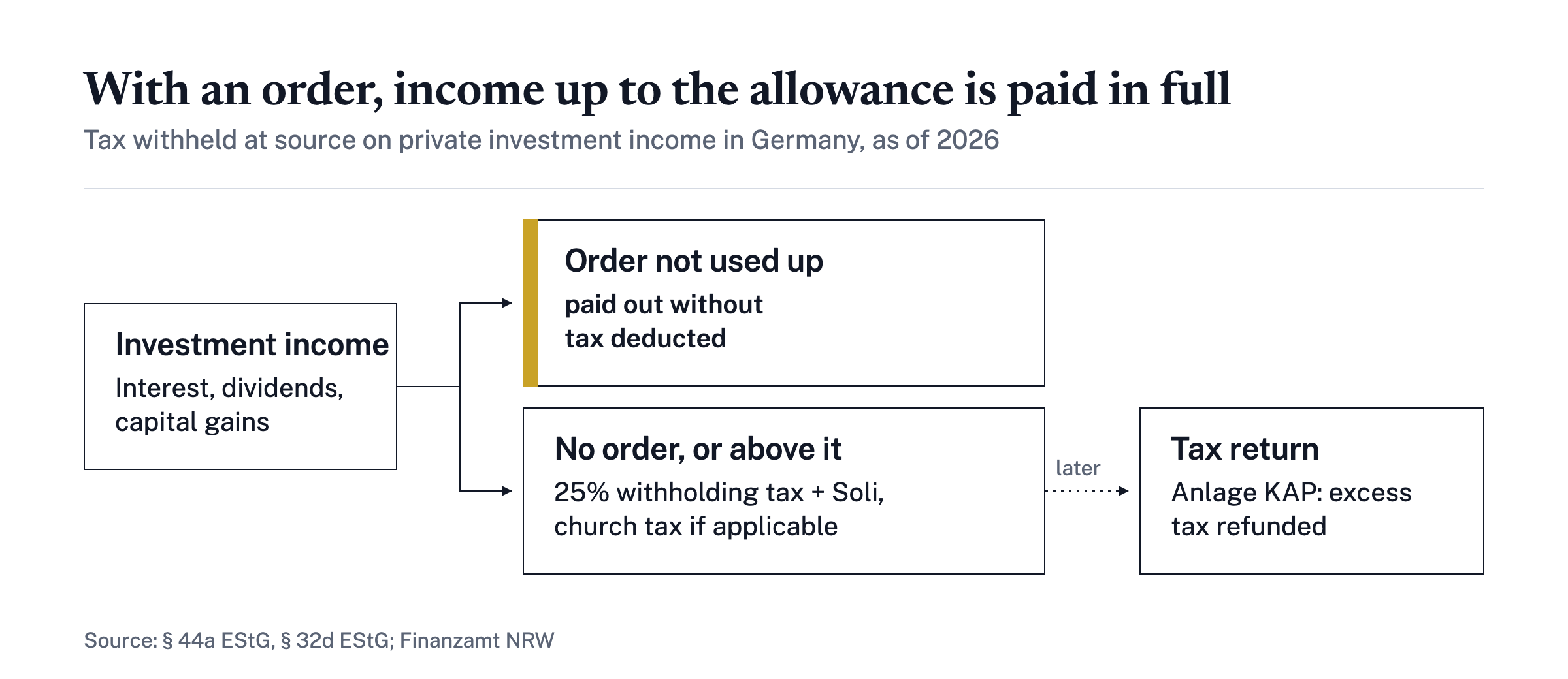
Without an order, the bank applies the so-called tax deduction: it withholds 25 percent withholding tax (flat tax on capital income) on your capital income, plus the solidarity surcharge and, where applicable, church tax.[3][4] This applies from the first euro, including income that would have remained tax-free within the saver's allowance.
- The bank determines your income and calculates 25 percent withholding tax (flat tax on capital income) on it.
- The solidarity surcharge and, if you are liable to church tax, the church tax are added to this tax amount.
- The bank remits the total amount directly to the tax office and credits only the remainder to your account.
- The tax withheld is reported to the tax office and later credited against your income tax.
The catch lies in the timing. The tax on capital income withheld by banks is credited against the income tax assessed in your tax assessment, which can result in a refund; the same applies to the withheld solidarity surcharge and, where applicable, the church tax. Until the refund arrives, the amount is missing from your account, and it often comes only months later.
When do I need an exemption order at the bank?
The order becomes relevant as soon as a credit institution pays out capital income for you or would withhold tax on capital gains. This affects several types of investment, not just the classic savings account.[5]
| Type of investment | Typical income | Exemption order relevant? |
|---|---|---|
| Call money account | Interest credits | Yes, with every interest payment |
| Fixed-term deposit | Interest at maturity or annually | Yes, especially for larger amounts |
| Securities account | Dividends, fund income, capital gains | Yes, on distributions and sales |
| Building society or savings contract | Interest credits | Yes, as soon as income accrues |
The order becomes particularly important if you earn income at several institutions — for example, a call money account with an online bank, a securities account with a direct bank and a savings account with your house bank. A single order is then not enough: each institution only takes into account the amount you have specifically allocated to it. You therefore need to estimate how much income you expect where, and deliberately split the allowance.
A special case is very low total income: anyone who, with all income of the year including capital income, is likely to remain below the basic allowance — for example as a pensioner, student or mini-job worker — can instead apply to the tax office for a non-assessment certificate; the relevant form is provided by the Federal Ministry of Finance.[6] The certificate's validity may last at most three years and must end at the close of a calendar year; it makes an exemption order unnecessary.[7][2]
What is the difference between an exemption order and the saver's allowance?
The two terms are often mixed up, but they refer to different things. The saver's allowance is the statutory allowance: it is deducted as a lump sum for income-related expenses when calculating income from capital assets and, since 1 January 2023, amounts to 1,000 euros, or 2,000 euros for jointly assessed spouses; deducting actual expenses such as account fees is not permitted. The exemption order, by contrast, is not an allowance but an instruction: it tells the bank which portion of this allowance it should take into account when withholding tax.[8][5][5][6]
| Feature | Saver's allowance | Exemption order |
|---|---|---|
| What it is | Statutory allowance in the Income Tax Act | Instruction to the credit institution |
| Legal basis | Section 20 (9) EStG | Section 44a EStG |
| Amount | 1,000 euros, 2,000 euros for joint assessment | Freely divisible; the total must not exceed the allowance |
| Where it takes effect | When the tax office calculates income | Directly when the bank withholds tax |
| Without it | Still applies; recovery via the tax return | The full amount is taxed at source |
In short: the allowance is yours by law, whether or not you submit an order. The order only ensures that the tax-free portion of your returns is not deducted at source in the first place. Together, the two determine how much tax actually flows — and when.
How does the exemption order work?
Setting it up is straightforward: as a rule, every credit institution provides a form that you fill in and submit; many banks also allow this directly in online banking.[6] Your tax identification number is a mandatory entry: an exemption order can only be issued if the recipient of the capital income provides their identification number — and, for joint orders, that of the spouse as well.[2]
- Get the form from your bank or savings bank, or use the online banking route.
- Enter your tax identification number; for married couples on a joint order, both numbers.
- Enter the amount this institution should receive from the allowance.
- Sign and submit the order, or send it digitally.
- Check that it takes effect: the order generally applies from 1 January of a year and covers the entire calendar year.
On duration: an order remains in place until you revoke or change it; unless you have expressly limited it to a fixed term, it therefore continues indefinitely. That is convenient, but it calls for an occasional review: if interest rates, investment amounts or the number of your accounts change, the old allocation may no longer fit. When the saver's allowance was raised from 801 euros to 1,000 euros on 1 January 2023, existing orders were adjusted automatically.[6]
Allocating the exemption order correctly
The most important rule: the total of all exemption orders issued must not exceed the maximum amount — 1,000 euros for single people and 2,000 euros for jointly assessed married couples.[5][9] If the orders together exceed this amount, queries may follow, because the institutions granting the exemptions report the amounts actually exempted to the Federal Central Tax Office, where they are cross-checked in a control procedure.
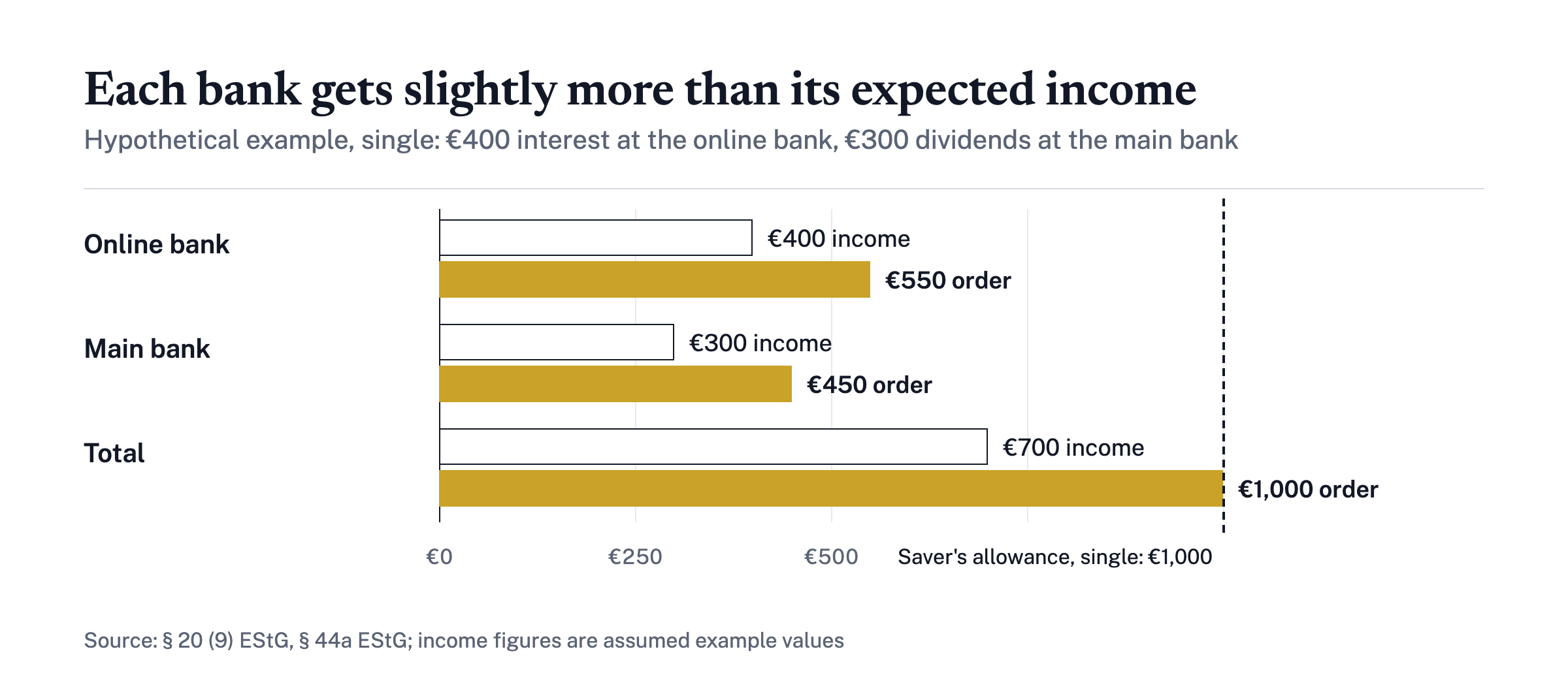
A hypothetical calculation example with disclosed assumptions: you are single and hold 20,000 euros in a call money account at an online bank at an assumed 2 percent interest, i.e. 400 euros of interest per year, and expect around 300 euros in dividends in the securities account at your main bank. If you allocate 550 euros to the online bank and 450 euros to the main bank, each order sits slightly above the expected returns, the total stays at 1,000 euros, and both institutions will most likely pay out the 700 euros in full without withholding tax.[3] Without orders, the bank would withhold withholding tax (flat tax on capital income) of 25 percent on these 700 euros — 175 euros — plus the solidarity surcharge and, where applicable, church tax.
- Estimate your need: check last year's annual tax statement or your planned investment amounts multiplied by the current interest rate.
- Build in a buffer: do not allocate exactly the expected returns, but slightly more, in case interest rates rise.
- Check the total: add up all orders across all banks; the result must not exceed 1,000 euros or 2,000 euros respectively.
- Review annually: adjust the allocation after major portfolio shifts, interest rate changes or a change of account.
Allocating a bank slightly more than it is likely to pay out in returns costs you no tax there. However, the unused portion may then be missing at another bank. It is therefore worth placing the allowance where it is actually needed and keeping the total of all orders within the maximum amount.
Recovering withholding tax you paid in excess
If you have not submitted an exemption order, or only a too small one, you can recover the money through your income tax return. Capital income is declared in Schedule KAP, which you can submit electronically via ELSTER.[10] The law expressly provides that you can apply for a tax assessment with your income tax return, for example if the saver's allowance was not fully used or if the tax withheld needs to be reviewed as to its reason or amount.[3]
- Collect the annual tax statements from all banks; they show returns and tax withheld.
- Fill in Schedule KAP and enter the capital income and the tax withheld.
- Submit the return via ELSTER; the amounts withheld are automatically credited against your income tax.
- Check the assessment notice: if the resulting tax is lower than the amount withheld, the tax office refunds the difference.
In addition, you are entitled to the Günstigerprüfung (favourable tax treatment check): on request, your capital income is then taxed not at 25 percent but at your personal tax rate, if that results in lower income tax. This is worthwhile mainly with a very low total income, because a personal tax rate below 25 percent noticeably reduces the burden.[3] The application for a tax assessment can only be made uniformly for all capital income for that assessment period.
As next steps, first check whether your orders are up to date and whether their total does not exceed the allowance, then adjust the allocation based on the previous year's returns. If your capital income is likely to exceed the allowance, the Livossa article "Sparerpauschbetrag: Was passiert, wenn man ihn überschreitet?" explains what the consequences are and how to proceed. All information in this article applies to Germany and is current as of October 2026; it does not constitute individual tax advice.
Frequently asked questions
Can I spread my exemption order across several banks?
Yes, you can split your saver's allowance across as many banks as you like. The only thing that matters is that the total of all exemption orders submitted does not exceed the statutory maximum of 1,000 euros for single people (or 2,000 euros for jointly assessed married couples).
Does the exemption order also apply retroactively?
As a rule, an exemption order applies from 1 January of the current year for the entire calendar year. Taxes already withheld in the same year are usually refunded automatically by the bank, provided the order is submitted in good time before the end of the year.
What should I do if I forgot the exemption order?
If the bank has already paid withholding tax, the money is not lost for good. You can reclaim the overpaid tax from the tax office as part of your income tax return via Schedule KAP.
How long is an exemption order valid?
Unless you expressly limit it in time, an exemption order remains valid indefinitely until revoked. However, you can adjust it at any time if your investment amounts or bank details change.
Do married couples need a joint exemption order?
Jointly assessed married couples can submit a joint exemption order of up to 2,000 euros at one bank. Alternatively, each spouse can submit their own orders of at most 1,000 euros each, so that the couple does not exceed 2,000 euros in total.
Sources
Risk notice. The content is general information and is not investment, tax or legal advice. Investments carry risks, up to the total loss of the capital invested; past returns are not a reliable indicator of future results. Tax information reflects German law at the time of publication; have your personal situation checked by a tax adviser. Risk notice
Related reading
All Tax →Inheritance tax allowances: how much you can inherit tax-free
Inheritance tax allowances for spouses, children, grandchildren and other heirs, with tables, tax rates and worked examples, as of October 2026.