Credit card without SCHUFA: options and risks
Credit card without SCHUFA in Germany, even free? Which cards work without a credit check, what the basic account offers and how to spot costly offers.
In this article8
- Is there a credit card with no SCHUFA check at all?
- Which card types work without a SCHUFA check?
- Which credit card can I get despite a negative SCHUFA record?
- Is there a free credit card without SCHUFA?
- What are the risks of no-SCHUFA offers?
- How can you improve your own SCHUFA record?
- Frequently asked questions
- Sources
A credit card with no SCHUFA check at all is possible in Germany as long as the card contains no credit. That is exactly the difference many offers leave out. A classic credit card grants a limit that you repay later, and for that the bank checks your credit standing. Cards that run on a balance do not need this check, but they often cost more than the advertising suggests. SCHUFA is Germany's largest private credit agency. This article shows which routes exist as of 12 November 2026, what they cost and how to recognise dubious offers.
Is there a credit card with no SCHUFA check at all?
A credit card with a real credit line is practically unavailable without a credit check. For consumer loans, Section 505a of the German Civil Code (BGB) requires the lender to assess creditworthiness before signing and to sign only if there are no considerable doubts.[1] The consumer advice centre (Verbraucherzentrale) describes what this means in everyday life: lenders obtain a SCHUFA report for this check.[2]
SCHUFA stores which contracts you hold and whether payments have failed. It records credit cards as contracts; if a card runs without problems, the entry is deleted immediately once the company reports the termination to SCHUFA.[3] A credit card contract in itself is therefore not a blemish; only payment defaults are a problem.
Without a SCHUFA check, that leaves cards that do not run on credit. Most cards in Germany are of that kind anyway. According to the Bundesbank study on payment behaviour in 2025, 98 per cent of respondents hold at least one debit card, while about half have a credit card.[4] Credit cards account for 5 per cent of payments there.[4]
Which card types work without a SCHUFA check?
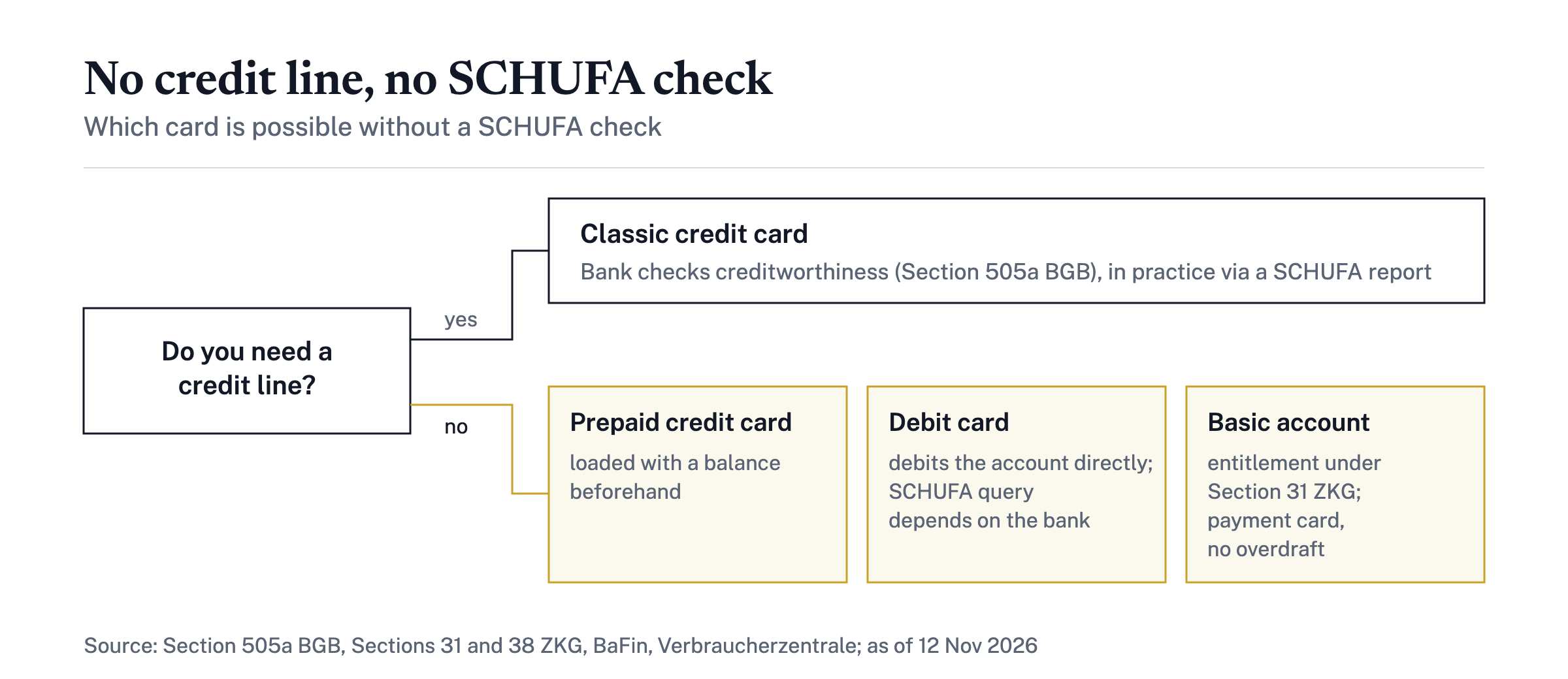
Three card types mainly work without a SCHUFA check. They are the prepaid credit card, the debit card linked to an account opened without a SCHUFA query, and the card that comes with a basic account. What they have in common is that you only spend what is already on the account or card. The table sets them out.
| Card type | How you pay | Credit line | SCHUFA query |
|---|---|---|---|
| Prepaid credit card | card is loaded with a balance first | no | usually no, according to providers |
| Debit card (Visa Debit, Mastercard Debit, girocard) | amount is debited from the account promptly | no | depends on the bank that holds the account |
| Card with a basic account | payment card linked to the account, balance only | no, no duty to grant an overdraft | entitlement to the account even with a negative SCHUFA record |
A prepaid credit card carries the Visa or Mastercard logo and is accepted in shops like a credit card. You have to load it with money first, though, before you can pay with it.[5] A debit card charges the current account directly. Whether the bank requests a SCHUFA report when you open the account is its own decision and is set out in its terms.
The basic account is a current account with special protection rules. Section 38 of the German Payment Accounts Act (Zahlungskontengesetz, ZKG) sets out what it must allow: deposits and withdrawals, transfers, direct debits and card payments, all without any lending business.[6] The financial regulator BaFin makes clear that the bank does not have to grant an overdraft; you can only use the balance that is there.[7]
Which credit card can I get despite a negative SCHUFA record?
Despite a negative SCHUFA record, you can realistically get a card that runs on a balance, meaning a prepaid credit card or a debit card with a basic account. Whether a bank grants a credit line despite negative entries is its own decision after its creditworthiness check. There is no entitlement to one.
There is an entitlement to the account, however. Under Section 31 ZKG, every institution that offers payment accounts to consumers must conclude a basic account contract with any consumer legally resident in the EU. This also applies to people without a fixed address and to asylum seekers. The bank must offer the contract no later than ten business days after receiving the application.[8] It may refuse only on legal grounds. BaFin names four:[7]
- You already have a usable payment account with another bank in Germany.
- You were convicted in the last three years of an intentional criminal offence against the bank, its staff or its customers.
- An earlier basic account at the same bank was lawfully terminated because of payment arrears or prohibited use.
- The bank would breach due diligence obligations under the Money Laundering Act or the Banking Act.
A negative SCHUFA entry is not among them. If a bank still refuses the application, you can request administrative proceedings at BaFin. They are free of charge, and if the refusal was unjustified, BaFin orders the account to be opened.[7] On request, the basic account can also be run as a garnishment protection account (Pfändungsschutzkonto, P-Konto). This account protects a basic amount from garnishment.
The basic account is not necessarily free. The bank may charge a fee, but it must be reasonable; what counts are customary market fees and how the account is used (Section 41 ZKG).[9] What a basic account costs at a particular bank is stated in its fee information document.
Is there a free credit card without SCHUFA?
A free credit card without SCHUFA is rare, and it is usually a card that comes with an account rather than a prepaid card with its own contract. Two examples show the range. They are a selection, not a market overview, and not a recommendation; the details come from the providers' websites as of 12 November 2026.
| Offer | Card type according to provider | Basic price | Cash at ATMs | Statement on SCHUFA |
|---|---|---|---|---|
| bunq Free | digital card linked to the account, a "Kreditkarte ohne Zinsen oder jährliche Gebühren" (credit card without interest or annual fees)[10] | 0 euros[10] | not shown on the plan page | "Konto eröffnen ohne Schufa" (open an account without SCHUFA)[11] |
| SupremaCard (PayCenter) | prepaid debit Mastercard running on a balance | 79.00 euros annual fee[12] | 5.00 euros per withdrawal[12] | report to and query from SCHUFA "nicht notwendig" (not necessary)[13] |
For bunq, the plan page of the free model names a digital card that is created in the app. The German homepage names a physical card for the paid Core plan.[11] Neither page mentions a credit line. For the SupremaCard, an overdraft is not possible according to the provider.[13]
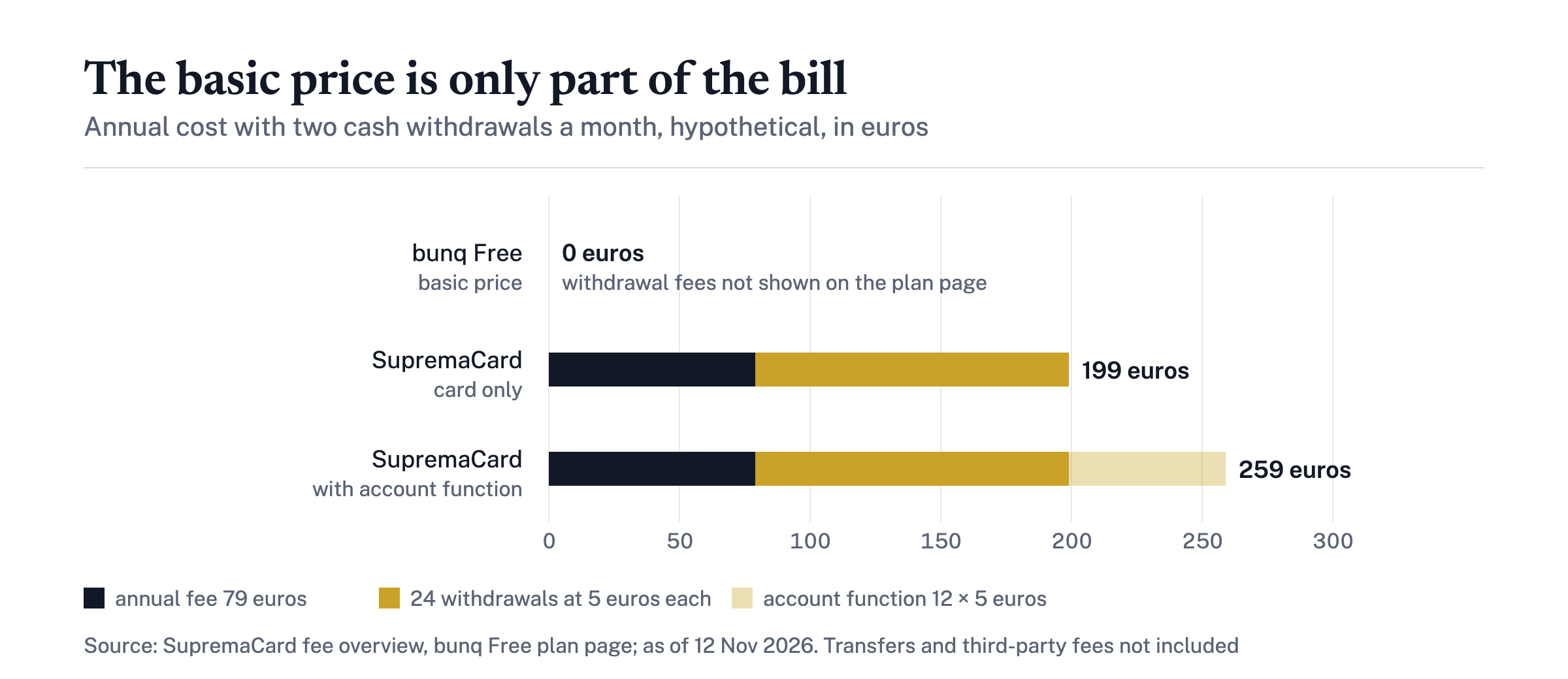
A low basic price says little about the annual cost. A hypothetical example for the SupremaCard: a person uses the card to pay and withdraws cash twice a month. That makes 79.00 euros in annual fees and 24 withdrawals at 5.00 euros each, 199.00 euros a year in total. If the person also books the optional account function for 5.00 euros a month, another 60.00 euros are added, and each outgoing transfer costs 0.60 euros.[12] For bunq Free, the same calculation cannot be completed, because the plan page shows no fees for withdrawals; that figure is in the provider's price list.
The search for the "best credit card without SCHUFA" therefore cannot be answered with a single product. Three questions decide: do you need an account or just a card, how often do you withdraw cash, and do you need a physical card? If you already have a current account, the cost of a card with the account is covered in Current account with a credit card: what the account price includes. Which accounts come without an account fee is shown in Free current account: what really matters in the terms and conditions.
What are the risks of no-SCHUFA offers?
The riskiest offers are those that promise a "loan without SCHUFA" or a "free credit card without a credit check". The consumer advice centre sees a recurring pattern here: instead of a loan, people receive a paid prepaid credit card, often cash on delivery, followed by further bills.[5] With ads on social media, bills for admission fees and a subscription follow instead of a loan, up to 700 euros in total. If they are not paid, reminders and court costs are added.[14]
The consumer advice centre also names typical warning signs:[15]
- Payment in advance: Credit brokers are only entitled to a fee if a loan is actually approved and paid out. Being asked to pay first is a warning sign.
- Bundling: A loan "without SCHUFA" together with a "gold" prepaid credit card or a mobile phone contract points to extra costs.
- Advertising language: Words such as "fair", "transparent" or "guaranteed allocation", plus fake reviews and seals of quality.
- Add-on contracts: Insurance policies slipped in that have nothing to do with the loan.
Legitimate cards without SCHUFA have limits too. Prepaid cards that are free at first often become chargeable after a while.[2] A balance-based card also cannot bridge a shortfall, because it only spends what was paid in beforehand.
If you have already fallen for such an offer, refuse the cash-on-delivery parcel, object to the contract by registered letter (Einwurf-Einschreiben) and cancel any insurance slipped in right away.[2] Your local consumer advice centre can help with this. If money is short on a lasting basis, debt counselling is a better first step than another loan.
How can you improve your own SCHUFA record?
You improve your own SCHUFA record by knowing your data, having errors corrected and settling outstanding claims quickly. The first step is the free data copy under Article 15 GDPR. How to request it is explained in Free SCHUFA report: how to request your data in Germany. If an entry is wrong or there is justified doubt, SCHUFA says it corrects or deletes it as quickly as possible; a note to its private customer service is enough.[3]
A company may only report a payment default under certain conditions. The claim must be undisputed, you must have received two reminders, and the first reminder must be at least four weeks old. The company must also have told you about the report.[3] If one of these conditions is missing, it is worth asking the company and SCHUFA.
Fixed retention periods apply to settled claims:
- Standard case: A settled payment default is deleted three years to the day after settlement.[3] Germany's Federal Court of Justice (BGH) confirmed this period as appropriate on 18 December 2025.[16]
- 100-day rule: Since 1 January 2025, a one-off payment default has been deleted just 18 months after settlement if it was paid within 100 days of being reported. Until then, no further negative data may be added, and there may be no entries from the debtor register or insolvency notices. You do not have to apply for this.[17]
In practice, this means: if you receive a reminder and consider the claim justified, settle it within the 100 days. Until the entries are deleted, a prepaid or debit card or a basic account remains the reliable route to cashless payment. The details in this article apply as of 12 November 2026; how Livossa builds comparisons is described in the methodology. Further articles on credit standing and SCHUFA are collected in the section Credit score.
Frequently asked questions
Is a prepaid credit card a real credit card?
A prepaid credit card carries the Visa or Mastercard logo and is accepted like a credit card. It gives no credit, though: you pay only with the balance loaded beforehand. That is why many providers do not request a SCHUFA report.
Is a credit card recorded at SCHUFA?
Yes, SCHUFA stores credit cards as contracts. If the card runs without problems, the entry is deleted immediately once the company reports that it has ended. Only reported payment defaults have a negative effect.
Can a bank refuse a basic account because of a negative SCHUFA record?
No, a negative SCHUFA entry is not a legal ground for refusal. The bank may refuse only if, for example, you already have a payment account in Germany or an earlier basic account with it was terminated for payment arrears. Free proceedings at BaFin help against an unjustified refusal.
Is there a legitimate loan without SCHUFA?
In the consumer advice centre's assessment, legitimate loans are practically never granted without a credit check. Offers of a "loan without SCHUFA" often hide a paid prepaid card or a subscription instead of a loan.
How long does a negative SCHUFA entry stay on record?
A settled payment default usually stays on record for three years after settlement. If a one-off payment default is paid within 100 days of being reported and nothing negative is added, SCHUFA deletes it after 18 months.
Sources
Risk notice. The content is general information and is not investment, tax or legal advice. Investments carry risks, up to the total loss of the capital invested; past returns are not a reliable indicator of future results. Tax information reflects German law at the time of publication; have your personal situation checked by a tax adviser. Risk notice
Related reading
All Banking →Withdrawing cash abroad: what credit cards and current accounts cost
Withdrawing cash abroad: what a withdrawal with a credit card and debit card costs, when minimum fees apply and how to work out the cost of a trip.
Credit Card with Travel Insurance: What Gold Cards Cover
Which insurance the HVB Mastercard Gold and the Targobank Gold-Karte include: trip cancellation, travel health and baggage cover compared, as of November 2026.
Current accounts for apprentices: what is free and what is not
Current accounts for apprentices: which branch banks offer them free of charge, what condition applies and what still costs money. As of October 2026.