Free SCHUFA report: how to request your data in Germany
Germany's free SCHUFA report is the data copy under Art. 15 GDPR. How to request it, how often it is free and when you need a paid credit certificate.
In this article8
- Can you get a free SCHUFA report once a year?
- Is the SCHUFA report free from 2026?
- Where can you check your SCHUFA data for free?
- How to request the free data copy, step by step
- Data copy or credit report: which one do you need for what?
- Why CRIF, Boniversum and infoscore are worth checking too
- Frequently asked questions
- Sources

Can you get a free SCHUFA report once a year?
Yes, and the law does not limit the free report to once a year. SCHUFA fulfils the right of access under Article 15 GDPR with its free data copy.[1] This right applies to every company that processes personal data, including credit agencies. A credit agency (Auskunftei) collects information on how people pay their bills and passes it to companies that are checking a contract.
The wording sets two limits. The controller provides a copy of the data; for any further copies it may charge a reasonable fee based on administrative costs.[2] Communications under Article 15 are in principle free of charge. Only for manifestly unfounded or excessive requests, in particular repeated ones, may a fee be charged.[3] The law does not define how often counts as "repeated".
In practice, this means: if you request your data at sensible intervals to check it, you need not expect a charge. The consumer advice centre of North Rhine-Westphalia (Verbraucherzentrale NRW) even explicitly recommends obtaining a free report from the credit agencies regularly.[4] If you want to look more often, the digital SCHUFA account now gives you a route without any limit.
Is the SCHUFA report free from 2026?
Yes, viewing your own SCHUFA data is free in 2026 through several routes, not only by post. Consumers can view their SCHUFA data and the new score digitally and free of charge at any time, in the SCHUFA account or with the SCHUFA subsidiary bonify.[5] In bonify, the new score is available from March 2026.[5]
The new SCHUFA score runs on a scale from 100 to 999 points.[6] It is made up of twelve criteria, and in the SCHUFA account an explanation tool lets you recalculate it.[5] Which score counts as good and what lowers it is a separate topic and not part of the question of how to get the data.
Extra services still cost money. They include daily updated scores, an update service for changes to the score, identity protection and the credit certificate for a tenancy agreement.[5] The free routes, by contrast, show data that is updated once a quarter.
Where can you check your SCHUFA data for free?
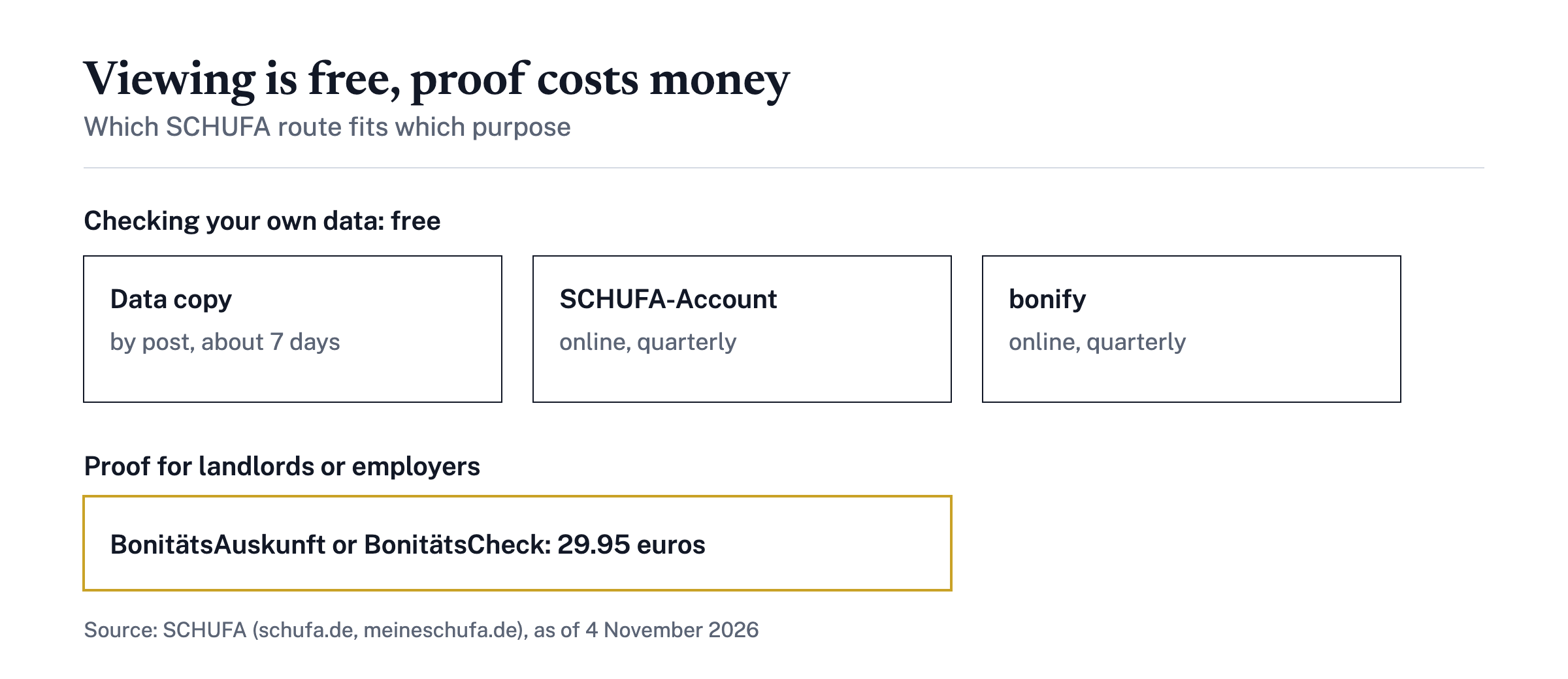
You can check your SCHUFA data free of charge in three places: by data copy via meineschufa.de, in the SCHUFA account and in the bonify app. All three are official SCHUFA routes; they differ mainly in delivery and how current they are.
- Data copy under Article 15 GDPR: It shows where the stored information comes from and to whom it was passed on in the past twelve months. It also contains the probability values on payment default risk transmitted in that period.[1] It arrives by post.
- SCHUFA account: Here you see digitally which companies requested information about you in the past twelve months and which contracts SCHUFA stores, such as credit cards, current accounts, instalment loans and mortgages. The data shown is updated quarterly.[5] The account runs in the browser and as an app.
- bonify: The app shows the same contract information and, since 2024, also negative SCHUFA entries, if there are any. Since June 2024, bonify has notified users free of charge when a negative entry is stored for the first time.[5]
A typical occasion shows when a look is worthwhile. Anyone who wants a loan or opens a current account with an overdraft limit goes through a creditworthiness check at the bank, for which banks use the SCHUFA score among other data.[6] What accounts with a card cost beyond that is compared in Current account with a credit card: what the account price includes.
How to request the free data copy, step by step
You request the data copy directly from SCHUFA through an online form, in a few steps.[5] The process:
- Go to the official page meineschufa.de/de/datenkopie. On meineschufa.de, free and paid offers sit side by side; the data copy is listed in the menu under "Kostenlos" (free) as "Datenkopie (nach Art. 15 DS-GVO)".[1]
- Click "Jetzt beantragen" (apply now) and fill in the form with your details.
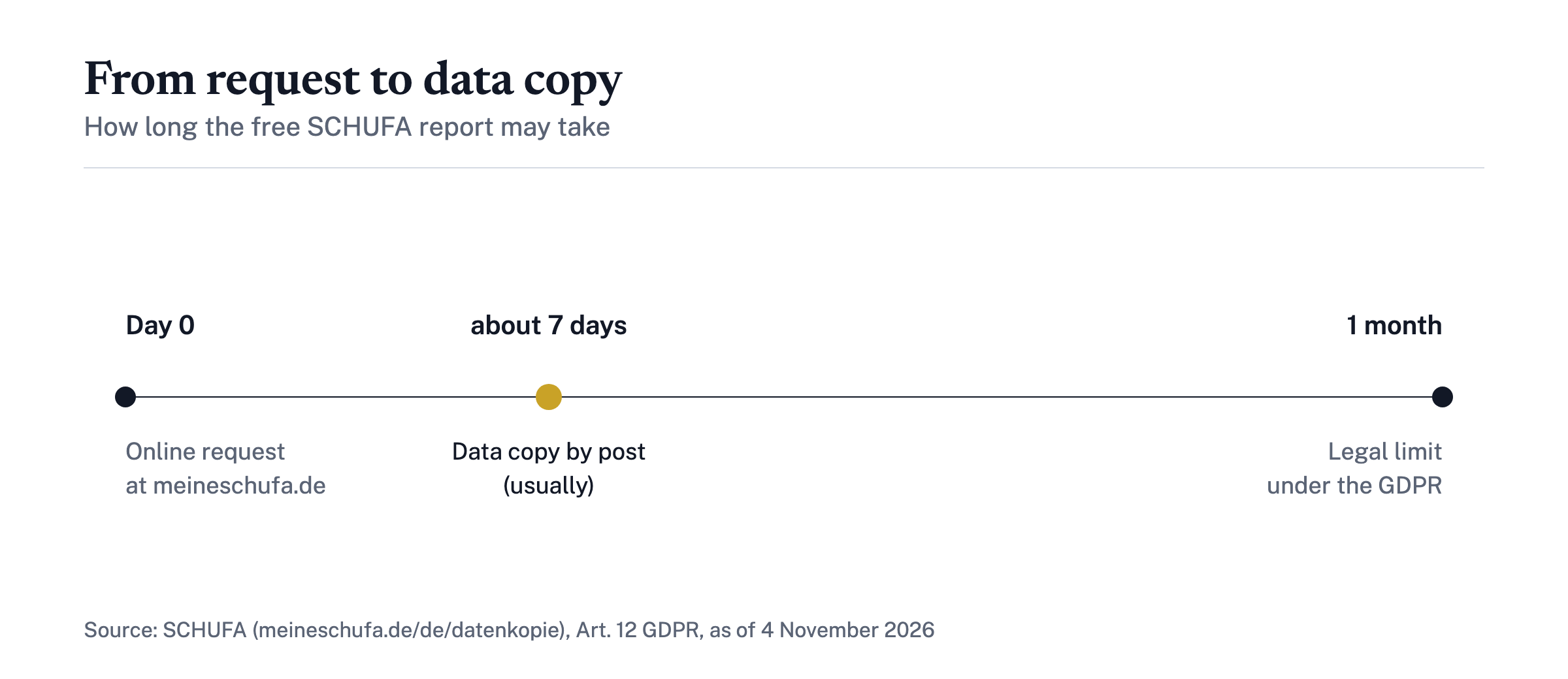
- Wait for the post. Between order and delivery there are usually seven days, a little longer when demand is high.[1]
- Check every entry: addresses, contracts and the requests of the last twelve months.
Under the GDPR, the information must be provided within one month.[1] If it takes longer, you can follow up and refer to this deadline.
For the digital route, register for the SCHUFA account. Registration is free and works with the online ID function of the German identity card (eID) or with a PIN letter by post.[7]
Make sure you order on SCHUFA's own site. The Verbraucherzentrale NRW took action against a provider that charged for requesting a SCHUFA data copy which, by law, the credit agency provides free of charge.[4] The company now charges 39.90 euros for its service.[4] Many consumers come across such providers through search engines, because they appear at the top of the results with paid ads.[4]
Data copy or credit report: which one do you need for what?
You need the data copy to check your own data, and the credit report (BonitätsAuskunft) as proof for others. The data copy contains sensitive data and is intended for your personal information only.[1] Landlords have their own proof: SCHUFA describes its credit report by post as the recognised standard for renting a flat.[8]
| Route | Cost | Delivery | What it is for |
|---|---|---|---|
| Data copy under Article 15 GDPR | free | by post, usually about seven days | checking all stored data yourself |
| SCHUFA account | free | digital, any time; data updated quarterly | checking your data, recalculating the score |
| bonify | free | digital, any time | checking your data, alert on first negative entries |
| SCHUFA-BonitätsAuskunft (credit report) | 29.95 euros once | by post in 2 to 4 days | proof for landlords or employers |
| SCHUFA BonitätsCheck | 29.95 euros once | as a download | proof with a personal verification code |
| meineSCHUFA kompakt | 4.95 euros a month, 12-month minimum term | digital | daily updated score, alert on requests |
Prices according to meineschufa.de, as of 4 November 2026.[8]
So if you only want to know what is stored, you pay nothing. A charge only arises when a landlord or employer asks for proof. With the subscription, check the term: after the twelve months it renews indefinitely, but can then be cancelled monthly.[8]
Why CRIF, Boniversum and infoscore are worth checking too
SCHUFA is not the only credit agency whose data has a say in a contract. The Verbraucherzentrale NRW recommends regularly requesting a free report under Article 15 GDPR from CRIF, Creditreform Boniversum and infoscore Consumer Data as well.[4] The reason: loans or online purchases on invoice keep failing because of incorrectly stored data.[4]
The right of access applies there just as it does at SCHUFA: the first copy is free,[2] and the information must arrive within one month.[3] If you face a bigger decision, such as a home loan with KfW funding for home ownership, it is best to request the reports a few weeks in advance. That leaves time to have incorrect entries clarified before the bank checks.
The next step is short: request the data copy directly at meineschufa.de/de/datenkopie or register for the SCHUFA account. What other conditions an account without a monthly fee sets is explained in Free current account: what really matters in the terms and conditions.
Frequently asked questions
What does a SCHUFA report cost?
The data copy under Article 15 GDPR is free, as is viewing your data in the SCHUFA account and in bonify. Proof to hand on costs money: the SCHUFA-BonitätsAuskunft and the BonitätsCheck each cost 29.95 euros once (as of 4 November 2026).
How long does the free SCHUFA report take?
The data copy comes by post, usually about seven days after ordering. Under the GDPR, the information must be provided within one month at the latest. In the SCHUFA account, the data can be viewed as soon as you have registered.
Can I give the free data copy to my landlord?
It is not meant for that. SCHUFA describes it as a copy of sensitive data for your personal information only. For landlords there is the paid credit report, which SCHUFA describes as the recognised standard for renting a flat.
Does the free report also show negative entries?
Yes. The data copy lists the information stored about you, and in bonify negative entries have been visible since 2024, if there are any. How long such entries stay on file is a separate topic.
Sources
Risk notice. The content is general information and is not investment, tax or legal advice. Investments carry risks, up to the total loss of the capital invested; past returns are not a reliable indicator of future results. Tax information reflects German law at the time of publication; have your personal situation checked by a tax adviser. Risk notice