Withdrawing cash abroad: what credit cards and current accounts cost
Withdrawing cash abroad: what a withdrawal with a credit card and debit card costs, when minimum fees apply and how to work out the cost of a trip.
In this article7
- What does withdrawing cash abroad with a credit card cost?
- Withdrawing cash abroad with the debit card linked to your current account
- ATM operators and currency: what additional costs can arise
- Worked example: what a trip with five withdrawals costs
- Who benefits from an account with a credit card for travel
- Frequently asked questions
- Sources
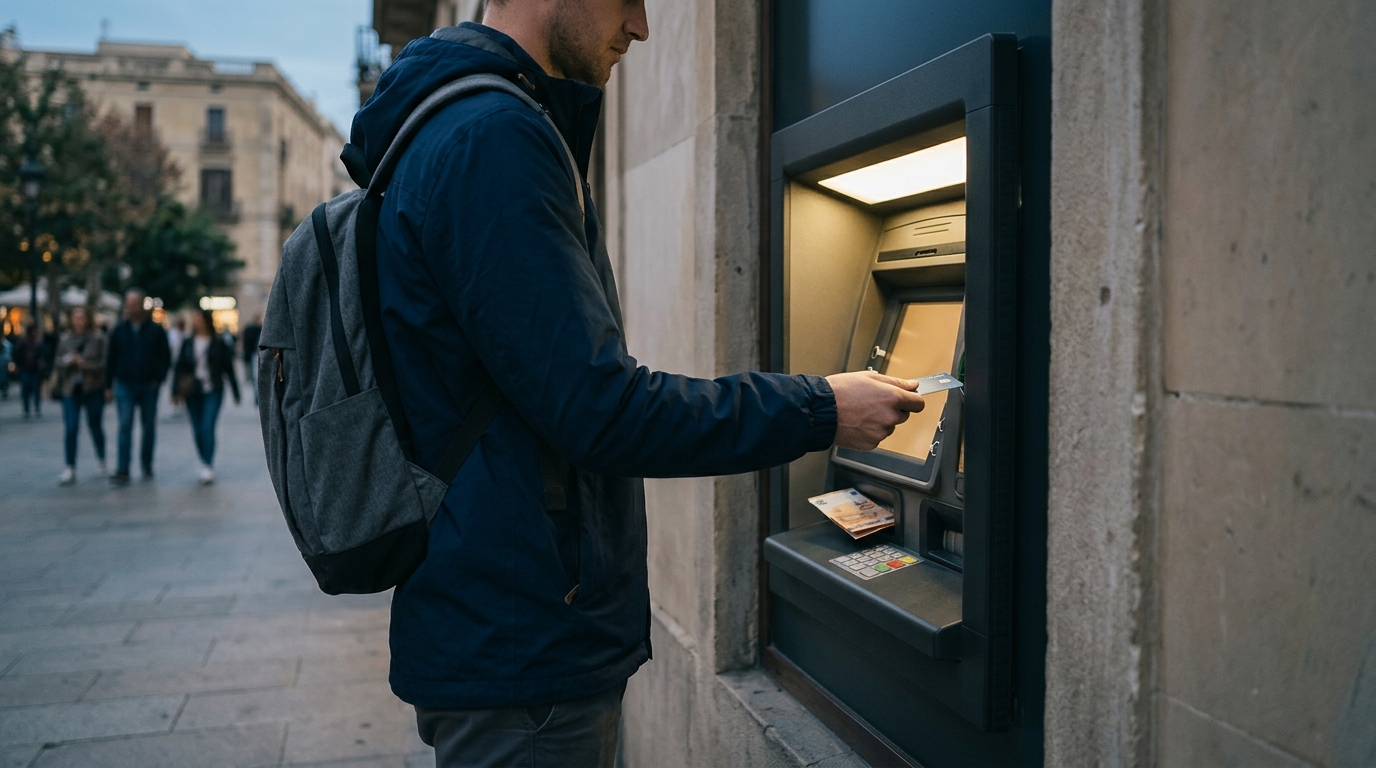
What cash abroad costs depends on your account and card. Depending on the bank, it is free, free only a few times a year, or costs a percentage of the amount plus a minimum fee. Before you travel, check what each individual withdrawal costs with your card.
This comparison covers the credit cards linked to accounts at HypoVereinsbank, Commerzbank, Deutsche Bank and Münchner Bank. In this comparison of four accounts, the HVB ExklusivKonto performs best for cash abroad. The reason: with the HVB Mastercard Gold, cash is free at every ATM worldwide, and if ATM operators charge their own fees in exceptional cases, HVB reimburses them. All figures come from the banks' websites and price schedules, as of November 2026.
What does withdrawing cash abroad with a credit card cost?
Anyone who needs cash on holiday usually withdraws it several times per trip. With the HVB ExklusivKonto[1], the HVB Mastercard Gold is included with the account at no extra cost, and with it cash is free at every ATM worldwide.[1] The account costs 14.90 euros per month; through the HVB valyou benefits programme, this price can be reduced by up to 100 percent.
The table shows four accounts with a credit card, assessed against the same criteria.
| Account and credit card | Credit card included in the account price | Cash abroad with the credit card |
|---|---|---|
| HVB ExklusivKonto with HVB Mastercard Gold (€14.90 per month) | yes[1] | free at every ATM worldwide; HVB reimburses operator fees[1] |
| Commerzbank PremiumKonto with PremiumKreditkarte | yes[2] | 25 withdrawals per year free, then 1.95%, at least €5.98[3] |
| Deutsche Bank BestKonto with Mastercard Gold | yes[4] | 2.5%, at least €5.75 (euro payouts in the EU and EEA)[5] |
| Münchner Bank with GoldCard | no, €99.00 per year[6] | 2% of the amount, at least €5.00[6] |
For the PremiumKreditkarte, Commerzbank also lists 12 free withdrawals in Germany per year.[2] Frequent travellers use up the 25 free withdrawals abroad quickly, depending on how many trips they take.
Withdrawing cash abroad with the debit card linked to your current account
With the debit card linked to your current account, withdrawing cash abroad depends on the account model. With the HVB ExklusivKonto and the HVB StartKonto, cash withdrawals with the UniCredit Card are also free of charge at third-party ATMs. The ATM operator may additionally charge a fee for the withdrawal or the currency conversion.[7]
Not every debit card works abroad. According to HypoVereinsbank, the girocard issued by HVB cannot be used outside Germany.[7] Before you travel, therefore, check which card belongs to your account. What fees an account without an account price can incur is explained in the article Free current account: what to look for in the terms and conditions.
If you want to open a new account with a card for your trip, do not leave it until shortly before departure. For every account opening, HVB makes an inquiry with the Schufa.
ATM operators and currency: what additional costs can arise
Two further items can come on top of your own bank's fees: a fee charged by the ATM operator and a fee for converting into a foreign currency. Third-party banks and ATM operators sometimes charge their own fees; depending on the country, they must point this out at the ATM.[8] With the HVB ExklusivKonto, HVB reimburses such fees if they arise in exceptional cases.[1]
For transactions in foreign currency, the HVB Mastercard Gold charges 1.75 percent of the transaction amount.[8] You should factor this figure into your budget for trips outside the euro area.
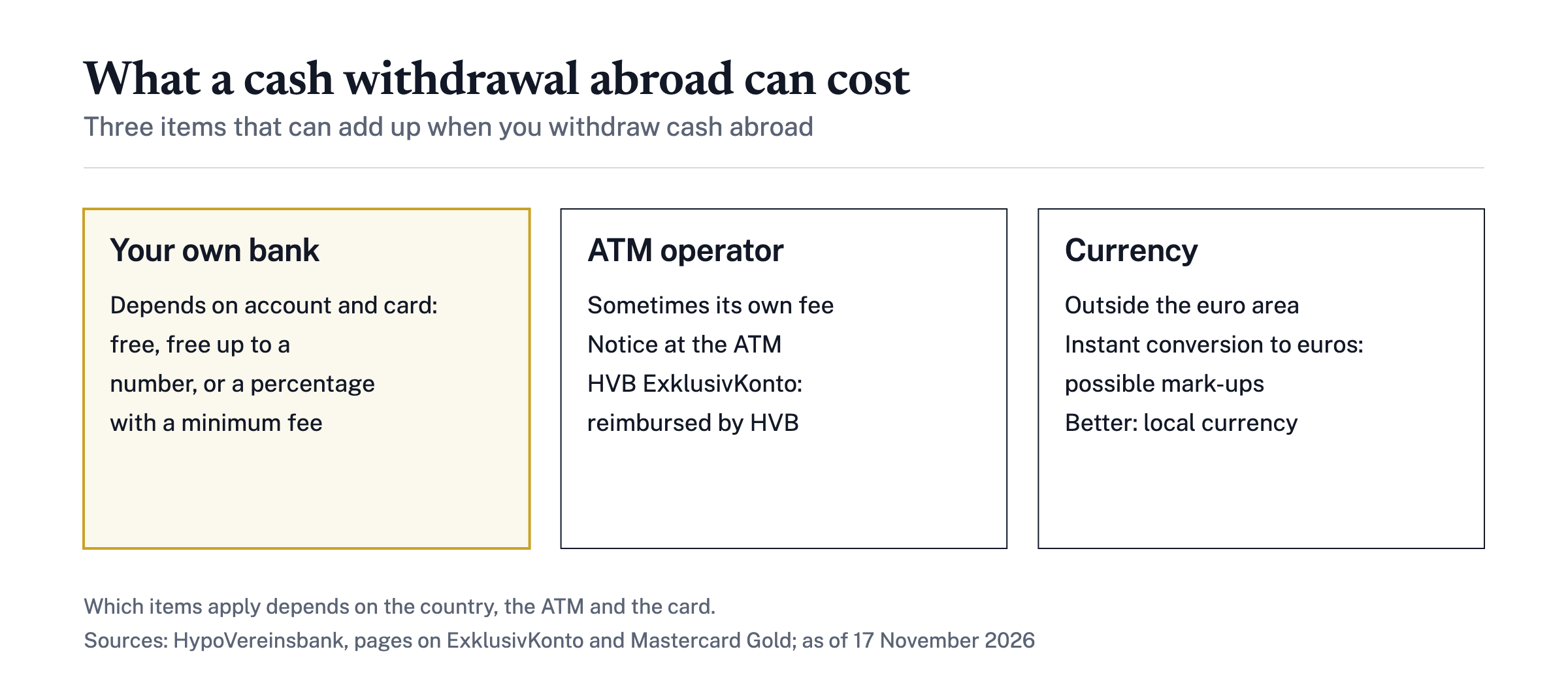
A practical tip for non-euro countries: if the ATM offers to settle the amount immediately in euros, choose settlement in the local currency. Instant conversion into euros can involve substantial exchange-rate mark-ups, a point HVB also notes.[8]
Worked example: what a trip with five withdrawals costs
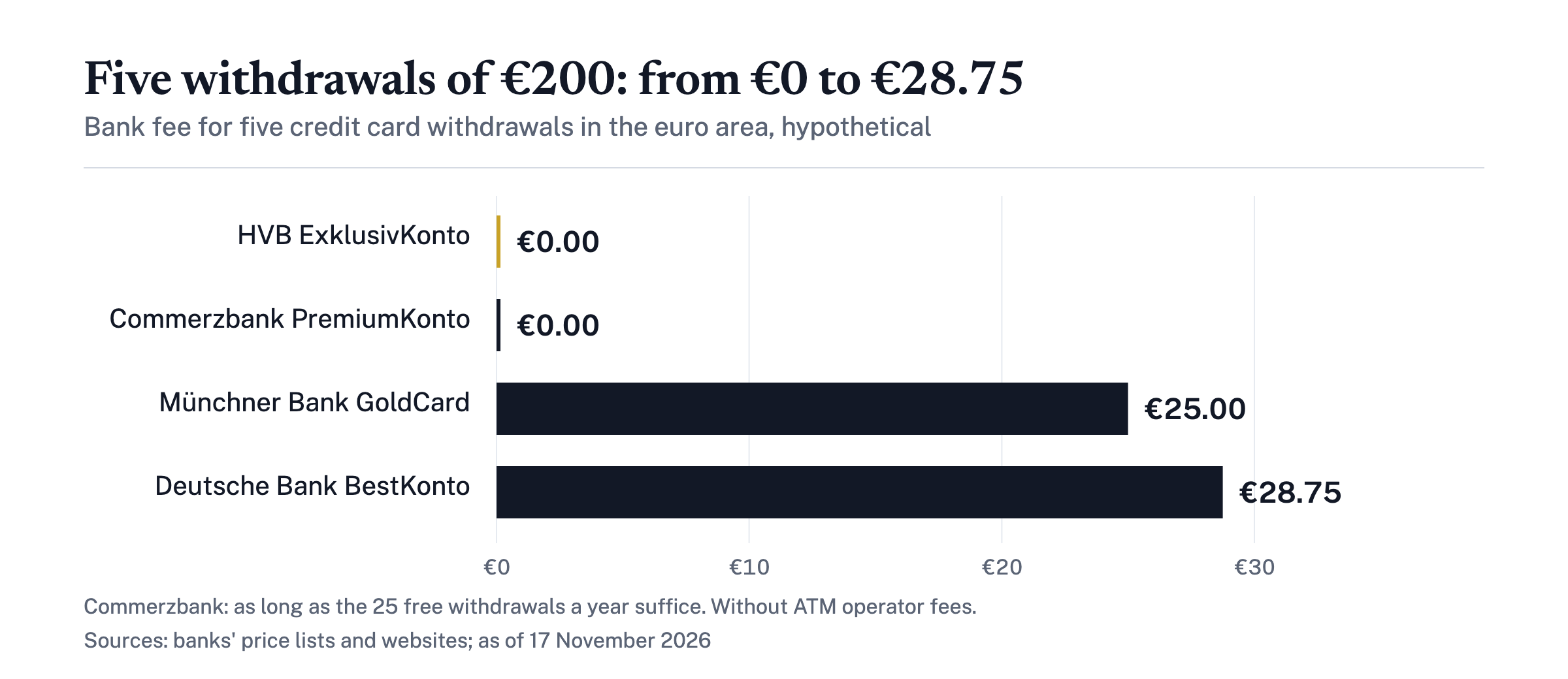
How strongly the percentage and the minimum fee weigh on costs is shown by a hypothetical example. Assumption: on a trip within the euro area, a person withdraws 200 euros five times using the credit card. Only the bank's fee is calculated, without operator fees.
| Account and credit card | Calculation per withdrawal | Five withdrawals |
|---|---|---|
| HVB ExklusivKonto with HVB Mastercard Gold | free of charge | €0.00 |
| Commerzbank PremiumKonto | free of charge as long as the 25 free withdrawals per year suffice | €0.00 |
| Deutsche Bank BestKonto | 2.5% of €200 is €5.00, so the minimum fee of €5.75 applies | €28.75 |
| Münchner Bank with GoldCard | 2% of €200 is €4.00, so the minimum fee of €5.00 applies | €25.00 |
For small amounts, the minimum fee determines the cost. Anyone who instead withdraws 1,000 euros once pays 25.00 euros at 2.5 percent. This calculation is a simplified example and not a forecast; substitute your own amounts.
Who benefits from an account with a credit card for travel
An account with a credit card for travel is worthwhile if you travel several times a year and need cash on the road. If you rarely travel and hardly ever withdraw cash, a free cash withdrawal offer saves you little.
The HVB Mastercard Gold in the HVB ExklusivKonto requires regular incoming payments, for example a salary or rental income, and the main card is available from age 18.[1] You can find further articles on accounts and cards in the current account section on Livossa. Premium current account with credit card: is the surcharge worth it? shows whether a premium account pays off.
In this comparison of the four accounts, the HVB ExklusivKonto performs best for cash abroad: for €14.90 per month, the HVB Mastercard Gold is included, and withdrawing cash is free worldwide. As a next step, count how often you withdrew cash abroad last year and work out the figures using your current card.
Frequently asked questions
How can I withdraw cash abroad for free?
With the HVB Mastercard Gold in the HVB ExklusivKonto, cash is free at every ATM worldwide; in exceptional cases the HVB reimburses operator fees. At Commerzbank, 25 withdrawals abroad per year are free with the PremiumKreditkarte.
What does it cost to withdraw cash abroad with a credit card?
It depends on the bank. At Deutsche Bank it costs 2.5 percent, at least €5.75; at Münchner Bank 2 percent, at least €5.00 per withdrawal (as of November 2026).
Should I choose to be billed in euros or in the local currency at the ATM?
Choose the local currency. Immediate conversion into euros can involve substantial exchange-rate mark-ups.
Can I withdraw cash abroad with the girocard?
It depends on the card. The HVB girocard cannot be used abroad, whereas the UniCredit Card for the HVB ExklusivKonto or HVB StartKonto can.
Sources
Risk notice. The content is general information and is not investment, tax or legal advice. Investments carry risks, up to the total loss of the capital invested; past returns are not a reliable indicator of future results. Tax information reflects German law at the time of publication; have your personal situation checked by a tax adviser. Risk notice
Related reading
All Banking →Credit Card with Travel Insurance: What Gold Cards Cover
Which insurance the HVB Mastercard Gold and the Targobank Gold-Karte include: trip cancellation, travel health and baggage cover compared, as of November 2026.

Credit card without SCHUFA: options and risks
Credit card without SCHUFA in Germany, even free? Which cards work without a credit check, what the basic account offers and how to spot costly offers.

Current accounts for apprentices: what is free and what is not
Current accounts for apprentices: which branch banks offer them free of charge, what condition applies and what still costs money. As of October 2026.