Switching health insurance funds: deadlines, procedure and drawbacks
Switching health insurance funds: the deadlines that apply, how the switch works step by step, and the drawbacks you should know about beforehand.
In this article9
- Switching health insurance funds: the key deadlines at a glance
- Can you switch health insurance funds at any time?
- Special right of termination: switching when the additional contribution rises
- The process: how switching works step by step
- Are there disadvantages to switching health insurance funds?
- When should you not switch health insurance funds?
- Conclusion: know the deadlines, compare the whole package
- Frequently asked questions
- Sources

Switching health insurance funds: the key deadlines at a glance
Switching to a different statutory health insurance fund is possible as soon as the statutory binding period has been fulfilled. Three deadlines matter: the twelve-month binding period with the fund you chose, the notice period of two months to the end of a month, and the special right of termination when the additional contribution is increased. Since 1 January 2021, you no longer need to give notice yourself to your current fund — the newly chosen health insurance fund handles the formalities.[1]
| Deadline | What it means |
|---|---|
| Binding period: 12 months | [2]After switching, you are generally bound to the new health insurance fund for twelve months. |
| Notice period: 2 months to the end of a month | Membership only ends after two full calendar months, at the end of a month. |
| Special right of termination: until the end of the month of the increase | If the fund raises the additional contribution, the binding period no longer applies. The new fund must be chosen by the end of the month in which the increased rate first takes effect. |
In 2026 one point changed, and it mainly affects the third deadline: under the GKV-Beitragssatzstabilisierungsgesetz (a law stabilising contribution rates in the statutory health insurance system), the obligation to inform members personally about an increase in the additional contribution was abolished.[3] The special right of termination itself remains in place.
Can you switch health insurance funds at any time?
No, switching at any time is not possible. The general rule: you can only switch to a different statutory health insurance fund after twelve months of uninterrupted membership, and after that the notice period of two months to the end of a month still applies.[2] If you miss the deadline, you stay with your current fund until the next deadline expires.
There are, however, exceptions to this twelve-month binding period. In the following situations, an early switch is possible:
- When changing employers, an immediate switch to a different health insurance fund may be possible.[3]
- If a voluntarily insured member meets the requirements for contribution-free family insurance, membership ends early.[2]
- Anyone leaving the statutory health insurance system entirely — for example to take out private health insurance — can give notice at any time. The condition is proof of alternative cover in case of illness.[2]
- Some health insurance funds set out in their statutes that the minimum binding period does not apply when switching to a fund of the same type of fund.[2]
In practice this means: if you have recently switched and shortly afterwards find a cheaper fund, first check whether one of the exceptions applies. If it does not, the only options are to wait for the end of the binding period or to use a later special right of termination, should your fund raise the additional contribution.
Special right of termination: switching when the additional contribution rises
If the health insurance fund raises its additional contribution, the otherwise applicable binding period no longer applies. The deadline is what matters: you must choose the new health insurance fund no later than the end of the month in which the increased contribution rate first takes effect. An example from the Verbraucherzentrale (German consumer advice centre): if the fund raises the additional contribution as of 1 January 2027, the deadline runs until 31 January 2027. The switch then takes effect after the notice period of two full months to the end of a month — in the example, on 31 March — so that you are insured with the new fund from 1 April.[3]
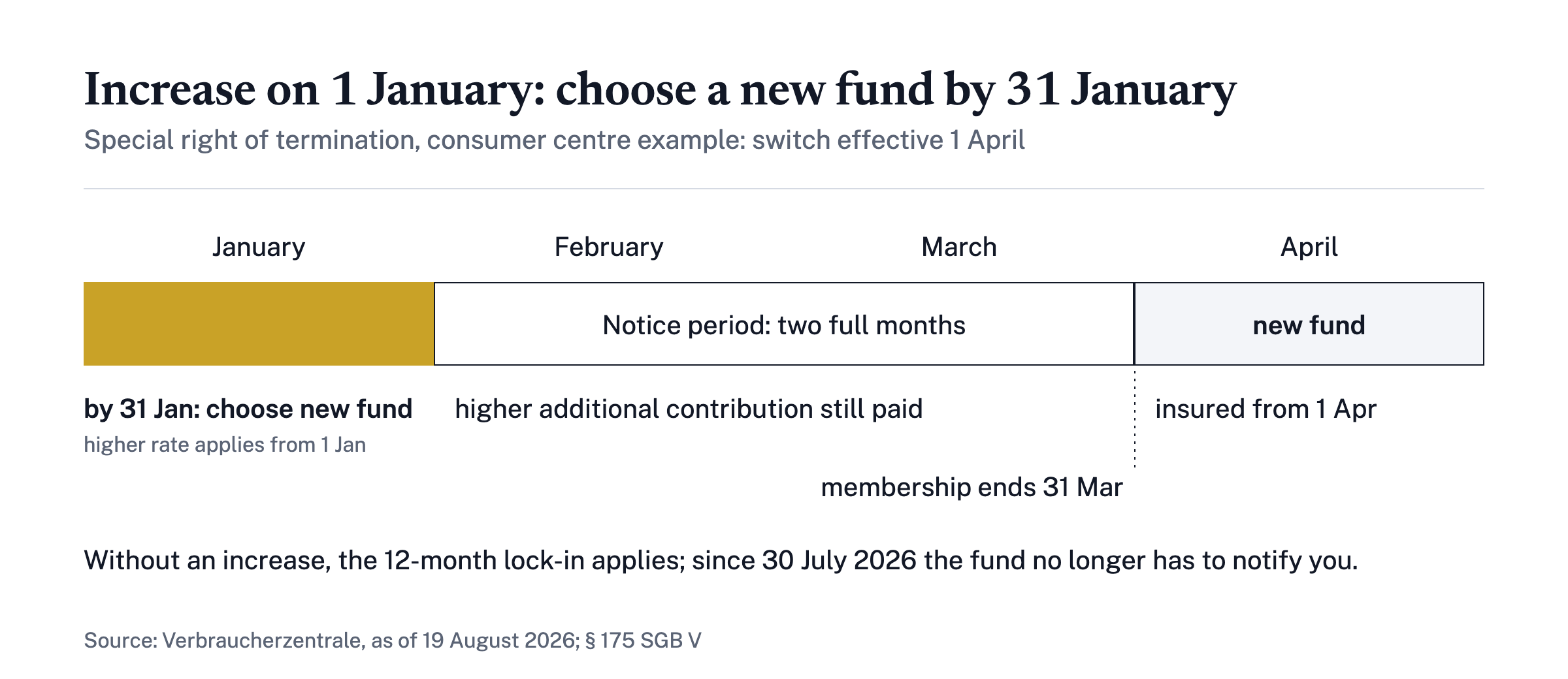
Worth knowing: the special right of termination does not remove the notice period. Until membership actually ends, you keep paying the increased additional contribution. Because the fund no longer informs you on its own initiative, it is worth keeping an eye on your own contribution rate. There are essentially three ways to do this:
- On your payslip, the deduction for the health insurance fund changes as soon as the additional contribution rises.
- The current additional contribution rates of all statutory health insurance funds are published and continuously updated in the health insurance fund list of the GKV-Spitzenverband.[4]
- If you know your current rate, you will notice an increase earliest on your health insurance fund's website or in its app.
Additional contributions are often raised at the start of the year, but this does not have to be the case. If you do not know your own rate, you may only notice an increase once the deadline for the special right of termination has already passed. The regular binding period of twelve months then applies again.
The process: how switching works step by step
Switching itself is straightforward and takes place in three steps. You no longer need to cancel with your current health insurance fund yourself; the new fund handles the formalities via the electronic notification procedure.
- Choose a new health insurance fund: The health insurance fund list of the GKV-Spitzenverband shows the current additional contribution rates and notes in which federal states a fund is open. Not every health insurance fund can be chosen by every insured person.[4]
- Submit an application for membership: If your current fund has raised the additional contribution, invoke your special right of termination. Both health insurance funds check compliance with the notice period.
- Inform your employer: Your employer must be informed of any change of health insurance fund as quickly as possible; they receive the membership certificate electronically.[1]
Two questions can be clarified in advance. The health insurance fund you choose may not refuse your membership — not because of age, gender, state of health or pre-existing conditions either.[2] Family members covered under family insurance have no choice of their own: they are insured in the fund of the member, such as a spouse or a parent, and switch along with them.
Are there disadvantages to switching health insurance funds?
Yes, some disadvantages are real, even though switching within the statutory health insurance system is straightforward overall. The statutory basic benefits are largely prescribed uniformly; differences arise mainly in voluntary supplementary benefits, bonus programmes, optional tariffs, service and price. That is exactly where the points lie that a switch can cost you:
- Bonus programme status and collected bonuses lapse when you switch and start from zero at the new fund.
- An ongoing optional tariff binds you to the health insurance fund, usually for one year, or for three years in the case of a deductible tariff or the sickness benefit tariff. During this period, switching is generally not possible.[1]
- Those who have taken out the optional sickness benefit tariff are excluded from the special right of termination following an increase in the additional contribution.[1]
- The increased additional contribution must be paid until the end of membership, even if you use the special right of termination.
Whether the switch is worthwhile despite these points therefore depends on the individual case. If you are in an ongoing bonus programme shortly before a bonus payout, or hold an optional tariff with a long remaining term, you may lose more by switching than the contribution reduction brings. If, on the other hand, you compare only the price and do not use supplementary benefits anyway, you carry a lower risk.
When should you not switch health insurance funds?
You should not switch as long as an optional tariff binds you, or if the savings do not offset the losses in bonus and supplementary benefits. Two questions help with the assessment:
- Is an optional tariff with a remaining term still running? Then a regular switch during the term is not possible — up to three years for deductible or sickness benefit tariffs.[1]
- Is the saving small? If the difference in the additional contribution amounts to only a few euros per month, it often does not justify the effort and the loss of bonus and supplementary benefits.
Strictly speaking, this is not a change of health insurance fund, but an important distinction: switching systems between statutory and private health insurance. It follows different rules and is a separate decision, covered by the Livossa article “GKV oder PKV: Wann sich der Wechsel lohnen kann”. Returning from private to statutory health insurance is generally not possible, especially in older age; it is only possible if those affected once again become subject to compulsory insurance in the statutory health insurance system.[5] Anyone considering this step should examine the consequences thoroughly in advance.
Conclusion: know the deadlines, compare the whole package
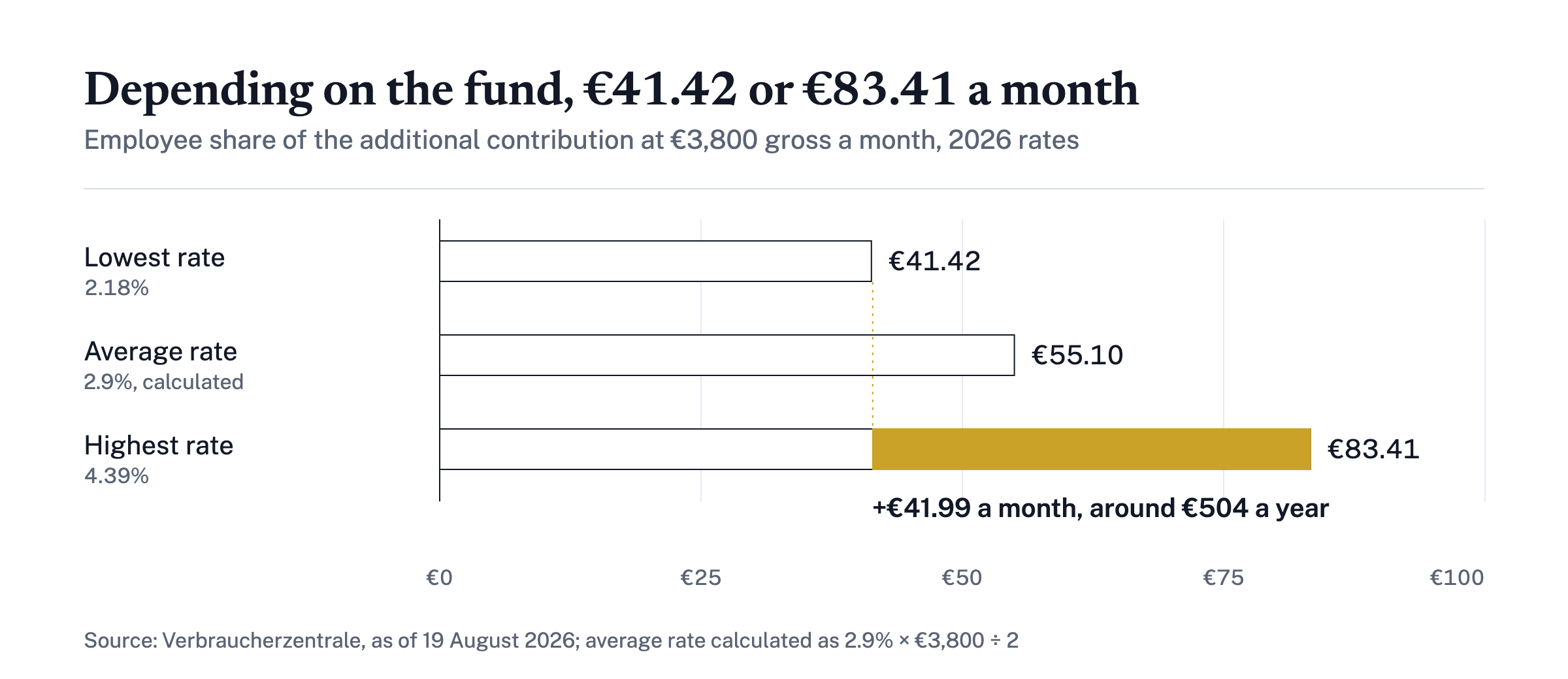
How large the price difference between health insurance funds can be is shown by a sample calculation from the Verbraucherzentrale (German consumer advice centre) (as of 2026, the additional contribution is shared equally between employee and employer): with a gross salary of 3,800 euros per month, the employee pays 41.42 euros per month themselves at the lowest additional contribution rate of 2.18 percent, and 83.41 euros at the highest rate of 4.39 percent.[3] The difference is just under 42 euros per month, or around 504 euros per year.[3]
| Assumption: 3,800 euros gross per month | Additional contribution 2.18 % | Additional contribution 4.39 % |
|---|---|---|
| Additional contribution in total | 82.84 euros | 166.82 euros |
| Employee share | 41.42 euros | 83.41 euros |
| Extra cost for the employee per year | [3]– | around 504 euros |
The average additional contribution rate in 2026 is 2.9 percent, making it an important cost factor, but the actual rates differ considerably from fund to fund.[3] The calculation above depends on the individual salary and is no substitute for personal advice. Besides the additional contribution, voluntary supplementary benefits, bonus programmes, optional tariffs, service and accessibility can also make a difference.[3] The decision should therefore cover the whole package of price, supplementary benefits and service, not the additional contribution alone.
Two checks are worth doing: look up your health insurance fund's current additional contribution rate in the GKV-Spitzenverband's list of health insurance funds and note it down, so that you notice a later increase early enough. Then check your deadlines: is the twelve-month binding period still running, does an exception apply, or do you have a special right of termination? If you are instead considering switching between statutory and private health insurance, read the Livossa article "Statutory or private health insurance: when switching can pay off".
Frequently asked questions
Do I have to cancel my old health insurance fund myself?
No. Since 1 January 2021 it is enough to submit an application to the new health insurance fund; it informs your previous fund about the switch and handles the formalities. Only insured persons who leave the statutory health insurance system entirely, for example to move to private health insurance, still have to cancel themselves. There, alternative coverage must be proven for the cancellation to take effect.
How long does it take for the switch to take effect?
A notice period of two full months to the end of the month applies. Example from the Verbraucherzentrale (German consumer advice centre): if a fund raises the additional contribution effective 1 January, the new fund must be chosen by 31 January; membership then ends on 31 March, and coverage with the new fund begins on 1 April. Until then, the increased additional contribution must be paid.
Can a health insurance fund reject me because of pre-existing conditions or my age?
No. Under § 175 SGB V, the statutory health insurance fund you choose may not refuse membership — not because of age, gender or health status either. Unlike private health insurance, there is no health check. One limitation: not every fund is open to everyone; some company-based funds only accept members regionally or from certain employers.
What happens to my bonus programme when I switch?
Bonus programmes are voluntary supplementary benefits offered by the funds. When you switch, accumulated points and bonuses generally lapse, and your status starts from zero at the new fund. Since the statutory basic benefits are largely uniform, it is worth checking before switching what bonus and supplementary benefits the new fund actually offers.
Can I switch if I have taken out an optional tariff?
To a limited extent. Anyone using an optional tariff is tied to the fund for its term — usually one year, or three years for a deductible tariff or the sickness benefit tariff. The special right of termination in the event of an additional contribution increase also applies here, with one exception: members with a sickness benefit tariff cannot use it.
Is switching worthwhile just because of the additional contribution?
Often yes, but not always. In 2026 the average additional contribution rate is 2.9 percent, and the range among funds open nationwide runs from 2.18 to 4.39 percent. With a gross salary of 3,800 euros, the difference for the employee is around 42 euros per month, or around 504 euros per year. Anyone planning to switch should therefore first check what the new fund offers in terms of supplementary benefits, bonus programmes and service.
Can I return from private health insurance to the statutory system?
As a rule, only if you become subject to compulsory insurance in the statutory health insurance system again, for example through dependent employment below the compulsory insurance threshold. For older insured persons, returning is generally ruled out; exceptions are possible only in special cases. Anyone considering switching systems will find details in the further Livossa article "Statutory or private health insurance: when switching can pay off".
Sources
Risk notice. The content is general information and is not investment, tax or legal advice. Investments carry risks, up to the total loss of the capital invested; past returns are not a reliable indicator of future results. Tax information reflects German law at the time of publication; have your personal situation checked by a tax adviser. Risk notice
Related reading
All Insurance →Switching car insurance: deadline, notice periods and special termination right
Switching car insurance: deadline 30 November, one-month notice period, special termination after a premium increase or claim, plus the 2027 type classes.