Switching car insurance: deadline, notice periods and special termination right
Switching car insurance: deadline 30 November, one-month notice period, special termination after a premium increase or claim, plus the 2027 type classes.
In this article5

When can car insurance be cancelled?
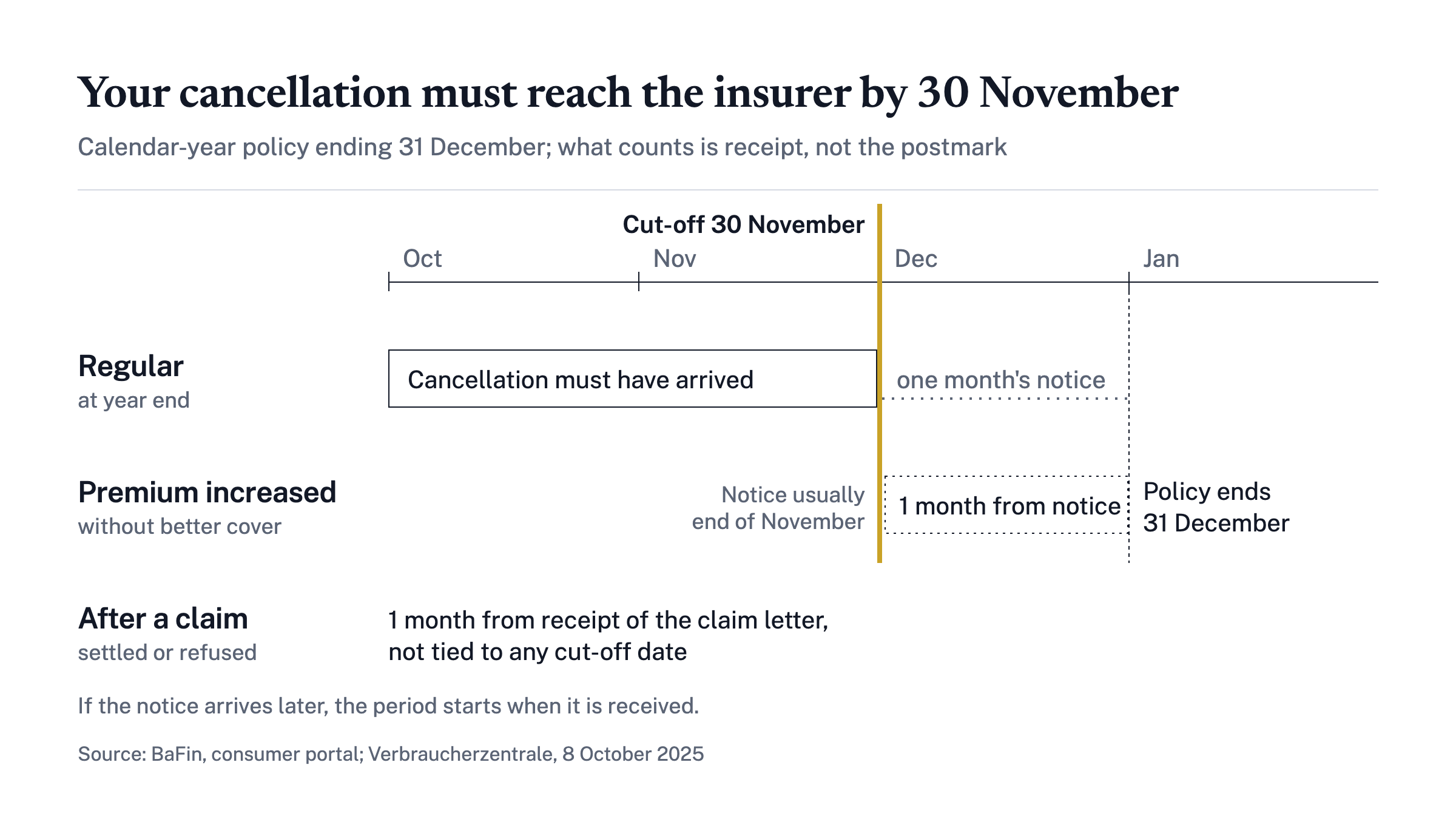
Car insurance can be terminated ordinarily at the end of the insurance year — for most policies, therefore, on 31 December with a deadline of 30 November. The notice period is usually one month. What matters is receipt: the letter must be in the insurer's hands by the deadline; the date of posting alone is not enough. Anyone who misses the deadline remains bound for another insurance year, unless grounds for special termination arise in the meantime. The German financial regulator BaFin explains the cancellation rules in its consumer portal.[1][2]
| Policy model | Policy end date | Termination must be received |
|---|---|---|
| Calendar year, most common case | 31 December | 30 November |
| Policy within the year, example 1 April to 31 March | 31 March | one month earlier, i.e. end of February |
| Insurance year starting on the date of vehicle registration | on the anniversary of registration | one month earlier |
Not every policy follows the calendar year. Some providers set the insurance year to periods such as 1 April to 31 March; a one-month notice period applies in those cases too. Other insurers start the insurance year on the day the vehicle was registered: if it began on 1 October, cancellation is only possible by 30 September. Which model applies is stated in the policy document and on the premium invoice, usually under the policy start date or main due date.[2][1]
The deadline is not the only opportunity to switch. If the annual premium invoice arrives after 30 November and shows an increase, a special termination right arises; the details are covered in the section on the special termination right.
What happens to car insurance when you change vehicles?
When a car is sold, the car insurance initially passes to the buyer — it does not end automatically. Only the buyer can then terminate it: if they present a confirmation of insurance from a different provider at the registration office, the old policy is automatically deemed terminated. Buyer and seller are jointly liable for the premium due until the car is re-registered, as the comparison portal Verivox explained back in 2013.[3] Until then, the seller's motor liability cover continues. This so-called extended cover typically keeps the protection in place for one month beyond deregistration or re-registration, but it applies only to motor liability. All steps from the purchase contract through deregistration to the eVB number are covered in the separate guide “Car insurance when changing vehicles: what to do”.
Which cars are becoming more expensive to insure?
In 2027, prices rise mainly for the models that the GDV places in a higher type class: in motor liability, this affects around 7.4 million drivers who are likely to pay more, while around 5.1 million receive a lower classification. For the remaining almost 30 million — 71 percent of all drivers — the classification stays the same as the previous year.[4] The German Insurance Association (GDV) publishes the type class statistics once a year; the edition dated 30 September 2026 reflects the claims records of the years 2023 to 2025 for around 33,000 car models.[4]
| Segment | Number of type classes | Range |
|---|---|---|
| Motor liability | 16 | [4]10 to 25 |
| Comprehensive cover | 25 | [4]10 to 34 |
| Partial cover | 24 | [4]10 to 33 |
The type class shows how many claims a model causes and how expensive they are compared with other models. In partial and comprehensive cover, the focus is on damage to your own vehicle; there, alongside claim frequency, the replacement value, repair costs and spare part prices also count. The GDV's rule of thumb: the more expensive a car and its spare parts are, the higher its comprehensive cover type class usually is.[4] Small cars that are cheap to repair are often placed low, while premium SUVs, sports cars and luxury models such as the Porsche Panamera, Range Rover or Toyota Land Cruiser sit in high comprehensive cover classes.[4]
For insurers, the statistics are not binding; they can be applied to new policies immediately and to existing policies only from the next insurance year.[5][4] A type class change alone also says nothing about the premium, because regional class, annual mileage and repair costs — which have been rising faster than general inflation for years — also affect the premium.[4] The regional classes are recalculated every year as well; for 2027, the classification changes for almost ten million drivers across the 413 registration districts.[4]
When does the special termination right apply?
A special termination right applies in the event of a premium increase and after a claim, each with a notice period of one month. It requires a specific trigger and allows termination away from the deadline.[2]
- Premium increase: If the insurer raises premiums without improving benefits accordingly, you generally have a special termination right. The increase must be communicated at least one month before it takes effect, usually at the end of November; from receipt of the notice, you can terminate within one month. If the notice arrives later, the period starts on receipt.[2] If the premium invoice is only issued after 30 November and contains an increase, the right also applies.[1]
- Claim: After negotiations over the compensation are concluded, you have one month to terminate. This also applies if the insurer has acknowledged its obligation to pay in motor liability or rejected it without justification.[2] The one-month period starts when the letter in which the insurer accepts or rejects the claim is received.
- Revocation after a new policy: A newly concluded policy can generally be revoked within 14 days without giving reasons. This is not a special termination right, but it does provide a short window to change your mind.
With an extraordinary termination, you also state the reason in the termination letter, such as the claim or the premium increase. You can terminate at the end of the one-month period or choose a later date. After a termination due to a claim, the insurer refunds any premiums paid in excess.
The special termination right does not spare you from checking the new tariff. Anyone who switches after an accident is usually placed by the new insurer in a lower no-claims class that takes the accident into account.[1] The worked example shows what this means for the savings.
Worked example: how much switching car insurance can save
In this hypothetical model case, switching can save 180 euros per year; the example illustrates the mechanism, not market prices. All amounts are assumed values, and a real comparison would produce different figures. The assumptions are motor liability and comprehensive cover with a typical deductible for a mid-size car with average annual mileage. The driver is 45 years old and classified in no-claims class 20, and the regional class stays unchanged. As of 1 January 2027, the GDV moves the model up two classes in liability, and the current insurer passes the adjustment on in full. The comparison tariff offers the same protection with a more favourable premium scale.
| Item | Current policy after adjustment | Comparison tariff (hypothetical) |
|---|---|---|
| Annual premium, liability and comprehensive cover (assumed) | 940 euros | 760 euros |
| Difference from the current policy per year | 0 euros | 180 euros |
| Difference over three policy years | 0 euros | 540 euros |
The difference between the two annual premiums is the saving per year; over three policy years it grows to three times that amount. The result depends heavily on the assumptions: if the no-claims class, the deductible or the annual mileage changes, the comparison shifts. In October 2025, the Verbraucherzentrale wrote that comparisons can often save several hundred euros; for novice drivers, the difference between the cheapest and the most expensive liability tariff with partial cover amounts to several hundred euros.[1]
Three points can reduce the saving. No-claims bonus protection and special classifications apply only with the current insurer and are not transferred when you switch. You should be able to meet discount conditions such as garage parking or low mileage on a permanent basis, otherwise contractual penalties eat up the saving. And for expensive or unusual models, comprehensive cover can be hard to obtain from the new insurer.[1]
Switching car insurance: the steps in the right order
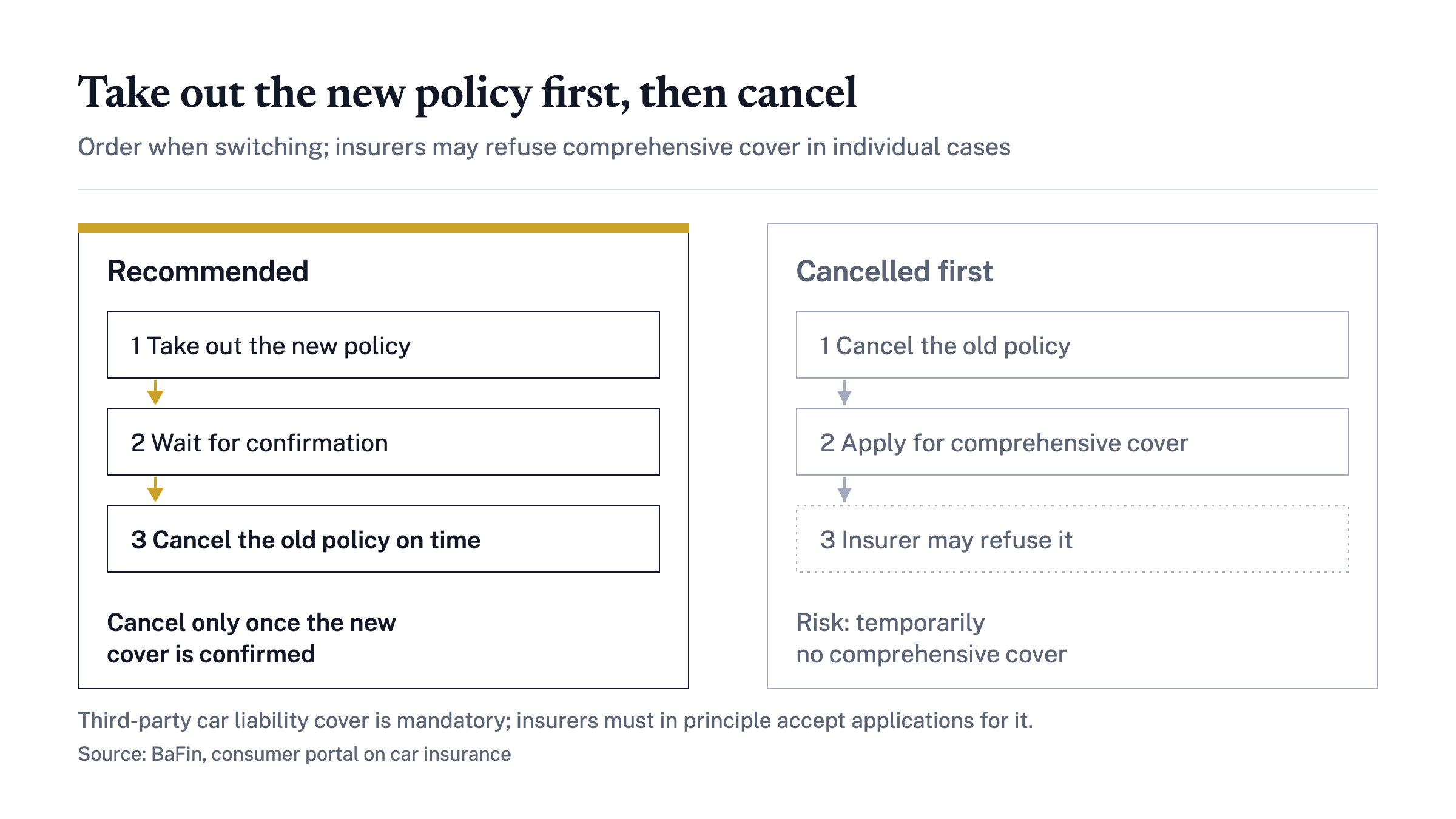
Switching works most reliably if you first take out the new policy and then cancel the old one. For partial cover and comprehensive cover policies, insurers can reject applications in individual cases; anyone who cancels first risks being temporarily without comprehensive cover. Motor liability, by contrast, is mandatory — in Germany no vehicle may be registered without it. Insurers must in principle accept liability applications, but they can refuse if factual or territorial restrictions in their business plan stand in the way.[2]
- Check the insurance year, the deadline and any possible grounds for special termination in the policy document and on the premium invoice.
- Have the registration certificate Part 1 (vehicle registration document), the current insurance contract and the latest premium invoice ready.
- Take out the new policy and wait for the confirmation.
- Cancel the old policy in text form within the notice period, quoting the insurance number and licence plate, adding the reason in the case of an extraordinary termination, and keep the cancellation confirmation.
To register or re-register a vehicle, the registration office needs the electronic insurance confirmation, known as the eVB number. It proves that motor liability insurance exists. The number is free of charge, is valid for only one registration process and can be requested directly from the insurer, often online.[6] Its maximum validity is 730 days, though three to six months is common with many insurers.[6] When you change insurers without changing the vehicle, the new insurer usually transmits the confirmation to the registration office automatically.
After switching, two checks are worthwhile. If the first invoice under the new policy is higher than agreed, pay it in full under protest so as not to risk your insurance cover, and then clarify the amount. You should also ask for written confirmation of which no-claims class the previous insurer reports to the new one. The Verbraucherzentrale regularly receives complaints that a less favourable class was reported than the one noted on the premium invoice.[1]
What matters in the new tariff
Switching only pays off if the new tariff also provides cover in the event of a claim. Besides the price, four criteria therefore matter.
- The statutory minimum cover in motor liability is 7.5 million euros for personal injury, 1.22 million euros for property damage and 50,000 euros for pure financial loss. Very high claims arise, for example, when a vehicle collides with a fully occupied bus; anything above the sum insured is paid by the owner or driver themselves.[2]
- Clauses such as no-claims bonus protection prevent a downgrade of the no-claims class after an accident, but they only apply with your current insurer. Before signing, it is therefore worth checking how sharply a provider downgrades after a claim, because some companies impose extreme downgrades.[1]
- Discounts for a garage-kept vehicle, low mileage or a restricted circle of drivers should only be agreed if you can permanently meet the conditions.
- Depending on the tariff, the cover may include, for example, reimbursement of the new price for a new car, cover for gross negligence under comprehensive cover, or the so-called Mallorca policy for rental cars abroad.
Tariffs, type classes and deadlines change; the GDV published the type class statistics for 2027 as of 30 September 2026, and the consumer advice centre guide cited dates from 8 October 2025. Before switching, you should check the insurance year and deadline in your own contract, have the no-claims class confirmed in writing, read the new tariff's terms in full, and submit the termination in a way that allows receipt by the insurer to be proven.[4][1]
Frequently asked questions
When is the deadline for switching car insurance?
For contracts ending with the calendar year, the termination must reach the insurer by 30 November. The notice period is one month; if the insurance year differs, the deadline shifts accordingly.
Do I always have a special termination right in the event of a premium increase?
Yes, if the insurer raises premiums without improving benefits to the same extent. You can then terminate within one month of receiving the notice, even if the invoice arrives after 30 November.
What happens to the insurance when buying a car?
Anyone who buys a car that has not been deregistered initially takes over the existing insurance contract. If the buyer presents confirmation from another insurer at re-registration, the old contract ends.
Can I terminate the car insurance after an accident?
Yes. After the claim has been settled, or after recognition or unjustified rejection of the obligation to pay benefits, you have one month for an extraordinary termination.
Will all cars become more expensive to insure in 2027?
No. According to the GDV type class statistics of 30 September 2026, around 7.4 million drivers will be placed in a higher motor liability class and around 5.1 million in a lower one. For 71 percent, the classification remains unchanged.
Sources
Risk notice. The content is general information and is not investment, tax or legal advice. Investments carry risks, up to the total loss of the capital invested; past returns are not a reliable indicator of future results. Tax information reflects German law at the time of publication; have your personal situation checked by a tax adviser. Risk notice
Related reading
All Insurance →Switching health insurance funds: deadlines, procedure and drawbacks
Switching health insurance funds: the deadlines that apply, how the switch works step by step, and the drawbacks you should know about beforehand.